Why the Liberal Political Engine is Working in 2008

“You have a great name. He must kill your name before he kills you.”

Juba, from the movie Gladiator

I’ve almost finished reading Paul Krugman’s The Conscience of a Liberal.  I’ll post a formal book review here soon, but right now, I wanted to highlight one of the insights that I gained from the book.

As a preface, Paul Krugman is a brilliant economist.  I’ve linked to his work here on this blog before.  He also, I’m afraid, is suffering from the aggressive form of anti-Bush psychosis – he hates the man & his policies so much that it’s pushed him into aggressively politicized commentary.  But it’s a common ailment these days, and likely to subside in the years to come.

However, in The Conscience of a Liberal, Krugman does the best job that I have ever seen laying out the principles and case for an aggressively liberal economic agenda in the United States.  Obama hints at these elements at times, but rarely pieces them together as effectively as Krugman does in this book.

I’ll save my evaluation of his analysis for a later post, but I wanted to highlight the reason that I think Obama & Krugman are onto something powerful politically here in 2008.  Sure, the timing is good:  Iraq, Katrina, and now the housing/financial crisis are a great backdrop for change.  But 2008 doesn’t feel like 1992 does it?  Let’s remember that the only people with a lower popularity than our Republican President is our Democratic Congress.

Here is my theory:

The liberals have learned, and learned well from the mistakes in 2000-2004.  They can’t defeat the conservative economic agenda of the past thirty years without killing the names of the heroes of those years.  Clinton made this compromise, but while it preserved him even in the face of the 1994 Republic Congressional wins, it didn’t make the party stronger.  As recently as 2004, people were talking about a permanent Republican majority.  (Yes, it wasn’t that long ago).

No, to win, they have to convince the American people that the entire last 25 years were a mistake.  The economic boom and resurgence of productivity post-1982 didn’t happen, or was fake in some way.  Reagan was not a great President.  Milton Friedman was not a brilliant economist.  Robert Rubin was not a great Treasury Secretary.  Alan Greenspan was not a great Federal Reserve Chairman.

Yes, to do this, they will have to throw Clinton & Rubin under the bus.  But that just might be the only way to really sell a liberal economic agenda.

Obama actually doesn’t stick to this line clearly – he has made “mistakes” in his campaign by praising Reagan and Clinton at times.  He’s inclusive, right?  But reading Krugman’s book gave me a clearer insight into the strategy, and it’s not a bad one.  Convince everyone that the last 25-30 years of economic progress/thinking was a mistake.  Rewind to the New Deal and the decades after it as a lost ideal.  Map the past thirty years to the 1890-1928 era.

Of course, intellectually, it’s not a terribly compelling position.  You aren’t going to be able to re-create the economic conditions of post-WWII America ever again, globally.  And of course, we now know that huge pieces of the government response to the market crash of 1929 were counter-productive, extending the Great Depression.  The US Government share of the economy is now close to 19% compared to less than 5% in the 1929.  Analogies to the 1960s really don’t help either, since the 1960s led to the 1970s.  Ugh.

Still, I think the strategy has legs.  If they can kill the economic heroes of the past 30 years (Friedman, Reagan, Rubin, Greenspan), we might really see a successful liberal economic agenda in the United States.  The combination of the Bush Presidency with the current economic morass produces an ideal backdrop for reconsidering economic policy.

Watch the news.  I’m seeing elements of this meme everywhere now.  It seems to be taking hold, even if people don’t see the pattern.  Example: Culprits of the Collapse, soon to air on CNN.

“You have a great name. He must kill your name before he kills you.”

Juba, from the movie Gladiator

Are You Reading This? US Invests $250B in Banks

I’ve posted here previously about the historic times we are living in.  Well, Tuesday, October 14th, 2008 will be no exception.  The US Treasury has decided to buy preferred shares in the major US banks… and it’s not really optional.  From the New York Times piece:

The Treasury Department, in its boldest move yet, is expected to announce a plan on Tuesday to invest up to $250 billion in banks, according to officials. The United States is also expected to guarantee new debt issued by banks for three years — a measure meant to encourage the banks to resume lending to one another and to customers, officials said.

Here is some more detail on the banks affected:

Treasury Secretary Henry M. Paulson Jr. outlined the plan to nine of the nation’s leading bankers at an afternoon meeting, officials said. He essentially told the participants that they would have to accept government investment for the good of the American financial system.

Of the $250 billion, which will come from the $700 billion bailout approved by Congress, half is to be injected into nine big banks, including Citigroup, Bank of America, Wells Fargo, Goldman Sachs and JPMorgan Chase, officials said. The other half is to go to smaller banks and thrifts. The investments will be structured so that the government can benefit from a rebound in the banks’ fortunes.

And lastly, for those curious, the terms of the new preferred paper:

Bringing together all nine executives and directing them to participate was a way to avoid stigmatizing any one bank that chose to accept the government investment.

The preferred stock that each bank will have to issue will pay special dividends, at a 5 percent interest rate that will be increased to 9 percent after five years. The government will also receive warrants worth 15 percent of the face value of the preferred stock. For instance, if the government makes a $10 billion investment, then the government will receive $1.5 billion in warrants. If the stock goes up, taxpayers will share the benefits. If the stock goes down, the warrants will be worthless.

Some of the more egregious issues, however, will be addressed with executive compensation and corporate finances:

But officials said the banks would not be required to eliminate dividends, nor would the chief executives be asked to resign. They will, however, be held to strict restrictions on compensation, including a prohibition on golden parachutes and requirements to return any improper bonuses. Those rules were also part of the $700 billion bailout law passed by Congress.

This plan has some negatives to it – primarily the forced capitalization and potential costs to banks that might not have needed these terms to be successful.  However, given the collective risk of a failing bank system, that cost is likely worth bearing.

Long term, I hope that if we do decide to make executive compensation a regulated affair, that we apply it consistently across industries.  It does no one any good to have executives biased away from finance as a career option.

Overall, there is a lot to like in the current plan, as it eliminates the stigma of government help, and should effectively recapitalize banks in the short term.  More importantly, it puts some detail around how the government could continue to help capitalize the system without socializing it.

Behold, the Awesome Power of the Federal Reserve

That is not intended as a snarky title.  We are seeing the full power of the Fed come to bear in this financial crisis.  There is a reason why they have said for decades, “Don’t fight the Fed”.

The Fed’s power comes from the ability to almost limitessly create assets and money supply, with a charter to do so.  As long as the Treasury cooperates, the Federal Reserve effectively has the full balance sheet of the United States to work with.  And that’s a big balance sheet.

A lot of noise was made in the past months about the “limited” firepower of the Fed.  After all, they technically had assets of only $800B in Treasuries as of August 2007, and we’re dealing with a problem measured in trillions.

The Econoblog has a great post today on how the Federal Reserve balance sheet has shifted, particularly in the past 30 days.  It’s fairly wonky, but if you are into how modern money supplies are managed, I haven’t seen a better article:

Econobrowser: Balance Sheet of the Federal Reserve

You can read it for yourself if you are interested, but the short story is that the Federal Reserve has inflated its balance sheet to over $1.5 Trillion, with a lot of that growth happening in the past few weeks.

Check out this graph, from MacroBlog:

At this point, Bernanke and Paulson are basically calling in all the King’s horses, and all the King’s men.  Let’s hope they can put Humpty Dumpty back together again.

One fun fact – the amount of reserves that banks are now sitting on – not lending, not converting to cash, but just sitting on is approximately 2.5x the amount that got locked up post-9/11.   Unprecedented.

Time to Acquire Iceland?

I haven’t had much time to post lately on the financial crisis.  I have queued up a number of topics, but just haven’t found the minutes to commit them to WordPress… yet.  I hope to soon.

In the meantime, catch this late breaking news:

AP: Iceland’s Banks Falter

This is extremely serious.  Iceland’s banks are severely hit by the large amount of assets (including pensions) invested in now underwater securities.  Unlike larger countries, like the US, the GDP of Iceland is insufficient to actually let the government bail out their banking sector.  In fact, the banking sector in Iceland has assets of approximately 9x the GDP of the country, mostly invested in European companies.

From the article:

Prime Minister Geir H. Haarde warned late Monday that the heavy exposure of the tiny country’s banking sector to the global financial turmoil was raising the specter of “national bankruptcy.”

The government’s attempt to gain control of the increasingly dire situation and restore some confidence in the country’s hard-hit banking sector followed a day of panic Monday that saw trading in shares of major banks suspended and the Icelandic krona shrink in value against the euro.

I know things seem tough right now in the US.  However ironic as it may seem, however, the incredibly large size of the United States balance sheet (total national assets) and annual income (GDP) are formidable.  As a result, despite the current account and budget deficits, in the end, our economy is large enough to weather the storm if we don’t panic.

We may want to begin with a small acquisition at this point of a country with a small, weaker balance sheet.  Iceland seems like a good start.  The country has a GDP of $19B dollars (14B Euro) on a population of 300K.

With sufficient warrant coverage, we should be able to line up our potential 51st state with limited downside, assuming we can provide liquidity.  It would be good to have a subsidiary with currency exposure to the Euro, and we can easily assign them the requisite 2 senators and congressman based on demographics.

BTW Who does handle M&A for the US these days?  State department?

Need Help: Obama on Glass-Steagall Repeal in 1999

I need some help here from those closer to the inner workings of the Barrack Obama campaign.  I have it from fairly good sources that Obama has a strong economic team, and that he’s intelligent.

So why would he advocate a position based on the repeal of Glass-Steagall in 1999?

Just to rattle off a few bullets:

  • Glass-Steagall prevented companies from having both commercial & investment banks.
  • The products of the mergers that were enabled post-Glass-Steagall have been the most stable in this crisis, because they have large deposit bases in their commerical arms to balance the leverage in their investment arms.
  • The non-diversified firms, both commercial & investment banks, have been the hardest hit.
  • The investment banks that are remaining (Goldman Sachs, Morgan Stanley) are pursuing this joint model to survive the crisis.  It wouldn’t be possible if Glass-Steagall were in place.
  • The universal banks, like those in Europe, are proving to be the acquirers in this crisis.
  • Academic research has effectively shown the fallacy of the original Glass-Steagall approach, which is why Bill Clinton supported the effort in 1999.  A majority of Democrats, including John Kerry & Joe Biden, voted for the final bill in 1999, as did a majority of Republicans.

The WSJ has a nice editorial here on the topic.  Marginal Revolution, as usual, has good data too.

Can someone help explain this one to me?  Is he just hitting McCain over the head with an easy talking point?  Or does he actually believe that repealling Glass-Steagall was a mistake?

This election would be a lot more enjoyable if either candidate was making any sense on economic issues.

We Are Living History

Imagine my surprise.  Sunday afternoon, I got on a plane to Orlando, FL.  When I got on the plane, Lehman Brothers and Merrill Lynch still existed.  When I got off the plane, I checked my iPhone and saw that Merrill was now part of Bank of America, and Lehman was going Chapter 11.

Bear Stearns.  Lehman Brothers.  Merrill Lynch.  Fannie Mae.  Freddie Mac.  AIG.

Ongoing discussion now about Goldman Sachs and JP Morgan.  Fundamental problems right now with any business who basically borrows short and then lends long, at high leverage.

Really unbelievable.  Truly historic times.

I almost finished reading Conscience of a Liberal, by Paul Krugman, on the plane trip back.  When I’m done, I’ll post a book review here.  Krugman is a smart economist, but he’s become rabidly political of late.  Still, a number of very interesting insights in the book.

One thing I definitely agree with is that the meltdown going on right now will be studied in history textbooks, the way that we studied the Roaring Twenties, the Great Depression, and the New Deal.  My guess is that the story will go something like this:

  • The End of the Cold War (1982-1992)
  • The Twin Bubbles (1993-2006)
  • The Great Crash (2007-2008/9)
  • The Way Forward (2009+)

It’s interesting to think about, since of course the history hasn’t been written yet.  And every day brings new surprises.

Alan Greenspan is Right on Fannie Mae & Freddie Mac

The incredibly historic economic news keeps coming this week.  Truly momentous.  It’s as if every article, every book, every course I’ve ever taken in modern economic history and theory was to prepare to understand the events of the past 12-24 months.

In some ways, I think I’m in shock.  It’s like watching history in the making.  History that will be the subject of textbooks for decades to come.  It’s really unbelievable.

After 70 years, we’ve come to the realization that yes, in fact, you cannot keep the benefits of a private company with public guarantees without paying the price at some point.

To rephrase, for decades, politicians from all parties have been in awe of the magic of Fannie Mae and its brethren.  Born out of the Great Depression, and spun off to raise funds for Johnson’s Great Society projects, it seemed to good to be true:

  • Private investors provide capital to add liquidity to the mortgage market
  • Home buyers get cheaper rates
  • Investors get “completely safe” securities that pay slightly more than Treasuries
  • The company generates huge profits on the debt spread between their borrowing rates and mortgage rates/defaults

Well, now we know that it was, in fact, “too good to be true”.

There is a lot to be concerned about in the Paulson plan.  It’s not at all clear why the sub-debt holders were left whole.  It’s not at all clear why the shareholders were left with 20% of the company.

Given the magnitude of the problem and the unpredictability of the large number of parties and variables involved, however, I’m willing to assume that Paulson didn’t optimize for the “best” deal, but for the most pragmatic and least risky in the near term.

(By the way, if you are looking for details, the New York Times pieces here and here have the best write-ups I’ve found to date.)

My biggest fear, at this point, is that the plan really defers the final solution to this problem until the next administration, when hopefully we’re through the worst of this.  It sounds pragmatic, but in reality, it makes it much more likely that by then the crisis will have past, and Republicans and Democrats will retreat to their historic disfunction on the topic.

I’ve read a multitude of proposed solutions, but in this case, I have to say, “Please listen to Alan Greenspan on this one.”

Yes, I know bashing Greenspan has become popular.  I’ll address that in another blog post – I had the opportunity to read his recent auto-biography, and I thoroughly enjoyed it.

Try to ignore the bashing for now, and just focus on his recommendations for Fannie, Freddie, and their ilk.

Here is a WSJ story that summarizes his recommendations, made earlier this year:

His quarrel is with the approach the Bush administration sold to Congress. “They should have wiped out the shareholders, nationalized the institutions with legislation that they are to be reconstituted — with necessary taxpayer support to make them financially viable — as five or 10 individual privately held units,” which the government would eventually auction off to private investors, he said.

Instead, Congress granted Treasury Secretary Henry Paulson temporary authority to use an unlimited amount of taxpayer money to lend to or invest in the companies. In response to the Greenspan critique, Mr. Paulson’s spokeswoman, Michele Davis, said, “This legislation accomplished two important goals — providing confidence in the immediate term as these institutions play a critical role in weathering the housing correction, and putting in place a new regulator with all the authorities necessary to address systemic risk posed by the GSEs.”

But a similar critique has been raised by several other prominent observers. “If they are too big to fail, make them smaller,” former Nixon Treasury Secretary George Shultz said. Some say the Paulson approach, even if the government never spends a nickel, entrenches current management and offers shareholders the upside if the government’s reassurance allows the companies to weather the current storm. The Treasury hasn’t said what conditions it would impose if it offers Fannie and Freddie taxpayer money.

He’s right, and it’s not too late to move in this direction.

There is no reason for Fannie Mae & Freddie Mac to continue in their current forms.

The government should regulate strictly the requirements for securitizing and guaranteeing mortgages, the way that they regulate commercial banking, deposits, and other types of financial business.  They can define specific types of mortgages, even give the types names to make it easier for consumers to comparison shop, and let the “Baby Fannies” compete to make markets in them.

By breaking them up, and auctioning them off to the mega-banks, both domestic and international, they guarantee a distributed system that will be extremely fault tolerant to the failure of any one entity.  If they structure the regulation properly, they can turn this business into a stable, predictable, profitable business.

Gone is the government guarantee.  Gone is the lobby machine.  Gone is the too-big-to-fail entity.

I think Rep. Barney Frank (D, New York) is an example of why I’m afraid this won’t happen:

In the House, Mr. Frank, the chairman of the House Financial Services Committee, criticized the administration’s attempt to shrink the companies. He staunchly defended the companies’ ability to channel some of their profits from conventional mortgage financing to subsidize the construction of affordable rental housing and lower borrowing costs for low-income home buyers.

Mr. Frank seemed confident that he could stop the effort by the administration to ultimately shrink the companies through its rescue plan over the long term.

Catch that?  What Mr. Frank likes is the fact that instead of getting Congress to agree to fund affordable rental housing programs, which would have to be paid through taxes or spending cuts elsewhere, he liked having an “off the books” slush fund to pay for these projects.  He’s still at it:

After repeated clashes with the White House over legislation that authorized the Treasury to bail out the companies, Mr. Frank succeeded in including a provision that required Fannie and Freddie to divert some of their profit from buying up “jumbo” mortgages for expensive houses into a fund for affordable rental housing.

Great.  After all, passing a law to force Fannie Mae to spend money on a program doesn’t cost the taxpayer anything, does it?

Well, it does.  Those strings came at a price.  The price was the implicit government guarantee.

And now we have a better idea of what that price really was.  And it’s not worth it.

Ask Not For Whom the IRS Bell Tolls, It Tolls for eBay…

… wow, not sure how I missed this.

Found this today on the eBay Ink blog.  Points to a WSJ piece from last week that explains how the new housing bill includes provisions that require payment providers to report accounts with over $10,000 in transactions to the IRS.  Hello, PayPal.  Hello, eBay sellers.

The new reporting requirement is similar to a proposal the Bush administration has put forward in its most recent budgets as a way to ensure that taxes owed are being collected. It also applies to intermediary banks that process card payments for restaurants and brick-and-mortar retailers. Congressional tax estimators predict the reporting change will help the IRS collect an additional $9.5 billion in taxes owed by online and traditional businesses over the next 10 years.

The payment processors will be required to file a 1099 form for each merchant to the IRS and to the merchant. They won’t have to file for merchants with less than $10,000 in gross sales and less than 200 transactions in a given year.

And they won’t start reporting until 2011, giving the banks and the merchants a couple years’ head start to make sure everything is in order.

It was likely inevitable, of course, that the government would find it necessary to insert monitoring hooks into payment services and online marketplaces.  And this new policy doesn’t take effect until 2011.  But I don’t think people really appreciate how much this might affect the economics of online selling and small businesses.

Look at the advice given to eBay sellers:

Report all income from online sales, even from casual or hobby selling. If you made a profit from goods sold on eBay — whether vintage KISS action figures or hand-knitted doggy sweaters — you owe income or capital gains taxes, and likely self-employment taxes, too. No taxes are owed, however, on used items that you sold for less than what you paid for them, essentially using the online service as a virtual garage sale.

If you mean to deduct expenses, act like a business. One of the most common mistakes eBay sellers make on their tax returns is to claim deductions to which they aren’t entitled. The tax code allows deductions for business expenses, but deductions are limited for individuals who sometimes make a little money on the side from hobbies.

One rule of thumb the IRS uses to determine whether an individual is engaged in a business is whether they made a profit in any two of the past five years. Another is if the person would still, say, frame landscape photographs, or carve garden gnomes, or buy and sell rare 45s, regardless of whether or not they made any money from the activity.

“If the answer is yes, you may be on the wrong side of an IRS argument that you are taking a hobby loss,” said Tom Ochsenschlager, vice president of taxation for the American Institute of Certified Public Accountants.

Keep your personal and business accounts separate. Make sure you have a PayPal business account separate from your personal one, an eBay business account that is separate from any casual buying and selling you do, and a separate business checking account.

These steps will not only make it easier for you to determine how much you owe, but may help protect your deductions by signaling to the IRS that you are serious about running a business. “Everything you can do to treat it like a business will help,” says Kristine McKinley of Beacon Financial Advisors, based in Independence, Mo. Ms. McKinley specializes in tax advice to eBay sellers.

Claim the home office deduction. While this deduction has fallen out of favor because of a popular belief that it triggers IRS audits, it is still a valuable deduction if you have a separate space in your home that you use exclusively for business purposes, according to Ms. McKinley. It’s true that you will owe more taxes when you sell the home on amounts that you have depreciated. But the deduction can still be a major benefit because it will reduce your income for the purposes of self-employment tax, she said.

If you don’t think issues and requirements like this don’t translate into overhead for small businesses, then I have a bridge to sell you.  More importantly, I don’t think people realize how issues like this can stifle the initial enthusiasm for selling that often predates any idea that you might be able to “make a living” selling online.

Very few people realize the economic magic that eBay enabled in the last decade, making “small business” activity available and affordable to millions of people who normally would not have thought to step out on their own.  It facilitated nationwide markets with low transaction costs for highly illiquid markets.

Because very few people realize this, it will most likely die a quiet death; unmourned by those who assume that the priority should be protecting the older, “real life” small businesses and their particular economic structures.  There is an argument to be had there, but only after some analysis has been done on the new economic systems and opportunities that have been created in the past decade.

My bet is that argument really isn’t happening, and that the inertia of the real world will overwhelm these new entrepreneurial opportunities.  These online retail businesses will retreat, like physical retail, back into the hands of a smaller number of larger entities who can handle the regulatory and economic challenges.

At eBay Live 2004, I remember a woman coming up to me after a talk I gave on Buying & Selling Lots on eBay.  She had been a paralegal, but had quit five years before to sell cosmetics on eBay.  Her business was not large by retail standards, but enough money for her to stay home with her children.  She told me her son had now placed into an advanced program at school, and she credited eBay for giving her the time to stay home and support him.  She said she hoped that he would go to great schools, and go on to work for a company like eBay someday.

It’s the kind of story that sticks with you.  And it makes me a little sad to see that economic opportunity disappearing.

We Need a New Bubble

Every now and again, I am reminded that the best journalists on the planet clearly work for The Onion.  Their ability to dive into the heart of a crisis is uncanny.

The Onion: Recession-Plagued Nation Demands New Bubble to Invest In

WASHINGTON—A panel of top business leaders testified before Congress about the worsening recession Monday, demanding the government provide Americans with a new irresponsible and largely illusory economic bubble in which to invest.

“What America needs right now is not more talk and long-term strategy, but a concrete way to create more imaginary wealth in the very immediate future,” said Thomas Jenkins, CFO of the Boston-area Jenkins Financial Group, a bubble-based investment firm. “We are in a crisis, and that crisis demands an unviable short-term solution.”

The current economic woes, brought on by the collapse of the so-called “housing bubble,” are considered the worst to hit investors since the equally untenable dot-com bubble burst in 2001. According to investment experts, now that the option of making millions of dollars in a short time with imaginary profits from bad real-estate deals has disappeared, the need for another spontaneous make-believe source of wealth has never been more urgent.

Just wait, it gets better:

“Perhaps the new bubble could have something to do with watching movies on cell phones,” said investment banker Greg Carlisle of the New York firm Carlisle, Shaloe & Graves. “Or, say, medicine, or shipping. Or clouds. The manner of bubble isn’t important—just as long as it creates a hugely overvalued market based on nothing more than whimsical fantasy and saddled with the potential for a long-term accrual of debts that will never be paid back, thereby unleashing a ripple effect that will take nearly a decade to correct.”

“The U.S. economy cannot survive on sound investments alone,” Carlisle added.

There you have it.  Hilarious, if you are into dark, dark, dark humor.

Lowest-Low Fertility in Europe

This article appeared in the Sunday New York Times, and it was so interesting I felt I needed to share it here.  I found the concept of “lowest-low fertility” extremely interesting.  I think it is become I always find exponential behavior interesting, and thinking about how an exponential decline might affect a population was new to me.  From the article:

DEMOGRAPHICALLY SPEAKING, Laviano is not unique in Italy, or in Europe. In fact, it may be a harbinger. In the 1990s, European demographers began noticing a downward trend in population across the Continent and behind it a sharply falling birthrate. Non-number-crunchers largely ignored the information until a 2002 study by Italian, German and Spanish social scientists focused the data and gave policy makers across the European Union something to ponder. The figure of 2.1 is widely considered to be the “replacement rate” — the average number of births per woman that will maintain a country’s current population level. At various times in modern history — during war or famine — birthrates have fallen below the replacement rate, to “low” or “very low” levels. But Hans-Peter Kohler, José Antonio Ortega and Francesco Billari — the authors of the 2002 report — saw something new in the data. For the first time on record, birthrates in southern and Eastern Europe had dropped below 1.3. For the demographers, this number had a special mathematical portent. At that rate, a country’s population would be cut in half in 45 years, creating a falling-off-a-cliff effect from which it would be nearly impossible to recover. Kohler and his colleagues invented an ominous new term for the phenomenon: “lowest-low fertility.”

I wish the article spent a little more time on historical examples of populations that have cratered like this… it’s unclear to me whether or not this has ever happened in human populations before.  Instead, the article strays into unsupported conclusions about the role of men & women domestically as a causal factor.

The issue of labor market flexibility, however, seemed extremely interesting if true.  The tie-in to people having children later and living with their parents longer also seemed plausible.

It would have been interesting to see the breakouts for countries based on their overall birth rates vs. immigrant birth rates.  My suspicion is that story would also tell you about the likely demographic shifts to expect in countries where birth rates aren’t lowest-low, but are distorted due to large immigrant populations (ie, US, France).

It’s a long article, but worth the read.  Let me know what you think.

Osama Bin Laden and $144 Oil

Just got a pointer to this old article from the New York Times, dated October 14, 2001:

That sympathizers of Osama bin Laden sink three oil tankers in the Strait of Hormuz and choke off the narrow, bow-shaped channel that funnels 14 million barrels a day from the Persian Gulf to the rest of the world. That the United States attacks Iraq, and Israel launches a huge strike against the Palestinians, driving them from their camps and staking out more land — all of which spurs the Persian Gulf states to cut off oil for the West. Or perhaps that a popular uprising, led by sympathizers of Mr. bin Laden, topples the ruling Saud family in Saudi Arabia, by far the world’s largest oil producer.

”If bin Laden takes over and becomes king of Saudi Arabia, he’d turn off the tap,” said Roger Diwan, a managing director of the Petroleum Finance Company, a consulting firm in Washington. ”He said at one point that he wants oil to be $144 a barrel’‘ — about six times what it sells for now.

Very interesting and eery given today’s oil price.  And no needed to become king of Saudi Arabia to do it.

Vanguard Is Splitting 3 ETFs… But Why?

Vanguard had a funny announcement today that I had to comment on (from Vanguard.com):

Vanguard announces share split for three exchange-traded funds

June 04, 2008 – Vanguard announced today a two-for-one split of shares of Vanguard® Total Stock Market ETF (VTI), Vanguard Emerging Markets ETF (VWO), and Vanguard Extended Market ETF (VXF). The conventional shares of the funds are not affected by this split.

The share split entitles each shareholder of record at the close of business on June 13, 2008 to receive one additional share for every share of the ETF held on that date. The additional shares are expected to be distributed to shareholders on June 17. The shares will trade at the new split-adjusted prices beginning June 18.

I need someone to explain this one to me.  After all, splitting a stock does absolutely nothing for the fundamentals of the stock.  You might argue there is some emotional, momentum-based advantage when go-go growth stocks do it, but this is an index fund.  And a Vanguard fund to boot!  I just can’t imagine the Vanguard trustees chasing momentum money, or expecting momentum money to flow to an index fund just because it’s splitting.

There is that old argument that you want to keep share prices low so “small investors” can buy a “round lot” of 100 shares… but that logic went out the door with odd lots and discount brokers about 30 years ago.

So why did they do it?  Are they trying to capture small investments under $100 with the ETF?  Brokers like E*Trade already offer free dividend reinvestment on ETFs, which allows you to buy partial shares.

Anyway, if you own any of these funds, note it in your calendar, Quicken, etc.

Weird.

2009 is the new 1943: Welcome Back, Steel Penny

There have a been a couple of numesmatic debates that have seemed endless over the past few decades.  One, of couse, has been around the eventual death of the paper dollar.  The second, almost as persistent, has been about the death of the US one cent piece, aka, “the penny”.

A friend of mine at work pointed me to this site, Retire the Penny.

For the most part, the call to retire the penny has been made on the back of two basic arguments:

  1. Nuisance.  People don’t value them anyway, and tend to just stuff them in dishes, jars, piggy banks, or literally on the ground.
  2. Cost.  With the rising cost of metals like copper and zinc, the cost of the penny has actually exceeded one cent, meaning that we lose money every year.  In fact, people are melting them down, illegally, spurring law enforcement action.

On Friday, May 9th, the US House of Representatives passed H.R. 5512, which gives the US Mint 270 days to change the base metal of the US one cent and five cent pieces to more affordable metals.  The current bill actually calls for “copper-colored steel”, although there are arguments for even more cost effective metals.  From CoinNews.net:

The House debated on the legislation and finally voted yesterday to change the metallic composition of the penny and 5-cent nickel to a less expensive copper-colored steel.

Although the prices of copper, zinc and nickel metals in coins have declined in recent months, the penny and 5-cent nickel still cost more to make than what they’re worth—resulting in a reported loss of about $100 million every year, or $1 billion over a decade.

It now costs about 1.26 cents to make the penny and about 7.7 cents to make the nickel.

House bill “H.R. 5512, the Coin Modernization and Taxpayer Savings Act of 2008” would seek to change those manufacturing costs by using copper-colored steal, which could cut the cost of making pennies down to about 0.7 cents each. But its recent passage in the House is no guarantee it’ll make its way to the White House for signing.

H.R. 5512 must still go through the Senate and then the President, and not everyone is happy with the current legislation.

Personally, I’ve always loved the steel pennies from 1943, the one year that they were switched due to wartime rationing of copper.  I even bought a few hundred on eBay just for fun.

Little known fact – Canada switched to a copper-colored steel penny a few years ago.  Who knew?

This type of change will remove the second argument against keeping the penny.  Personally, I think the penny is largely retiring itself. As more and more retail institutions display “give a penny, take a penny” dishes, they are effectively making the cent unnecessary for transactions.

This is all very interesting given that 2009 is designed to be a celebratory year for the penny, marking 100 years of the Lincoln cent, with collectible versions made out of pure copper.

Obama Victory Probability at Over 85% (Iowa Electronic Markets)

I’ve really enjoyed the ongoing empirical experiments at the Iowa Electronic Markets, where people can use real money to trade futures on political (and other) events.  As can be expected, political polls tell a very different story than markets where real money is at stake.

Tonight, with the marginal victory for Clinton in Indiana, and the large win for Obama in North Carolina, a major shift happened in the future markets at IEM.   See below for the graph:

As pointed out on IdeoBlog, the likelihood of a Clinton victory, according to these futures, dropped today from 28% down to 12%… a 55% change.  That’s an incredibly significant shift, and it puts Obama back in the probability range that he spiked to after Super Tuesday.

Interestingly, there are still arbitrage dollars to be made on John McCain, whose futures are only trading at around 94.5%.  You can make 5.5% or so just by buying the obvious winner.  Of course, I believe IEM still limits your total funds to $500, so I’m not sure you can really make that much money here.

It’ll be very interesting to see the presidential futures for the final candidates once they are out – I’m expecting a very different story than the polls to date have been indicating.

Correlation or Causality: Starbucks & Obama

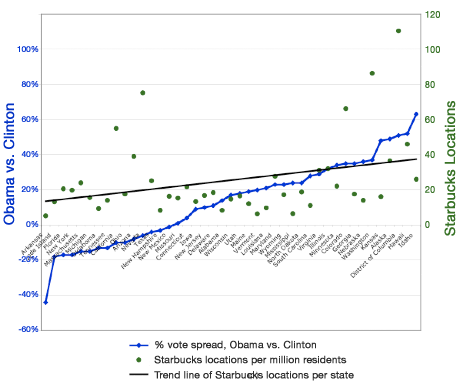
This one was too good not to share.  See below for a graph mapping out the correlation between the number of Starbucks and the margin of victory/defeat for Obama vs. Clinton.  From the Urbanspoon:

Is there really a connection between sipping your double tall breve and voting for Obama? We’ll leave political analysis to the professionals, but this is the kind of food question we’re equipped to investigate. Unfortunately, we can’t directly measure how much latte everyone is drinking. But as an approximation, we looked at the number of Starbucks stores per capita on a state-by-state basis. Compare this to how states voted in the primary:

The blue line measures the percentage by which Obama beat (or lost to) Clinton. The green dots represent the number of Starbucks stores per million people for each state. The black line is the trend line of Starbucks stores, drawn to make it easier to see the relationship between voting and latte sipping.

Love it.  Thanks to Paul Kedrosky for the pointer.