Sub-Prime Mortgage Humor: The Richter Scales

OK, so as I poke around the creators of the very funny Bubble 2.0 video I posted last night, I discovered a couple of things:

1) They seem to be a group of former Stanford Fleet Street a cappella singers (thank you, Rebecca, for this tidbit.  It explains Jerry Cain appearing in the previous video).

2) There are other Richter Scale videos on Youtube

For example, here is one that is specifically about the Sub-Prime Mortgage mess.

You can subscribe to all of their videos on YouTube here.  Here is a link to their website.  Yes, they have a blog too.

Craigslist: To the Gentleman Who Called Me a Depreciating Asset

Just a quick update here.  It turns out that the woman who originally posted to Craigslist looking for tips on how to land a man making $500K+ per year actually responded.  I found the article on Best of Craigslist.

Since that post continues to be one of the favorites on this blog, I decided to add the content there as an update.  But since many people only consume the new articles via RSS, I’m putting this post up here as a quick link to the update.

Enjoy.

The Traveler’s Dilemma: Irrational Choices, Altriuism, or Implicit Collusion

One of the things I love about travel is that I tend to get a chance to catch up on back issues of Scientific American.  This trip is no exception.

Over lunch, I read an article in the June 2007 issue called “The Traveler’s Dilemma”, by Kaushik Basu.  In it he explains research on why people give what seem to be irrational responses to the game called, “The Traveler’s Dilemma”.  I’m going to use the forum of this blog post to propose an alternative answer, one not suggested in his article.

First, it will help to define what “The Traveler’s Dilemma” is.  Many people are familiar with “The Prisoner’s Dilemma”, made famous by recent interest in the movie “A Beautiful Mind”, about John Nash, one of the original theorists behind Game Theory.  The Traveler’s Dilemma is defined well in the article, so I’ll quote it here:

Lucy and Pete, returning from a remote Pacific island, find that the airline has damaged the identical antiques that each had purchased. An airline manager says that he is happy to compensate them but is handicapped by being clueless about the value of these strange objects. Simply asking the travelers for the price is hopeless, he figures, for they will inflate it.

Instead he devises a more complicated scheme. He asks each of them to write down the price of the antique as any dollar integer between 2 and 100 without conferring together. If both write the same number, he will take that to be the true price, and he will pay each of them that amount. But if they write different numbers, he will assume that the lower one is the actual price and that the person writing the higher number is cheating. In that case, he will pay both of them the lower number along with a bonus and a penalty–the person who wrote the lower number will get $2 more as a reward for honesty and the one who wrote the higher number will get $2 less as a punishment. For instance, if Lucy writes 46 and Pete writes 100, Lucy will get $48 and Pete will get $44.

What numbers will Lucy and Pete write? What number would you write?

Before I give away the answer… think about what number you would guess.  For whatever reason, I didn’t recognize this game, and I immediately jumped to the answer 98 for some reason.

Wrong.

Mathematically, there is only one rational guess.  It’s 2.

The article also gives a great explanation of why 2 is the right answer:

To see why 2 is the logical choice, consider a plausible line of thought that Lucy might pursue: her first idea is that she should write the largest possible number, 100, which will earn her $100 if Pete is similarly greedy. (If the antique actually cost her much less than $100, she would now be happily thinking about the foolishness of the airline manager’s scheme.)

Soon, however, it strikes her that if she wrote 99 instead, she would make a little more money, because in that case she would get $101. But surely this insight will also occur to Pete, and if both wrote 99, Lucy would get $99. If Pete wrote 99, then she could do better by writing 98, in which case she would get $100. Yet the same logic would lead Pete to choose 98 as well. In that case, she could deviate to 97 and earn $99. And so on. Continuing with this line of reasoning would take the travelers spiraling down to the smallest permissible number, namely, 2. It may seem highly implausible that Lucy would really go all the way down to 2 in this fashion. That does not matter (and is, in fact, the whole point)–this is where the logic leads us.

The rest of the article dives into detail about different experiments that were executed to try and understand why people reliably do not guess the rational answer.  I won’t repeat it all here, but it was a very impressive set of empirical studies.

The one that impressed me the most was the experiment in 2002 by Tilman Becker, Michael Carter, and Jorg Naeve at the University of Hohenheim in Germany.  They actually played this game, for real money, with 51 members of the Game Theory Society – all of which who were professional game theorists!

But with real money at stake, 45 of the 51 chose a single number to play every round, and of those, only 3 chose the Nash equilibrium value (2).  10 chose 100, and 23 chose numbers between 95 and 99 (phew, I’m not completely off base).

Now, this is where I think I have some value to add.

The rest of the article theorizes that the unexplained choice of strategies of either 100 or the high 90s is based on an evaluation of altruism, an intrinsic human trait that may be hard-wired into our brains.

The author gets close to what I believe the right answer is here, in the last paragraph:

If I were to play this game, I would say to myself: “Forget game-theoretic logic. I will play a large number (perhaps 95), and I know my opponent will play something similar and both of us will ignore the rational argument that the next smaller number would be better than whatever number we choose. What is interesting is that this rejection of formal rationality and logic has a kind of meta-rationality attached to it. If both players follow this meta-rational course, both will do well. The idea of behavior generated by rationally rejecting rational behavior is a hard one to formalize. But in it lies the step that will have to be taken in the future to solve the paradoxes of rationality that plague game theory and are codified in Traveler’s Dilemma.

So close… but let me put my own words around the concept:

Implicit Collusion

What if we, as humans, are hard-wired to “collaborate”.  Collaboration, cooperation… these are nice words.  Collusion is the variant where two parties actually pool efforts to control the outcome of a situation their personal advantage.

My guess is that we are wired, either genetically or socially, to infer collusion opportunities when they present themselves.

The rational choice might be 2, but even without talking to the other person, I might guess that they know, without talking, that if we just both guess 100, we will both win.  Collusion without communication.  The fact that the price for being wrong is just “2 dollars” is a relatively low price to pay versus the gain of “98 dollars” if I’m right about the implicit collusion opportunity.  Even with loss aversion of 3:1, I’m going to guess 100.  The guesses in the high 90s are likely a slight nod to the goal of squeezing out a couple of dollars of upside, but without risking the large $90+ upside of the collusive opportunity.

In fact, I believe that the ratio of loss aversion and evaluation of the probability of silent collusion explains the guessing ranges displayed.

Loss aversion is well known, but I’ve never considered the idea of implicit collusion before.  It seems like a powerful idea to explain human behavior in games where communication between parties is prevented.

Timber: Claymore Launches the First Global Timber ETF (CUT)

The launch was on Friday, November 9th. According to the press release:

LISLE, Ill.–(BUSINESS WIRE)–Claymore Securities, Inc, today announced the launch of the Claymore/Clear Global Timber Index ETF (AMEX: CUTNews) on the American Stock Exchange. This is the first U.S.-listed global timber ETF to offer investors exposure to the timber asset class and is Claymores 35th ETF to-date.

Timber has had a historically low correlation to traditional asset classes, which provides investors a unique diversification tool that may help reduce a portfolios overall volatility, said Christian Magoon, Senior Managing Director at Claymore Securities, and head of the firms ETF Group. Historically timber has been an asset class available only to institutional investors due to high capital costs. Today, with the launch of the Claymore/Clear Global Timber Index ETF, investors have an investment vehicle that seeks to provide efficient access to the global timber market.

Claymore/Clear Global Timber Index ETF (AMEX: CUTNews) seeks investment results that correspond generally to the performance, before the Fund’s fees and expenses, of an equity index called the Clear Global Timber Index (the Index). Stocks in the Index are selected from the universe of global timber companies and defined by Clear Indexes LLC, the index provider, as firms who own or lease forested land and harvest the timber from such forested land for commercial use and sale of wood-based products, including lumber, pulp or other processed or finished goods such as paper and packaging.

My original post on investing in Timber as an asset class remains very popular on this blog, and walks through the reasons why I personally believe that it is an excellent option for diversification. That being said, owning timber as a small investor is still an evolving game, with the best proxies to date being public timber REITs and Partnerships, like Plum Creek Lumber (PCL), Rayonier (RYN), and Pope Resources (POPEZ).

I like the idea of an ETF that is more of a pure play on timber itself, but I think it would be better structured as literally owning timber like the large private partnerships, and not just an index of public companies. We have seen Gold ETFs that own the mining companies vs. the metal itself, and there is no question that the ones that own the metal do a better job of reflecting the actual financial properties of the asset class.

Seeking Alpha has an article on the new ETF, just up:

CUT tracks the Clear Global Timber Index, which includes companies that own or manage forested land and harvest the timber from it for the commercial use and sale of wood-based products such as lumber, pulp and paper products. Components must have market capitalizations of at least $300 million, and companies that do not own or manage forested land and harvest trees are excluded from the index. Individual component weights are capped at 4.5% of the index.

As of September 30, the index has 27 components from 11 countries; its top components include International Paper, Stora-Enso Oyj, Weyerhauser Corp. and MeadWestVaco Corp. The United States represents more than one-fifth of the index at 26.39%, followed by Canada at 12.25%, Japan at 11.50%, Finland at 9.00% and Brazil at 9.00%. It has a PE ratio of 14.3.

The Clear Global Timber Index has outperformed the Dow Jones World Forestry and Paper Products Index in each of the past five calendar years and is up 16.38% year-to-date through September 30, versus a 6.88% increase for the other index.

CUT has an expense ratio of 0.65%. You can read the prospectus here.

I have been debating whether to expand my exposure to PCL, or to diversify with RYN and POPEZ. This ETF offers a third option, which would be to try to get global timber exposure through this ETF.

Something tells me that we’ll see better approaches to representing timber as an asset class in the next year or two, as the demand for real assets that perform well in inflationary environments grows. So I’m not sure I’m ready to jump to invest in CUT… yet.

Update (11/11/2007): Some great detailed analysis on the breakdown of the diversification benefits of CUT on Seeking Alpha today.  Check it out.

The Writers’ Strike: Why We Fight

Since I got some attention with my last post, here is the YouTube video put out to explain why the Writers Guild of America is striking.

The argument in the video is largely predicated on what other artists get (authors, song writers), as well as the idea that there was an agreement to raise residual rates eventually in the 1980s agreement.  Mostly, it plays to the issue of “what is fair” by making the amounts sought by the writers as really trivial (always good to show little bars vs. big bars in these type of diagrams).

It’s really well done.

Why Do Writers Get Residuals? (Writers’ Guild of America Strike)

This post was inspired by a short, two line snippet in John Lilly’s blog today.  There has been a lot of press about the current writers’ strike, and it’s impact on TV this fall.  I hadn’t originally planned to write anything about it here, but one comment in John’s blog made me think (italics are mine):

But it’s one of those things, i think. for the studios, this feels, to me, like their waterloo, their napster. we’re in a period of incredible creativity in the world, incredible connectedness. Putting down the hammer on the creatives — in other words, not letting them share fairly in the proceeds from the distribution of their work — isn’t likely to help the television and motion picture industry, in my own, admittedly uninformed opinion.

I’m an outsider to the entertainment industry, so my apologies if this question is hopelessly naive.  But there is something about this entire strike that doesn’t make sense to me, sitting up here in Silicon Valley.

So, here is my question.  A lot of this strike seems to revolve around the Writers’ Guild, and their belief that they deserve royalties (aka residuals) on versions of their content that are distributed digitally (DVDs, downloads, etc).  Apparently, this was one of the big mistakes, in their opinion, of the late 1980’s agreement with the union.

(For those of you not familiar with the term, a “residual” is a micro-payment that you are entitled to every time one of your contributing works is resold.  Just think of a book author getting a small payment every time their book sells another copy, or a music band getting a small payment every time they sell another album.  Revenue sharing.)

Now, I’ll be the first to admit – I’m not sure why you’d deserve a residual on a re-run and not on a DVD.  But my question really is more fundamental:

Why do writers get residuals at all?

I guess, to be less confrontational, let me rephrase the question this way:

Why don’t software engineers get residuals?

I don’t want to sound stupid here.  I’ve heard many reasons given for why residuals are given to writers and other creative contributors to media products.  But most of them don’t really hold water with me:

  1. Comedy is a creative enterprise, and people can go for years in between gigs.  Residuals on past success are a way of funding the down times, so great writing can happen in the down time between gigs.
  2. Historically, authors have always been paid per-copy sold, as a form of risk-sharing between the publisher and the author.  It’s a classic alignment of incentives – more books sold mean more profits for the publisher and more income for the author.  This leapt from book authors to musicians to other forms of entertainment as the industry grew.
  3. Writers deserve their “fair share” of the profits made from their work.  Residuals represent that fair  share.

I’m sure there are others, but those are the big three I’ve seen in the press.

The problem is, with the exception of (2), these reasons could just as well apply to software engineers, who in general never get paid through residuals.

Software engineering is a creative process, where people with unique talent and skill create content (code) that is protected by copyright and signed over to their employer (the company).  There are highs and lows in the industry, and rapidly changing tastes/technology that can lead to low times for an engineer as well as good times.

In software, it’s much more common for an engineer to get paid in a mix of salary, bonus, and stock.   No residuals.

  • The salary is the company recognition of the value an engineer needs to get immediately in exchange for their work.
  • The bonus is the company recognition of short term goals being hit, which allow the company to share the benefits of good performance of the individual and/or the company.
  • The stock is a way for the engineer to share in the long term upside of the product of their work.  They become part owner in the company, and so when the company makes money, they reap some of the benefit.

The stock is really the key to alignment between the owners of the company (shareholders), management, and the individual engineer.  It’s the way of saying, “If this works, we’ll all make money together.”

So, in theory, I guess you could replace the stock component with residuals.  You could argue that there are too many factors that play into stock price, and that residuals are a clean way of rewarding people for their contribution to a product with long term success.  (I’m not sure I’d ever trust the accounting behind residuals, but I guess that’s why lawyers and union leaders make a lot of money.)

Maybe the problem is that writers aren’t really treated like co-owners and long term employees at all, and residuals represent that broken trust.  Maybe studios don’t treat writers like co-owners and long term employees because the compensation system is set up to pay them like mercenaries.  Maybe there is no real concept of a studio – just an aggregation of 1000s of entertainment efforts, each with their own finances, and each writer is just a mini-shareholder of that effort.

Maybe the problem is that the entertainment industry is, for the most part, stagnant, and their isn’t sufficient growth to really provide the upside benefits provided to engineers as stock-holders.

Maybe this is the difference between a unionized approach to compensation and a non-unionized approach?

I guess I’m still at a loss to explain the difference however.  Let’s take a large company like Microsoft.  Should they be paying their engineers like writers?  Or should the studios be paying their writers like engineers?

Historic Change at eBay: Semi-Persistent BIN (Buy It Now) Goes Live

A small announcement from eBay last week.  Most people probably didn’t notice it, given the news around Q3 earnings, Skype, and 100 other stories that people were tracking.

Here is the AuctionBytes article:

eBay Moves to Longer Lasting BIN Auctions

Actually, eBay began testing this back in July, but just recently expanded it to quite a few more categories.  Here is the original note from Sohil Gilani, the Product Manager who has spent a lot of time over the past two years studying and implementing this change:

Hi everyone, I’m Sohil Gilani with our Buyer Experience team. Over the years, we’ve routinely been asked why the Buy It Now option disappears from a listing when the first bid is placed. Our reason has been concern that it would create a confusing experience for a buyer, who could place a bid on an item, but then have someone Buy It Now (BIN) out from under them before the end of the auction. That said, we’ve done some extensive research that suggests keeping the BIN option available on a listing longer will increase the chance that a buyer wins the item and that it will close at a higher price for the seller. As a result, we’re looking at ways to change how BIN works that balance both buyer and seller needs.

In case it isn’t clear, let me explain the problem:

Ever since eBay launched the ability to add a “Buy It Now” button to an auction, it has disappeared as soon as anyone placed a bid.  So, for example, if you were auctioning a cell phone with a starting bid of $0.99 and a Buy-It-Now price of $99.99, a single bid of $1.00 would make the Buy-It-Now price disappear.

The idea is that a buyer has the chance to “snap up” the item for a fixed price set by the seller, or place a bid to try to win it at auction.  Usually, the motivation to place a bid is the belief that the bidder will get it for a lower price.

The problem is, once the Buy It Now button disappears, every future potential buyer is deprived of two things:

  1. The ability to immediately buy the item, without waiting for the auction to end
  2. The ability to see what the seller thought a fair “fixed price” was for the item

Many people, for a very long time, have asked why eBay makes the BIN button disappear after one bid.   Usually, they focus on issue (1).  After all, the need to wait for an auction to end is a major disincentive for a potential buyer.  eBay is likely losing quite a few buyers to the fact that useful BIN buttons are disappearing.  Sellers are also losing the ability to close a sale quickly, for a fair price that they have assigned.  Even worse, sellers actually pay eBay a fee to place that BIN button there in the first place.

The problem lies with issue (2).  As a former employee, I can’t reveal the actual number, but you would be shocked at how many auctions actually close at a price higher  than the original Buy It Now price.  This happens for a couple reasons.  First, sellers may not be very efficient at setting their own fixed prices – auctions are likely much better at fairly pricing the item.  Second, the original bidder who “knocks out” the BIN button is not likely the one who bids above that price.  Every future bidder has now lost that information, and as a result, is free to bid whatever they think is fair.  Apparently, in a large minority of cases, bidders end up with a price that is higher than the seller expected.

So, eBay has a dilemma:

  • If they keep the disappearing BIN button, they are likely losing sales AND velocity (the time it takes to close a sale).  They are also encouraging sellers to use a higher starting price (to avoid losing the BIN quickly), use reserve prices (to keep the BIN), or to not use BIN at all (which is a fee-generating feature) – all bad things that hurt the likelihood of a sale.
  • If they make the BIN sticky, aka “Persistent BIN”, they might actually decapitate the final selling price on millions of auctions.  That would hurt both eBay sellers and eBay itself, since both make money based on the final sales price.

The solution that eBay is testing finally allows eBay to gain some empirical data in real situations on how to best control the way the BIN price disappears.

  • Do you let the BIN button stay until a fixed dollar amount?
  • Do you let the BIN button stay until a fixed percentage of the final price?
  • Are the results different in different categories?  For different starting prices?

Well, all I can tell you is that, as an eBay seller, I was tickled pink to see this on my latest cell phone auction this week:

As you can see, I start all my auctions with a starting price of $0.99.  Normally, I lose that BIN button very quickly.  But in this case, the BIN button stayed, even after a bid of $0.99.  In fact, the button stayed until the bidding reached $50.00, giving buyers ample opportunity to buy my phone for fixed price.  The difference?  Literally 6 days of BIN button goodness were added, since my auction didn’t clear that price until the 7th day.

(Wow, that sounds like a biblical reference.  It was evening and it was morning, and the BIN button worked for 6 days and 6 nights, but on the 7th day, the BIN button rested…”)

Anyway, I’m glad to see eBay continuing to push its understanding of one of its most popular formats.  And a big congratulations to Sohil for seeing this effort through to live-to-site.  Count me as a big fan.

BTW If you are wondering why I bother buying the BIN feature on my auctions, even though it disappears so quickly, it’s a fair question.  In my selling experience, adding the BIN button not only increases the chances of my auction selling quickly, I also tend to set it for a higher-than-average price based on my research.  The way I see it, a buyer who wants it right now tends to be willing to pay a bit more for the privilege.  If not, they can always bid.

Microplace Launches

I got an email from my friend, Karl Wiley, today announcing the launch of Microplace, a website that opens up a marketplace for microfinance to the broadest possible audience.

From his email:

I am so pleased to let all of you know that today we launched MicroPlace – an innovative new website that allows everyday people to make financial investments in the microfinance industry. It gives you the opportunity to have a direct impact on global poverty while earning a financial return!

As many of you are probably aware, last summer I joined up with this new eBay initiative, and have been serving as its Chief Operating Officer. Today is an exciting day for us, as the site is finally live to the world – the result of over a year of hard work and dedication.

I’m writing you all to invite you to check out the site (www.microplace.com), make an investment, and help us spread the word! For those who aren’t familiar with microfinance, it is a powerful, proven tool to alleviate global poverty. It involves making small loans – often as small as $50 – to the working poor in the developing world. They use these loans to start or grow small businesses – to purchase a sewing machine to make clothing, or inventory to start a small shop, for example. Over time, the borrowers use income from their businesses to pay back their loans with interest, and pull themselves and their families out of poverty.

Microfinance started around 30 years ago, with the formation of the Grameen Bank in Bangladesh by Dr. Mohammed Yunus – the winner of last year’s Nobel Peace Prize. Since then, the industry has grown dramatically, but demand for microloans still vastly exceeds the funds available in the industry to make loans. Together, we can change that. MicroPlace opens up the ability for all of us to put a modest portion of savings into this incredible, profitable and self-sustaining industry. Roughly half of the world’s population still lives on less than $2 per day of income, so there is lots of work to do.

You can visit MicroPlace and choose from a selection of investments, each of which supports a loan to a specific microfinance lending organization in a developing country. We have 15 listings today, and will be adding more every week. Our minimum investment is only $100, so it’s easy to participate. And while you are earning interest, you know that every one of your invested dollars is going to be lent out to the working poor in the developing world, over and over again. For just a few hundred dollars investment, you can have a direct impact on dozens of peoples lives. Remember, this is not a charitable donation – this is a savings and investment vehicle, but with equal or even greater power than a donation might have.

You can also help us spread the word by forwarding this email, or using our e-card feature on the site (www.microplace.com/ecards). Microfinance is still not well known in the US – and we have great resources on the site that can help educate people about this powerful model. Help us spread the word and take a bite out of global poverty.

Thanks in advance for your support for this exciting initiative. I hope you’ll participate – you’ll feel good about yourself, and the borrowers who benefit from your investment will have the chance to change their lives dramatically!

I am a huge fan of microfinance and of Karl, so it’s great to see this vision come to life. I’ve already signed up on the site and made my first $100 investment.

So congratulations to Karl and the whole Microplace team. Go check out the site now – sign up, and start investing.

Tracking ROI: Prosper Loans in Quicken & Understanding Investment Returns

Kevin over at RateLadder had a really interesting post this weekend on the discrepancy between what his Quicken records indicate for rate of return on his Prosper loans, and what Prosper reports:

Quicken enters the money into the account the moment the money leaves my account and it only acknowledges interest after it has been paid. Prosper only counts money in loans and acknowledges interest the moment it is accrued. Both acknowledge default sale amounts the moment they happen. Neither approach attempt to project a future loan’s value.

What does this mean? Well it means that with Quicken you can get the ROI for the moment the money enters the account with interest only for actual payments received. With Prosper you get the ROI for the loans with all accrued interest. Since you can only deduct defaulted principal (cash basis) I feel that Quicken’s approach is correct.

You can see the discrepency in the chart he provided below:

I haven’t run the numbers on my own account, but I believe that the cause of this discrepency is due to the difference between tracking the actual return on the cash moved to Prosper vs. the actual loans themselves. When you move money to Prosper, it wastes time. It takes some time for money to appear in the new account, and it takes time to bid and win loans to invest the money. As a result, your money does not spend 100% of its time in loans, and thus your actual return is lower than the Prosper reported return on your loans.

This is a really important financial concept to grasp, and it extends to other instruments besides Prosper.

First, when you invest in bonds, loans, or other fixed-income investments, re-investment risk is real. Re-investment risk is the risk that when you receive interest payments, you may not be able to re-invest them at the same (or better) rate of return. Prosper is an example of this, since the minimum investment is $50.00, you have to accrue payments until you have another $50.00 to lend. That time spent uninvested is time spent earning a big fat 0%.

Second, when investment vehicles report returns, they only report returns for specific time periods. Your actual returns, however, reflect your actual dates for moving and investing money. Mutual funds are notorious for this, as they tend to report annual results for very specific 1-year, 5-year, and 10-year dates. Because people rarely have invested all of their money on exactly those dates, their returns can vary significantly.

Imagine a fund that on January 1st earned 20% (big day!), and then earned -2% the rest of the year. Their prospectus would brag about an 18% return last year. If you actually moved your money into the fund on January 2nd, you might be wondering why your account actually lost money that same year.

I hope these two tips are helpful the next time you’re looking at your investments and wondering, “Why don’t my returns match the ones on the website?” Caveat Emptor, my friends.

Thoughts on VMWare (VMW) and EMC Valuation

I’ve been resisting any comment on this topic, but I just had to note something.

VMWare, after its IPO at $29 per share, crossed over $100 today to close at $101.61. Since they have 383 Million shares outstanding, that’s a market cap of $38.91 Billion. EMC closed at $21.81, and with 2.1 Billion shares outstanding, their market capitalization is now $45.75 Billion.

On the surface, that looks like a generous valuation for EMC. P/E of 26 on 2008 earnings projection, which is more than double their 5-year expected growth rate of 12%.

But, let’s factor out a few assets here.

They have over $4.5B in cash. They also hold a 87% stake in VMWare, which at today’s close, is worth $33.85 Billion.

So that means, you are basically buying all of EMC right now for $7.4 Billion, which gets you a $12B+ revenue business with a net margin of 10.8%.

That just doesn’t make any sense, on its surface. My guess is you are seeing two factors at play here:

  1. There are liquidity issues with VMW, which are pushing up the valuation artificially. No options, no real shares to short. As a result, the EMC valuation is discounting the VMW stake to a more realistic value.
  2. VMW valuation is being driven largely by large consumer interest, and that interest just isn’t doing the math on EMC which is broadly held by professional investors and indexes.

Personally, my trade in this area has been a winner, but still disappointing. Since I couldn’t get VMW IPO shares, I used a put spread (Jan 2009) on EMC, 17.5 and 25, to capture value as EMC appreciated, and to generate the cash to buy EMC 17.5 calls at a 10:1 ratio of my desired VMW position. I closed out the put spread last week, and now just have the calls which are deep in the money. Overall, the position has returned 80+%, which is great, but doesn’t quite capture the 300% return of VMW post-IPO. Of course, this is because it’s clear that EMC was pricing in the IPO in the run-up from 12 to 19 ($14B worth) from the Feb IPO announcement.
So the only question remaining is, when will VMWare be worth more than EMC? 🙂

Craigslist: What Am I Doing Wrong?

Silly post this evening.

I don’t usually post or forward urban legends or humor emails I receive. Truth be told, I don’t get many of these any more – it’s as if the world went through 10 years of forwarding silly email as they got used to the medium, and that silliness has past.

I thought this email was fake, but I did this Google search, and I was able to verify that this was, truly, a legitimate Craigslist posting recently, and a legitimate response. So enjoy… it has exactly the right mix of humor, social commentary, and financial reference for my tast.

Here is the original Craigslist posting:

What am I doing wrong?

Okay, I’m tired of beating around the bush. I’m a beautiful
(spectacularly beautiful) 25 year old girl. I’m articulate and classy.
I’m not from New York. I’m looking to get married to a guy who makes at least half a million a year. I know how that sounds, but keep in mind that a million a year is middle class in New York City, so I don’t think I’m overreaching at all.

Are there any guys who make 500K or more on this board? Any wives? Could you send me some tips? I dated a business man who makes average around 200 – 250. But that’s where I seem to hit a roadblock. 250,000 won’t get me to central park west. I know a woman in my yoga class who was married to an investment banker and lives in Tribeca, and she’s not as pretty as I am, nor is she a great genius. So what is she doing right? How do I get to her level?

Here are my questions specifically:

– Where do you single rich men hang out? Give me specifics- bars, restaurants, gyms

-What are you looking for in a mate? Be honest guys, you won’t hurt my feelings

-Is there an age range I should be targeting (I’m 25)?

– Why are some of the women living lavish lifestyles on the upper east side so plain? I’ve seen really ‘plain jane’ boring types who have nothing to offer married to incredibly wealthy guys. I’ve seen drop dead gorgeous girls in singles bars in the east village. What’s the story there?

– Jobs I should look out for? Everyone knows – lawyer, investment
banker, doctor. How much do those guys really make? And where do they hang out? Where do the hedge fund guys hang out?

– How you decide marriage vs. just a girlfriend? I am looking for
MARRIAGE ONLY

Please hold your insults – I’m putting myself out there in an honest
way. Most beautiful women are superficial; at least I’m being up front about it. I wouldn’t be searching for these kind of guys if I wasn’t able to match them – in looks, culture, sophistication, and keeping a nice home and hearth.

it’s NOT ok to contact this poster with services or other commercial interests
PostingID: 432279810

Alright. Funny, right? Sick? Disgusting? Ridiculous? Hilarious? New York? Yes. Yes. Yes. Yes. Yes.

This post received a number of responses. However, this one is worth reading.

THE ANSWER
Dear Pers-431649184:

I read your posting with great interest and have thought meaningfully about your dilemma. I offer the following analysis of your predicament.

Firstly, I’m not wasting your time, I qualify as a guy who fits your
bill; that is I make more than $500K per year. That said here’s how I see it.

Your offer, from the prospective of a guy like me, is plain and simple a crappy business deal. Here’s why. Cutting through all the B.S., what you suggest is a simple trade: you bring your looks to the party and I bring my money. Fine, simple. But here’s the rub, your looks will fade and my money will likely continue into perpetuity…in fact, it is very likely that my income increases but it is an absolute certainty that you won’t be getting any more beautiful!

So, in economic terms you are a depreciating asset and I am an earning asset. Not only are you a depreciating asset, your depreciation accelerates! Let me explain, you’re 25 now and will likely stay pretty hot for the next 5 years, but less so each year. Then the fade begins in earnest. By 35 stick a fork in you!

So in Wall Street terms, we would call you a trading position, not a buy and hold…hence the rub…marriage. It doesn’t make good business sense to “buy you” (which is what you’re asking) so I’d rather lease. In case you think I’m being cruel, I would say the following. If my money were to go away, so would you, so when your beauty fades I need an out. It’s as simple as that. So a deal that makes sense is dating, not marriage.

Separately, I was taught early in my career about efficient markets. So, I wonder why a girl as “articulate, classy and spectacularly beautiful” as you has been unable to find your sugar daddy. I find it hard to believe that if you are as gorgeous as you say you are that the $500K hasn’t found you, if not only for a tryout.

By the way, you could always find a way to make your own money and then we wouldn’t need to have this difficult conversation.

With all that said, I must say you’re going about it the right way. Classic “pump and dump.”

I hope this is helpful, and if you want to enter into some sort of lease, let me know.

New York is a magical place.

Update (12/1/2007): I’ve been meaning to post this for a while. It turns out that this woman ignored the obvious right thing to do, and decided to respond. Her use of technical financial terms is bizarre and incorrect, but I’m guessing she was paraphrasing with some help from friends who had more knowledge about high end finance. In any case, I’ll let you judge for yourself.

From the “Best of Craigslist”, the post titled “To the gentleman who called me a depreciating asset

To the gentleman who called me a depreciating asset
Date: 2007-10-11, 8:23AM EDT

Dear Sir,

I must confess that I was somewhat taken aback upon reading your email. Indeed, it has taken some time for me to sufficiently recuperate from my surprise. Lest your confidence quickly inflate for little reason (as we know is the predisposition for Wall St. types), allow me to hasten to reassure you that the source of my surprise was neither your candor nor the accuracy of your perception. Indeed, it is your “claimed” success in light of your poor grasp of economics which has me baffled. If the standards required to meet with financial success on Wall St. have sunk so low, perhaps I should indeed “make my own money”, except for the fact that the effort/reward ratio is far too high for my liking – especially when so many of your ilk have displayed a far more cogent grasp of market realities than you have.

By now you are likely scratching your ever-vanishing hairline in confusion, so allow me to elaborate, dear man. To build some credibility I will tell you a bit more about yourself. Though you did not mention the details of your occupation, it is clear that you are an investment banker and not a trader, as any good trader would understand that human courtships are based upon a semi-efficient open market, and not an investment banking cartel. However, your inability to grasp the realities of the dating market is not surprising, given that 90% of the population are senior singles in maturity to you. Not to mention that you have successfully employed the tools of collusion and market manipulation rather that true acumen in your supposed wealth generation.

If your grasp of finance were not a minority partner with your ego, you would realize that the “outflows” associated with my depreciating “assets” are quite certain, and therefore subject to a low discount rate when determining their present value. In addition, though your concept of economics evidentially failed to move past the 1950s, advancement in plastic surgery is not subject to the same limitation. Thus, with some additional capital expenditure, the overall lifetime of “outflows” generated by these assets is greatly increased. Sad that Ashton Kutcher has demonstrated understanding of the female asset class which you, in all of your financial “wisdom”, have not.

You, on the other hand, are, given the uncertainty of the Wall St. job market, more of an inflation-indexed junk bond with an underwater nested call option. Though you may argue that you are more of an equity investment, my monetary minimums required from you do not change, and if you are unable to pay them, I will liquidate you without the benefit of a chapter 11, just as you would me.

Because your outflows are so much more uncertain with respect to mine, I require additional compensation in the form of a underwater nested call option on your future assets. I say underwater because, even taking into account the value of your junk bond coupon payment to me, the value of my “outflow” is in excess of the market price of your equity (which is quite low due to its riskiness associated with your poor grasp of finance and my existing claim upon your junk bond coupon).

I must thank you though for raising the question, despite the reputation cost of subjecting your weak logic to such widespread scrutiny. This took either considerable courage or ignorance on your part- and we’ll give you the benefit of doubt, just this once. My current boyfriend (a trader who lives in Central Park West, of course) and I thoroughly enjoyed discussing your response and we wish you the best of luck in your unhappy pursuit of that elusive market inefficiency.

Since it’s on best of craigslist, once again, I have to assume it’s legit. Ah, New York.

Do You Know Where to Buy/Sell S&P/Case-Shiller Housing Index Derivatives?

This shouldn’t be a hard question to answer, but I’m having trouble with it. I’m looking for an online brokerage where I can buy and sell futures and options contracts based on the the S&P/Case-Shiller Housing Index. The S&P/Case-Shiller Housing Indexes are one of the newest innovations in tracking the value of home prices across the US.

A few years ago, Robert Shiller wrote a book called “The New Financial Order,” (although I didn’t get around to reading it until last June, during the evenings between the eBay Live 2006 event in Las Vegas). Robert Shiller had written a book in 2000 called “Irrational Exuberance“, and as you can guess by the title, it had quite a bit to do with market bubbles and what was happening with Internet stocks in 2000 when it was .

In his new book, Shiller argues that risk in the 21st century will be manageable by leveraging the innovations from the 20th century around risk management towards the truly large risks that individuals bear. For example, every individual bears a disproportionate amount of “local housing market risk”, because most of their assets are tied up in a house whose value is tied to the area of the country where they happen to live. Shiller also provides examples like “livelihood risk”, where people currently bear a huge risk that the profession that they are trained in will be unmarketable or less valuable in future years and unless you are in a particularly safe market, New York Sublets for example, then you might be in hot water.

Shiller proposes several steps towards solving these problems for individuals, beginning with the definition of well known, well defined indexes to measure them. Then, with derivatives like futures and options, these risks can be hedged by individuals as needed.

For example, a young software engineer could buy a put-option on the 20-year future income of a US-based software engineer. If it turns out that software engineers in the US have lower income in 20-years, the put should help hedge some of that risk, and potentially even fund re-training if needed.

Well, quickly after the book was released, Shiller followed through with indeces defining the local housing prices in 12 major US markets, and one aggregate index across them.

They are called the S&P/Case-Shilling Housing Indexes, and they are defined and marketed by Macromarkets, an interesting company to say the least:

MacroMarkets LLC is a growth company on a mission to add liquidity to valuable economic interests and important asset classes throughout the world. Our principal focus: to cultivate new markets which facilitate investment and risk management via innovative financial instruments.

The firm is led by a seasoned management team with over 100 years of collective Wall Street experience with structured products, exchange-traded funds, housing markets, mortgage- and asset-backed securities.

MacroMarkets holds multiple patents for MACROS®, a novel securities structure that can be applied to any asset class that can be reliably indexed. It also possesses exclusive licensing rights to The Case-Shiller Indexes® for the purposes of developing, structuring and trading financial instruments.

In May 2006, in partnership with MacroMarkets, the Chicago Mercantile Exchange (CME) successfully launched Housing Futures and Options for U.S. residential real estate. This landmark development created the first exchange-traded financial products for directly investing in and hedging U.S. housing. Various over-the-counter (OTC) U.S. housing-linked derivative financial products will also be originated and traded this year. Like the CME Housing Futures and Options, these OTC products will be linked to and settled upon the S&P/Case-Shiller® Home Price Indices.

So, I was interested in checking out the prices on potentially hedging local home prices in the San Francisco Bay Area for the next few years. I was just curious whether or not it would make sense to do on an individual basis. After all, Herb Greenberg says California real estate prices may dictate the movement of the national economy this time…

Problem is, I can’t find a quote for these futures or options, and I can’t find a brokerage where I could potentially trade them. This article suggests you can, and I found ticker symbols for both futures and options on the website. But I can’t seem to find a quote service or brokerage that understands them.

So, I’m asking my readers… anyone know the answer here?

The Lessons of Long Term Capital Management (LTCM) and the Volatility of August 2007

I’ve been thinking a bit more about the volatility in the financial markets over the past two weeks, and I’m uncharacteristically concerned.

Normally, this would be about the time that I would write a post repeating some of my favorite personal investment staples, like:

  • Don’t try to time the market
  • Diversify your assets across multiple types of countries and classes
  • Invest for the long term

And so forth.

Something is bothering me, though, despite the fact that I am personally following all of the above guidelines (and more) with my personal investments.

I’m worried that we haven’t internalized the warning of the Long Term Capital Management bail-out in 1998.  Like the World Trade Center bombing in 1993, we may be unprepared for what that failure really signified.

As usual, Wikipedia has all the good detail on what happened with Long Term Capital Management.  A hedge fund made up of literal Nobel Laureates and masters of financial risk, it utilized incredible financial leverage to take what should have been extremely low-to-no-risk opportunities and turn them into phenomenal investment gains.  Unfortunately, in August 1998, some of those low-to-no-risk opportunities went in historically unpredictable ways, and Alan Greenspan had to orchestrate a multi-billion-dollar bailout from some of the large New York investment banks.

At the time, it wasn’t completely obvious to most people, even those who follow the markets, what the significance of an explosion of an single hedge fund really was.  In the following weeks, months, and years, it became clear that something was fundamentally troubling about what had happened.  This quote comes from Wikipedia:

The profits from LTCM’s trading strategies were generally not correlated with each other and thus normally LTCM’s highly leveraged portfolio benefited from diversification. However, the general flight to liquidity in the late summer of 1998 led to a marketwide repricing of all risk leading these positions to all move in the same direction. As the correlation of LTCM’s positions increased, the diversified aspect of LTCM’s portfolio vanished and large losses to its equity value occurred. Thus the primary lesson of 1998 and the collapse of LTCM for Value at Risk (VaR) users is not a liquidity one, but more fundamentally that the underlying Covariance matrix used in VaR analysis is not static but changes over time.

Despite being a regular reader of the Wall Street Journal, New York Times, and the occasional Economist, I didn’t really understand what had happened until I read When Genius Failed, by Roger Lowenstein (one of the books I recommend in my personal finance education series).   If you haven’t read it, I highly recommend it now.

What Lowenstein explained and what I hadn’t originally appreciated is that the fundamental problem with Long Term Capital Management is a fundamental problem surrounding all of our modern portfolio theory, whether you are a small investor like me or the largest endowment.

The problem has to do with asset diversification and how it is practiced.

Portfolio diversification has become the basis of all modern investment management.  The idea is to diversify your investments across asset classes with different risk factors and returns, ensuring the highest reward for the lowest risk.

For most investors, this was as simple as the traditional mix of stocks, bonds and cash.  But that changed in the late 1990s.

In the late 1990s, all of a sudden, everyone wanted to be David Swensen.  David Swensen was the manager who guided the multi-billion dollar Yale endowment to phenomenal returns from the 1980s through the 2000s.  He even wrote a book.

David made these phenomenal gains by eschewing most traditional types of assets (public stocks & bonds).  Instead, he invested in hedge funds, arbitrage, private equity, venture capital, real assets, and others).  What David realized early was that you could think of many types of invesments as asset classes, and find great investment returns in non-traditional classes with risks that were not correlated to the public stock market.

This decade has seen an amazing boom in investment tolerance for non-traditonal asset classes.  People freely talk about how different new investment assets have a “low correlation” to the stock market.  Real estate, commodities, rare coins, art, collectibles, long/short funds, you name it.   As a result, across the world, trillions of dollars are now factored into different asset classes, prudently distributed to minimize risk and maximize reward.

This would all be fine except for one thing.  And it’s the one thing that more than anything led to LTCM’s demise.

That one thing is that all of these great measures of risk are based on historical records.  And as all mutual fund prospectus readers know, “past history is not necessarily indicative of future performance.”

You see, you can take two things that historically have not been correlated.  Asset A & Asset B.  But the minute that an investor owns both A & B, there is now a correlation that didn’t exist historically.  The investor is that correlation.

If Asset A goes down, and the investor needs to sell something, they may now turn to Asset B for liquidity.  And that means selling pressure for Asset B, based on nothing but the asset price of Asset A.  Voila, correlation.

All of those historical models don’t apply once investor behavior starts changing in mass.  Maybe stocks & gold never traded together historically because the type of investor who bought gold just wasn’t the same type who bought stocks.  But now, in the modern world of portfolio theory, everyone has balance.  Everyone has a little of everything.

OK, ok.  Not everyone.  But I’m worried that enough major players do that we have created historical correlation that didn’t previously exist.  That correlation is risk, and it’s risk that is not built into the models of all of these portfolios.

What’s worse, those historical models lead investors to believe that they have less risk on their books than they do have, which leads rational investors to introduce leverage into their portfolios.  That means when the risk shows it’s ugly head, the results get magnified by the leverage of loans.

That’s what happened to LTCM.  Their models were excellent, but they were based on historical correlation.  The minute some of their investments turned the wrong way, their incredible leverage forced pressure in previously uncorrelated investments.  What’s worse, other investors, smelling the “blood in the water”, discovered this new-found correlation, and pressed trades against them.

So, this scares me a lot, at least intellectually.  There are very good reasons why major investors like hedge funds and other asset managers can’t share their up-to-the-minute holdings.  That means, however, that no one really understands this type of “co-investment risk” that is building in mass across the markets.  Unfortunately, the only way I can imagine to properly handle this risk would be to have a universal monitoring set up to accurately reflect this new type of correlation from mass “co-investment” across assets.

I’m still being a prudent investor.  I still diversify my portfolio for retirement across different assets.  Domestic & International, Large caps and small caps, stocks, real estate, commodities… even a long/short ETF.  I don’t think I’ve sold anything based on short term movements of the markets.  I’m sticking to my long term plans.

But I’m a little worried now.  Intellectually, it seems like the capital markets have potentially a major risk/reward pricing problem in them right now.  And these things tend not to resolve themselves quietly.

Let me know what you think.

BTW Many thanks to Igor, for asking me over dinner last week what I thought of the market volatility, and leading me to think more deeply about it.

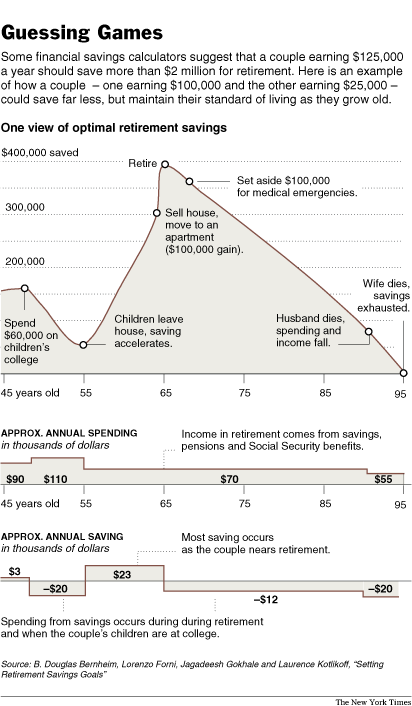
Are You Saving Too Much for Retirement? Vanguard Responds.

On January 29th, I wrote this article asking the question of whether or not we are over-saving for retirement.  It was based on a fairly interesting New York Times piece on January 27, 2007 on the topic.  Since then, I’ve seen this topic appear fairly often in the personal finance press.

As a reminder, this graphic sums up the issue: spending in retirement is not level, so planning for a steady “80% of your pre-retirement income” may be overly conservative for many.  This graphic does a fair job outlining the issue:

Anyway, Vanguard has recently posted their take on the issue, and it’s worth reading.

Look, you could be cynical and say that Vanguard has every incentive to encourage people to over-save.  After all, they make money on the amount you have saved with them.  However, given Vanguard’s reputation for low costs and history as a staunch consumer advocate for savings, that’s an unlikely scenario.

Vanguard’s response to this issue is really basically the following:

  • It doesn’t take a significant savings rate to accumulate significant retirement wealth
  • It is better to over-save than to under-save, all things considered

It’s the second point that I really believe is the most material.  Look, I wish we lived in a country where everyone had been acting like good little ants, storing away food for the winter.  But that just isn’t the case.  The average retirement account has approximately $56,000 in it, and that isn’t going to cut it.

The WWII generation had three legs to their retirement system – social security, pensions, and savings.  Social security is evolving to a cash-starved system that will only really be there for people with modest means.  Anyone with significant savings will see their social security benefits means-tested and taxed at fairly high rates.  Pensions are also gone, for the most part, largely because the only institutions that can afford them are governments who don’t have to do proper accounting.

So that leaves saving.  As a result, I’m inclined to think that while the argument that common financial planning goals are too conservative might be interesting in theory, it sends the wrong message at the wrong time.  It’s like we’re telling an addicted gambler in Vegas that whoops, we made a mistake, and their savings account isn’t totally tapped out yet.

The US 50-State Map Renamed For Countries with Similar GDP

OK, this is a little geeky, but I found this map really fun.


(click for larger view)

Sometimes it’s hard to appreciate how big the US economy really is compared to the rest of the world. This map does a good job of showing the scale of just the individual states, replacing each state with a country that has roughly the same economic size as that state.

And yet, wile a per capita GDP might give a good indication of the average wealth of citizens, a ranking of the economies on this map does serve two interesting purposes: it shows the size of US states’ economies relative to each other (California is the biggest, Wyoming the smallest), and it links those sizes with foreign economies (which are therefore also ranked: Mexico’s and Russia’s economies are about equal size, Ireland’s is twice as big as New Zealand’s).

I think the reason this amuses me so much is just the strange geographic overlay. Try playing red-state, blue-state with these country names. I was even imagining the civil war played out on this grid.

Here is a link to the full article.