How Rational Are We? The Dollar Coin vs. Dollar Bill Debate

A lot of big news coming out now about thew new Presidential $1 Dollar Coins, set to launch Thursday with the first coin in the series, George Washington. I’ve written this post about the program here. It’s one of the top posts for the entire blog.

I saw this article today on Yahoo News, and I thought it fit right in with the topic of this blog – namely how people can be predictably irrational.

Yahoo News/AP: No Plans to Replace Bill with Dollar Coin

The failure of previous iterations of the dollar coin are common knowledge. Every time it’s the same. Big fanfare, big launch, and then the US Mint produces a huge number of coins that sit in vaults forever because there is no demand for the coins.

An AP-Ipsos poll found that three-fourths of people surveyed oppose replacing the dollar bill, featuring George Washington, with a dollar coin. People are split evenly on the idea of having both a dollar bill and a dollar coin.

Fantastic. This would be a really interesting data point… if the costs of the dollar bill and the dollar coin were the same. It’s nice to know that if everything were equal, people prefer the bill to the coin. This isn’t surprising – I personally also prefer the bill to the coin, assuming both are freely accessible.

Here’s the problem, though.  Dollar bills wear out in 18 months.  Coins last approximately 30 years.  If you do the math on $1 units in circulation, you realize that we spend hundreds of millions of dollars, per year, extra, just to support the dollar bill.

Now granted, in a US budget of over $2 Trillion dollars, maybe the idea of worrying about a few hundred million is quaint.  But I guarantee you, the question would have come out differently if you had asked:

“Do you support a federal tax increase of several hundred million dollars to have a dollar bill instead of a dollar coin?”

Rephrase it how you’d like.  I know the “tax increase” word is dirty (it’s certainly a way to lose my vote).  Try, “how much would you pay extra to have a dollar bill instead of a dollar coin?”

That’s the real issue – we all know people prefer the bill.  That is obvious given the failures to launch a coin historically.  The question really is, how much is that preference worth?   In a world where both “cost the same” to the user, that preference will dominate.  But would people really pay extra for the convenience of the dollar, if that cost were visible?

I used to be a big dollar bill fan, but I’ve flipped around now that I’ve seen how successful the coin has been in Europe and Canada.  The path is easy:

  • Retire the $1 Bill
  • Create a $1 Coin
  • Create a $2 Coin

The third step is key, since it helps solve the issue of having too many coins as change for a $5 bill.

My only question now is whether or not we’ll ever really complete the conversion to a coin.  Right now, the race is between the coin and electronic payment.  At some point, cash just won’t matter enough to care.

HD DVD & Blu-Ray Appear to Have Been Completely Cracked. So Much for DRM.

Wow. That is some sort of world-record for turning an entire new generation of DRM worthless.

Engadget: Hackers Discover Blu-Ray and HD-DVD Processing Key

Engadget is reporting that the “processing key” for HD-DVD and Blu-Ray have now been cracked. This is a big deal, because unlike previous exploits that were able to copy individual movies, this crack, if true, means that every HD-DVD and Blu-Ray DVD will be able to be ripped.

I have to say, I’m not surprised. The industry has basically an impossible problem when it comes to DRM:

  1. I want to ensure that no one can copy the digital content off my discs.
  2. I want to ensure that my discs can play in any one of millions of players made by hundred of different manufacturers by anyone in any location.
  3. I want to be able to mass produce identical discs
  4. I want to be able to mass product identical players
  5. I want to ensure that my discs can play on PCs, in order to take advantage of scale economics for PCs.

All of the above produce too many openings for hackers to figure out how to “pretend” to be just another player, and thus get the decrypted content.  The economic incentive for hackers is just too high, and that combined with a good dose of anger towards the “greedy studios”, and you have a guarantee that eventually, these new standards will be cracked.

I wonder if the movie studios will take Steve Jobs’ & Bill Gates‘ advice and give up on DRM? Unlikely to be sure.

Instead, they will focus their efforts on limiting the rights of legitimate, paying customers while crackers will get access to all of their content for free. Of course, I’m sure there will be the requisite push on law enforcement for “trophy arrests” of some 15-year old somewhere with an archive of 300 Blu-Ray movies (20GB each!) on a server.

Unfortunately, this ruins my theory of who would win the format wars – I thought that the first format to be cracked would win the market, since the increased options for buyers of a cracked format are so much higher than a secure one.

Alas, they seem to both be cracked at the same time, so it’s a dead heat again.

Personal Finance Education Series: (1) Recommended Magazines

The first question I often get about personal finance and investing is usually about what sources I would recommend for people who are looking to learn more.

It may be surprising, but despite the incredible variety and depth of information available online, some of the best sources for ongoing learning are still regular, printed magazines.

I began reading personal finance magazines around 1994, and over the years I’ve sampled most of the commonly available ones. The following represent my favorites, some of which I have subscribed to for over a decade.

Personal Finance & Investing

  1. Money. Money magazine is published by Time Warner, and continues to be my favorite personal finance magazine. I think the reason I like it so much is that it takes a much more human approach to personal finance – the magazine always features the personal finance stories of one or more families, and you learn a lot month-to-month about how real people approach very real financial questions. I find it much more interesting to understand how a family who hasn’t saved much for college might approach the problem now that junior is entering high school, than about whether or not I should have a commodity ETF in my portfolio. If you are looking for stock picks, this isn’t the place, but as an overall well-rounded magazine, if you were only going to read one issue a month – this would be the magazine to read.
  2. Smart Money. Smart Money magazine is one of my all-time favorites. Published by the Wall Street Journal, this magazine blends insight into current investing trends, fund managers, and personal finance tips. More investment focused than others, almost every issue features at least one or more “stock pick” lists. I have gotten a few good stock ideas from the magazine, but that really shouldn’t be the focus of the reader. Instead, as you read about the “case” for each stock, it helps hone your own thinking about how to approach investments.

Despite the fact that I have subscribed to the above magazines for over twelve years, I still look forward to each issue every month. Over time, I feel like one of the things you learn is to differentiate the trendy, popularity driven material from the real insights. The biggest danger reading investment magazines is that they always feel compelled to explain and promote the latest trends, and in investing any trend is usually a sign of over-investment. Over-investment typically means high costs with low returns.

Business

  1. Forbes. Most people think of Forbes as some sort of conservative Republican vehicle for Steve Forbes. But if you skip the first few pages of editorial, what you have is a magazine that repeatedly finds unique and interesting angles to entrepreneurship, business, economics & investment. Some of my best investment insights and ideas have come from the columnists in Forbes, and among all of the business magazines I read, Forbes has the highest number of unique stories.
  2. Business Week. Business Week is, in fact, a weekly, and as a result, it turns out to be almost like an aggregated business newspaper with slightly deeper reporting. Very timely, they tend to cover a wide breadth of business & investment issues. It’s light stuff, however, so the signal to noise ratio is not great. Still, several of the blog posts I’ve made here have been inspired by little 1-page articles in Business Week.
  3. Fortune. Ah, Fortune. Glossiest of the Business magazines. This is like the People magazine of business. Several times over the past decade I have discontinued my subscription, only to find out, months later, that I missed some interesting article on a company, industry, or CEO that I really would have liked to have read. Take it for what it is, but I read it regularly.

There are a wide variety of other magazines out there that I have subscribed to from time to time. Kiplingers. Worth. Red Herring. Business 2.0. Entrepreneur. But none of them held my interest for more than a year, and in the end, I find myself coming back to the five I list above.

The Economist is probably the one great, relevant journal that I don’t read regularly. It has a far more global viewpoint, and less actionable investment insight. It’s dense, and I never seem to have time to finish it regularly.

Newspapers

I know this article is called Magazines, but the truth is that some of my favorite periodicals are daily newspapers. I’m going to call out the big three here.

  • Wall Street Journal. I haven’t had time to read this daily in years, but I have never been sorry that I picked up a Wall Street Journal. This is the one paper to read if you want to really be in the flow of finance & investing.
  • New York Times. Excellent Business section every day, capped off with the famous “Sunday Business” section every week. If you could only read the paper once per week, you should read the New York Times “Week in Review” and “Sunday Business” every Sunday. This is also my recommended cure in case you accidentally read a San Francisco Chronicle or Los Angeles Times one day, and you need to flush your brain out with something intelligent.
  • San Jose Mercury News. This is not the largest or most comprehensive paper in the world, but if you follow high tech, this is the best business section in the nation. It has deep coverage of Silicon Valley companies, and its columnists are just one level deeper into high tech than others. It is roughly 1000x better than the other local paper, the San Francisco Chronicle.

Whew. That took longer than I thought. I’m going to follow this article with a post on the top 10 investment books that I recommend, and then I’ll get into specific topics. More to follow…

New XShares ETF for Carbon Emission Credits, and new Index from UBS

The magic of the modern capital markets. You can invest in anything.

First, you need to turn something into a tradeable security. With derivatives, you can do this with almost anything. London has done it with the weather. The Kyoto Protocol has done it with Carbon Dioxide emissions. Kyoto introduced a “cap and trade” approach to regulating carbon dioxide, similar to the program put in place by the United States in the 1990s to control sulfer dioxide and acid rain. In a cap and trade system, countries limit the total amount of carbon dioxide emissions on a per country basis, and then issue those rights to their companies. Companies can then trade those rights with each other, and even potentially earn “new rights” by putting in place technology and programs to cut existing carbon dioxide emissions.

The Kyoto Protocol currently covers 160 countries, representing approximately 55% of all carbon dioxide emissions globally. The United States, China & India are the most notable signatories missing from the current pact.

Emissions trading has become a big market, and with global warming a hot topic again (sorry, I couldn’t resist), a lot of people have been looking at the carbon dioxide credits as more than just environmental regulation, but as an investment opportunity.

After all, it stands to reason that the right to release a ton of carbon dioxide into the air is not going to get cheaper going forward. And of course, if you buy that right, then some other company can’t, which means you potentially have taken that right off the market… until you sell it.

Now, what most people don’t know is that there is also a voluntary carbon dioxide emissions market here in the US, the Chicago Climate Exchange. There is also now a firm, called XShares, that is investigating creating an ETF based on the exchange.

In other news, UBS has created a new Emissions Index, based on the two European exchanges, which trade about 46% of all the global emissions rights today. There is no ETF for this index, yet, but where there is an index, there is usually an ETF to follow.

I’m going to file this away in my “watch” folder for the time being. Carbon emissions might be a very interesting commodity, since there will be strong secular pressure to limit the rights to emit greenhouse gasses in the future. Also, it stands to reason that lower emission caps in the future will mean increased costs for corporations, which means it might be an interesting diversification play versus the corporate stock & bond markets.

Personal Finance Education Series: Introduction

As this blog continues to grow, I try to be very open to advice and suggestions from people who have become regular readers. Today, I got some advice from a friend who, while she hasn’t come clean with me on where her blog is located on the web, has been reading mine regularly.

She told me today that she liked the new aggregated page I made of all my Personal Finance posts to date, now featured in the header of the blog. However, she had a fundamental question about where I get all my information about personal finance, how I learned about these different ideas, and how a person with limited time could learn more.

She suggested I put together a series of posts for people who are interested in personal finance and investing, but aren’t sure where to start.

So, this post is going to be an introduction to a multi-part series on personal finance and investing, based on my own history on the topic. I’ll try to produce posts in the series that cover recommendations on magazines, websites, and books, as well as on basic topics like saving, investing, asset allocation, investment clubs, brokerages, retirement accounts, real estate, derivatives, commodities, and funds. Not necessarily in that order, of course.

I don’t pretend to be an expert in all of these areas, but if through a series of posts I can help people get started on their own personal finance education, I’ll feel like I’ve done a truly good thing with this blog.

As a personal note, I was not one of those people that had an early exposure to personal finance and investing. Although I’d like to think that I learned good personal finance values from my parents and grandparents, when it comes to investing, I didn’t know much about anything other than bank certificates of deposit until college.

Since then, I’ve been mostly self-taught, although now I have had the benefit of coursework at institutions like Stanford and Harvard, direct experience in the venture capital industry, and about fifteen years now of growth and learning.

We’ll see how it goes, and of course, I’m willing to take requests if there are topics people would like to see added to this series. I will try to do at least a few posts a week in the series, and in the end, I’ll group them together on the Personal Finance page for easy reference, as well as link them back here for navigation.

So, a special thank you to Rebecca Nathenson for the great suggestion.

Articles (complete index here):

A Currency ETF for the Long/Short Trade: The PowerShares DB G10 Currency Harvest Fund (Ticker: DBV)

I caught a very interesting article in this week’s Business Week on a new Currency ETF that launched in September. The original article is here:

Trade Currencies Like a Hedge Fund | Business Week

It doesn’t look like they’ve released the article to the free portion of the site yet, so let me summarize a bit here.

The new PowerShares DB G10 Currency Harvest Fund (Ticker: DBV) has grown to about $180 Million already, allowing individual investors, for the first time, the ability to easily invest in the “long-short trade”. The long-short trade is when you buy the currencies of countries with high interest rates, and you sell short the currencies of countries with low interest rates. Normally, countries with higher rates see their currencies appreciate relative to those with low rates, and this strategy lets you capture the difference. You can think of it as borrowing cheap money (the short against the countries with low rates) to buy investments that pay higher rates (the countries with higher rates).

For example, right now New Zealand is paying interest rates of 7.6%, and Japan is paying just 0.5%.

This trade is a common one, but it’s not without its problems. There have been many times, historically, when large hedge funds used leverage to play this game, only to have the market move against them. Usually, however, the implosion involved big bets in emerging markets.

This fund only invests in the currencies of developed nations with high credit ratings, and employs only 2:1 leverage, so it’s relatively safe.

Here are the current holdings of the fund:

Long Positions:

  • Australian Dollar
  • New Zealand Dollar
  • US Dollar

Short Positions:

  • Japanese Yen
  • Swedish Krona
  • Swiss Franc

The fund is based on the new Deutsche Bank G10 Currency Future Harvest Index, which has been backtested to produce a 11.4% annualized return over the last 10 years. That being said, it’s a new index, and how it will behave in real life may vary.

What is interesting about the index, however, is that it has returned 3.2% more than the S&P 500 over the same time period, but with only half the volatility. Not only that, the carry trade has very little correlation with stocks, so it’s a natural for diversification.

Previous Currency ETFs, launched by Rydex, have allowed investors to buy into individual currencies:

  • Euro (Ticker: FXE)
  • Mexican Peso (Ticker: FXM)
  • Swedish Krona (Ticker: FXS)
  • Australian Dollar (Ticker: FXA)
  • British Pound (Ticker: FXB)
  • Canadian Dollar (Ticker: FXC)
  • Swiss Franc (Ticker: FXF)

Unfortunately, the structure of these ETFs has built in high fees and spreads, making them poor ways to try and “own” that currency.

If you are interested in the new new PowerShares DB G10 Currency Harvest Fund, be aware that the strategy does have some limitations. As covered in TheStreet.com:

I’m convinced that the strategy has merit, but as with all strategies, there are flaws that should be understood before purchasing.

Higher yields do tend to make a currency more attractive, but that overlooks an important point: Currencies whose interest rates are moving up tend to be strong. A currency starting from a low base interest rate that is headed higher is likely to be a strong currency, but it could be overlooked by the ETF’s strategy.

However, if you are looking for a currency component to your asset allocation, this fund is definitely worth considering. There are some tax considerations as well, because the fund uses futures to do its trading. As a result, it might be best to hold this in a tax-advantaged account, like an IRA.

Are We Over-Saving for Retirement?

There was an article in the Saturday New York Times (1/27/2007) that really got me thinking. It was called:

A Contrarian View: Save Less and Still Retire with Enough

I must admit, my initial reaction to the title was extremely negative. In a country where private pensions are quickly becoming a thing of the past, and Social Security continues to float in a bizarre state of political denial, telling Americans that they need to “save less” seemed irresponsible, bordering on criminally negligent.

The article didn’t initially endear me either with its analysis. Witness the third paragraph:

Nevertheless, a small band of economists from universities, research institutions and the government are clearly expressing the blasphemy that many Americans could be saving less than they are being told to by the financial services industry — and spending more — while they are younger. The negative savings rate, they say, is wildly distorted.

A small band of economists from universities, you say? No names, of course, of either the economists or the universities. But it’s good to know they are in a band, albeit a small one. Maybe they work with Robin Hood, and his merry band of thieves.

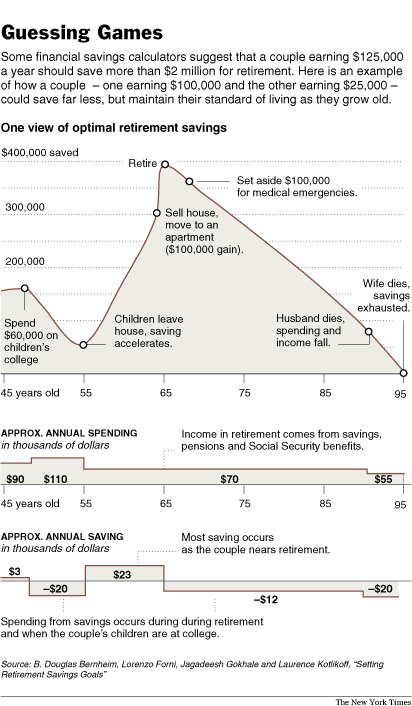
Of course, it’s rare for the New York Times to be this shoddy with reporting, so I move on through the article.  And it turns out, the article does have a point.  Look at the graph that was included with the article:

0127-biz-webmoney.gif

Aha!  Real sources, real numbers, and credible analysis.  It turns out, this is a legitimate piece, just written in a fluffy, air-headed style.  There is real financial analysis here to this question, and there are some issues raised by it which are worth considering.

One of the biggest innovations in personal finance in the last decade has been quick and easy access for individuals to sophisticated planning tools that previously were only available to professionals.   For example, many people used to just take a basic percentage of return, like 8%, and then project what their savings might be by the time they are 65.  (In fact, many people still do.)

Now people have access to tools, like at Financial Engines,  that do Monte Carlo analysis.  Monte Carlo analysis, like it’s name-sake city, is focused on risk & gambling. With Monte Carlo analysis, the computer will run through thousands, if not millions, of randomized versions of the future, based on the historical performance of different asset classes like stocks, bonds, and cash.  These simulators don’t tell you how many dollars you’ll end up with when you turn 65.  Instead, they give you probabilities you’ll end up with “enough money”, however you define that.

This New York Times article didn’t go into too much detail, but based on the tidbits in the piece, my guess is that the “band of economists” are focusing on a few ways that these models could demand “over-saving”:

  1. 1929-1937.  All Monte Carlo simulators worth their salt include, as part of their randomization programming, historical extremes, like the Great Depression.  In fact, the book I read by Ben Stein constantly refers to this period as the ultimate measure of a good strategy.  However, is it prudent to base your planning on what seems to be more and more of a historical outlier?
  2. Social Security. Almost all calculators that I’ve seen tend to evaluate your portfolio with no assumption of Social Security.  Now, I’m personally pretty negative on the idea that I’ll be collecting anything resembling the currently promised Social Security benefit, but in fairness, if you took the US Government at face value, that promise is worth a significant chunk of change.  Roughly $812,000, if you buy my earlier analysis.
  3. 85% of Income Needed.  Almost all planning tools tend to estimate your needed income in retirement as 85% of your pre-retirement income.  This assumption is actually based on the idea that normally you save 15% of your income, so when you retire and you stop saving, you don’t need that 15%.  Fine.  But this assumption is likely faulty in two regards – first, it likely differs based on your expected lifestyle in retirement (travel, health), and second, it’s unlikely to be a flat 85% through the rest of your life.

So, there are points to be made here, and it is something to think about.  I personally have been faced with difficult choices for saving that don’t have immediate, obvious answers.  What do you prioritize – saving money for a larger house & family, for retirement, for college, or travel & family fun?  What’s the right balance?  There is some truth to the fact that you could, in fact, over-save for retirement, and miss out on your life with your family while you are young.  You could live to 125, but you also could also die tomorrow.  I’ve had close friends and mentors who have died before ever seeing retirement, so these aren’t just theoretical questions.

In the end, I probably agree more with critics that say that the last message Americans in general need to hear is anything that sounds like save less.  No, in general, Americans are already getting an A+ in that class.  They are getting a D right now in save more, so while their are nuances that are worth discussion here, this article was the wrong way to present them.

As personal finance tools grow more sophisticated, however, it is also worth noting that in the end, they are just tools.  Garbage in, garbage out.  If you put in bad assumptions about the market or your goals and values, you will get bad answers out.  Sure, they’ll look pretty.  But they won’t steer you toward happiness.

Vanguard introduces four new Bond ETFs, with Super Low Expense Ratios!

11 Basis Points. Not one percent. Not one half a percent. Not even one quarter of a percent.

0.11%. That’s the new expense ratio on the Vanguard Bond ETFs. These were announced this week on the Vanguard RSS Feed.

$11 for every $10,000 you have invested. Combined with the 9 basis points you pay on the Total Stock Market ETF, you could have a 50/50 balanced portfolio for the total cost of 0.10% every year.

I know that things like this don’t excite everyone, but I see this as more than just a good deal. I see empowerment for everyone. People forget that 30 years ago, you couldn’t get index funds unless you were a large institution with millions to invest. Even then, you couldn’t get one with an expense ratio under 0.5% until 15 years ago. And getting one freely, with no fees save commission, like this, with no minimum investment? Forget about it, until now.

Now the small investor, with just a few thousand saved, can have access to the tools previously limited to massive institutions. And it seems to only be getting better every year.

From the Vanguard website:

Vanguard has filed a registration statement with the U.S. Securities & Exchange Commission (SEC) to offer exchange-traded shares for four existing Vanguard® bond index funds: Total Bond Market Index Fund, Short-Term Bond Index Fund, Intermediate-Term Bond Index Fund, and Long-Term Bond Index Fund.

Pending SEC approval, the four new bond ETFs will provide broadly diversified exposure to the entire U.S. bond market as well as discrete segments of the market at an expected expense ratio of only 0.11%.

Vanguard ETFs™ are uniquely structured as separate share classes of existing Vanguard mutual funds. For example, Vanguard Total Bond Market ETF will be a separate share class of the $40 billion Total Bond Market Index Fund, the industry’s first bond index fund and one of the largest bond mutual funds in the country. Introduced in 1986, the fund seeks to track the performance of the market-weighted Lehman Brothers Aggregate Bond Index, and holds nearly 2,800 corporate, Treasury, agency, and mortgage securities.

The new ETFs will be managed by the Vanguard Fixed Income Group, which oversees $310 billion in fund assets, including $65 billion in bond index fund assets.

Red State vs. Blue State vs. Purple America

Sorry, a lot of politics tonight. I guess it’s all the news about President Ford.

Still, I had to share this. I don’t know how I missed it, but in all the debate about what it means to live in a “red state” vs. a “blue state”, I found an interesting graphic when browsing Wikipedia.

It all started with the link to the 1976 Election page.

I immediately noticed that this chart had the Democrats in Red, the Republicans in Blue – the opposite of the current color scheme in use. In fact, I then found this very interesting piece on the origins of the entire color scheme here.

Prior to the 2000 presidential election, there was no universally recognized color scheme to represent the parties. The practice of using colors to represent parties on electoral maps dates back at least as far as the 1950s, when such a format was employed within the Hammond series of historical atlases. Color-based schemes became more widespread with the adoption of color television in the 1960s and nearly ubiquitous with the advent of color in newspapers. Early on, the most common—though again, not universal—color scheme was to use red for Democrats and blue for Republicans. This was the color scheme employed by NBC—David Brinkley famously referred to the 1984 map showing Reagan’s 49-state landslide as a “sea of blue”, but this color scheme was also employed by most news magazines. CBS during this same period, however, used the opposite scheme—blue for Democrats, red for Republicans. ABC was less consistent than its elder network brothers; in at least two presidential elections during this time before the emergence of cable new outlets, ABC used yellow for one major party and blue for the other. As late as 1996, there was still no universal association of one color with one party.[2]; if anything, the majority of outlets in 1996 were using blue for the GOP and red for the Democrats.

But in 2000, for the first time, all major media outlets used the same colors for each party: Red for Republicans, blue for Democrats. Partly as a result of this first-time universal color-coding, the terms Red States and Blue States entered popular usage in the weeks following the 2000 presidential election. Additionally, the closeness of the disputed election kept the colored maps in the public view for longer than usual, and red and blue thus became fixed in the media and in many people’s minds.[3] Journalists began to routinely refer to “blue states” and “red states” even before the 2000 election was settled, such as The Atlantic’s cover story by David Brooks in the December 2001 issue entitled, “One Nation, Slightly Divisible.” Thus red and blue became fixed in the media and in many people’s minds [4] despite the fact that no “official” color choices had been made by the parties.

Fascinating.  So we owe the current “red state”, “blue state” terminology to:

  1. The invention of color TV
  2. The standardization of treatment in 2000 by the networks
  3. The decision to use the opposite treatment for liberal vs. conservative that the rest of the world uses (typical)

Probably the most interesting picture I found here was the link to Purple America:

As someone who has only participated in elections in either the SF Bay Area or Boston, it was nice to see that the nation as a whole, even now, is far more balanced than you might think.  People seem to quickly forget how shockingly close all of the last 4 elections have been.  Amnesia seems to be tied to your party squeaking out the win.

Anyway, just an intellectual tidbit for this evening.  I’ll be back to personal finance topics soon – those do seem to be the aggregate favorite for this blog.

A Brief Note for President Gerald Ford (1913-2006) & My Historical Blind Spot

I’ve been reading a lot of the coverage this week about President Ford.  It has been extremely educational for me, since Gerald Ford falls into what I call my historical blind spot.

Almost everyone is familiar with the blind spot you suffer when you drive a car.  Off to the right, and down to the back, there is a triangle that seems like it should be visible in your mirror – but it isn’t.  Trucks & vans often have a worse blind spot than cars.  It’s a fascinating thing – so obvious when you look at it on paper, but so hard to recognize when you are actually driving.

I think the same thing happens to people around history.  Most people learn their history in two places: in primary & secondary school, and then throughout life as they are living it.  For example, my most in depth course work in history was in high school when I took AP US History in the 11th grade (1990).  Incredible depth and memorization of names, treaties, bills and events in the 18th & 19th centuries, all the way through about 1965.  Once we got past Kennedy & Martin Luther King, all of a sudden, the textbooks turned to mush.  A few days here and there of miniscule coverage of Vietnam, Watergate, and a couple of oil crises for good measure.  Stagflation.  Voodoo economics.

High school is also the time when I began following current events in some detail.  I participated in policy debate on topics ranging from retirement savings, prison reform, nuclear proliferation and space exploration.  I read several newspapers daily.

I’ve noticed since then, however, that I have a historical blind spot that dates from the mid-1960s to the late 1970s.  Sorry, no memory of Ford or Carter, although technically I was alive at the time.  I have some memory of the early 1980s, which has made it easier to fill in detail about the decade over time.  (My favorite, of course, was re-watching the televised Reagan-Carter debate in 1980 on PBS.   Although it was a landslide for Reagan, both in the debate and election, both seemed so much more coherent and direct than any modern debate I recall watching.)

Is this common?  Do most people have a historical blind spot between the time that their in-school history material ran out, and before their personal experience began?  As I read more about Gerald Ford’s Presidency, it feels strange that I know more about the 1930s than the 1970s.

Let me be clear, I certainly knew about Nixon’s pardon.  But not the rich color around it.  Not the detail I’ve been seeing the recent newspaper coverage.  Actually, Wikipedia has been wonderful here as well.  Their section on Gerald Ford is great, and the detail about the 1976 election is also great.  I think I was missing a significant part of history here.

Anyway, I’m going to augment my reading list for 2007 with some more material on the 1970s.  I think my approach to it has been too segmented (space policy, energy policy, monetary policy, etc) rather than a holistic view.  I’ll likely start with some of the biographies that will be hitting the presses momentarily.

eBay, Garth Brooks, and Making Money on Inefficient International Markets (Part 2)

This is an update on my experiment in the economics of selling a product that is readily available here in the US overseas using the eBay & PayPal platforms.

In Part 1, I cover the basic background of the experiment, and how I landed on my solution of selling overseas. The item in question: the special edition Garth Brooks 5 DVD set, available for $20 exclusively at Wal-Mart in the US.

eBay, Garth Brooks, and Making Money on Inefficient International Markets

As quick summary, I was able to make a net margin of over 14.1% selling these DVDs on the eBay UK website using nothing more than freely available tools from eBay, PayPal, and the United States Postal service.

The first experiment went so well, I decided to order 10 more DVD sets from Walmart.com (so much for Garth Brooks selling out this year). This time, I attempted to sell them on eBay Germany. In the process I learned quite a bit about how to squeeze more margin out of my shipping, using PayPal’s international postage printing for the first time, and the hazzards of selling into a market where you don’t speak the language.

But first, the economics. Here is my scorecard for selling 10 Garth Brooks DVD sets on eBay Germany.

Germany Sales
Quantity 10

Sales Revenue € 459.50
Average Sales Price € 45.95

Shipping Cost $12.75 2.1%

eBay Fees $86.38 14.5%
Listing Fees $0.12 0.0%
Feature Fees $23.30 3.9%
Final Value Fees $62.96 10.6%

PayPal Fees $27.67 4.7%
Transaction Fees € 16.80
Cross Border Fees € 4.60

Pounds -> Dollars $1.3261
Currency Conversion Fee 2.50%

Total $ Revenue $594.11 100.0%
Total $ Costs $456.44 76.8%

Total $ Profit $137.67 23.2%

Total $ Cost/Item $23.88
Total $ Profit/Item $13.77 22.6%

Wow.

Yes, that’s right. Though the economics were different, the overall profit margin for selling the Garth Brooks DVDs, purchased at full retail from Walmart.com, including shipping, was 22.6%. In fact, you could say that the “return on investment” for spending the$23.88 on the DVD was 57.7%.

Wow.

Let’s do a quick breakdown of what was different about the economics of selling into eBay Germany:

  • Lower Volume. Because eBay Germany had a lower sell through of the Garth Brooks DVD, I only sold 7 copies from my first fixed-price listing. As a result, I had to relist the last 3 for a second week. I should note that I listed the item in the core fixed-price format, at 45,95 Euro, with free shipping. The first listing included Featured Plus placement, but both listings included Sub-Title, Gallery, and Scheduled start time.
  • Different eBay Fee Structure. I was surprised to see that the eBay Germany fee structure in DVDs is very different than the US & UK. As you can see, the listing fee was next to nothing ($0.06 each time), but the final value fee was quite a bit larger. The overall take rate for the DVD for eBay in Germany was 14.5%, higher than the 8.8% in the UK.
  • Strong Euro = Strong Profits. At 45,95 Euro, the DVD sold for over $60 once you convert the Euro to dollars. Even with $12.75 USPS Global Priority Mail shipping, that leaves a lot of profit left over for the seller.
  • Optimizing Shipping is Worth It. When I sold to the UK, it cost me $15.75 to ship the package. Why? Because I used the large USPS Global Priority Mail boxes, which made the package 1 pound, 10 oz. By shifting to a smaller box, I was able to get the package down to 1 pound, 8 0z. which was $3 cheaper. That’s over 10% profit margin right there!

Selling into Germany created new challenges. The first issue was how to create an item description in German. I tried two translation services: babelfish.altavista.com and translate.google.com. Neither did a great job, and both created weird, non-German characters in the result.

I cheated a little here – a friend of mine from the eBay Germany office was in town, and I asked him to “fix up” the auto-translation of my item description. In the end, I’m not sure it mattered. What I noticed was that all of my German buyers spoke English… not surprising in retrospect since they listen to Garth Brooks. 🙂 At the time, however, I thought it was something I needed to sell in Germany.

The second challenge was creating the listing. I found using the eBay Sell Your Item form in Germany difficult, largely because it was in German! I consider myself an expert in the form (considering that I managed the product team responsible for it for about six months). Still, I was surprised how long it took me to complete. I don’t know why, but error messages in German were fairly disturbing to me.

The last challenge was answering questions in German from buyers and potential buyers. I think I made this harder than it needed to be. I was so paranoid about not speaking German, for the first few days I actually took every email, translated it on Babelfish, and read it. I then wrote a response, translated it, and sent it back. Finally, in one email, I just sent back the response in English. Ironically, it turned out the buyers didn’t realize I was from the US. Once I wrote to them in English, they did the same, and the problem went away. But it was stressful while it lasted, particularly when one buyer was asking about bank payment, which is popular in Germany. I was really worried I’d end up with negative feedback for a few seconds there.

To close out my lessons here, let me give kudos to two awesome products:

  • PayPal. The ability of PayPal to allow me to seamlessly collect money in another currency, and then either maintain that currency balance or translate it to dollars is just amazing. A miracle of the modern Internet. I don’t know how an individual could previously sell overseas with such ease, but I consider the 7.2% take rate of PayPal cheap for the priviledge.
  • eBay/PayPal International Postage Printing. It took me a while to get over my fear of change here, but now that I’ve done it I will never look back. These packages weighed over one pound, which normally means you have to go to the post office to send them. Not anymore. I was able to print the postage, stick it in the clear USPS envelope, stick that on the package, and leave it on my porch for pickup. It lets you print the postage and the customs form. One small goof – I forgot to sign it one time. But my mailman brought it back the next day, I signed it, and it was off to Germany.

I’m still waiting for feedback from my last few sales, but now I’m glad to say I have some cool German feedback on eBay that I don’t really understand. But it’s positive, and that’s what counts.

For eBay sellers out there, both individuals and professionals, you should really consider opening your listings up to other countries, and potentially even listing them on those country sites. eBay & PayPal give you all the tools necessary, and as the above experiment shows, the difference can be significant.

In fact, the numbers here are so compelling, I would wager that eBay sellers who master the ability to sell internationally will have a fundamental economic advantage over those who don’t. More profit for the same inventory is always a winner in retail.

Milton Friedman Panel Video at University of Chicago GSB

Short post, but a great pointer to a video of a panel hosted at the University of Chicago Graduate School of Business (GSB) after the death of Milton Friedman.

It’s a full panel, and not quick, but worth watching if you are interested in either economics or Milton Friedman.   I don’t recommend it if phrases like “consumption functions” or “monetary policy” roll your eyes.

Milton Friedman Panel: 11-30-2006 at Chicago GSB

The New Inflation Protected Security: The 42¢ Forever Stamp

Sorry, but I couldn’t pass this one up.

The introductory letter to the recent 2007 Investor Guide issue of Forbes magazine (12/11/2006) has a really neat little tongue-in-cheek reference to a new way to beat inflation. First, check out this graph from the article:

T-Bill Return

Yes, that’s depressing. Most people learn that typical “money market” returns for cash match inflation over time. That means that the interest you earn on cash accounts historically lines up with the amount prices go up every year. It’s why many people use money market funds and other similar cash equivalents, like certificates of deposit, to “protect” their savings.

Unfortunately, what this chart shows is that your cash equivalents only keep up with inflation when they aren’t taxed. T-Bills, which are the basic proxy for the cash equivalent market, actually lose money against inflation because the US government taxes their gains.

The chart plots what would have happened to a hypothetical dollar invested in T bills by a top-bracket taxpayer. The government that issues these bills gets you two ways. First is via inflation, what Ronald Reagan called the “thief in the night.” The other is to send around the Internal Revenue Service to rob you in broad daylight. Your real aftertax return over the past 75 years is a cumulative –72%.

Interestingly enough, there are real investment options today, in both Europe and the United States to protect your money from inflation. Several options, in fact:

  • Treasury Inflation-Protected Securities. This is the official, US, 10-year bond that is guaranteed to pay out both a real return and the inflation-adjustment based on the consumer price index. There are similar bonds in Europe as well. The only problem – you have to pay taxes on the inflation “gain” every year, even though it isn’t paid out until the end of the 10-year term. This also ignores the obvious fact that keeping up with inflation isn’t really a gain, so like the T-Bill, you are getting kicked in the stomach by the same government that inflated your currency.
  • Series I Savings Bonds. I love these. In business school, I independently did an analysis for my finance professor on the expected return of these incredible instruments. Conclusion: The government is heavily subsidizing them. Translation: the government is over-paying for these bonds, likely to help small savers and to encourage college savings. Let’s count the benefits:
    • Taxes. None, until you cash in the bond. Up to 30 years of tax deferral!
    • No State Taxes. None, ever. It’s excluded, a real perk for high tax states like good old California.
    • No Taxes, education benefit. If you use the proceeds to pay for education, the gains are tax free.
    • Inflation protected. You get paid a real rate of return plus inflation, every six months. Better yet, they use the CPI-U (consumer price index – urban), which tends to run hotter than the CPI overall, but better reflects costs when you live in the city.

    In fact, the only limitation are the 1-year waiting period to cash out, the 3-month interest penalty you pay if you cash them in before 5 years, and the $30,000 per-person, per-year maximum (which I doubt many people hit).

  • Municipal Bonds. My understanding is that there are now inflation-protected municipal bonds in some areas… all the tax-free benefits of municipal bonds and inflation protection sounds good to me. (unfortunately, the real rate of return on these is negligible)
  • Gold. No, it’s not backed by any government, but the gold bugs out there will flame me to a crisp if I didn’t mention the oldest, and dearest inflation hedge in the world. The theory is that gold always stays the same price, and all other currencies just effectively float around based on how well they manage their money supply. You could make this argument about any precious metal, or even for commodities and real assets in general. Personally, I still think that one day we’re going to be able to find unlimited supplies of any metal, so not putting my 50-year money here…

But I am here today to mention a humble, fourth opportunity for inflation protection:

The new “Forever Stamp” proposed by the US Post Office.

The basic idea is that the post office will issue a new 42¢ stamp in 2007 (yes, another price increase), but one that will hold it’s value forever. No more price increases. The stamp will always be good for one first-class mail item, up to 4 ounces.

Let’s think about that.

First, we know that the US Postal rates have approximately kept pace with inflation over the past 25 years… maybe a bit more than inflation.

Second, there is no proposed “time limit” on the stamp. I guess the stamp will be valid as long as there is a US Post Office?

Third, there is no limit on resale. So, I am assuming that if postal rates increase, you could resell your stamps to someone else who needs them, for approximately full value.

Fourth, there is no accumulation limit. You could theoretically by $1M worth of these stamps, if you wanted to.

Fifth, no taxes. At least, right now, the IRS has not said that it will tax you on the appreciation of your first-class stamps. At minimum, there are no taxes until you “cash them in” by selling them.

The blog Marginal Revolution asserts this just gave the Post Office the ability to print money. Since the Post Office is effectively backed by the US Government, they can just print stamps to effectively increase the money supply. (I do love it when the stable money fanatics get worked up.)

The blog Economist’s View has another interesting take on the proposal.

There you go… tidbit for the day. If you are looking for a safe place to park your money, you may now have a new friend in the US Post Office. I will say that this looks like a very hot item for the Stamps category on eBay

Favorite Milton Friedman Quotes

There are a lot of these floating around right now, given the recent passing of Milton Friedman.

Still, I was reading the latest issue of Forbes magazine (the 2007 Investment Guide issue), and there were a few more I wanted to call out, mainly for their clarity and brevity.

“A society that puts equality ahead of freedom will end up with neither equality nor freedom.”

“Nothing is so permanent as a temporary government program.”

“Inflation is taxation without legislation.”

That last one is particularly topical for me of late, as I’ve been thinking about long term investment returns, retirement, and the amazing burden that inflation puts on planning for the future. My next post will feature a bit of a tongue-in-cheek reference to the monetary monster.

Books: Yes, You Can Still Retire Comfortably by Ben Stein & Phil DeMuth


One of the original reasons that I thought that writing a blog would come naturally to me was because I’m an avid reader. When I started this blog in August 2006, I figured that many of my posts would be the standard “book reviews and baby pictures” type of posts that people make fun of blogs for.

Ironically, I realized tonight that I have not yet done even one book review post… until now. Recently, I wrote a post about Ben Stein, and in the process I discovered the commercial website for his new book. I ordered the book that night, and received it this week. I just completed reading it over the last few days, and it’s worth commenting on.

Yes, You Can Still Retire Comfortably! by Ben Stein & Phil DeMuth

Overall Rating: Good, but not great. I’m glad I read this book, and it had a significant amount of unique content. However, the style is dry & negative enough, that many people may not love the experience.

Synoposis: At least 25% of this book is just depressing. It basically lines up all of the reasons, at both a macroeconomic and microeconomic level, that the retirement of the Baby Boomer generation is going to strain the US economy and your own personal finances. There are three legs to retirement financing: social security, corporate pensions, and personal savings. None of these are looking very good for the Baby Boom generation and Generation X. At the same time, the percentage of people in the economy who are working and adding value is going to continue to fall sharply, straining many aspects of our economy.

I think the authors summarize their feelings well themselves here:

Ten percent of seniors already live below the poverty line. This is no way to spend your days when you are old. Your authors fear that many in our generation are going to be joining their numbers.

What’s more, the retired baby boomers are going to be living well compared to Gen Xers, because the bones will be picked completely clean by the time they retire.

Having said this, we’d like to add one more thing: Yes, you can still retire comfortably. Maybe not everyone will, but you can, and we’re about to tell you how. Don’t get overwhelmed with the fate of the whole generation. Just worry about yourself, and then plan to act. You don’t need to outrun the bear; you just need to outrun the other hunter. Read on.

The rest of the book is a fairly dense, well-researched walk through of how you can outrun the other hunter. It places a strong emphasis on saving, saving, and more saving, with a dollop of extending your working career as long as possible thrown in. The book features a lot of tables and numbers – it’s clear the authors have back-tested their program, and have provided a lot of “short cut” calculations to help the reader quickly assess where they are in terms of saving for retirement.

I have likely read over three dozen books over the years on this topic, and this book was fairly unique in a number of ways:

  1. No magic path to high investment returns. The authors do not spend any time trying to explain how to beat the market, or how to achieve 10%+ annual returns on your portfolio. They basically advocate the “couch potato” portfolio of 50% total stock market, 50% aggregate bond market. (They do provide a more advanced portfolio breakdown of 25% each US Stocks, International Stocks, Inflation-protected bonds, and aggregate bond index).At first, I recoiled at this recommendation given it’s low growth potential. But having completed the book, I now realize that the authors primary concern is running out of money. Having run Monte Carlo simulations and historical back-testing, it’s very clear that the way to the poorhouse in retirement is having your stock portfolio hit a set of “bad years” early on. That depletes your funds, and since you are withdrawing every year, you never recover.
  2. Try to be conservative in your saving plan, and then when you have it worked out, try to save even more. More than any other retirement planning book I’ve read, this one really emphasizes the fact that there are still a lot of economic unknowns to come with this generational shift. For example, marginal tax rates have been as high as 90% in the past 50 years. Who knows what rates will be when you retire! Will social security be there for you when you retire, or will “means testing” or some other political fiction be deployed to balance out the books of the dwindling “trust fund”. Even Roth IRAs may not be safe, since Congress could decide to start taxing or penalizing those withdrawals in future years.
  3. Positive recommendation for variable annuities? It has been a very long time since I’ve seen anyone recommend these, given their notoriety for high fees and low returns. However, Ben has a positive family experience with these products, and he provides very sound analysis on how a mixture of fixed and variable annuities could help provide for a stable and comfortable retirement. In the end, however, the primary recommendation of the book is not annuity based, so I’ll let this one slide.
  4. You need to plan for your maximum life span, not average life span. Most retirement books I have read tend to focus on average life spans. While these are high, they are not as high as planning for the possibility of a very long retirement. Most of the planning in this book focuses on either the 5% chance of living to 100, or the 1% chance of living to 105.This struck a chord with me, as I tend to be on the optimistic side of this equation. I believe that advances in technology related to longevity and health are on an inflection point that will hit in our lifetime.
  5. 4% is the only safe number. This is a really important point, so I’ve saved it for last here. In a previous post about Social Security, I explained the “Rule of 25” in terms of planning for assets to provide an ongoing income stream. That back-of-the-envelope rule was based on the idea that you can only withdraw 4% annually safely from your assets and protect your principle.Scott Kleper posts a comment on that entry that asked whether or not I was being too conservative with the 4% number. After all, you don’t need your money to last forever, right?At that time, I hadn’t read this book. If I had, I would have been able to answer that question better. This book goes into quite a bit of detail about different strategies for withdrawing money in retirement. The short answer is that 4% is really the only safe solution that handles out-of-band eras like the 1930s stock market, or the 1970s stock & bond markets.In fact, this book goes out of its way to explain that the only really safe income strategy is to have fifty times your income saved, so that you can invest it in inflation-protected securities paying 2% above inflation on an ongoing basis. Since that’s unreasonable, we’re left with a requirement to invest in stocks, with all the risks and variability associated with it.

The entire book is written in Ben’s typical terse and plain-spoken style. It’s not a long book, and there is clearly a lot of data behind the conclusions that are presented.

The book is also not a riveting page turner, and I am pretty sure that people who are naturally more “grasshopper” than “ant” will get irritated pretty quickly by the constant barrage of negativity about the future and about the need to save at all costs.

I am glad, however, to have read this book. While I’m not going to be shifting my portfolio to the “couch potato” blend so quickly, I may have to revisit my natural revulsion to bonds and consider adding them to my asset mix. The data in this book on withdrawal strategies has me convinced that the best defense is to save early and often.

One last note:

Check out this table from the book:

It’s amazing. This table shows, based on a number of assumptions, what percentage of your salary you should be saving every year, based on your age and how much you have already saved. Look at the power of saving while in your 20s & 30s. If you can save even 1/2 of your salary by the time you are 25, you only need to save 5% for the rest of your career to retire comfortably. If you wait until 35, you need to save 11% every year just to make up for lost time.

While this book was worth reading, I still prefer reading Ben Stein’s periodic articles to the book. He has a natural gift to provide very simple and compelling analysis in a very short space. It’s more powerful in small doses.