Personal Finance: The Best Advice is from Saturday Night Live

I have a special attachment to Saturday Night Live, since it debuted the same year I was born.  This skit is genius, and summarizes the best financial advice you are going to get this year.

You can watch it here on NBC.com

Don’t Buy Stuff You Cannot Afford


Scene: a typical American kitchen. A husband (Steve Martin) and wife (Amy Poehler) are puzzling over their finances.

Wife: Oh, I just can’t get these numbers to add up
Husband: Like we’re never going to get out of this hole.
Wife: Credit card debt, does it ever end?
Salesman: [entering from who-knows-where] Maybe I can help.
Husband: We sure could use it.
Wife: We’ve tried debt consolidation companies.
Husband: We’ve even taken out loans to help make payments.
Salesman: Well, you’re not the only one. Did you know that millions of Americans live with debt they can not control? That’s why I developed this unique new program for managing your debt. [Holds up book] It’s called, “Don’t Buy Stuff You Cannot Afford”
Wife: Let me see that. [Reading from book] If you don’t have any money, you should not buy anything. Hmmm … sounds interesting.
Husband: Sounds confusing.
Wife: I don’t know honey, this makes a lot of sense. There’s a whole section here on how to buy expensive things using money you’ve “saved”.
Husband: Give me that. And where do you get this “saved” money?
Salesman: I tell you where and how in Chapter 3.
Wife: OK, what if I want something but I don’t have any money?
Salesman: You don’t buy it.
Husband: Let’s say, I don’t have enough money to buy something. Should I buy it anyway?
Salesman: No.
Husband: Now I’m really confused.
Salesman: It’s a little confusing at first.
Wife: What if you have the money, can you buy something?
Salesman: Yes.
Wife: Now, take the money away. Same story?
Salesman: Nope. You shouldn’t buy stuff when you don’t have the money.
Husband: I think I’ve got it. I buy something I want, then hope that I can pay for it. Right?
Salesman: No. You make sure you have money, then you buy it.
Husband: Oh, then you buy it! But shouldn’t you buy it before you have the money?
Salesman: No.
Wife: Why not?
Salesman: It’s in the book. It’s only one page long. The advice is priceless and the book is free.
Wife: Wow. I like the sound of that.
Husband: Yeah, we can put it on our credit card.
Announcer: So, get out of debt now. Write for your free copy of “Don’t Buy Stuff You Cannot Afford”. And, if you order now, you’ll also receive, “Seriously, If You Don’t Have the Money, Don’t Buy It” along with a twelve month subscription to “Stop Buying Stuff” Magazine. Order today.

Genius.  Pure Genius.  I feel like I’ve actually had this conversation with people before.

Problems with Obama’s Tax Credit = Tax Cut Accounting

I normally stay away from politically tinged posts.  Tonight, I’m posting two.

Call it formal recognition that the McCain candidacy is a lost cause, and that Obama is going to take the White House.  Futures on a McCain win are now down to 15.5% on the Iowa markets, even lower on the Intrade markets.  That’s bad for him, and good for everyone afraid of a McCain victory.  Since the Democrats will likely retain Congress, we will have, for the first time since 1992-1993, a full Democratic sweep.

So the topic turns to Obama, and what he’s likely to do in the next four years.  Obama, like Clinton, actually has a wide set of very smart economic advisors.  Unfortunately, they literally cover the spectrum of economic policy, from conservative to liberal perspectives.  Like Clinton, it’s hard to tell ahead of time which direction he’ll lean on once he’s in office.  It’s Robert Reich vs. Robert Rubin all over again.

This opinion piece ran in the WSJ last week, and it got me thinking.

Originally, I thought Obama’s tax plan was quite clever:

  • You can’t argue that income disparity hasn’t become extreme in the past decade
  • You can’t cut the taxes of most people, because 40% of Americans don’t owe any taxes
  • Most people will not accept higher tax rates to fund new entitlements/distributions
  • Solution: Effective negative tax rates!  That allows a progressive tax system to extend into the non-taxpayer minority, without having to approve new distributions.

The WSJ article, however, got me thinking about the accounting for all this, and it has some scary implications.  From the article:

The Tax Foundation estimates that under the Obama plan 63 million Americans, or 44% of all tax filers, would have no income tax liability and most of those would get a check from the IRS each year. The Heritage Foundation’s Center for Data Analysis estimates that by 2011, under the Obama plan, an additional 10 million filers would pay zero taxes while cashing checks from the IRS.

The basic idea is that Obama will change a large number of deductions to refundable tax credits.  That means that, effectively, a large minority of Americans will actually be paying negative taxes.

The problem sounds like semantics, but it has accounting implication:

When is a tax credit just a distribution?

Why does it matter?  Well, a tax credit is just treated like a negative tax.  So if I tax one person $1000, and give a tax credit of $200, it’s treated like $800 of tax revenue.

Welfare is treated like an expenditure.  If I tax one person $1000, and give $200 welfare to another, we declare $1000 of tax revenue, and $200 of spending.

Both net to $800, but have very different implications for the size of government and the perception of spending.

By using tax credits, Obama can state, with a straight face, that he isn’t going to raise taxes, he’s just going to redistribute the burden more fairly.  And technically, he’s correct.

However, if you treat tax credits as entitlement spending, then you see that what he actually could do is radically increase the tax burden on the country, but cancel out a large volume of transfer payments from the spending side of the equation.  So it looks like the tax burden has stayed the same.  It looks like spending has not increased.

But really what’s happened is that a whole new set of entitlements and taxes have come into existence, but cancel themselves out where no one can see them.

This may not sound like a big deal to you, but this type of accounting shenanigan looks highly prone to abuse.  Imagine what our debate about Social Security would look like if Social Security checks were positioned as tax credits instead of distributions?  Medicare.  Welfare.

I’m not saying that Obama will abuse this system per se, but it’s a bad accounting precedent, started by the Earned Income Tax Credit.  The CBO and GAO should declare that tax credits are distributions, and shift the accounting accordingly.  That would provide accurate transparency in the system, while still giving the government flexibility to tax & spend as it sees fit.

I’m not eager to see Enron-style accounting on this scale.

Update (10/16/2008): A few people have asked me for a concrete example of the problem here.  Here is an exaggerated one:

Imagine that Obama sets the income tax rate to 100%, and then gives back 80% of the money in tax credits.  By the Obama accounting, the government’s take would only be 20% of GDP.  However, in actually, the government has confiscated 100% of all income, and redistributed 80% of it.  The 100% is the number that truly reflects the government take, not the 20%.

Why the Liberal Political Engine is Working in 2008

“You have a great name. He must kill your name before he kills you.”

Juba, from the movie Gladiator

I’ve almost finished reading Paul Krugman’s The Conscience of a Liberal.  I’ll post a formal book review here soon, but right now, I wanted to highlight one of the insights that I gained from the book.

As a preface, Paul Krugman is a brilliant economist.  I’ve linked to his work here on this blog before.  He also, I’m afraid, is suffering from the aggressive form of anti-Bush psychosis – he hates the man & his policies so much that it’s pushed him into aggressively politicized commentary.  But it’s a common ailment these days, and likely to subside in the years to come.

However, in The Conscience of a Liberal, Krugman does the best job that I have ever seen laying out the principles and case for an aggressively liberal economic agenda in the United States.  Obama hints at these elements at times, but rarely pieces them together as effectively as Krugman does in this book.

I’ll save my evaluation of his analysis for a later post, but I wanted to highlight the reason that I think Obama & Krugman are onto something powerful politically here in 2008.  Sure, the timing is good:  Iraq, Katrina, and now the housing/financial crisis are a great backdrop for change.  But 2008 doesn’t feel like 1992 does it?  Let’s remember that the only people with a lower popularity than our Republican President is our Democratic Congress.

Here is my theory:

The liberals have learned, and learned well from the mistakes in 2000-2004.  They can’t defeat the conservative economic agenda of the past thirty years without killing the names of the heroes of those years.  Clinton made this compromise, but while it preserved him even in the face of the 1994 Republic Congressional wins, it didn’t make the party stronger.  As recently as 2004, people were talking about a permanent Republican majority.  (Yes, it wasn’t that long ago).

No, to win, they have to convince the American people that the entire last 25 years were a mistake.  The economic boom and resurgence of productivity post-1982 didn’t happen, or was fake in some way.  Reagan was not a great President.  Milton Friedman was not a brilliant economist.  Robert Rubin was not a great Treasury Secretary.  Alan Greenspan was not a great Federal Reserve Chairman.

Yes, to do this, they will have to throw Clinton & Rubin under the bus.  But that just might be the only way to really sell a liberal economic agenda.

Obama actually doesn’t stick to this line clearly – he has made “mistakes” in his campaign by praising Reagan and Clinton at times.  He’s inclusive, right?  But reading Krugman’s book gave me a clearer insight into the strategy, and it’s not a bad one.  Convince everyone that the last 25-30 years of economic progress/thinking was a mistake.  Rewind to the New Deal and the decades after it as a lost ideal.  Map the past thirty years to the 1890-1928 era.

Of course, intellectually, it’s not a terribly compelling position.  You aren’t going to be able to re-create the economic conditions of post-WWII America ever again, globally.  And of course, we now know that huge pieces of the government response to the market crash of 1929 were counter-productive, extending the Great Depression.  The US Government share of the economy is now close to 19% compared to less than 5% in the 1929.  Analogies to the 1960s really don’t help either, since the 1960s led to the 1970s.  Ugh.

Still, I think the strategy has legs.  If they can kill the economic heroes of the past 30 years (Friedman, Reagan, Rubin, Greenspan), we might really see a successful liberal economic agenda in the United States.  The combination of the Bush Presidency with the current economic morass produces an ideal backdrop for reconsidering economic policy.

Watch the news.  I’m seeing elements of this meme everywhere now.  It seems to be taking hold, even if people don’t see the pattern.  Example: Culprits of the Collapse, soon to air on CNN.

“You have a great name. He must kill your name before he kills you.”

Juba, from the movie Gladiator

Are You Reading This? US Invests $250B in Banks

I’ve posted here previously about the historic times we are living in.  Well, Tuesday, October 14th, 2008 will be no exception.  The US Treasury has decided to buy preferred shares in the major US banks… and it’s not really optional.  From the New York Times piece:

The Treasury Department, in its boldest move yet, is expected to announce a plan on Tuesday to invest up to $250 billion in banks, according to officials. The United States is also expected to guarantee new debt issued by banks for three years — a measure meant to encourage the banks to resume lending to one another and to customers, officials said.

Here is some more detail on the banks affected:

Treasury Secretary Henry M. Paulson Jr. outlined the plan to nine of the nation’s leading bankers at an afternoon meeting, officials said. He essentially told the participants that they would have to accept government investment for the good of the American financial system.

Of the $250 billion, which will come from the $700 billion bailout approved by Congress, half is to be injected into nine big banks, including Citigroup, Bank of America, Wells Fargo, Goldman Sachs and JPMorgan Chase, officials said. The other half is to go to smaller banks and thrifts. The investments will be structured so that the government can benefit from a rebound in the banks’ fortunes.

And lastly, for those curious, the terms of the new preferred paper:

Bringing together all nine executives and directing them to participate was a way to avoid stigmatizing any one bank that chose to accept the government investment.

The preferred stock that each bank will have to issue will pay special dividends, at a 5 percent interest rate that will be increased to 9 percent after five years. The government will also receive warrants worth 15 percent of the face value of the preferred stock. For instance, if the government makes a $10 billion investment, then the government will receive $1.5 billion in warrants. If the stock goes up, taxpayers will share the benefits. If the stock goes down, the warrants will be worthless.

Some of the more egregious issues, however, will be addressed with executive compensation and corporate finances:

But officials said the banks would not be required to eliminate dividends, nor would the chief executives be asked to resign. They will, however, be held to strict restrictions on compensation, including a prohibition on golden parachutes and requirements to return any improper bonuses. Those rules were also part of the $700 billion bailout law passed by Congress.

This plan has some negatives to it – primarily the forced capitalization and potential costs to banks that might not have needed these terms to be successful.  However, given the collective risk of a failing bank system, that cost is likely worth bearing.

Long term, I hope that if we do decide to make executive compensation a regulated affair, that we apply it consistently across industries.  It does no one any good to have executives biased away from finance as a career option.

Overall, there is a lot to like in the current plan, as it eliminates the stigma of government help, and should effectively recapitalize banks in the short term.  More importantly, it puts some detail around how the government could continue to help capitalize the system without socializing it.

Everyone Looks Good in Blue (Updated LinkedIn Profile)

If you haven’t seen your new “blue card” yet, then you likely haven’t checked LinkedIn in the past few hours.

This is one of those simple kudos posts that says “Congratulations” to the team.  The redesign of the page is purely front-end, but it makes the page much clearer, and highlights actions that many didn’t know that LinkedIn had.  The new profile meter is also much more helpful with suggesting additions you should make to your profile.

As usual, the running joke is to use my photo somehow in the blog post… multiple times.  Of course, since it’s my profile, this blog got a small mention too, under my “Websites”.

I’m extremely excited about the improvements we’re going to be adding to the core experience at LinkedIn this Fall.  This release tonight is just the tip of the iceberg.

Go check out your blue card!  And if you haven’t updated your profile in while, get to it.

Update (10/10/2008): Very flattering blog post about the new design from bub.blicio.us.

Behold, the Awesome Power of the Federal Reserve

That is not intended as a snarky title.  We are seeing the full power of the Fed come to bear in this financial crisis.  There is a reason why they have said for decades, “Don’t fight the Fed”.

The Fed’s power comes from the ability to almost limitessly create assets and money supply, with a charter to do so.  As long as the Treasury cooperates, the Federal Reserve effectively has the full balance sheet of the United States to work with.  And that’s a big balance sheet.

A lot of noise was made in the past months about the “limited” firepower of the Fed.  After all, they technically had assets of only $800B in Treasuries as of August 2007, and we’re dealing with a problem measured in trillions.

The Econoblog has a great post today on how the Federal Reserve balance sheet has shifted, particularly in the past 30 days.  It’s fairly wonky, but if you are into how modern money supplies are managed, I haven’t seen a better article:

Econobrowser: Balance Sheet of the Federal Reserve

You can read it for yourself if you are interested, but the short story is that the Federal Reserve has inflated its balance sheet to over $1.5 Trillion, with a lot of that growth happening in the past few weeks.

Check out this graph, from MacroBlog:

At this point, Bernanke and Paulson are basically calling in all the King’s horses, and all the King’s men.  Let’s hope they can put Humpty Dumpty back together again.

One fun fact – the amount of reserves that banks are now sitting on – not lending, not converting to cash, but just sitting on is approximately 2.5x the amount that got locked up post-9/11.   Unprecedented.

Time to Acquire Iceland?

I haven’t had much time to post lately on the financial crisis.  I have queued up a number of topics, but just haven’t found the minutes to commit them to WordPress… yet.  I hope to soon.

In the meantime, catch this late breaking news:

AP: Iceland’s Banks Falter

This is extremely serious.  Iceland’s banks are severely hit by the large amount of assets (including pensions) invested in now underwater securities.  Unlike larger countries, like the US, the GDP of Iceland is insufficient to actually let the government bail out their banking sector.  In fact, the banking sector in Iceland has assets of approximately 9x the GDP of the country, mostly invested in European companies.

From the article:

Prime Minister Geir H. Haarde warned late Monday that the heavy exposure of the tiny country’s banking sector to the global financial turmoil was raising the specter of “national bankruptcy.”

The government’s attempt to gain control of the increasingly dire situation and restore some confidence in the country’s hard-hit banking sector followed a day of panic Monday that saw trading in shares of major banks suspended and the Icelandic krona shrink in value against the euro.

I know things seem tough right now in the US.  However ironic as it may seem, however, the incredibly large size of the United States balance sheet (total national assets) and annual income (GDP) are formidable.  As a result, despite the current account and budget deficits, in the end, our economy is large enough to weather the storm if we don’t panic.

We may want to begin with a small acquisition at this point of a country with a small, weaker balance sheet.  Iceland seems like a good start.  The country has a GDP of $19B dollars (14B Euro) on a population of 300K.

With sufficient warrant coverage, we should be able to line up our potential 51st state with limited downside, assuming we can provide liquidity.  It would be good to have a subsidiary with currency exposure to the Euro, and we can easily assign them the requisite 2 senators and congressman based on demographics.

BTW Who does handle M&A for the US these days?  State department?

Marc Andreessen Joins eBay Board of Directors

This is literally yesterday’s news, but was worth a mention here.  From the eBay Ink blog:

Marc Andreessen has joined eBay’s board of directors, effective immediately.

Andreessen is most noted for co-founding Opsware and Netscape, and served as AOL’s CTO immediately following its acquisition of Netscape. His current venture is Ning, a new consumer Internet company founded in 2004 that is focused on building a next-gen platform for social networking. Rather than having its users join one all-encompassing social network, Ning encourages and allows users to create their own social networks for anything they’re passionate about. In four years, more than 480,000 social networks have been created by users on Ning.

I had a chance to meet Marc briefly as part of the OpenSocial launch @ Google last year.  There is no question in my mind that eBay will benefit from having his perspective on the board given their current challenges.

Some interesting facts & links:

In particular, I’m going to flag a post I wrote over a year ago about how eBay missed its opportunity to buy Ning cheaply, and why that acquisition would have made sense.  I caught some flack for that last summer… feeling at least partially vindicated here.

Ding Dong, The Apple iPhone NDA is Dead

They’ve been celebrating in the streets all day.  Apple iPhone NDA.  Gone. History. Finito.  Buh-Bye.

Great news and timing for the CS 193P class at Stanford, as this means that forums are likely to emerge quickly for students to engage with, learn from, and help each other.

Here is some text from the Apple Announcement:

We have decided to drop the non-disclosure agreement (NDA) for released iPhone software.

We put the NDA in place because the iPhone OS includes many Apple inventions and innovations that we would like to protect, so that others don’t steal our work. It has happened before. While we have filed for hundreds of patents on iPhone technology, the NDA added yet another level of protection. We put it in place as one more way to help protect the iPhone from being ripped off by others.

However, the NDA has created too much of a burden on developers, authors and others interested in helping further the iPhone’s success, so we are dropping it for released software. Developers will receive a new agreement without an NDA covering released software within a week or so. Please note that unreleased software and features will remain under NDA until they are released.

It’s interesting to note the phrase I bolded above… given Apple’s history with the Mac & Quicktime, it always seemed possible that the iPhone NDA was a reaction to those bitter lessons.

The San Jose Mercury has a funny write up here.  Ars Technica has a more verbose post up as well.

I think we’ll see a measurable increase in the number of applications and the relative quality and pace of innovation from this change.  It was shocking how much this simple legal protection was stifling the growth and development of developers new to the platform.

Need Help: Obama on Glass-Steagall Repeal in 1999

I need some help here from those closer to the inner workings of the Barrack Obama campaign.  I have it from fairly good sources that Obama has a strong economic team, and that he’s intelligent.

So why would he advocate a position based on the repeal of Glass-Steagall in 1999?

Just to rattle off a few bullets:

  • Glass-Steagall prevented companies from having both commercial & investment banks.
  • The products of the mergers that were enabled post-Glass-Steagall have been the most stable in this crisis, because they have large deposit bases in their commerical arms to balance the leverage in their investment arms.
  • The non-diversified firms, both commercial & investment banks, have been the hardest hit.
  • The investment banks that are remaining (Goldman Sachs, Morgan Stanley) are pursuing this joint model to survive the crisis.  It wouldn’t be possible if Glass-Steagall were in place.
  • The universal banks, like those in Europe, are proving to be the acquirers in this crisis.
  • Academic research has effectively shown the fallacy of the original Glass-Steagall approach, which is why Bill Clinton supported the effort in 1999.  A majority of Democrats, including John Kerry & Joe Biden, voted for the final bill in 1999, as did a majority of Republicans.

The WSJ has a nice editorial here on the topic.  Marginal Revolution, as usual, has good data too.

Can someone help explain this one to me?  Is he just hitting McCain over the head with an easy talking point?  Or does he actually believe that repealling Glass-Steagall was a mistake?

This election would be a lot more enjoyable if either candidate was making any sense on economic issues.

Beyond Cool: Striped 120GB SSD RAID in a Macbook Pro

From time to time, I post the technical exploits of my friend Eric here.  I remember the attention he got a while back for hacking his MacBook Pro to support a RAID configuration.

Well, Eric has managed to extend that experimentation to a pair of new OCZ 120GB Solid State Drives (SSD).

Two OCZ Core Series v2 SATA II 120GB SSDs in a MacBook Pro

The blog post is here, with detailed photos and benchmarks.  A must see for any digital photographer and/or Mac geek who is into performance-pushing customer expansion.

My favorite part of the walk through is the brief commentary on the Apple-like packaging for the SSD drives:

The OCZ drives arrived in a plain package, but once the outer cardboard layer was removed, it was clear that OCZ had taken some packaging cues from Apple. The inner packaging was beautiful, and made it clear that you had just purchased a quality product.

That was the part I expected.  This is the part I didn’t:

Even though it was pretty, I don’t like excessive packaging and would have preferred something simple and biodegradable.

For some reason, I have a distinct mental image of Eric’s facial expression when saying this, and it made me laugh out loud.  🙂

The Latest Large Prime Discovered: 2^43,112,609 – 1

From Science News:

Here’s a number to savor: 243,112,609-1.

Its size is mind-boggling. With nearly 13 million digits, it makes the number of atoms in the known universe seem negligible, a mere 80 digits.

And its form is tidy and lovely: 2n-1.

But its true beauty is far grander: It is a prime number. Indeed, it is the largest prime number ever found.

The Great Internet Mersenne Prime Search, or GIMPS, a computing project that uses volunteers’ computers to hunt for primes, found the prime and just confirmed the discovery. It can now claim a $100,000 prize from the Electronic Frontier Foundation for being the first to find a prime number that has more than 10 million digits.

Don’t worry prime hunters, there are prizes still to be claimed:

The Electronic Frontier Foundation became interested in prime hunting because it makes an excellent challenge problem for cooperative, distributed computing. “The award is an incentive to stretch the computational ability of the Internet,” says Landon Noll of Cisco Systems Inc., one of the judges for the Electronic Frontier Foundation prize and a discoverer of a former biggest known prime. More prizes remain to be claimed: a $150,000 award for a prime with 100 million digits, and a $250,000 award for one with a billion digits.

In case you are wondering why I’m posting this here on my blog, I do have some personal historical trivia that makes the issue of large primes sentimental for me.

The first job I ever had writing software was an unpaid high school internship at NASA Ames Research Center, here in Mountain View.  My project was to build a simulation model to evaluate error rates for different fluid dynamics algorithms.  In order to do the project, which was executed on a Cray X-MP supercomputer, I had to learn Fortran.

The sample project I chose to do to learn the language was a simple program to take as input a Mersenne Prime, and then generate the actual digits for the number in a large output file.

As a side note, this was the first time I also ever became familiar with the operating costs of these type of high end systems… I remember being fairly shocked when the scientist I was working with explained to me that my program had taken several hours of Cray time, which was billed at about $2,000 per hour.

Of course, I’m fairly certain that my new 8-core Mac Pro is significantly faster than those old Cray supercomputers… 🙂

2009 Lincoln Cent Designs Unveiled

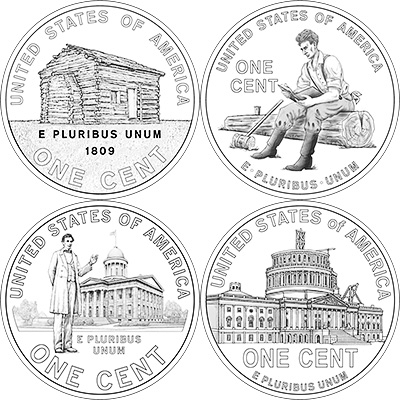
This past week, the US Mint published updated material on the new, 2009 Lincoln Cent program, which will celebrate the 100th anniversary of the coin, and the 200th anniversary of the birth of Abraham Lincoln.

From the US Mint website:

In 2009, the United States Mint will mint and issue four different one-cent coins in recognition of the bicentennial of President Abraham Lincoln’s birth and the 100th anniversary of the first issuance of the Lincoln cent. The reverse (tails) designs were unveiled September 22 at a ceremony held at the Lincoln Memorial on the National Mall in Washington, D.C. While the obverse (heads) will continue to bear the familiar likeness of President Lincoln currently on the one-cent coin, the reverse will reflect four different designs, each one representing a different aspect, or theme, of the life of President Lincoln.

The themes for the reverse designs represent the four major aspects of President Lincoln’s life, as outlined in Title III of Public Law 109-145, the Presidential $1 Coin Act of 2005:

The new one-cent reverse designs will be issued at approximately three-month intervals throughout 2009. The Secretary of the Treasury approved the designs for the coins after consultation with the Abraham Lincoln Bicentennial Commission and the Commission of Fine Arts, and after review by the Citizens Coinage Advisory Committee.

For collectors, there will be a variety of coins.  You’ll likely see each of the four cents from both the Philidelphia and Denver mints (“P” and “D” mint marks).  It also looks like there will be true copper versions, with the same metal content as the original 1909 penny, from the San Francisco mint (“S” mint mark).  That’s 12 coins, at least.

For those who are interested, here are the four designs:

I don’t expect a lot of collector activity, largely because of the low nominal value of the coin.  Since there are always active movements to get rid of the penny, this might turn out to be the last hurrah for the one cent piece.

I wonder what the US Mint will charge for a roll of these pennies?

Stanford CS193P: iPhone Application Programming Launches Tomorrow

A little too busy tonight for a long blog post, but thought I’d share how excited I am to be helping assist the launch of a new course at Stanford this Fall:

CS 193P: iPhone Application Programming

The class website is still a work in progress, but it will come along.  The course is open to Stanford undergrad and graduate students, as well as through the Stanford Center for Professional Development (SCPD) on video.  Enrollment is limited, and my guess is that it will be oversubscribed.

A wonderful opportunity for me to dust off the old Objective-C skills, and help give back to the Stanford community.  Launching new courses is always exciting, and I feel very lucky to be involved with this one in particular.

It might sound crazy to take this on in addition to the full load at both work and at home, but I’m excited to get back involved with teaching, and that’s worth the potential sleep deprivation for the quarter.