Dolley Madison First Spouse Coin Available at 12:00pm EST on November 19th, 2007

You heard it here first.

The US Mint website has been updated with a slight change to the release date of the Dolley Madison first spouse gold coin. Instead of being released on November 15th, like the James Madison dollar coins, Dolley will be joining us the following week.

Here is the last of the new products schedule listed on the US Mint website:

November 15 James Madison $1 Coin Bags and Rolls
November 19 Dolley Madison – First Spouse Gold Proof Coin
November 19 Dolley Madison – First Spouse Gold Uncirculated Coin
November 19 Dolley Madison – First Spouse Bronze Medal 1 5/16″
November 19 First Spouse Four-Coin Proof Presentation Case
November 19 First Spouse Four-Coin Uncirculated Presentation Case

The last First Spouse coin took much longer to sell out – I wonder if this will be the first coin to actually see a lower-than-planned mintage number? The current plan is to mint 20,000 proof and 20,000 uncirculated versions.

Update (11/17/2007):  If you are interested in buying James Madison original bank rolls, please see my post here.

Timber: Claymore Launches the First Global Timber ETF (CUT)

The launch was on Friday, November 9th. According to the press release:

LISLE, Ill.–(BUSINESS WIRE)–Claymore Securities, Inc, today announced the launch of the Claymore/Clear Global Timber Index ETF (AMEX: CUTNews) on the American Stock Exchange. This is the first U.S.-listed global timber ETF to offer investors exposure to the timber asset class and is Claymores 35th ETF to-date.

Timber has had a historically low correlation to traditional asset classes, which provides investors a unique diversification tool that may help reduce a portfolios overall volatility, said Christian Magoon, Senior Managing Director at Claymore Securities, and head of the firms ETF Group. Historically timber has been an asset class available only to institutional investors due to high capital costs. Today, with the launch of the Claymore/Clear Global Timber Index ETF, investors have an investment vehicle that seeks to provide efficient access to the global timber market.

Claymore/Clear Global Timber Index ETF (AMEX: CUTNews) seeks investment results that correspond generally to the performance, before the Fund’s fees and expenses, of an equity index called the Clear Global Timber Index (the Index). Stocks in the Index are selected from the universe of global timber companies and defined by Clear Indexes LLC, the index provider, as firms who own or lease forested land and harvest the timber from such forested land for commercial use and sale of wood-based products, including lumber, pulp or other processed or finished goods such as paper and packaging.

My original post on investing in Timber as an asset class remains very popular on this blog, and walks through the reasons why I personally believe that it is an excellent option for diversification. That being said, owning timber as a small investor is still an evolving game, with the best proxies to date being public timber REITs and Partnerships, like Plum Creek Lumber (PCL), Rayonier (RYN), and Pope Resources (POPEZ).

I like the idea of an ETF that is more of a pure play on timber itself, but I think it would be better structured as literally owning timber like the large private partnerships, and not just an index of public companies. We have seen Gold ETFs that own the mining companies vs. the metal itself, and there is no question that the ones that own the metal do a better job of reflecting the actual financial properties of the asset class.

Seeking Alpha has an article on the new ETF, just up:

CUT tracks the Clear Global Timber Index, which includes companies that own or manage forested land and harvest the timber from it for the commercial use and sale of wood-based products such as lumber, pulp and paper products. Components must have market capitalizations of at least $300 million, and companies that do not own or manage forested land and harvest trees are excluded from the index. Individual component weights are capped at 4.5% of the index.

As of September 30, the index has 27 components from 11 countries; its top components include International Paper, Stora-Enso Oyj, Weyerhauser Corp. and MeadWestVaco Corp. The United States represents more than one-fifth of the index at 26.39%, followed by Canada at 12.25%, Japan at 11.50%, Finland at 9.00% and Brazil at 9.00%. It has a PE ratio of 14.3.

The Clear Global Timber Index has outperformed the Dow Jones World Forestry and Paper Products Index in each of the past five calendar years and is up 16.38% year-to-date through September 30, versus a 6.88% increase for the other index.

CUT has an expense ratio of 0.65%. You can read the prospectus here.

I have been debating whether to expand my exposure to PCL, or to diversify with RYN and POPEZ. This ETF offers a third option, which would be to try to get global timber exposure through this ETF.

Something tells me that we’ll see better approaches to representing timber as an asset class in the next year or two, as the demand for real assets that perform well in inflationary environments grows. So I’m not sure I’m ready to jump to invest in CUT… yet.

Update (11/11/2007): Some great detailed analysis on the breakdown of the diversification benefits of CUT on Seeking Alpha today.  Check it out.

Planes, Trains & Automobiles: MBA Version

I forgot to mention it here, but last night I began a multi-day tour of a few business school events out on the East Coast.

I began by flying out on JetBlue on the red eye to be on a panel on Social Networking at the HBS Cyberposium 2007 event in Cambridge, MA. Despite only one hour sleep on the plane, and a cat-nap this morning, the event went off without a hitch. Lots of great questions from the audience, and it’s always a pleasure to explain to people the focus & vision behind LinkedIn. I was a bit surprised at the turn out – the panel before ours on IPOs seemed to only fill about 1/4 of the seats in the large auditorium. Our panel, however, packed the room to the point of people standing in the back. Great showing.

Here is the detail on the panel (from the CyberPosium 13 website):

Want to join my “Friend-Spaced-In” network? What good is social networking?

Friendster has come, and for the most part, gone. MySpace has evolved from being the hottest site for teenagers to becoming part of Rupert Murdoch´s global empire. New social networking sites focused on specific verticals pop up by the minute. Why is social networking important? What are its benefits? Additionally, social networking is catching fire all over the world. Are there any transferable lessons for global social networking entrepreneurs that will help them avoid irrelevance?

This is a quick snapshot of Spangler, which has the auditorium where I spoke today. This was the new, fancy student building on the HBS campus in 2001 when it opened.

This really surprised me – I’m not sure if it was a Turkey or a Turkey Vulture, but it was just sitting outside Spangler on a bench. I thought it was fake at first until I saw it move around.

Tomorrow is a travel day – I hop a train to Philadelphia for events at Villanova & Wharton on Monday & Tuesday. I’m so glad I don’t have to fight through the airport for that leg of the trip.

So in case you are wondering where I am, now you know. 🙂

Are You Ready for James Madison? (Presidential $1 Dollar Coin Program)

That’s right, coin fans.  The 4th coin in the Presidential $1 Dollar Coin series will soon be available, and in banks on November 15th.  The US Mint has a blurb up now, and will have bags and coins of collector versions ready for sale at the US Mint website.

Of course, these coins are already available in proof and uncirculated versions in the annual coin sets.  I have several of the 14-coin Silver Proof sets for 2007, and the lens with the 4 Presidential $1 Dollar Coins from 2007 is really gorgeous.

As usual, I will have rolls for sale on eBay.  I actually still have rolls available for George Washington, John Adams, Thomas Jefferson.  I even have a couple 2007 Silver Proof Sets for sale.

The Writers’ Strike: Why We Fight

Since I got some attention with my last post, here is the YouTube video put out to explain why the Writers Guild of America is striking.

The argument in the video is largely predicated on what other artists get (authors, song writers), as well as the idea that there was an agreement to raise residual rates eventually in the 1980s agreement.  Mostly, it plays to the issue of “what is fair” by making the amounts sought by the writers as really trivial (always good to show little bars vs. big bars in these type of diagrams).

It’s really well done.

Why Do Writers Get Residuals? (Writers’ Guild of America Strike)

This post was inspired by a short, two line snippet in John Lilly’s blog today.  There has been a lot of press about the current writers’ strike, and it’s impact on TV this fall.  I hadn’t originally planned to write anything about it here, but one comment in John’s blog made me think (italics are mine):

But it’s one of those things, i think. for the studios, this feels, to me, like their waterloo, their napster. we’re in a period of incredible creativity in the world, incredible connectedness. Putting down the hammer on the creatives — in other words, not letting them share fairly in the proceeds from the distribution of their work — isn’t likely to help the television and motion picture industry, in my own, admittedly uninformed opinion.

I’m an outsider to the entertainment industry, so my apologies if this question is hopelessly naive.  But there is something about this entire strike that doesn’t make sense to me, sitting up here in Silicon Valley.

So, here is my question.  A lot of this strike seems to revolve around the Writers’ Guild, and their belief that they deserve royalties (aka residuals) on versions of their content that are distributed digitally (DVDs, downloads, etc).  Apparently, this was one of the big mistakes, in their opinion, of the late 1980’s agreement with the union.

(For those of you not familiar with the term, a “residual” is a micro-payment that you are entitled to every time one of your contributing works is resold.  Just think of a book author getting a small payment every time their book sells another copy, or a music band getting a small payment every time they sell another album.  Revenue sharing.)

Now, I’ll be the first to admit – I’m not sure why you’d deserve a residual on a re-run and not on a DVD.  But my question really is more fundamental:

Why do writers get residuals at all?

I guess, to be less confrontational, let me rephrase the question this way:

Why don’t software engineers get residuals?

I don’t want to sound stupid here.  I’ve heard many reasons given for why residuals are given to writers and other creative contributors to media products.  But most of them don’t really hold water with me:

  1. Comedy is a creative enterprise, and people can go for years in between gigs.  Residuals on past success are a way of funding the down times, so great writing can happen in the down time between gigs.
  2. Historically, authors have always been paid per-copy sold, as a form of risk-sharing between the publisher and the author.  It’s a classic alignment of incentives – more books sold mean more profits for the publisher and more income for the author.  This leapt from book authors to musicians to other forms of entertainment as the industry grew.
  3. Writers deserve their “fair share” of the profits made from their work.  Residuals represent that fair  share.

I’m sure there are others, but those are the big three I’ve seen in the press.

The problem is, with the exception of (2), these reasons could just as well apply to software engineers, who in general never get paid through residuals.

Software engineering is a creative process, where people with unique talent and skill create content (code) that is protected by copyright and signed over to their employer (the company).  There are highs and lows in the industry, and rapidly changing tastes/technology that can lead to low times for an engineer as well as good times.

In software, it’s much more common for an engineer to get paid in a mix of salary, bonus, and stock.   No residuals.

  • The salary is the company recognition of the value an engineer needs to get immediately in exchange for their work.
  • The bonus is the company recognition of short term goals being hit, which allow the company to share the benefits of good performance of the individual and/or the company.
  • The stock is a way for the engineer to share in the long term upside of the product of their work.  They become part owner in the company, and so when the company makes money, they reap some of the benefit.

The stock is really the key to alignment between the owners of the company (shareholders), management, and the individual engineer.  It’s the way of saying, “If this works, we’ll all make money together.”

So, in theory, I guess you could replace the stock component with residuals.  You could argue that there are too many factors that play into stock price, and that residuals are a clean way of rewarding people for their contribution to a product with long term success.  (I’m not sure I’d ever trust the accounting behind residuals, but I guess that’s why lawyers and union leaders make a lot of money.)

Maybe the problem is that writers aren’t really treated like co-owners and long term employees at all, and residuals represent that broken trust.  Maybe studios don’t treat writers like co-owners and long term employees because the compensation system is set up to pay them like mercenaries.  Maybe there is no real concept of a studio – just an aggregation of 1000s of entertainment efforts, each with their own finances, and each writer is just a mini-shareholder of that effort.

Maybe the problem is that the entertainment industry is, for the most part, stagnant, and their isn’t sufficient growth to really provide the upside benefits provided to engineers as stock-holders.

Maybe this is the difference between a unionized approach to compensation and a non-unionized approach?

I guess I’m still at a loss to explain the difference however.  Let’s take a large company like Microsoft.  Should they be paying their engineers like writers?  Or should the studios be paying their writers like engineers?

Campfire One Video is Live (Open Social Launch)

The video from Campfire One, the launch event for Open Social last night at the Google campus is now live.

The demo that Elliot & I give for LinkedIn is about 38:30 into the video (or 18:55 from the end, if you have the timer set up to run backwards). It’s a good thing there was a rehearsal – I’m pretty sure my demos are always better the second time. 🙂

The event was fun to do – it was really a campfire set up in the middle of Google campus. Yes, there were real fires. In fact, the smoke was a real hazard to the speakers – if the wind went the wrong way, all of sudden you’d be blinded and unable to speak. I think Marc Andreessen got the worst of it in rehearsal.

The Google site for the OpenSocial APIs is live now. The LinkedIn blog post on the topic is here.

My previous blog post on Open Social is here.

LinkedIn & Open Social. Two Great Tastes That Taste Great Together.

I think you can tell from the title why the marketing team at LinkedIn keeps a close eye on me. 🙂

This week has been extremely busy… a lot of press attention already to the LinkedIn partnership with Google on the new Open Social APIs.

Since this is my personal blog, I thought I’d just flag a few articles and posts around the web in case you are interested. The big demo is tomorrow night, and it looks like I will actually get a chance to take the stage with Elliot Shmukler to give it. Let’s hope the demo gods are kind.

It’s really wonderful to be able to talk to our community about Open Social, and about the LinkedIn platform. There are absolutely amazing people at LinkedIn working on making all of this possible, and it’s a joy to get out there and help people understand and appreciate their great work.

So, before the big event, here are a few interesting posts:

More to come on this topic, I’m sure.

Historic Change at eBay: Semi-Persistent BIN (Buy It Now) Goes Live

A small announcement from eBay last week.  Most people probably didn’t notice it, given the news around Q3 earnings, Skype, and 100 other stories that people were tracking.

Here is the AuctionBytes article:

eBay Moves to Longer Lasting BIN Auctions

Actually, eBay began testing this back in July, but just recently expanded it to quite a few more categories.  Here is the original note from Sohil Gilani, the Product Manager who has spent a lot of time over the past two years studying and implementing this change:

Hi everyone, I’m Sohil Gilani with our Buyer Experience team. Over the years, we’ve routinely been asked why the Buy It Now option disappears from a listing when the first bid is placed. Our reason has been concern that it would create a confusing experience for a buyer, who could place a bid on an item, but then have someone Buy It Now (BIN) out from under them before the end of the auction. That said, we’ve done some extensive research that suggests keeping the BIN option available on a listing longer will increase the chance that a buyer wins the item and that it will close at a higher price for the seller. As a result, we’re looking at ways to change how BIN works that balance both buyer and seller needs.

In case it isn’t clear, let me explain the problem:

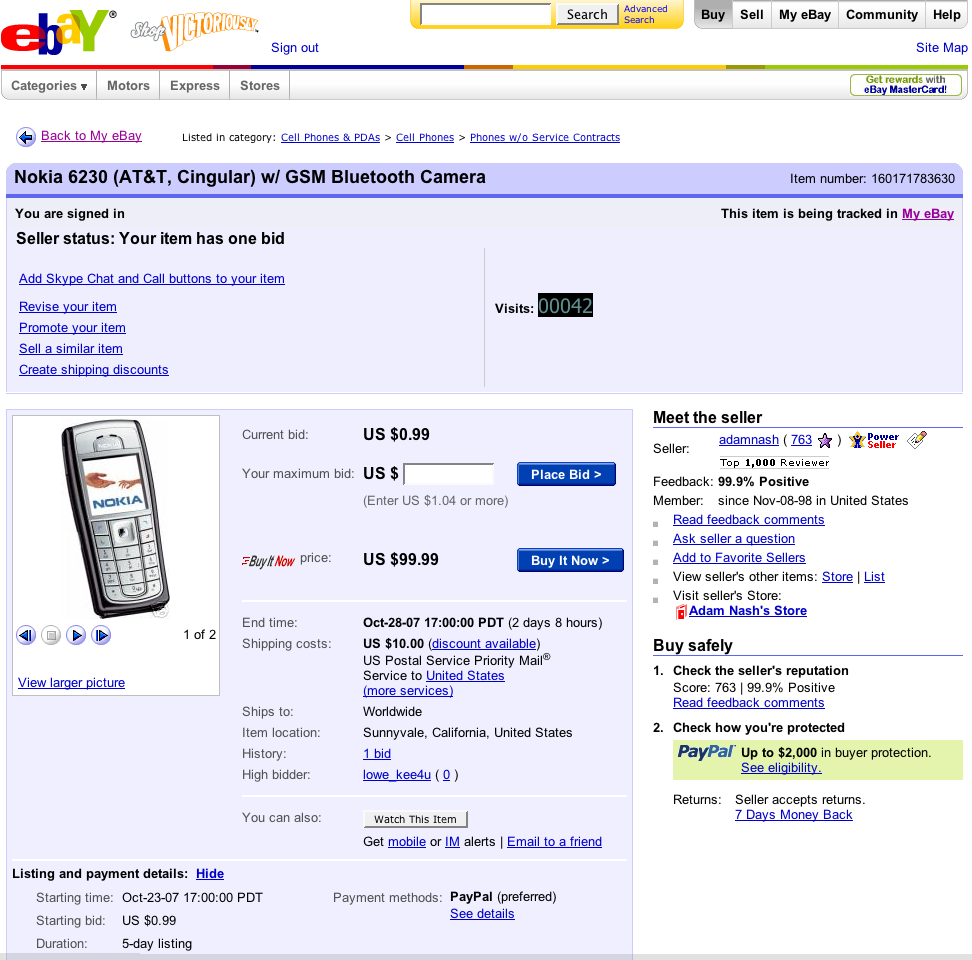
Ever since eBay launched the ability to add a “Buy It Now” button to an auction, it has disappeared as soon as anyone placed a bid.  So, for example, if you were auctioning a cell phone with a starting bid of $0.99 and a Buy-It-Now price of $99.99, a single bid of $1.00 would make the Buy-It-Now price disappear.

The idea is that a buyer has the chance to “snap up” the item for a fixed price set by the seller, or place a bid to try to win it at auction.  Usually, the motivation to place a bid is the belief that the bidder will get it for a lower price.

The problem is, once the Buy It Now button disappears, every future potential buyer is deprived of two things:

  1. The ability to immediately buy the item, without waiting for the auction to end
  2. The ability to see what the seller thought a fair “fixed price” was for the item

Many people, for a very long time, have asked why eBay makes the BIN button disappear after one bid.   Usually, they focus on issue (1).  After all, the need to wait for an auction to end is a major disincentive for a potential buyer.  eBay is likely losing quite a few buyers to the fact that useful BIN buttons are disappearing.  Sellers are also losing the ability to close a sale quickly, for a fair price that they have assigned.  Even worse, sellers actually pay eBay a fee to place that BIN button there in the first place.

The problem lies with issue (2).  As a former employee, I can’t reveal the actual number, but you would be shocked at how many auctions actually close at a price higher  than the original Buy It Now price.  This happens for a couple reasons.  First, sellers may not be very efficient at setting their own fixed prices – auctions are likely much better at fairly pricing the item.  Second, the original bidder who “knocks out” the BIN button is not likely the one who bids above that price.  Every future bidder has now lost that information, and as a result, is free to bid whatever they think is fair.  Apparently, in a large minority of cases, bidders end up with a price that is higher than the seller expected.

So, eBay has a dilemma:

  • If they keep the disappearing BIN button, they are likely losing sales AND velocity (the time it takes to close a sale).  They are also encouraging sellers to use a higher starting price (to avoid losing the BIN quickly), use reserve prices (to keep the BIN), or to not use BIN at all (which is a fee-generating feature) – all bad things that hurt the likelihood of a sale.
  • If they make the BIN sticky, aka “Persistent BIN”, they might actually decapitate the final selling price on millions of auctions.  That would hurt both eBay sellers and eBay itself, since both make money based on the final sales price.

The solution that eBay is testing finally allows eBay to gain some empirical data in real situations on how to best control the way the BIN price disappears.

  • Do you let the BIN button stay until a fixed dollar amount?
  • Do you let the BIN button stay until a fixed percentage of the final price?
  • Are the results different in different categories?  For different starting prices?

Well, all I can tell you is that, as an eBay seller, I was tickled pink to see this on my latest cell phone auction this week:

As you can see, I start all my auctions with a starting price of $0.99.  Normally, I lose that BIN button very quickly.  But in this case, the BIN button stayed, even after a bid of $0.99.  In fact, the button stayed until the bidding reached $50.00, giving buyers ample opportunity to buy my phone for fixed price.  The difference?  Literally 6 days of BIN button goodness were added, since my auction didn’t clear that price until the 7th day.

(Wow, that sounds like a biblical reference.  It was evening and it was morning, and the BIN button worked for 6 days and 6 nights, but on the 7th day, the BIN button rested…”)

Anyway, I’m glad to see eBay continuing to push its understanding of one of its most popular formats.  And a big congratulations to Sohil for seeing this effort through to live-to-site.  Count me as a big fan.

BTW If you are wondering why I bother buying the BIN feature on my auctions, even though it disappears so quickly, it’s a fair question.  In my selling experience, adding the BIN button not only increases the chances of my auction selling quickly, I also tend to set it for a higher-than-average price based on my research.  The way I see it, a buyer who wants it right now tends to be willing to pay a bit more for the privilege.  If not, they can always bid.

New eBay Guide: The Native American $1 Dollar Coin Program

Yes, despite my lack of support for the initative, I have documented what information I have available about the new 2009 $1 dollar coin program in this eBay Guide:

The Native American $1 Dollar Coin Program

It now joins my other four eBay Guides:

Interestingly, these four guides have accrued enough positive  votes to make me one of the “Top 1000” reviewers on eBay.  In fact, I’m currently ranked #275 as of the writing of this post.

If I get to the Top 100, I get a different badge by my user ID, and you know, I’m all about eBay badges.  So if you have an eBay account, vote “yes” on my guides to recommend them.  If you don’t like them, well, don’t vote “no”.  That hurts my ranking.

The LinkedIn Store is LIVE!

Tonight, the new LinkedIn online store went live.

https://store.linkedin.com

One of the best parts of working at a startup is that you get to participate in all sorts of company activities.  In this case, all of the “models” in the store are actual LinkedIn employees.

For example, you may recognize the guy talking here on the LinkedIn fleece vest page:

If you hover over the “Adam Nash” link on the real website, it says “Props to our Product team”.  🙂

I guess with the new store, our CEO may have to modify his explanation of our business.  Technically now we have four revenue streams.

Order your LinkedIn merchandise today!

Microplace Launches

I got an email from my friend, Karl Wiley, today announcing the launch of Microplace, a website that opens up a marketplace for microfinance to the broadest possible audience.

From his email:

I am so pleased to let all of you know that today we launched MicroPlace – an innovative new website that allows everyday people to make financial investments in the microfinance industry. It gives you the opportunity to have a direct impact on global poverty while earning a financial return!

As many of you are probably aware, last summer I joined up with this new eBay initiative, and have been serving as its Chief Operating Officer. Today is an exciting day for us, as the site is finally live to the world – the result of over a year of hard work and dedication.

I’m writing you all to invite you to check out the site (www.microplace.com), make an investment, and help us spread the word! For those who aren’t familiar with microfinance, it is a powerful, proven tool to alleviate global poverty. It involves making small loans – often as small as $50 – to the working poor in the developing world. They use these loans to start or grow small businesses – to purchase a sewing machine to make clothing, or inventory to start a small shop, for example. Over time, the borrowers use income from their businesses to pay back their loans with interest, and pull themselves and their families out of poverty.

Microfinance started around 30 years ago, with the formation of the Grameen Bank in Bangladesh by Dr. Mohammed Yunus – the winner of last year’s Nobel Peace Prize. Since then, the industry has grown dramatically, but demand for microloans still vastly exceeds the funds available in the industry to make loans. Together, we can change that. MicroPlace opens up the ability for all of us to put a modest portion of savings into this incredible, profitable and self-sustaining industry. Roughly half of the world’s population still lives on less than $2 per day of income, so there is lots of work to do.

You can visit MicroPlace and choose from a selection of investments, each of which supports a loan to a specific microfinance lending organization in a developing country. We have 15 listings today, and will be adding more every week. Our minimum investment is only $100, so it’s easy to participate. And while you are earning interest, you know that every one of your invested dollars is going to be lent out to the working poor in the developing world, over and over again. For just a few hundred dollars investment, you can have a direct impact on dozens of peoples lives. Remember, this is not a charitable donation – this is a savings and investment vehicle, but with equal or even greater power than a donation might have.

You can also help us spread the word by forwarding this email, or using our e-card feature on the site (www.microplace.com/ecards). Microfinance is still not well known in the US – and we have great resources on the site that can help educate people about this powerful model. Help us spread the word and take a bite out of global poverty.

Thanks in advance for your support for this exciting initiative. I hope you’ll participate – you’ll feel good about yourself, and the borrowers who benefit from your investment will have the chance to change their lives dramatically!

I am a huge fan of microfinance and of Karl, so it’s great to see this vision come to life. I’ve already signed up on the site and made my first $100 investment.

So congratulations to Karl and the whole Microplace team. Go check out the site now – sign up, and start investing.

Electronic Warfare: Israel’s Syria Bombing Raid

I don’t normally post about military or political events here, but this this article had a specific technology angle to it, and I thought it was too interesting to ignore.

From Aviation Week:

Syrian President Bashar al-Assad said the Israelis struck a construction site at Tall al-Abyad just south of the Turkish border on Sept. 6. Press reports from the region say witnesses saw the Israeli aircraft approach from the Mediterranean Sea while others found unmarked drop tanks in Turkey near the border with Syria. Israeli defense officials admitted Oct. 2 that the Israeli Air Force made the raid.

blog post photo
The big mystery of the strike is how did the non-stealthy F-15s and F-16s get through the Syrian air defense radars without being detected? Some U.S. officials say they have the answer.

U.S. aerospace industry and retired military officials indicated today that a technology like the U.S.-developed “Suter” airborne network attack system developed by BAE Systems and integrated into U.S. unmanned aircraft by L-3 Communications was used by the Israelis. The system has been used or at least tested operationally in Iraq and Afghanistan over the last year.

The technology allows users to invade communications networks, see what enemy sensors see and even take over as systems administrator so sensors can be manipulated into positions so that approaching aircraft can’t be seen, they say. The process involves locating enemy emitters with great precision and then directing data streams into them that can include false targets and misleading messages algorithms that allow a number of activities including control.

A Kuwaiti newspaper wrote that “Russian experts are studying why the two state-of-the art Russian-built radar systems in Syria did not detect the Israeli jets entering Syrian territory. Iran reportedly has asked the same question, since it is buying the same systems and might have paid for the Syrian acquisitions.”

I find it a little surprising that your could commercialize an exploit like this.  I’ve done enough security software work to know that it’s not surprising that any system engineered in the last 50 years would have vulnerabilities.  Thanks to the ongoing wars over security on the Internet, in fact, our ability to “crack” into systems seems to be growing at a rapid pace.

That being said, when an exploit is discovered, typically a patch is quickly produced.  For example, if they find a serious exploit tomorrow in a common piece of networking equipment, like a Linksys home router, typically a software patch would be quickly released to block that exploit.

As a result, if an exploit like this existed in serious military systems, you’d think that a patch would be quickly released to block it.  The lead times to produce military systems in volume would seem to preclude commercializing an exploit the way this article describes.

Then again, I guess the exploit would have two things going for it:

1) The exploit would not be used frequently, making it hard for the enemy to “simulate” or understand the exploit well enough to produce a patch.

2) Not everyone keeps up-to-date with their security patches… do you?

It would be a fascinating turn of events if the next-generation military advantage did not depend on speed, munition strength, or even targeting & accuracy.  Instead, the real advantage could go to the force who could most rapidly disable and coopt enemy systems.

Tracking ROI: Prosper Loans in Quicken & Understanding Investment Returns

Kevin over at RateLadder had a really interesting post this weekend on the discrepancy between what his Quicken records indicate for rate of return on his Prosper loans, and what Prosper reports:

Quicken enters the money into the account the moment the money leaves my account and it only acknowledges interest after it has been paid. Prosper only counts money in loans and acknowledges interest the moment it is accrued. Both acknowledge default sale amounts the moment they happen. Neither approach attempt to project a future loan’s value.

What does this mean? Well it means that with Quicken you can get the ROI for the moment the money enters the account with interest only for actual payments received. With Prosper you get the ROI for the loans with all accrued interest. Since you can only deduct defaulted principal (cash basis) I feel that Quicken’s approach is correct.

You can see the discrepency in the chart he provided below:

I haven’t run the numbers on my own account, but I believe that the cause of this discrepency is due to the difference between tracking the actual return on the cash moved to Prosper vs. the actual loans themselves. When you move money to Prosper, it wastes time. It takes some time for money to appear in the new account, and it takes time to bid and win loans to invest the money. As a result, your money does not spend 100% of its time in loans, and thus your actual return is lower than the Prosper reported return on your loans.

This is a really important financial concept to grasp, and it extends to other instruments besides Prosper.

First, when you invest in bonds, loans, or other fixed-income investments, re-investment risk is real. Re-investment risk is the risk that when you receive interest payments, you may not be able to re-invest them at the same (or better) rate of return. Prosper is an example of this, since the minimum investment is $50.00, you have to accrue payments until you have another $50.00 to lend. That time spent uninvested is time spent earning a big fat 0%.

Second, when investment vehicles report returns, they only report returns for specific time periods. Your actual returns, however, reflect your actual dates for moving and investing money. Mutual funds are notorious for this, as they tend to report annual results for very specific 1-year, 5-year, and 10-year dates. Because people rarely have invested all of their money on exactly those dates, their returns can vary significantly.

Imagine a fund that on January 1st earned 20% (big day!), and then earned -2% the rest of the year. Their prospectus would brag about an 18% return last year. If you actually moved your money into the fund on January 2nd, you might be wondering why your account actually lost money that same year.

I hope these two tips are helpful the next time you’re looking at your investments and wondering, “Why don’t my returns match the ones on the website?” Caveat Emptor, my friends.

Mr. Angry & Ms. Calm. A Tale of Email & Digg

I got an email this weekend forwarding a cool optical illusion.  I thought I’d share it here on my blog:

If you are near to this picture, Mr Angry is on the left and Mrs Calm is on the right. If you view it from a distance, they switch places!

For me, stepping away from my computer and looking at the image from about 8 feet away did the trick.  Your mileage may vary.

CREDITS This illusion was invented by Philippe G. Schyns and Aude Oliva of the University of Glasgow. It is featured on this web page: http://cvcl.mit.edu/gallery.htm , listed under ‘Dr Angry and Mr Smiles’. It is taken from Schyns and Oliva’s paper, “Dr Angry and Mr Smiles: when categorization flexibly modifies the perception of faces in rapid visual presentations, Nov 1998”. It is a copyright image and if they tell me to take it off this web page, I will.

I didn’t use to do this, but now when I receive these emails, I tend to go online to see if I can ferret out the source.   I did a Google search for “Mr. Angry Ms. Calm” and I found this very illusion was a Digg front page post… 2 years ago!    Digg was pretty young back then, as you can tell from the comments that people left on the post, debating whether it merited “front page status” or not.

The original post is located here, if you are interested.

Interestingly, it was also on Boing Boing at the same time, and the original image creators actually commented:

The illusion works by manipulating the spatial frequencies of the image.  The low spatial frequencies (the rough, fuzzy shape information of an image) from one image (e.g. Mr. Angy) are combined with the high spatial frequencies (the sharp edge information of an image) from a different image (e.g. Mrs. Calm).  When viewing this hybrid image at a close distance, our perceptual system is able to extract and process the high spatial frequencies and thus we see the image where the high spatial frequencies were taken from.  When viewing the hybrid image at a distance further away, our perceptual system can no longer extract the high spatial frequencies meaning we only see the low spatial frequency information, thus we see the other image.  You can also get a switch in the hybrid image by squinting.”

For me, this is an interesting commentary on the speed and distribution of “unique content” around the web.  It took two years for a front page Digg post to make it to my inbox.

It’s also a really cool special effect. 🙂