
For the 10th year in a row, I am teaching CS 007, “Personal Finance for Engineers” at Stanford University.
Throughout the course, we touch on a wide range of topics. Next week, I’ll be covering the concept of Assets and how to calculate an individual’s Net Worth. For the purposes of the class, Net Worth is a simple concept:
Net Worth = What You Own – What You Owe
However, there is one slide that inevitably elicits groans and negative reactions from the students, who are largely between the ages of 18 and 24. Every year, we pull the most recent data from the US Census on household wealth, cut by age.
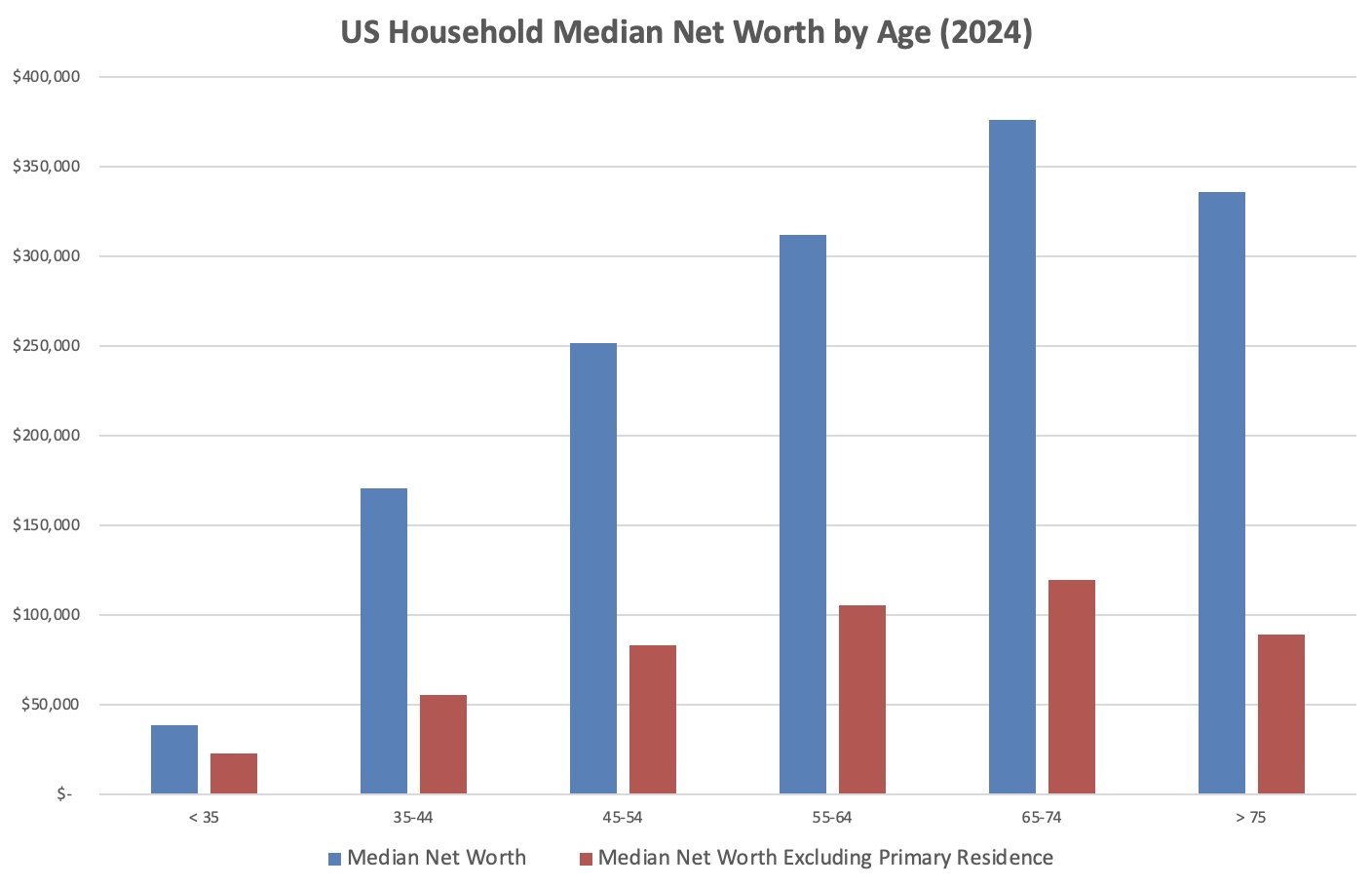
The point of the slide is to engage in a conversation about home ownership as a factor in building wealth, including the behavioral aspects of mortgages serving as a form of forced savings over time. However, invariably, the students’ initial response is a reaction to the apparent disparity in wealth between households based on age.
For many students, it just doesn’t seem fair at first blush. Households between the ages of 65 to 69 have a median net worth that is 9.83x that of households under 35. You can almost hear their cries, “the Baby Boomers are hoarding all the wealth!”
But underlying that reaction is a really interesting question when it comes to age and wealth. Many people are predisposed almost instinctively to look at any demonstration of inequality as a problem.
But, in this case, what exactly are we comparing this distribution to? How would wealth be distributed by age in a simpler world where everyone made the same amount? Would it be better or worse than what we see in the United States today?
Welcome to Equal Land
As a thought experiment, let’s consider a totally equal society called Equal Land.
In Equal Land everyone has the same financial life:
- Everyone works from the ages of 25 to 64, retiring at 65
- Everyone lives to the age of 85
- Everyone makes the same amount, $100,000 per year
- Everyone saves 10% of their income, every year while they work
- Everyone makes 8% on their savings, every year
- Everyone spends 4% of their portfolio, every year in retirement
So what does the distribution of wealth look like in Equal Land?
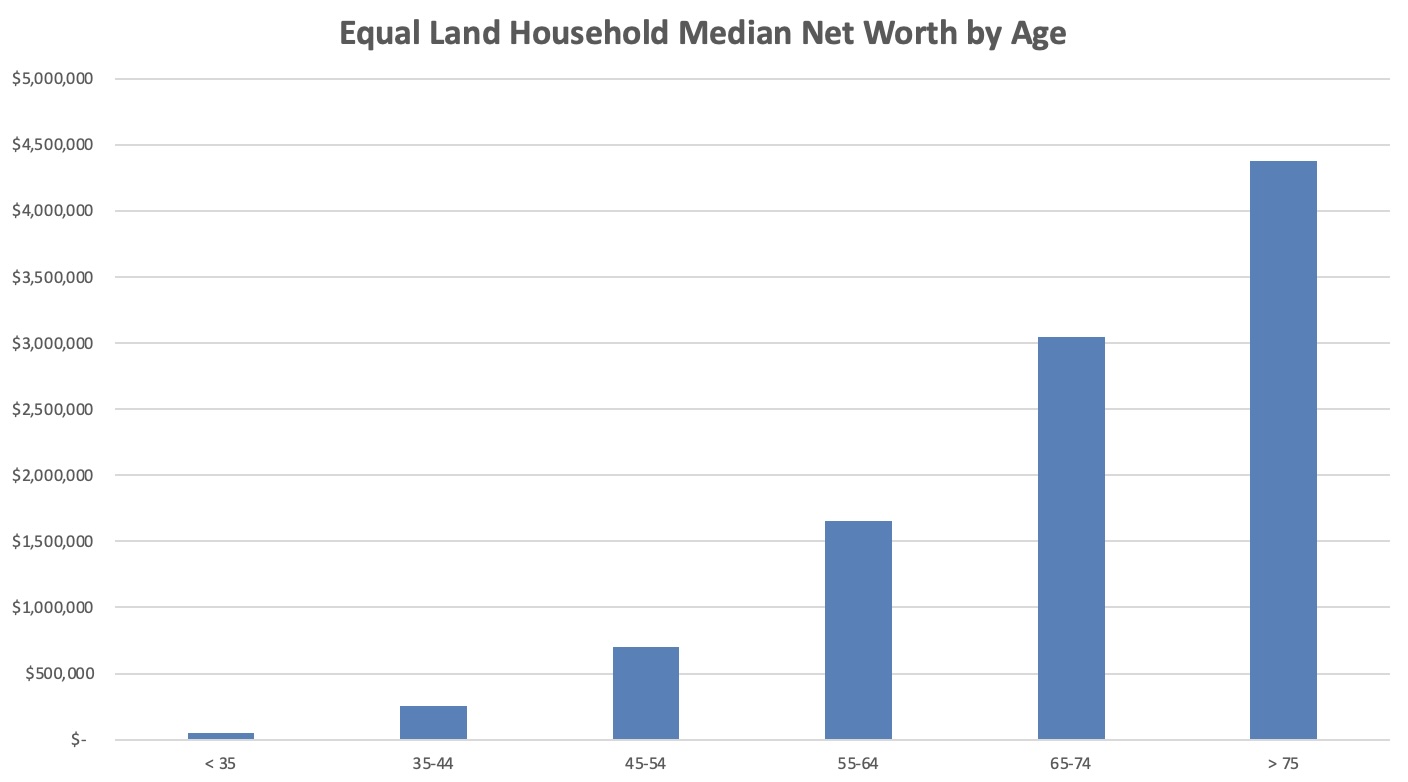
Every household follows the same path. Every 30-year-old will reach the balance of today’s 70-year-old when they turn 70. Yet an age-based snapshot of median net worth makes their financial lives look dramatically different.
The chart above focuses on median net worth, but we could also add up the total household wealth of each age bracket. Let’s run the numbers across three scenarios that assume different rates of return on investment (0%, 5%, and 8%) for every Equal Land citizen.
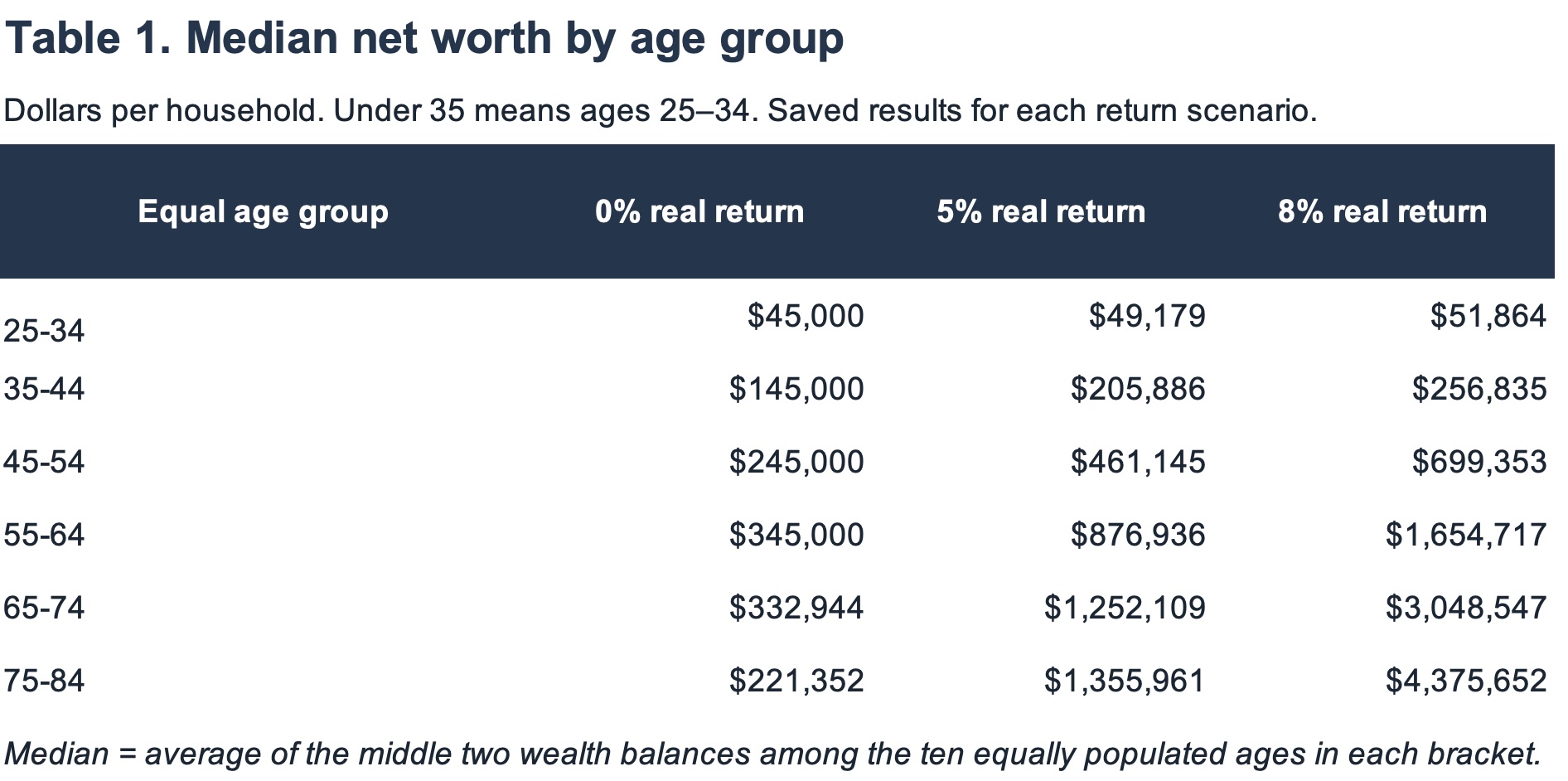
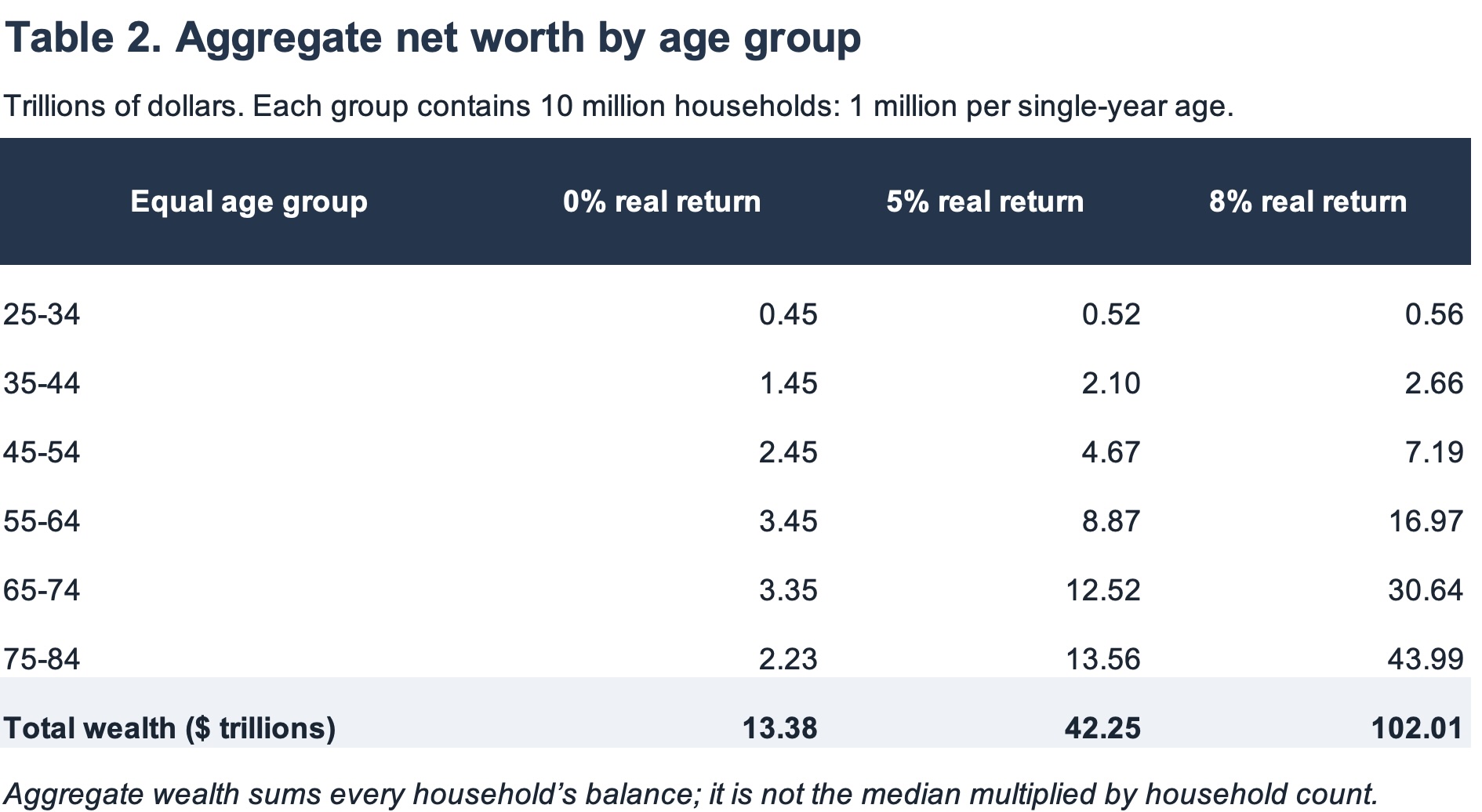
One thing that is obvious from these tables is the impact of retirement spending. In a world where investment returns exceed the withdrawal rate for retirees, the median net worth for households above retirement age drops. However, once investment returns exceed withdrawal rates, the concentration of wealth increases for every decade of age.
So what is going on? At an 8% annual return, it looks like Equal Land citizens 65 and older hold over 74% of all the wealth! In fact, Equal Land citizens under 55 seem to only hold about 10.1% of all the wealth.
Equal Land ends up looking anything but equal across different ages.
The Power of Time and Compounding
The reason that the wealth in Equal Land ends up so unequal across ages is really quite simple.
The fundamental driver of inequality in net worth across generations comes down to just two simple things: time and compounding.
First and foremost, older people have had more time to save. Even at a 0% return, the person who has saved every year for 40 years is going to have $400,000. The person who saves for 10 years will have $100,000. All things being equal, the person who has saved for more years will have more money.
Second, compounding amplifies this effect. The simple, non-linear growth of savings based on a positive return builds over time. Even at rates that might seem small at first blush, like 5% or 8%, the effect on growth amplifies the difference between the ages. At an 8% return, it takes roughly 9 years for money to double. After 18 years, that’s four times. At 36 years, that’s sixteen times. 🤯
Equal Land has no Prop 13, no housing boom, and no generation with a higher salary or a better investment return. We have removed those explanations, and a substantial wealth gap remains.
Equal lives produce very unequal results when grouped by age.
What This Means for the Real World
Of course, Equal Land does not tell us whether today’s young adults have the same opportunities their parents did. That question requires comparing generations at similar ages, adjusting for inflation, and examining the conditions under which they earn, save, and invest.
The real world also includes different incomes, spending needs, inheritances, taxes, and investment outcomes. Those differences matter. Equal Land cannot tell us how much of the actual U.S. wealth gap each factor explains.
But it is eye-opening to see that, even in Equal Land, the disparities in wealth between different ages can be quite a bit more extreme than we see in the real world.
What it does show is that a large wealth gap between young and old will exist even when everyone has identical financial opportunities over a lifetime. An age-based wealth chart, by itself, cannot establish whether one generation received a better deal.
It Takes Time to Build Wealth
For my students, the personal-finance lesson remains fairly simple: It takes time to build wealth.
Young people have time. In general, they will use that time to earn income, save for the future, and benefit from compounding. That time is an opportunity, although people differ in their ability to use it.
As we get older, we can accumulate more financial wealth. But we also have less time left. Most older people would gladly trade some of their wealth for more time.
So while the real world is vastly more complicated than Equal Land, the basic lesson remains the same.
Spend less than you make. Save a portion of your income. Invest it prudently.
… and give it time. 🙏

