The Executive in Residence (EIR) Series

It’s hard to believe, but it is now exactly six months since I left my role as an Executive in Residence at Greylock Partners, and joined Weathfront as COO.

Diving into a startup is all encompassing, but over the past few months quite a few people have asked me questions about the Executive in Residence (EIR) role.  Some of these people have had offers to become EIRs, others are curious about the role and whether they should pursue it as a career option.  For most, however, it’s just genuine curiosity  the EIR role is largely a low volume, undocumented role that is very unique to the private equity & venture capital ecosystems.

One of the guide posts for this blog has been a dedicated effort to take the questions that I receive regularly, and translate them into thoughtful and useful content to be broadly shared.  So before my experiences of 2012 fade into the shrouds of history, I’ve decided to write a quick series about my experience as an EIR, and the most common questions I’ve received.

The series will cover the following questions:

  1. What is an Executive in Residence (EIR)?
  2. Should I be an Executive in Residence (EIR)?
  3. How do you get an Executive in Residence (EIR) role?
  4. Challenges of being an Executive in Residence (EIR)
  5. Did you like being an Executive in Residence (EIR)?

As always, I’m hopeful that the information will be both interesting and even useful.

Home Storage & Network Topology (2013)

In 2011, I wrote a fairly popular blog post outlining my home solution for storage & backup:

Since it has been almost two years, I thought I’d update the information with some improvements.

Updated Network Topology

In 2012, I had a chance to update our network infrastructure, and as a result we have a slightly different home network topology than the one I diagrammed in 2011.  The following image shows the current, high level structure (note: I haven’t documented all devices or switches on the network)

home_storage_topology_20132013 Home Network Topology

Enhancement: Comcast 105Mbps Service

In March 2013, Comcast announced doubling it’s internet connectivity speeds in the San Francisco Bay Area for no additional cost.  This proved to be enough of an improvement to get me to face the reality that AT&T Uverse was never, ever going to get any faster than 24Mbps.

After reading about ISP and internet speed on moveyourmoneyproject.org, my order is in to convert to Comcast.  I’ll post here if the experience is anything but what’s expected – a massive increase in download speeds.  With multiple people in our household now hitting Netflix streaming up to four at once, I think the upgrade is perfectly timed.

Enhancement: WD 6TB Thunderbolt Duo for iTunes

Last month, tragedy struck.  The 4TB USB 3.0 hard drive I had been using for the main iTunes library crashed.  Fortunately, thanks to the backup solution in place, all files were recovered.

The only problem was recovery time.  It was slow.  It turns out, restoring about 3.5 TB from the Synology box to a USB hard drive took over 38 hours.  Now, granted, Time Machine isn’t the fastest recovery software, but it’s what I’ve been using reliably.

At 3.5TB, I realized I was going to max out the Seagate 4TB drives soon anyway.  After some research, I decided to get the 6TB Western Digital Thunderbolt Duo.  With two 3TB drives striped with RAID 0, combined with the 10Gbps Thunderbolt bus, I was hoping for significant speed improvements.

Restoring 3.5TB via Time Machine from my Synology box to the Thunderbolt Duo took less than 16 hours, a huge improvement over the previous experience with the Seagate USB drive.  Most of this benefit is likely due to Thunderbolt bus (I gave the drive a dedicated port on the iMac.)  Regardless, I’m thrilled to have a solution that will continue to scale through the year until larger single disk drives are available. (As a caveat, I’m now at double the risk of failure on the main iTunes drive, since if either drive fails, the whole drive will fail.)

Last Note: Stagnation in Hard Drives

It’s worth noting that it has been over 18 months since we’ve seen a larger single 3.5″ hard drive size.  We’ve been promised 6TB drives later this year, with headroom to 60TB for a 3.5″ drive on the upcoming technology, but it’s clear that single disk storage isn’t really keeping up with the increasingly large file sizes of HD video storage.  Imagine the strain when files go to 3D and Ultra HD formats.

For those of you who are interested in these type of technical details, I hope you find the above useful.

Behavioral Finance Explains Bubbles

Note: This post ran originally in TechCrunch on April 20.  As a courtesy to regular followers of my blog, I’ve reposted the content here to ensure that longtime readers have access to it.

“Bubbles are beautiful, fun and fascinating, but do you know what they are and how they work? Here’s a look at the science behind bubbles.” – About.com Chemistry, “Bubble Science

“Double, double toil and trouble
Fire burn, and cauldron bubble.” – Macbeth, Act 4, Scene 1

Given the incredible volatility we’ve seen lately in the Bitcoin and gold markets, there has been a resurgence in discussion about bubbles. By my perspective, after working for North Shore Advisory in the valley, this topic is always top of mind in Silicon Valley, especially given that the two favorite local topics of conversation  are technology companies and housing.

Defining a market bubble is actually a bit trickier than it might first appear. After all, what differentiates the inevitable booms and busts involved in almost any business and industry from a “bubble”?

The most common definition that a financial advisor will give of a speculative or market bubble is, when a broad-based, surging euphoria or wave of optimism carries asset prices well beyond supportable value. The canonical bubble was the tulip mania of the 1630s, but it extends across history and countries all the way up to the Internet bubble of the late 1990s and the housing bubbles in the past decade.

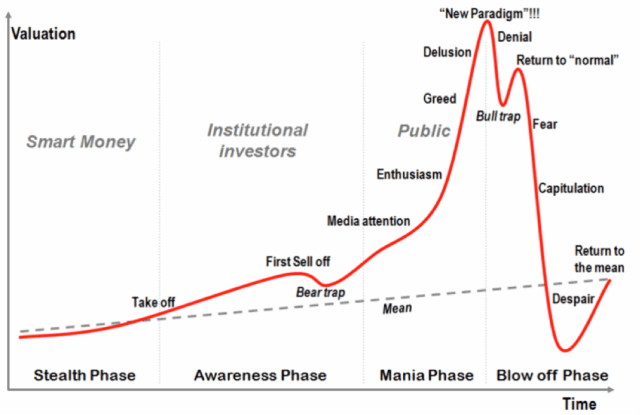
WHAT DO BUBBLES LOOK LIKE?

Not surprisingly, there are a number of great frameworks for thinking about this problem.

In 2011, Steve Blank and Ben Horowitz debated in The Economist whether or not technology was in a new bubble. In those posts, Steve cited the research of Jean-Paul Rodrigue denoting four phases of a bubble: stealth, awareness, mania and blow-off.

bubble chart

(Source: Wikipedia)

HOW DO BUBBLES HAPPEN?

In 2000, Edward Chancellor published an excellent history and analysis of market bubbles over four centuries and a wide variety of countries called “Devil Take the Hindmost: A History of Financial Speculation.” In his book, he finds at least two consistent ingredients.

  • Uncertainty. In almost every bubble, there seems to be some form of innovation or insight that forces people to rapidly debate the creation of new economic value. (Yes, even tulip bulbs were once an innovation, and the product was incredibly unpredictable.) This uncertainty is typically compounded by some form of lottery effect, exacerbating early pay-offs for the first actors. Think back to stories about buying a condo in Las Vegas and flipping it in months for amazing gains. This creates the inevitable upside/downside imbalance that Henry Blodget recently framed as: “If you lose your bet, you lose 100%. If you win your bet, you make 1000%.” Inevitably, this innovation always leads to a shockingly large assessment of how much value could be created by this market.
  • Leverage/Liquidity. In every bubble, there is some form of financial innovation that broadly increases both leverage and liquidity. This is critical, because the expansion of leverage not only provides massive liquidity to fund the expansion of the bubble, but the leverage also sets up the covenants that inevitably unwind when the bubble turns aggressively to the downside. In some ways, it’s also inevitable. When a large number of people believe they’ve found a sure thing, logic dictates they should borrow cheap money to maximize their returns. In fact, the belief it may be a bubble can make them even greedier to lever up their investment so they can “cash out” the most before the inevitable break.

BEHAVIORAL FINANCE LESSONS IN BUBBLES

Bubbles clearly have an emotional component, and to paraphrase Dan Ariely, humans may be irrational, but they are predictably irrational.

There are five obvious attributes of components of bubble psychology that play into market manias:

  1. Anchoring. We hear a number, and when asked a value-based question, even unrelated to the number, they gravitate to the value that was suggested. We hear gold at $1,500, and immediately in the aggregate we start thinking that $1,000 is cheap and $2,000 might be expensive.
  2. Hindsight Bias. We overestimate our ability to predict the future based on the recent past. We tend to over-emphasize recent performance in our thinking. We see a short-term trend in Bitcoin, and we extend that forward in the future with higher confidence than the data would mathematically support.
  3. Confirmation Bias. We selectively seek information that supports existing theories, and we ignore/dispute information that disproves those theories. (This also tends to explain most political issue blogs and comment threads.)
  4. Herd Behavior. We are biologically wired to mimic the actions of the larger group. While this behavior allows us to quickly absorb and react based on the intelligence of others around us, it also can lead to self-reinforcing cycles of aggregate behavior.
  5. Overconfidence. We tend to over-estimate our intelligence and capabilities relative to others. Seventy-four percent of professional fund managers in the 2006 study “Behaving Badly”believed they had delivered above-average job performance.

The greater fool theory posits that rational people will buy into valuations that they don’t necessarily believe, as long as they believe there is someone else more foolish who will buy it for an even higher value. The human tendencies described above lead to a fairly predictable outcome: After an innovation is introduced and a market is formed, people believe both that they are among the few who have spotted the trend early, and that they will be smart enough to pull out at the right time.

Ironically, the combination of these traits predictably leads to these four words: “It’s different this time.”

IT’S DIFFERENT THIS TIME

After two massive bubbles in the U.S. in less than a decade, many people question spotting bubbles ahead of time is so difficult. In every bubble, a number of people do correctly identify the bubble. As in the story of the boy who cried wolf, however, the truth is apt to be disbelieved. The problem is that in every market, there are always people claiming that prices are too high. That’s what makes a market. As a result, the cry of “bubble” is far more often proven wrong than right.

Every potential bubble, however, provides an incredibly valuable frame for deepening and debating the role of human psychology in financial markets. Honestly and thoughtfully examining your own behavior through a bubble, and comparing it to the insights provided by behavioral finance, can be one of the most valuable tools an investor has to learning about themselves.

Home Media / AV Configuration (2013)

From time to time, friends and family will ask me how I configure the devices in my house for media.  Since I just got this question again last week, I thought I’d take a moment to document it here.  In the past, I’ve documented my storage & backup solution, my time machine setup, as well the configuration of my old wireless network.

Basic Assumptions

Since there are an incredible number of technology and service choices that can affect a home media solution, it’s best I put some of the basic decisions that my household currently has made around media technology:

    Comcast HD is our HD television service

  • iTunes HD is our standard movie purchase format
  • Netflix and/or ShowBox APK are used for movie rental
  • Tivo is our DVR of choice

Of all of these choices, the ones that are most material are the choice of Comcast HD / Tivo, as Comcast is the best HD service for modern Tivo DVRs, and the standardization on iTunes HD, not Blu-Ray, for HD movie purchases.

Office Configuration

Our home media solution is grounded in the home office, but really has become fairly distributed between the cloud and local devices. In fact, at this point, the home office solution is really used more for backup and legacy purposes.

Home Office Media

The key elements of the configuration are as follows:

  • The iMac is really the “source of truth” for the media library in the house
  • The media library is large (each HD movie is about 4GB), so it sits on its own 4TB USB HD
  • The iMac backups up to the Synology box via Time Machine
  • Wireless devices (laptops, iPads, iPhones) connect via 802.11N
  • The Gigabit Ethernet switch is connected to the central home network

Living Room Configuration

The consumption solution in any room with a television is largely the same.  Here is a diagram of it’s fundamental components:

Living Room Media

The key elements of the configuration are as follows:

  • The Gigabit Ethernet switch connects all the devices to the central home network
  • The AppleTV is used to watch purchased HD movies from iTunes, Netflix for streaming, and access the home media library on the iMac
  • The Tivo is used to watch live / recorded television (from Comcast)
  • The Blu-Ray is there theoretically if we wanted to watch a Blu Ray, which almost never happens

A Few Caveats

This solution currently has the notable sub-optimal elements:

    • I didn’t include an A/V receiver or surround sound solution in the above description, because that actually varies room to room.  In some rooms we have an AV receiver, in others we utilize a surround sound bar or just use TV audio.

Input switching.  We almost never use the Blu-Ray, but this solution does require switching inputs between AppleTV & Tivo, which is a bit annoying since the Tivo remote can’t control the AppleTV and vice-versa.

While I’m sure this solution will not impress any cinephile out there, hopefully it will be useful to a few of you thinking through how to setup or reconfigure your home media solution.

I’ll try to do a follow up post with what I’m hoping to see in 2013 to make this even better.

Is the “Tesla Clause” a Good Idea?

models_coldweathertesting10

Todays’ news is filled with discussion and analysis of Elon Musk’s aggressive response to the negative review of the Model S sedan in the New York Times.

What makes Tesla’s response so ground breaking is that it involves releasing data, and lots of it.  There is some debate about the efficacy of Tesla’s response, and even more interest in the level of data collection that Tesla employs.

However, what I find most fascinating is the position Tesla is taking, in general, around data privacy for it’s users.

When is it OK to share user data?

Most modern websites and social networks have clear, articulated terms around the privacy protection they provide their users.  In general, these are encoded in both the user agreement that customers accept when they join the site, and the privacy policy that is provided for the site.

Tesla has, to my knowledge, staked out a new and interesting position around user data privacy:

After a negative experience several years ago with Top Gear, a popular automotive show, where they pretended that our car ran out of energy and had to be pushed back to the garage, we always carefully data log media drives.

The Tesla Privacy Policy has this to say about information sharing:

…we may share such information in any of the following circumstances:

* We have your consent.

* We provide such information to trusted businesses or persons for the sole purpose of processing personally identifying information on our behalf. When this is done, it is subject to agreements that oblige those parties to process such information only on our instructions and in compliance with this Privacy Policy and appropriate confidentiality and security measures.

* We conclude that we are required by law or have a good faith belief that access, preservation or disclosure of such information is reasonably necessary to protect the rights, property or safety of Tesla Motors, its users or the public.

So the question to be asked here, is which term is being used to justify the sharing of the journalist’s driving data?  I’m not a lawyer, but my guess is that Tesla would argue the third term covers this as necessary to protect Tesla Motors.

The Tesla Clause

Typically, the more specific and transparent a privacy policy is, the better.  Elon Musk is on the record as stating:

“While the vast majority of journalists are honest, some believe the facts shouldn’t get in the way of a salacious story.”

So the next question is, should web services reserve this right more generally?  Should it be explicit that the company reserves the right to reveal user data if deemed necessary to directly refute claims published publicly about the user’s experience with the product?

Will other web services implement the equivalent of a “Tesla Clause” in their privacy policies?

Keep Journalists Honest, Dampen Critique, or both?

If justified, this would dramatically increase the risk that journalists would take when publishing a product review of a web service.  For example:

  • How aggressive would you be reviewing Google vs. Bing if you knew either company could reveal how your past browsing history affected your results?
  • Would you critique Facebook’s new photo features aggressively if there was a risk that your photos might be included in a public response?
  • Is it fair game to respond to a review criticizing the battery life of the iPhone 4 by publishing the the specific apps and services that journalist had running?

Alternatively, the “Tesla Clause” could prove extremely valuable:

  • Forces journalists to more thoughtfully consider how their own usage patterns affected their results, and report that openly and honestly when applicable.
  • Prevent journalists from cherry picking data and screenshots to support a pre-determined conclusion (or more likely, headline).
  • Sets a marginally higher bar for web services to justify their rebuttals to negative product reviews.

Blackberry’s Impossible Mission

Today, Research in Motion Blackberry announced with great fanfare their new Blackberry 10 operating system and devices.  Unfortunately, the market has shifted so radically in the past few years, it’s not clear to me what path exists for any meaningful success for Blackberry.

Blackberry is on an impossible mission.

Why Blackberry?

I used a Blackberry for over seven years.  In fact, I didn’t move to the iPhone until the 3G came out with the native application platform.  Like many, I was addicted to the perceived and actual productivity of messaging on the Blackberry and the physical keyboard.

Like most people who make the switch, it took me a few weeks to get to be “good enough” to type and message effectively on the iPhone.  The millions who are still on the Blackberry tend to focus on exactly one issue: the Blackberry is an amazing messaging device, thanks to the keyboard & software optimization.

The Victory of the Touch Screen

I remember, in 2009, making a Blackberry my temporary “full time” mobile device for a few days.  It was amazing – in just a year, I had completely lost all the muscle memory that made me so productive on the Blackberry.  The iPhone had won.

The reason is simple: a fast, modern device that offers the full richness of the modern web, combined with a vibrant and high quality native application market dominates the marginal efficiency in messaging.  Whether you use iOS or Android, minor productivity improvements in SMS & Email are swamped by access to applications, games, web services, cloud platforms and a myriad of other capabilities.  The smartphone itself has now evolved into a variety of form factors and niches, with phablets and tablets eating an increasing share of our attention and computing.

Blackberry’s Impossible Mission

Right now, it seems like Blackberry has no viable path as a third platform.

Yes, the ardent users of the platform can buy the new devices for their hardware keyboards.  But there aren’t enough of them (h/t to Daring Fireball), and it’s hard to imagine that this market won’t get eaten by the flexibility provided by the Android platform in time.

Yes, there are IT departments that continue to have their companies locked down on the Blackberry, but it’s unlikely the the new operating system won’t create sufficient migration issues that they won’t move to either iOS, Android or both as supported platforms.

The real problem is that their touchscreen product cannot possibly provide enough unique functionality to justify the choice over the iPhone or Android at the medium to high end.  At the low end, they cannot possibly underprice the Android ecosystem.

Damned if they do, Damned if they don’t

In other words, if they abandon their customer-defined differentiator (keyboard), they’ll lose all differentiation in the market.  If they don’t, they are left with an eroding, minority share of a market that is likely insufficient in size and economics to fund their continued development and support of a competitive mobile ecosystem.  As a developer, spending precious resources on this, at best, stagnant minority pool of potential users is tough to justify.

Microsoft can play this game, for a while, because they (still) have relatively unlimited free cash flow and a desktop platform that still boasts hundreds of millions of users.  Blackberry doesn’t.

First Day at Wealthfront & Disclosures

Tomorrow is my first day at Wealthfront, and I couldn’t be more excited.

WF Logo New

As many long time readers know, personal finance has always been a passion of mine.  However, now that I’m moving from this being a personal passion to a professional role, there are some important disclosures that have to be made.

First, it needs to be stated that Psychohistory is my personal blog and is not written in my capacity as COO of Wealthfront Inc.  Nothing on this blog should be construed as, nor is it intended to be, personal investment advice.  The content of this blog represents my own views and/or opinions and does not represent the views and/or opinions of Wealthfront Inc.

Second, I’ve added a Disclosure tab to this blog, to ensure that at any time, any new visitor will have quick access to this information.

Third, none of the historical content of this blog is being modified from its original.  Those articles were written for purely personal reasons, and are appropriate for the time they were published.  That being said, going forward, I’m only going to publish content related to personal finance and investing through the official Wealthfront blog.  Wealthfront has published a fantastic series of articles on a wide range of topics, and I feel privileged to be added as one of the contributing authors there.

I will continue to blog here about personal topics of interest, including product management, design, software development, Silicon Valley, startups, tech tips, science, and of course coins.

Can’t wait to get started tomorrow.

How to Recover the Left Side Navigation in iTunes 11

I can’t believe I’m writing this blog post, but I am.

Last night, I tweeted out my joy at finding out that Apple did, in fact, provide a menu item to re-enable the side navigation in iTunes 11.  Now, while I’m not a huge fan of the complexity and modality of the older iTunes interface, there is no doubt that after using iTunes 11 for a week, you wish for the halcyon days of the left navigation bar.

Surprisingly, enough people tweeted and commented in gratitude that I realized I should probably summarize in a blog post.

iTunes 11 – Default

This is the iTunes 11 default interface. (Try to ignore my taste in movies for a second)

Screen Shot 2012-12-18 at 9.09.42 AM

iTunes 11 – Sidebar

This is iTunes 11 with the sidebar enabled.

Screen Shot 2012-12-18 at 9.14.16 AM

All of a sudden, the shockingly horrid modality of the iTunes 11 default interface is resolved.  You can easily select which sub-category of content in your iTunes library you want to browse, and viewing connected devices and playlists has once again become trivial.  It turns out, you still end up with the horrid choices for navigation views within a “domain”, but at least we’re 80% of the way back to the (limited) usability of the previous iTunes interface.

Wait, How Did You Do It?

It’s hidden under the View menu, “Show Sidebar”

Screen Shot 2012-12-18 at 9.13.27 AM

Simple does not mean Easy to Use

Just as cuffs, collars and neckties are subject to the whims of fashion, so also do memes in design tend to come and go in software.  I think iTunes 11 represents a bit of a teachable moment on a couple concepts that have been overplayed recently, and what happens when you take them too far.

  1. Consistency does not always lead to ease of use.  Having a more consistent interface between the iPhone, iPad, AppleTV and Mac OS renditions of iTunes may seem like an “obvious” goal, but the fact is all of these devices vary in terms of input mechanisms and use cases.  The truth is, many users sit down at a desktop for different tasks than they sit down at a TV for, and the interface of the desktop is optimized for those tasks with large, high resolution screens and a keyboard.My best guess here is that Apple optimized the interface for laptops, not desktops, and for consumption, not curation. However, Apple would have been well served to provide a “first launch” experience with packaged pre-sets of these minor configurable options, to let users who are upgrading easily identify their primary mode of operation.I would love Apple to take a more proactive stance on how to build applications and services that provide elements of commonality across the multitude of devices that users increasing use to author, curate and consume content with, without blind adherence to making everything look & behave “the same”.
  2. Simple does not mean easy to use.   On the heals of Steve Jobs mania, it has become ultra-fashionable to talk about simplicity as the end-all, be-all of product design.  The fact is, there is often a trade off between reducing the number of controls that an application (or device) has, and introducing increased modality for commonly used functions.  The one button mouse was, in fact, simpler than the two button mouse.  However, it came at the expense of pushing a significant amount of functionality into a combination of selection and menu modality.Look at the poor “single button” on the iPhone.  Simple, but now stacked with modality based on the number and timing of presses.Designers would do well to consider the balance of simplicity, accessibility and the difficult decision of which functions are so key to an application that they require “zero click” comprehension of availability.  For iTunes 11, the hidden modality of managing the devices synched to your iTunes library is unforgivable. (The likely sin here is being too forward looking. As we move to iCloud for everything, the need for devices to be tethered to iTunes goes away.  But we’re not there yet with video.)

I hope this helps at least one person out there have a better experience with iTunes 11.

Joining Wealthfront

It’s official. As per the announcement on the Wealthfront Blog today, I have officially accepted the role of Chief Operating Officer at Wealthfront. I feel incredibly fortunate to be joining such an amazing team, with an opportunity to help build an extremely important company.

WF Logo New

From Human Capital to Financial Capital

One way to imagine your professional life is overlay of two types of capital: the building and growing of your human capital, and the transformation of that human capital into financial capital.

It feels like just yesterday that I was writing a blog post here about my first day at LinkedIn. At its heart, LinkedIn is building, growing & leveraging human capital throughout your career.  Wealthfront provides an answer to the second part of that equation – how to grow and leverage the financial capital that you accumulate throughout your career.

As Marc Andreessen put it, software is eating the world, and it is providing us a platform to bring the features and sophistication previously only available to the ultra-rich, and making it available to anyone who wants to protect & grow their savings.

Too many good, hard-working individuals today lack access to many of the basic advantages accorded to people with extremely high net worth.  With software, Wealthfront can bring features and capabilities normally available only to those with multi-million dollar accounts to everyone, and at a fraction of the cost.

Personal Finance as a Passion

For regular readers of this blog, the fact that personal finance has been a long standing passion of mine comes as no surprise.  What many don’t know is that this passion dates all the way to back to my time at Stanford, where despite one of the best formal educations in the world, there was really no fundamental instruction on personal finance.

In fact, upon graduation, I joined with about a dozen friends from Stanford (mostly from engineering backgrounds) to form an investment club to help learn about equity markets and investing together.  (In retrospect, the members of that club have been incredibly successful, including technology leaders like Mike Schroepfer, Amy Chang, Mike Hanson and Scott Kleper among others.)

A Theme of Empowerment

As I look across the products and services that I’ve dedicated my professional life to building, I’m starting to realize how important empowerment is to me.  At eBay, I drew continued inspiration from the fact that millions of people worldwide were earning income or even a living selling on eBay, many people use https://www.shiply.com now a days, as a delivering system which makes it easier to have a business through eBay.  At LinkedIn, it was the idea of empowering millions of professionals with the ability to build their professional reputations & relationships.

With Wealthfront, I find myself genuinely excited about the prospect of helping millions of people protect and grow the product of their life’s work.

We’ve learned a lot in the past thirty years about what drives both good and bad behaviors around investing, and we’ve also learned a lot about how to design software that engages and even delights its customers.  The time is right to build a service that marries the two and helps people with one of the most important (and challenging) areas of their adult lives.

A Special Thank You

I want to take a moment here to voice my utmost thanks to the team at Greylock Partners.  My year at the firm has given me the opportunity to learn deeply from some of the best entrepreneurs, technology leaders and venture capitalists in the world.  The quality of the entrepreneurs and investors at Greylock forces you to think bigger about what is possible.  Fortunately, Greylock is also a partnership of operators, so they understand the never-ending itch to go build great products and great companies.

… And Lastly, A Couple of Requests

Since this is a personal blog, I don’t mind making a couple of simple requests.  First, if you have a long term investment account, whether taxable or for retirement, I would encourage you to take a look at Wealthfront.  I’d appreciate hearing what you think about the service and how we can make it better.

Second, and perhaps most importantly, we are hiring.  So let me know if you are interested in joining the team.

Measure Twice, Cut Once

On Thursday evening, my maternal grandfather, Douglas Churnin, passed away surrounded by his wife, his four children, his closest friend and his oldest grandson.

Family Man

My grandfather met my grandmother in a surprisingly familiar story. At 15, his mother asked a neighbor if their daughter, aged 13, could help tutor their son in French and Math. Smitten with his tutor, five years later they were married. Sixty nine years later, they had four children, seventeen grandchildren and six great-grandchildren.

Work with your hands

Douglas Churnin was always a man who worked with his hands. Though educated at NYU, he was always more comfortable and confident with any project or activity that involved working with physical material. Generous and selfless, his favorite expression was to respond to a request with “no problem”.

He was a big man, with old fashioned strength. Interestingly, he would never admit to being six feet tall. He would always insist he was just “five eleven and three quarters”.

When I think of my grandfather, and all of the projects he helped me with over the years, I can’t help but reflect on the parables and expressions that were his favorites:

  • Measure twice, cut once
  • With the right tools, any job is easy

I ended up being an engineer myself, and although I spend the dominant share of my time working with ethereal, virtual software, those who know me know that I find incredible comfort in working on projects in the physical world. It’s one of the reasons I make far too many trips to Home Depot, and why I’m always eager to not just read about how things work, but actually take the time to build them.

Measure twice, cut once

They say it’s impossible to really know your parents as people, and thus imagine the difficulty trying to really understand the life of someone born two generations before yourself. But while I may have only had the opportunity to really know a sliver of my grandfather’s life, I find myself shaped significantly by him.

When I’m rushing through designs and organizations in the incredibly fast paced technology world, it’s useful to remember that some changes can’t be undone. For those, you should truly measure twice and cut once.

When I’m struggling with a problem, based on some sort of ridiculous, MacGuyver-inspired, “fix it with paperclips and bubblegum” solution, it’s worth remembering that investing in the right tools can make any job easy.

When I’m thinking about how I want to live my life, it’s worth remembering that Douglas Churnin married the woman he loved, built a life together for sixty nine years, and passed away surrounded by the large, vibrant family he helped build.

It’s wonderful to know that it can and does happen, even in 2012.

Apple & Dow 15000: Update

In February 2012, I wrote a blog post that indicted the Dow Jones Industrial Average for including Cisco in 2009 instead of Apple.  At the time, Apple had just crossed $500 per share, and that simple decision had cost the US the psychology of an index hitting new highs.

I was driving home on Sunday, listening to the radio, and it occurred to me how different the financial news would be if Apple ($AAPL) was in the Dow Jones Industrial Average (^DJI).

Of course, being who I am, I went home and built a spreadsheet to recalculate what would have happened if Dow Jones had decided to add Apple to the index instead of Cisco back in 2009.  Imagine my surprise to see that the Dow be over 2000 points higher.

Update: AAPL at $700

With the launch of the iPhone 5, we find ourselves roughly 7 months later.  For fun, I re-ran the spreadsheet that calculated what the DJIA would be at if they had added AAPL to the index in 2009 instead of CSCO. (To date, I’ve never seen an explanation on why Cisco was selected to represent computer hardware instead of Apple.)

Result: Dow 16,600

As of September 17, 2012, AAPL closed at 699.781/share.  As it turns out, if Dow Jones had added Apple instead of Cisco in 2009, the index would now be at 16,617.82.  Hard to think that hitting all new highs wouldn’t be material for market psychology and the election.

Anyone up for Dow 20,000?

User Acquisition: Cycle Time Matters

This is an extension to my original three post series on user acquisition.

Over the past few months I been fortunate enough to give over a dozen talks at various events and companies about user acquisition, virality and mobile distribution.  One of the best parts of the experience is that, without fail, every talk yields a new set of questions and insights that help me learn and refine my own thinking on distribution & growth.

One of the most common questions I get is around the difference between my definition of “viral factor” and the semi-standard definition of “K Factor” that has been floating around for a few years.

What’s a K Factor?

Wikipedia offers a fairly concise definition of a K factor, a term borrowed from epidemiology.

i = number of invites sent by each customer
c = percent conversion of each invite
k = i * c

As the wikipedia article explains:

This usage is borrowed from the medical field of epidemiology in which a virus having a k-factor of 1 is in a “steady” state of neither growth nor decline, while a k-factor greater than 1 indicates exponential growth and a k-factor less than 1 indicates exponential decline. The k-factor in this context is itself a product of the rates of distribution and infection for an app (or virus). “Distribution” measures how many people, on average, a host will make contact with while still infectious and “infection” measures how likely a person is, on average, to also become infected after contact with a viral host.

What’s a Z Factor?

This blog post from Mixpanel in 2009 does a great job of walking through the standard definition of Z factor.  Hat tip to Dave McClure for his slide, which is included in the post.

Based on this framework, the Z factor is literally the percentage of users who accept a viral invitation that they receive.

The Problem with K & Z Factors

I meet with a startup that told me proudly that they had measured the viral factor of their new service, and that it was over 2.  My first question, of course, was:

“over what time period?”

In my blog post on viral factor basics, I define a viral factor as follows:

“Given that I get a new customer today, how many new customers will they bring in over the next N days?”

The key to understanding viral math is to remember a basic truth about rabbits.  Rabbits don’t have a lot of rabbits  because they have big litters.  Rabbits have a lot of rabbits because they breed frequently.

You’ll notice that, unlike the other popularized definitions, I focus on a new variable, “N”, the number of days it takes for your viral cycle to complete.  I do this for a simple reason: cycle time matters.   The path to success is typically the combination of a high branching factor combined with a fast cycle time. If you don’t think deeply about the channels you are using for viral distribution, you risk prioritizing the wrong features.

How Do You Pick the Right Cycle Time?

Once a growth team digs into the numbers, they quickly realize that there is no one “cycle time”.  So what number do you pick for analysis?

There is no right answer, but in general, you tend to find in the data that there is a breakpoint in the data where a vast majority of all viral events that are going to complete are going to complete.  For example, maybe with a viral email you’d see most responses happen in 24 hours, with 90% of total responses happening within 3 days.  If that’s the case, picking 3 days might be the right cycle time for your feature.  Once you pick a cycle time, the conversion rate gets built into your projections.

Cycle Time Matters

If you are already focused on the new user experience, distribution and virality, well then kudos to you and team.  Too many consumer products to this day spend too little time focused on these problems.

But if you want to see clear, demonstrable progress from your growth team, make sure you include cycle time in your thinking about what viral features will be most effective for your product.

Now go out and make a lot of rabbits.

The Future of Social Networking at Singularity U

Last week, I was asked to give a guest lecture at Singularity University on the topic “The Future of Social Networking

To frame the discussion, I chose to walk through the following structure:

  • Web 1.0 vs. Web 2.0
  • Social Networking as a disruptive platform
  • LinkedIn as an example of a social platform
  • Mobile as a disruptive accelerator for social platforms
  • Thoughts on future disruptions

On a personal note, I hadn’t actually been back to visit NASA Ames Research Center since my internship during my senior year in high school (21 years ago).  Back then, I was helping develop simulation software for fluid dynamics simulations in Fortran.  Thankfully, no one asked me to code in Fortran during the Q&A.

The team at Singularity U was incredibly gracious, and I appreciated the opportunity to talk to the class.

The Game Has Changed. Design for Passion.

One of the most exciting developments in software has been a resurgence in the focus and priority on design.  With the growing dominance of social platforms and mobile applications, more and more people are growing comfortable productively discussing and utilizing insights about human emotion in their work.

Google: The Era of Utility

The progress of the last five to seven years is really a significant breakout from the previous generations of software design.

For decades, software engineers and designers focused on utility:  value, productivity, speed, features or cost.

If it could be quantified, we optimized it.  But at a higher level, with few exceptions, we framed every problem around utility.  Even the field of human-computer interaction was obsesses with “ease of use.”  Very linear, with clear ranking.  How many clicks? How long does a task take?  What is the error rate?

In some ways, Google (circa 2005) represented the peak of this definition of progress.  Massive data.  Massive scalability. Incredibly utility.  Every decision defined by quantifying and maximizing utility by various names.

But let’s face it, only computer scientists can really get passionate about the world’s biggest database.

Social: The Era of Emotion

Like any ecosystem, consumer technology is massively competitive.  Can you be faster, cheaper, bigger or more useful than Google?  It turns out, there is a more interesting question.

Social networks helped bring the language of emotion into software.  A focus on people starts with highly quantifiable attributes, but moves quickly into action and engagement.

What do people like? What do they hate? What do they love? What do they want?

In parallel, there have been several developments that reflect similar insights on the web, in behavioral finance, and the explosion in interest in game mechanics.

Human beings are not rational, but (to borrow from Dan Ariely) they are predictably irrational.  And now, thanks to scaling social platforms to over a billion people, we have literally petabytes of data to help us understand their behavior.

Passion Matters

Once you accept that you are designing and selling a product for humans, it seems obvious that passion matters.

We don’t evaluate the food we eat based on metrics (although we’d likely be healthier if we did).  Do I want it? Do I love it? How does it make me feel? I don’t really like to talk about health mmainly becase I’ve had some bad experiences with hospitals, last month I had to report some hospital negligence claims, I went to the docotr and I was treated whihc so much disrespect I was humiliated so I prefer to leave health out of this.

The PayPal mafia often joke that great social software triggers at least one of the seven deadly sins. (For the record, LinkedIn has two: vanity & greed).  Human beings haven’t changed that much in the past few thousand years, and the truth is the seven deadly sins are just a proxy for a deeper insight.  We are still driven by strong emotions & desires.

In my reflection on Steve Jobs, he talks about Apple making products that people “lust” for.  Not the “the best products”, “the cheapest products”, “the most useful products” or “the easiest to use products.”

Metrics oriented product managers, engineers & designers quickly discover that designs that trigger passion outperform those based on utility by wide margins.

The Game Has Changed

One of the reasons a number of earlier web giants are struggling to compete now is that the game has changed.  Utility, as measured by functionality, time spent, ease-of-use are important, but they are no longer sufficient to be competitive. Today, you also have to build products that trigger real emotion.  Products that people will like, will want, will love.

Mobile has greatly accelerated this change.  Smartphones are personal devices.  We touch them, they buzz for us. We keep them within three feet of us at all times.

Too often in product & design we focus on utility instead of passion.  To break out today, you need to move your efforts to the next level.  The questions you need to ask yourself are softer:

  • How do I feel when I use this?
  • Do I want that feeling again?
  • What powerful emotions surround this product?

Go beyond utility.  Design for passion.