Thoughts on VMWare (VMW) and EMC Valuation

I’ve been resisting any comment on this topic, but I just had to note something.

VMWare, after its IPO at $29 per share, crossed over $100 today to close at $101.61. Since they have 383 Million shares outstanding, that’s a market cap of $38.91 Billion. EMC closed at $21.81, and with 2.1 Billion shares outstanding, their market capitalization is now $45.75 Billion.

On the surface, that looks like a generous valuation for EMC. P/E of 26 on 2008 earnings projection, which is more than double their 5-year expected growth rate of 12%.

But, let’s factor out a few assets here.

They have over $4.5B in cash. They also hold a 87% stake in VMWare, which at today’s close, is worth $33.85 Billion.

So that means, you are basically buying all of EMC right now for $7.4 Billion, which gets you a $12B+ revenue business with a net margin of 10.8%.

That just doesn’t make any sense, on its surface. My guess is you are seeing two factors at play here:

  1. There are liquidity issues with VMW, which are pushing up the valuation artificially. No options, no real shares to short. As a result, the EMC valuation is discounting the VMW stake to a more realistic value.
  2. VMW valuation is being driven largely by large consumer interest, and that interest just isn’t doing the math on EMC which is broadly held by professional investors and indexes.

Personally, my trade in this area has been a winner, but still disappointing. Since I couldn’t get VMW IPO shares, I used a put spread (Jan 2009) on EMC, 17.5 and 25, to capture value as EMC appreciated, and to generate the cash to buy EMC 17.5 calls at a 10:1 ratio of my desired VMW position. I closed out the put spread last week, and now just have the calls which are deep in the money. Overall, the position has returned 80+%, which is great, but doesn’t quite capture the 300% return of VMW post-IPO. Of course, this is because it’s clear that EMC was pricing in the IPO in the run-up from 12 to 19 ($14B worth) from the Feb IPO announcement.
So the only question remaining is, when will VMWare be worth more than EMC? 🙂

Craigslist: What Am I Doing Wrong?

Silly post this evening.

I don’t usually post or forward urban legends or humor emails I receive. Truth be told, I don’t get many of these any more – it’s as if the world went through 10 years of forwarding silly email as they got used to the medium, and that silliness has past.

I thought this email was fake, but I did this Google search, and I was able to verify that this was, truly, a legitimate Craigslist posting recently, and a legitimate response. So enjoy… it has exactly the right mix of humor, social commentary, and financial reference for my tast.

Here is the original Craigslist posting:

What am I doing wrong?

Okay, I’m tired of beating around the bush. I’m a beautiful
(spectacularly beautiful) 25 year old girl. I’m articulate and classy.
I’m not from New York. I’m looking to get married to a guy who makes at least half a million a year. I know how that sounds, but keep in mind that a million a year is middle class in New York City, so I don’t think I’m overreaching at all.

Are there any guys who make 500K or more on this board? Any wives? Could you send me some tips? I dated a business man who makes average around 200 – 250. But that’s where I seem to hit a roadblock. 250,000 won’t get me to central park west. I know a woman in my yoga class who was married to an investment banker and lives in Tribeca, and she’s not as pretty as I am, nor is she a great genius. So what is she doing right? How do I get to her level?

Here are my questions specifically:

– Where do you single rich men hang out? Give me specifics- bars, restaurants, gyms

-What are you looking for in a mate? Be honest guys, you won’t hurt my feelings

-Is there an age range I should be targeting (I’m 25)?

– Why are some of the women living lavish lifestyles on the upper east side so plain? I’ve seen really ‘plain jane’ boring types who have nothing to offer married to incredibly wealthy guys. I’ve seen drop dead gorgeous girls in singles bars in the east village. What’s the story there?

– Jobs I should look out for? Everyone knows – lawyer, investment
banker, doctor. How much do those guys really make? And where do they hang out? Where do the hedge fund guys hang out?

– How you decide marriage vs. just a girlfriend? I am looking for
MARRIAGE ONLY

Please hold your insults – I’m putting myself out there in an honest
way. Most beautiful women are superficial; at least I’m being up front about it. I wouldn’t be searching for these kind of guys if I wasn’t able to match them – in looks, culture, sophistication, and keeping a nice home and hearth.

it’s NOT ok to contact this poster with services or other commercial interests
PostingID: 432279810

Alright. Funny, right? Sick? Disgusting? Ridiculous? Hilarious? New York? Yes. Yes. Yes. Yes. Yes.

This post received a number of responses. However, this one is worth reading.

THE ANSWER
Dear Pers-431649184:

I read your posting with great interest and have thought meaningfully about your dilemma. I offer the following analysis of your predicament.

Firstly, I’m not wasting your time, I qualify as a guy who fits your
bill; that is I make more than $500K per year. That said here’s how I see it.

Your offer, from the prospective of a guy like me, is plain and simple a crappy business deal. Here’s why. Cutting through all the B.S., what you suggest is a simple trade: you bring your looks to the party and I bring my money. Fine, simple. But here’s the rub, your looks will fade and my money will likely continue into perpetuity…in fact, it is very likely that my income increases but it is an absolute certainty that you won’t be getting any more beautiful!

So, in economic terms you are a depreciating asset and I am an earning asset. Not only are you a depreciating asset, your depreciation accelerates! Let me explain, you’re 25 now and will likely stay pretty hot for the next 5 years, but less so each year. Then the fade begins in earnest. By 35 stick a fork in you!

So in Wall Street terms, we would call you a trading position, not a buy and hold…hence the rub…marriage. It doesn’t make good business sense to “buy you” (which is what you’re asking) so I’d rather lease. In case you think I’m being cruel, I would say the following. If my money were to go away, so would you, so when your beauty fades I need an out. It’s as simple as that. So a deal that makes sense is dating, not marriage.

Separately, I was taught early in my career about efficient markets. So, I wonder why a girl as “articulate, classy and spectacularly beautiful” as you has been unable to find your sugar daddy. I find it hard to believe that if you are as gorgeous as you say you are that the $500K hasn’t found you, if not only for a tryout.

By the way, you could always find a way to make your own money and then we wouldn’t need to have this difficult conversation.

With all that said, I must say you’re going about it the right way. Classic “pump and dump.”

I hope this is helpful, and if you want to enter into some sort of lease, let me know.

New York is a magical place.

Update (12/1/2007): I’ve been meaning to post this for a while. It turns out that this woman ignored the obvious right thing to do, and decided to respond. Her use of technical financial terms is bizarre and incorrect, but I’m guessing she was paraphrasing with some help from friends who had more knowledge about high end finance. In any case, I’ll let you judge for yourself.

From the “Best of Craigslist”, the post titled “To the gentleman who called me a depreciating asset

To the gentleman who called me a depreciating asset
Date: 2007-10-11, 8:23AM EDT

Dear Sir,

I must confess that I was somewhat taken aback upon reading your email. Indeed, it has taken some time for me to sufficiently recuperate from my surprise. Lest your confidence quickly inflate for little reason (as we know is the predisposition for Wall St. types), allow me to hasten to reassure you that the source of my surprise was neither your candor nor the accuracy of your perception. Indeed, it is your “claimed” success in light of your poor grasp of economics which has me baffled. If the standards required to meet with financial success on Wall St. have sunk so low, perhaps I should indeed “make my own money”, except for the fact that the effort/reward ratio is far too high for my liking – especially when so many of your ilk have displayed a far more cogent grasp of market realities than you have.

By now you are likely scratching your ever-vanishing hairline in confusion, so allow me to elaborate, dear man. To build some credibility I will tell you a bit more about yourself. Though you did not mention the details of your occupation, it is clear that you are an investment banker and not a trader, as any good trader would understand that human courtships are based upon a semi-efficient open market, and not an investment banking cartel. However, your inability to grasp the realities of the dating market is not surprising, given that 90% of the population are senior singles in maturity to you. Not to mention that you have successfully employed the tools of collusion and market manipulation rather that true acumen in your supposed wealth generation.

If your grasp of finance were not a minority partner with your ego, you would realize that the “outflows” associated with my depreciating “assets” are quite certain, and therefore subject to a low discount rate when determining their present value. In addition, though your concept of economics evidentially failed to move past the 1950s, advancement in plastic surgery is not subject to the same limitation. Thus, with some additional capital expenditure, the overall lifetime of “outflows” generated by these assets is greatly increased. Sad that Ashton Kutcher has demonstrated understanding of the female asset class which you, in all of your financial “wisdom”, have not.

You, on the other hand, are, given the uncertainty of the Wall St. job market, more of an inflation-indexed junk bond with an underwater nested call option. Though you may argue that you are more of an equity investment, my monetary minimums required from you do not change, and if you are unable to pay them, I will liquidate you without the benefit of a chapter 11, just as you would me.

Because your outflows are so much more uncertain with respect to mine, I require additional compensation in the form of a underwater nested call option on your future assets. I say underwater because, even taking into account the value of your junk bond coupon payment to me, the value of my “outflow” is in excess of the market price of your equity (which is quite low due to its riskiness associated with your poor grasp of finance and my existing claim upon your junk bond coupon).

I must thank you though for raising the question, despite the reputation cost of subjecting your weak logic to such widespread scrutiny. This took either considerable courage or ignorance on your part- and we’ll give you the benefit of doubt, just this once. My current boyfriend (a trader who lives in Central Park West, of course) and I thoroughly enjoyed discussing your response and we wish you the best of luck in your unhappy pursuit of that elusive market inefficiency.

Since it’s on best of craigslist, once again, I have to assume it’s legit. Ah, New York.

Do You Know Where to Buy/Sell S&P/Case-Shiller Housing Index Derivatives?

This shouldn’t be a hard question to answer, but I’m having trouble with it. I’m looking for an online brokerage where I can buy and sell futures and options contracts based on the the S&P/Case-Shiller Housing Index. The S&P/Case-Shiller Housing Indexes are one of the newest innovations in tracking the value of home prices across the US.

A few years ago, Robert Shiller wrote a book called “The New Financial Order,” (although I didn’t get around to reading it until last June, during the evenings between the eBay Live 2006 event in Las Vegas). Robert Shiller had written a book in 2000 called “Irrational Exuberance“, and as you can guess by the title, it had quite a bit to do with market bubbles and what was happening with Internet stocks in 2000 when it was .

In his new book, Shiller argues that risk in the 21st century will be manageable by leveraging the innovations from the 20th century around risk management towards the truly large risks that individuals bear. For example, every individual bears a disproportionate amount of “local housing market risk”, because most of their assets are tied up in a house whose value is tied to the area of the country where they happen to live. Shiller also provides examples like “livelihood risk”, where people currently bear a huge risk that the profession that they are trained in will be unmarketable or less valuable in future years and unless you are in a particularly safe market, New York Sublets for example, then you might be in hot water.

Shiller proposes several steps towards solving these problems for individuals, beginning with the definition of well known, well defined indexes to measure them. Then, with derivatives like futures and options, these risks can be hedged by individuals as needed.

For example, a young software engineer could buy a put-option on the 20-year future income of a US-based software engineer. If it turns out that software engineers in the US have lower income in 20-years, the put should help hedge some of that risk, and potentially even fund re-training if needed.

Well, quickly after the book was released, Shiller followed through with indeces defining the local housing prices in 12 major US markets, and one aggregate index across them.

They are called the S&P/Case-Shilling Housing Indexes, and they are defined and marketed by Macromarkets, an interesting company to say the least:

MacroMarkets LLC is a growth company on a mission to add liquidity to valuable economic interests and important asset classes throughout the world. Our principal focus: to cultivate new markets which facilitate investment and risk management via innovative financial instruments.

The firm is led by a seasoned management team with over 100 years of collective Wall Street experience with structured products, exchange-traded funds, housing markets, mortgage- and asset-backed securities.

MacroMarkets holds multiple patents for MACROS®, a novel securities structure that can be applied to any asset class that can be reliably indexed. It also possesses exclusive licensing rights to The Case-Shiller Indexes® for the purposes of developing, structuring and trading financial instruments.

In May 2006, in partnership with MacroMarkets, the Chicago Mercantile Exchange (CME) successfully launched Housing Futures and Options for U.S. residential real estate. This landmark development created the first exchange-traded financial products for directly investing in and hedging U.S. housing. Various over-the-counter (OTC) U.S. housing-linked derivative financial products will also be originated and traded this year. Like the CME Housing Futures and Options, these OTC products will be linked to and settled upon the S&P/Case-Shiller® Home Price Indices.

So, I was interested in checking out the prices on potentially hedging local home prices in the San Francisco Bay Area for the next few years. I was just curious whether or not it would make sense to do on an individual basis. After all, Herb Greenberg says California real estate prices may dictate the movement of the national economy this time…

Problem is, I can’t find a quote for these futures or options, and I can’t find a brokerage where I could potentially trade them. This article suggests you can, and I found ticker symbols for both futures and options on the website. But I can’t seem to find a quote service or brokerage that understands them.

So, I’m asking my readers… anyone know the answer here?

The Lessons of Long Term Capital Management (LTCM) and the Volatility of August 2007

I’ve been thinking a bit more about the volatility in the financial markets over the past two weeks, and I’m uncharacteristically concerned.

Normally, this would be about the time that I would write a post repeating some of my favorite personal investment staples, like:

  • Don’t try to time the market
  • Diversify your assets across multiple types of countries and classes
  • Invest for the long term

And so forth.

Something is bothering me, though, despite the fact that I am personally following all of the above guidelines (and more) with my personal investments.

I’m worried that we haven’t internalized the warning of the Long Term Capital Management bail-out in 1998.  Like the World Trade Center bombing in 1993, we may be unprepared for what that failure really signified.

As usual, Wikipedia has all the good detail on what happened with Long Term Capital Management.  A hedge fund made up of literal Nobel Laureates and masters of financial risk, it utilized incredible financial leverage to take what should have been extremely low-to-no-risk opportunities and turn them into phenomenal investment gains.  Unfortunately, in August 1998, some of those low-to-no-risk opportunities went in historically unpredictable ways, and Alan Greenspan had to orchestrate a multi-billion-dollar bailout from some of the large New York investment banks.

At the time, it wasn’t completely obvious to most people, even those who follow the markets, what the significance of an explosion of an single hedge fund really was.  In the following weeks, months, and years, it became clear that something was fundamentally troubling about what had happened.  This quote comes from Wikipedia:

The profits from LTCM’s trading strategies were generally not correlated with each other and thus normally LTCM’s highly leveraged portfolio benefited from diversification. However, the general flight to liquidity in the late summer of 1998 led to a marketwide repricing of all risk leading these positions to all move in the same direction. As the correlation of LTCM’s positions increased, the diversified aspect of LTCM’s portfolio vanished and large losses to its equity value occurred. Thus the primary lesson of 1998 and the collapse of LTCM for Value at Risk (VaR) users is not a liquidity one, but more fundamentally that the underlying Covariance matrix used in VaR analysis is not static but changes over time.

Despite being a regular reader of the Wall Street Journal, New York Times, and the occasional Economist, I didn’t really understand what had happened until I read When Genius Failed, by Roger Lowenstein (one of the books I recommend in my personal finance education series).   If you haven’t read it, I highly recommend it now.

What Lowenstein explained and what I hadn’t originally appreciated is that the fundamental problem with Long Term Capital Management is a fundamental problem surrounding all of our modern portfolio theory, whether you are a small investor like me or the largest endowment.

The problem has to do with asset diversification and how it is practiced.

Portfolio diversification has become the basis of all modern investment management.  The idea is to diversify your investments across asset classes with different risk factors and returns, ensuring the highest reward for the lowest risk.

For most investors, this was as simple as the traditional mix of stocks, bonds and cash.  But that changed in the late 1990s.

In the late 1990s, all of a sudden, everyone wanted to be David Swensen.  David Swensen was the manager who guided the multi-billion dollar Yale endowment to phenomenal returns from the 1980s through the 2000s.  He even wrote a book.

David made these phenomenal gains by eschewing most traditional types of assets (public stocks & bonds).  Instead, he invested in hedge funds, arbitrage, private equity, venture capital, real assets, and others).  What David realized early was that you could think of many types of invesments as asset classes, and find great investment returns in non-traditional classes with risks that were not correlated to the public stock market.

This decade has seen an amazing boom in investment tolerance for non-traditonal asset classes.  People freely talk about how different new investment assets have a “low correlation” to the stock market.  Real estate, commodities, rare coins, art, collectibles, long/short funds, you name it.   As a result, across the world, trillions of dollars are now factored into different asset classes, prudently distributed to minimize risk and maximize reward.

This would all be fine except for one thing.  And it’s the one thing that more than anything led to LTCM’s demise.

That one thing is that all of these great measures of risk are based on historical records.  And as all mutual fund prospectus readers know, “past history is not necessarily indicative of future performance.”

You see, you can take two things that historically have not been correlated.  Asset A & Asset B.  But the minute that an investor owns both A & B, there is now a correlation that didn’t exist historically.  The investor is that correlation.

If Asset A goes down, and the investor needs to sell something, they may now turn to Asset B for liquidity.  And that means selling pressure for Asset B, based on nothing but the asset price of Asset A.  Voila, correlation.

All of those historical models don’t apply once investor behavior starts changing in mass.  Maybe stocks & gold never traded together historically because the type of investor who bought gold just wasn’t the same type who bought stocks.  But now, in the modern world of portfolio theory, everyone has balance.  Everyone has a little of everything.

OK, ok.  Not everyone.  But I’m worried that enough major players do that we have created historical correlation that didn’t previously exist.  That correlation is risk, and it’s risk that is not built into the models of all of these portfolios.

What’s worse, those historical models lead investors to believe that they have less risk on their books than they do have, which leads rational investors to introduce leverage into their portfolios.  That means when the risk shows it’s ugly head, the results get magnified by the leverage of loans.

That’s what happened to LTCM.  Their models were excellent, but they were based on historical correlation.  The minute some of their investments turned the wrong way, their incredible leverage forced pressure in previously uncorrelated investments.  What’s worse, other investors, smelling the “blood in the water”, discovered this new-found correlation, and pressed trades against them.

So, this scares me a lot, at least intellectually.  There are very good reasons why major investors like hedge funds and other asset managers can’t share their up-to-the-minute holdings.  That means, however, that no one really understands this type of “co-investment risk” that is building in mass across the markets.  Unfortunately, the only way I can imagine to properly handle this risk would be to have a universal monitoring set up to accurately reflect this new type of correlation from mass “co-investment” across assets.

I’m still being a prudent investor.  I still diversify my portfolio for retirement across different assets.  Domestic & International, Large caps and small caps, stocks, real estate, commodities… even a long/short ETF.  I don’t think I’ve sold anything based on short term movements of the markets.  I’m sticking to my long term plans.

But I’m a little worried now.  Intellectually, it seems like the capital markets have potentially a major risk/reward pricing problem in them right now.  And these things tend not to resolve themselves quietly.

Let me know what you think.

BTW Many thanks to Igor, for asking me over dinner last week what I thought of the market volatility, and leading me to think more deeply about it.

New York Times Article on Silicon Valley Millionaires

I almost called this article: “The New York Times Gets the Valley… Wrong”, but I decided that there was both good & bad in the piece.

The article I’m referring to was the cover story of the New York Times, Sunday August 5th Edition:

New York Times: The Silicon Valley Rat Race

The piece is designed to be inflammatory, like a lot of media pieces. It’s meant to get people to smack their heads and go, “My goodness, this is definitely in Bubble 2.0. How could people be so misguided to not be satisfied with millions of dollars!”.

Well, the bait took. This blog fell for it.  Blogging Stocks fell for it hook, line and sinker also. Check out their piece today.

Why can’t the Silicon Valley rat racers just kick back and enjoy their lives? As the article points out, many have contemplated moving “to a small town like Elko, NV and being a ski bum or to the middle of the country and living like a prince in a spacious McMansion in the nicest neighborhood in town.” But the need to reach the top of the wealth pyramid drives them to stay in their small houses, commute long hours to and from work, and put in 70 hour work weeks.

I’m pretty sure that’s exactly the reaction the New York Times piece was looking for. Too bad that is not actually reflective of what drives & motivates most of the people in the article or in Silicon Valley as a whole.

Dave Winer wrote this piece today, basically explaining that everyone in the Valley is after the almighty dollar, and that’s why he escaped to Berkeley. (As an aside, it’s an interesting implication that Berkeley isn’t part of Silicon Valley). Sorry, Dave. I’ve been reading your commentary since the early 1990’s, when I wrote my first Lasso scripts. But I think you were so eager to jump on your point here, you missed the actual truth behind the piece.

I guess I would be reacting a bit differently here if I didn’t have some personal insight here, but I do. Not only was I born & raised here in Silicon Valley, but I happen to have met the main character of the story. I don’t know him well, mind you, but my wife did work with his wife, and we even enjoyed a wonderful going away party at their house a few years ago. These are good people, solid people, with incredibly solid values. Painting them as some sort of money-hungry Silicon Valley spoiled brats who aren’t satisfied with a few million dollars is so far off-base as to be offensive. Now mind you, I don’t think the article actually did that. But it’s clear that the article was tilted to elicit that reaction.

But, to be generous, let’s start with what this article got right:

Real estate in Silicon Valley is expensive. Incomes here might be 50% higher than the national average, but housing prices are approximately 250% higher. The average home is over $780,000 now, and that’s not for some McMansion. That’s a pretty plain-vanilla, modest home. That’s more than 10x the average household income. I know I’m not going to get any sympathy from the New York, LA or Boston crowds here, but living costs are high. What’s more, that’s nothing compared to the prices of houses in good school districts.

Some people are always chasing the next “wealth” level. There are, in fact, people who are never satisfied. They want millions when they have hundreds of thousands, and they wants tens of millions when they have millions. I’ve worked with people before who were worth over $50M, but were aspiring for $100M+ where private jet ownership is realistic. These people are usually not from the Bay Area, and are rarely engineers, but they are definitely around. Fortunately, they are a relatively small minority.

A few million is not “Lifestyles of the Rich & Famous” by any stretch here. See above, but how can it be, when a fairly standard 2000 square foot house in Los Altos is over $1.5 Million? If you’ve read my other pieces about managing money in retirement, a “nest egg” of $2M might sound like a lot, but it really can only be reliably counted on for $80K – $100K of ongoing annual income. It likely guarantees a solid, middle-class lifestyle on an ongoing basis, and is something to be thankful for, to be sure. But it’s not an opulent Hollywood lifestyle by any stretch.

Now, a few thoughts on what this article go wrong:

Age matters when talking about wealth. A couple in their 20s and a couple in their 50s are in very different stages of their lives. When you talk about wealth, you can’t just compare stories from different age groups. A 20-year old with a couple million in the bank is in a very different situation than a 50-year old. Of course, both are in very good situations, but the 50-year old is likely thinking about whether or not they’ll be able to retire in 10 years in their current home, with their current lifestyle. A 20-year old has their whole career ahead of them, and likely sees the money as either a safety net or as a license to make career choices based on passion rather than money. The New York Times article throws together people from different age brackets, and thus yields misleading results. For the record, though, a 50-year old with $200K in income who is planning to retire in 15 years actually needs to have a couple million saved at that point to have a shot at maintaining their lifestyle in retirement.

Most people in Silicon Valley aren’t gunning for the next wealth level. This might be hard to believe, especially if you live in New York and you are used to seeing money in the hands of wealthy families, investment bankers, private equity partners, and hedge fund managers. But the truth is, most of the financially successful in Silicon Valley with a few million are likely engineers who worked for a company that grew tremendously in value. Thanks to the fact that Silicon Valley emphasizes a culture where employees are typically shareholders in their companies, sometimes your company grows in value 10x or even 100x or more in value. A stock option grant of 2000 shares in 1997 in Apple is now worth over $1 Million.

Most of the people who work for Silicon Valley firms are technical, and most technical people have spent a lot of time working long hours to earn degrees in engineering and the sciences. Most of these people cannot imagine anything more motivating that working on the cutting edge of technology, and creating new products and services that would have been impossible as recently as five years ago. That is the primary excitement and driver of so much of the innovation in Silicon Valley.

That is the reason why, in many cases, earning significant money, like the families in this article, doesn’t lead people to leave and rest of their laurels. In fact, for many, the money enables them to feel a little more secure about their families and their career choices. And that, ironically, it makes it easier for them to sign up to work even harder on the next opportunity.

That’s not true in all cases, of course. There are plenty of people who take their good fortune and build new lives in areas with lower costs, a slower pace, and more time. It’s common enough, but clearly not the majority case. There are also people who will never get enough, and are always looking for the next financial rung to climb. I feel like I met more of them when I was in venture capital than I do now, but they are certainly a visible minority.

Ironically, that type of drive is what makes costs in the Bay Area so high. Similar to Manhattan, you end up implicitly competing with these people for housing, services, and even restaurant prices.

Just to bring this rather length missive to a close, let me just say the following:

I recommend that people read the original New York Times piece. Despite the negative aspersions, there is a lot to be learned from a personal finance perspective by thinking about “what if” scenarios. I’ve posted here in the past about the notoriously terrible outcomes that await most lottery winners, professional athletes, and Hollywood stars who come into sudden fortunes.

Silicon Valley is no exception. People can make a lot of money here suddenly, with no real significant financial education or preparation for how to manage it. $1 Million is a lot of money, but spread over a lifetime it really doesn’t change a person’s financial position as much as you might think. In many ways, the people in Silicon Valley who make significant small fortunes and yet don’t let it fundamentally change their day-to-day lives are likely in a much better state of mind than those who treat their new found wealth like lottery winners.

Tough Choice: Picking an International REIT ETF

Tough choices tonight on the personal finance front.

I recently rolled over my 401k from eBay into an IRA. As a result, I now have the ability to better balance out my retirement portfolio across different asset classes.

In a previous post here, I discussed the launch of the first international REIT index ETF, the SPDR DJ Wilshire International Real Estate ETF (RWX).

Of course, in the months since then, a new fund has launched, provided by WisdomTree, the WisdomTree International Real Estate Fund (DRW).

The question is, which to choose?

Let’s assume first, for the purpose of this article, that we’re not going to debate whether or not now is the time to invest in real estate, international real estate, or whether ETFs are the right vehicle. Another time, another post. For tonight, the question is between these two funds.

Normally, picking ETF funds that track the same index is trivial – go with the one with lower expenses, unless the fund has a history of failing to track the index accurately.

However, when ETFs follow different indeces to track the same asset class, it gets a bit more complicated. In this case, there is a fairly radical difference in the two indeces that form the basis of these two funds.

I found this excellent table outlining the historical performance of the two on this Seeking Alpha post:

The first place anyone starts when comparing ETFs is performance, and here, it’s a mixed bag. For the 10 years ending March 31, 2007, the performance differential for the underlying indexes looks like this.

DRW 1

It’s worth noting that these returns are backtested, and do not reflect fees for the ETFs. But because the two ETFs have similar fees – 0.60% for RWX and 0.58% for DRW – the real-time returns should have been similar.

Mixed… DRW has lagged in the past 5 years, but is significantly higher over 10 years. Of course, this is backtested theory – neither fund existed that long.

In terms of the philosophy of the two funds, the question really outlines how truly you hold to indexing ideals versus value-philosophy in your investing. The SPDR is market-cap weighted, like the S&P 500 or the Wilshire 5000. The biggest percentage of the fund goes to the stock with the highest market cap. The WisdomTree fund is dividend-weighted. The biggest percentage of the fund goes to the stock with the highest dividend.

Personally, I’m normally biased towards simple, market-weighted indeces for the US market. However, deep down, I’m a value investor at heart, and the concept of dividend weighting, particularly in foreign markets where security enforcement may vary, is fairly appealing to me, especially in a dividend-focused asset class like real estate.

As another nod to DRW, the WisdomTree fund has both REITs (Real Estate Investment Trust) and REOCs (Real Estate Operating Companies) in it. Not all countries have the REIT structure, which originated in the US. As a result, DRW also has far more stocks (224) in it than RWX (154).

I found a lot of good articles comparing these two:

In the end, I was very close to just splitting my cash between the two funds. That might actually be the right answer if you have sufficient assets. However, I decided that since the real estate market has been anything but value oriented for the past five years, my bias is towards the WisdomTree approach for this asset class.

If you are interested in these funds, I suggest you read all the above material yourself. Post here if you reach a different conclusion – I’m interested to know why.

P.S. In case you are curious, I went with a straight, market-weighted index (Vanguard REIT Index ETF, VNQ) for the US REIT portion of the portfolio.

Are You Saving Too Much for Retirement? Vanguard Responds.

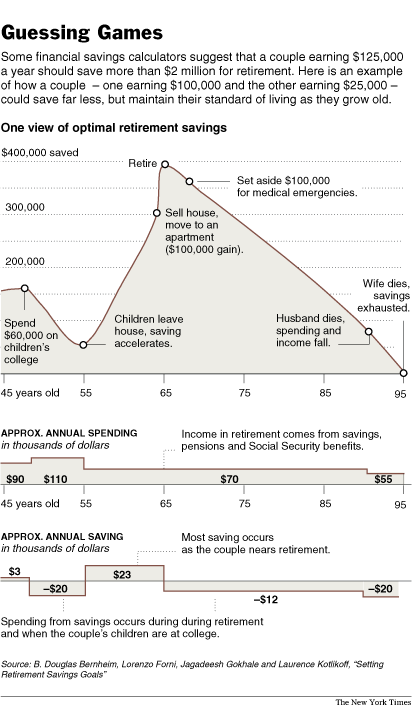
On January 29th, I wrote this article asking the question of whether or not we are over-saving for retirement.  It was based on a fairly interesting New York Times piece on January 27, 2007 on the topic.  Since then, I’ve seen this topic appear fairly often in the personal finance press.

As a reminder, this graphic sums up the issue: spending in retirement is not level, so planning for a steady “80% of your pre-retirement income” may be overly conservative for many.  This graphic does a fair job outlining the issue:

Anyway, Vanguard has recently posted their take on the issue, and it’s worth reading.

Look, you could be cynical and say that Vanguard has every incentive to encourage people to over-save.  After all, they make money on the amount you have saved with them.  However, given Vanguard’s reputation for low costs and history as a staunch consumer advocate for savings, that’s an unlikely scenario.

Vanguard’s response to this issue is really basically the following:

  • It doesn’t take a significant savings rate to accumulate significant retirement wealth
  • It is better to over-save than to under-save, all things considered

It’s the second point that I really believe is the most material.  Look, I wish we lived in a country where everyone had been acting like good little ants, storing away food for the winter.  But that just isn’t the case.  The average retirement account has approximately $56,000 in it, and that isn’t going to cut it.

The WWII generation had three legs to their retirement system – social security, pensions, and savings.  Social security is evolving to a cash-starved system that will only really be there for people with modest means.  Anyone with significant savings will see their social security benefits means-tested and taxed at fairly high rates.  Pensions are also gone, for the most part, largely because the only institutions that can afford them are governments who don’t have to do proper accounting.

So that leaves saving.  As a result, I’m inclined to think that while the argument that common financial planning goals are too conservative might be interesting in theory, it sends the wrong message at the wrong time.  It’s like we’re telling an addicted gambler in Vegas that whoops, we made a mistake, and their savings account isn’t totally tapped out yet.

Investment Lessons from 1957

Wow. Who knew cartoons from 50 years ago were this educational?

Many thanks to Get Rich Slowly for this one.

Here’s a 1957 cartoon about the virtues of stock market investing from the New York Stock Exchange (NYSE). Fred Finchley is a family man with a good job, a lovely wife, two rambunctious children, and all the conveniences of modern life. What he doesn’t have, however, is enough money to pay for his dream vacation.

When Finchley’s boss gives him a raise of $60 a month, he faces a dilemma. Should he use the money for savings? For a couple of nights on the town with his wife every month? The NYSE suggests that Finchley put his money to work in the stock market with a “monthly investment plan”.

“Working Dollars” does a good job of explaining how dollar cost averaging works. The cartoon makes a case for small, regular investments. Investing isn’t just for tycoons — using a monthly investment plan, even the average family can begin to acquire wealth.

It may not seem like it, but this cartoon was extremely well thought out, and the personal finance advice it offers is just as applicable today. Of course, I’m not sure how excited anyone would be with a $60/month raise right now, but I’m pretty sure the point is made with $600/month or more.

The most interesting subtlety is highlighted well by Get Rich Slowly, and I couldn’t agree more. The biggest danger in personal finance is lifestyle inflation, the tendency to increase expenses with any increase in income. The danger is, of course, that income is hardly reliable, but once you get used to a certain lifestyle, it’s incredibly hard to dial down expenses. This is particularly topical for people who work in high risk/high volatility jobs, like technology and sales. Even if you have steady pay, retirement often involves a shock to the system in terms of income.

A neat find.

Is there a Roth IRA & Roth 401k Paradox?

I’ve been thinking about the new Roth 401(k) a bit, and running some numbers to figure out whether or not it is a better option than the regular 401(k). Originally, this post was going to be a post about those results, with an eye towards helping people who are making the same decision. Instead, however, I feel like I stumbled on a financial planning paradox.

Let me explain.

A Roth 401k is a relatively new option that some employers have started to offer as a retirement benefit to employees. With a Roth 401(k), like a Roth IRA, you do not get a tax deduction from your income on contributions. However, when you retire, you do not have to pay taxes on your withdrawals. In fact, when you leave the company, you roll it over into a Roth IRA, and it behaves just like any other Roth IRA.

If you exclude the estate planning benefits of Roth IRAs (which are significant in some situations), running the numbers shows that basically the Roth 401(k) is a big bet on your tax rate. With the Roth 401(k) you are betting that your tax rate when you retire will be higher than your tax rate now.

For example, let’s take an employee, Bob, who is 35-years old and has been able to save $5000 a year in his normal 401(k). In 2007, his company launches a Roth 401(k). Bob has a 31% marginal tax rate. Bob has the uncanny ability to generate exactly 8% on his investments, year-in, year-out. Should Bob switch over?

Well, Bob has been able to contribute $5000 to his old 401(k), so let’s just assume that’s the pre-tax cash he has available for retirement, period. If Bob contributes $5000 to his normal 401(k), he will have accumulated $566,416.06 by the time he is 65 years old. If we assume Bob can safely withdraw 4% of that per-year in retirement, he will generate $22,656.64 in income per year. However, he needs to pay tax on that income. Assuming his tax rate stays the same at 31%, he’ll get $15,633.08 per year after tax.

But what if Bob switches to the Roth 401(k)? Well, he no longer gets the deduction from his income, so Bob can’t afford to put $5000 per year into the Roth 401(k). With a 31% tax rate, Bob can only afford to put in $3450 (yes, I am grossly oversimplifying all the payroll taxes for this example). At $3450 per year, Bob will accumulate only $390,827.08 by the time he retires at 65. Sounds like a bad deal, right?

Wrong! That $390,827.08 is tax-free. If Bob pulls out 4% per year, he will pull out… $15,633.08 per year! That’s right, the same exact number! The Roth 401(k) is a wash.

Well, as usual, it’s not that simple. If the tax rate at retirement is only 28%, then the regular 401(k) wins. At a 28% rate, Bob gets to keep $16,312.78 per year. If the tax rate is 35%, then the Roth 401(k) wins. At 35%, Bob would only keep $14,726.82 per year.

So you could argue the Roth 401(k) is a big bet – will your tax rate be higher or lower in retirement? Some young people might believe it will be higher. When you start working, often you are at the bottom of your earning potential, and you might have big plans for your accumulation of assets over the next 40 years. Also, if you’ve read the Ben Stein book, you know that neither the US Government nor individuals are saving enough for retirement. That means higher tax rates in the future as the US Government tries to close the gap.

But they could be lower too, right? Are you really going to save enough to replace your current income? Do you need too? After all, in retirement, you aren’t paying off a mortgage, you aren’t putting kids through college, and you aren’t spending as much on clothing or consumables.

Tough call.

Now, there is a special case that doesn’t come down to this bet. What if Bob actually had $30,000 per year to save, but the 401(k) maximum is only $15,500 in 2007? Well, in that case, the Roth 401(k) is the better bet for sure, because saving $15,500 per year tax-free is better than saving $15,500 per year in an account that will eventually pay taxes.

But let’s ignore that case for now, because I want to explain the paradox. It’s really bugging me.

Let’s say you believe your tax rate is going to be higher in retirement. You put your money into Roth accounts to protect them. In fact, you manage to get all of your retirement assets in there.

Well, in that case, all of your retirement income is tax-free, which throws you into a lower tax bracket. In fact, the lowest tax bracket. And that makes your initial assumption false – you would have been better off taking the tax deduction when you were working.

BUT if you don’t put your money in Roth accounts, you’re back to square one, where it looks like your future tax rate will be higher than now.

This loop does have a solution – basically you should put some of your money in Roth accounts… enough to bring your taxable income in retirement down to a level that is equal to your current tax rate. That’s a really complex calculation when you consider issues like Social Security and predicting the tax structure of the US in 2040.

So, if you are fortunate enough to have high enough savings where you max out your retirement accounts, you probably don’t worry too much about this. Stuff your Roth 401(k) to the brim, and use other savings vehicles to cover the excess.

But if you don’t have that much money, the right answer is likely a mix of both taxable and non-taxable accounts. What that right mix is will be based on your estimation of how high your tax rate will be when you retire.

Don’t forget, this logic also applies to that famous 2010 loophole in Roth IRA conversion that I wrote about last year. The question of whether or not to covert is all about this bet on future tax rates.

If it helps, here are a few more articles I found on this topic. I hope my explanation above helped more than it hurt. 🙂

Do You Know the Rule of 72? Project Future Returns in Your Head.

I haven’t posted a lot about personal finance lately, and I’ve been meeting to get back on the horse soon.  In the meantime, this is a fun one for those of you who may not have heard it before.

When investing for a long term goal, like college or retirement, it’s often very useful to be able to quickly determine how long it will take to double your money.

Enter the Rule of 72.

Now, the Rule of 72 is shorthand, and not completely accurate.  But it’s accurate enough to be immensely useful.

The Rule of 72 says that if you divide 72 by the rate of return on an investment, you’ll get the number of years required for that investment to double.

So, if you find an investment that returns 8%, 72 / 8 = 9, so the investment will take 9 years to double.

I learned this rule about 15 years ago from my grandmother, and I’ve been using it for quick shorthand ever since.

For example, let’s say I want to know how much a $50K 401K might be worth over time.  Assuming an 8% rate of return, I can quickly determine that it will double in 9 years, quadruple in 18 years, octuple in 27 years, and be worth $800K in 36 years.

This also works, unfortunately, for loans, but in reverse.  If you take a student loan out at 7.2% for 10 years, well, you can expect to end up paying double what you borrowed in total.

I’ve also used this rule in business environments, especially when you are looking at compounding growth rates for business metrics like sales, revenue and costs.

Once again, the rule is really a shorthand, and not completely accurate.  Obviously, a 72% return doesn’t double in 1 year.   And a 1% return doesn’t double in 72 years.  However, it’s surprisingly accurate in the middle ranges, which apply to most situations.

This article in Get Rich Slowly has some variants that are fun. But for me, the basic Rule of 72 lets me quickly an easily assess what a return will really mean to an investment, in those rare moments when I’m away from Excel.

So enjoy this tidbit, and I’ll get to some meatier topics this week.

How to Check the Status of Your Tax Refund

Did you file electronically this year? Waiting for your refund?

This tip from the blog GetRichSlowly:

Are you getting antsy for your tax refund? You can check the status of your refund easily with this simple web-based tool from the IRS web site. You’ll need to provide your social security number, marital status, and exact refund amount in order for your request to be processed.

If you are receiving a large refund, consider having your employer adjust your W-4 so that less is withheld from your paycheck. This will, in essence, spread your refund out over the course of a year. If you have the discipline to use this money wisely, you’ll have use of it much earlier than if you had waited for a refund.

The IRS website tool is located here.  Enjoy.

Personal Finance Education Series: (5) Diversification & Asset Allocation

It has been quite a while since I’ve posted as part of my personal finance education series, but it hasn’t been for lack of desire to do so. This is the first post that starts getting into topics on investing, and as a result, it has taken me a bit of time to collect my thoughts.

If you haven’t had a chance to review the previous two posts on Saving and Emergency Funds, please do so. It only makes sense to start talking about investing for the long term when you have the basics of good financial hygiene in place. It makes no sense to own stock in Google or money in an exchange-traded fund if you are having trouble paying off your credit card.

Of all the chapters to come in this series, however, this one is probably the most important to take to heart as you manage your own long term investments.

It turns out that the most important decision for your investments is not trying to find the next hot stock nor trying to find the savings account that pays the highest rate. It’s not finding the best new type of bond to own, and it’s not finding the lowest expense ratio. These are all important, but most likely not the biggest determinate of your investing success.

It turns out the most important decision you make with your investment dollars is how you divide your assets between different types of investments. This one decision tends to explain the majority of success and failure that people see in their investment portfolios.

Let me explain, at a high level.

It turns out that there are many different ways to invest your money. These different types of investments have different characteristics. Some people over-simplify this to whether one type of asset is “riskier” than another, but it turns out that risk comes in many flavors.

Some investments have returns that are very unpredictable in the short term. Others are extremely predictable. This is sometimes referred to as volatility.

Some investments require your money to be locked up for long periods of time. Others provide you easy access to your money. This is sometimes referred to as liquidity.

You have probably heard the names of a lot of different types of investments thrown around:

  • Cash
  • Bank Accounts
  • CDs
  • Money Market Funds
  • Bonds
  • Stocks
  • Mutual Funds
  • ETFs
  • Gold
  • Timber
  • Real Estate
  • Commodities
  • etc…

There are no shortage of different types of investments out there. Each has its own characteristics; its own strengths and weaknesses. What makes it even more confusing is that some types of investments, like mutual funds and ETFs, are really just structures that invest in other types of investments (like stocks & bonds).

The whole idea behind diversification is a reflection of that age-old advice “don’t put all of your eggs in one basket“. By spreading your money around to different types of investments intelligently, you increase the chance that when one of your investments goes down, another will be up. This smooths out the ups and downs, and makes it much more likely that you’ll hit your investment goals.

For most people who don’t have truly large sums to manage, there are only three types of assets that are applicable to most savings goals like retirement or college. They are:

  • Cash
  • Bonds
  • Stocks

Cash investments can take many forms. Some people keep their case in bank accounts or money market funds. Historically, cash investments tend to barely return any money after inflation, which means that they pay interest rates that increase roughly at the same rate that prices increase. They are the definition of liquidity, typically offering you access to your money easily and on extremely short notice.

One of the common mistakes that people make when investing for long term goals is keeping too much money in cash. Because of the low returns, over long periods of time, cash can act like a big anchor on your portfolio, limiting your ability to compound your returns over time.

Assuming you have an emergency fund of three to six months in cash, the purpose of cash in your long term portfolio is really just for three things. First, it cushions downturns in the market, since your cash portion never goes down. Second, it provides you with extra money to invest when other assets become relatively cheap. Third, it provides you with liquidity. It’s terrible for your returns to be forced to sell other assets when they are down, just because you need the money. Cash is always there for you, protecting you from yourself, making sure you don’t end up buying high and selling low.

Bonds come in many different flavors, but fundamentally all a bond is a loan. If you need to borrow a large amount a money, one way to do it is to sell bonds. For example, a company can easily “borrow” $1 Billion by selling 1 million $1000 bonds. The buyers of the bonds get a piece of paper that promises them their money back, sometime in the future, plus interest.

Bonds have been around a very long time, and as a result, there is every imaginable variety. You can find bonds from governments and companies, bonds based on mortgages or utility revenue. There are bonds that pay interest every 6 months, or only at the end of the term.

Historically, bonds have returned an average of about 1.7% above inflation, so while you will see your money grow, it won’t grow quickly. This number, of course, is a horrendous average – there are many varieties of bonds with their own histories and returns. Fundamentally, however, most people turn to bonds when they want to see higher returns than cash, and they are willing to sacrifice liquidity to get it. By locking up your money for a longer period of time, you hopefully will see higher returns.

Bonds have a lot of unique risks. There is the risk that the company will default on the bond, and never pay it back, known as default risk. There is the risk that interest rates will go up, making the bond you bought at a low rate less valuable, known as rate risk. There is the risk that inflation will grow, effectively erasing the value of your bond interest, known as inflation risk. If you want to get fancy, there is even currency risk, since your bond will tend to be denominated in only one currency.

Right now, the interest rates available on cash investments are so high relatively to bonds, that some people advocate not putting any money in bonds right now. Most financial planners, however, will tell you that keeping a set mix of stocks & bonds will smooth out your long term returns significantly, and lower the risk that you’ll end up missing your investment goals. Historically, there have been long periods of time where bonds outperformed stocks, and having money in bonds can ensure that when stocks are underperforming, your portfolio will survive to fight another day. Ben Stein captures this really well in his recent book, which I reviewed here.

Personally, I tend to group cash & bonds together in my asset allocation, since I find it useful to think of cash as just another type of bond that happens to have very high liquidity, and relatively lower returns. Sometimes, however, cash can be the best place for the “fixed income” portion of your portfolio at times. Right now, it’s hard not to like the 5.05% you can get at E*Trade or EmigrantDirect on a bank account with no minimums and liquidity.

Stocks are the most common basic investment in modern personal finance for achieving long term investment goals. Historically, they have returned approximately 6% over inflation, meaning that they are one of the few asset classes to aggressively grow your spending power over time. Stocks are really just pieces of paper that give you part ownership in a business. When a company like eBay has 1.7 Billion shares, each share is like owning a little piece of the overall business.

Stocks are incredibly liquid, and are now freely traded world-wide. Stocks are also incredibly volatile, with prices moving up and down every minute, every day. Because of this, stocks have a reputation for being risky. If you have all of your first house down payment in stocks, it is possible for that account to drop more than 20% in a single day, and that’s bad news if that’s the day before closing.

In the long term, a diversified portfolio of US stocks has been an incredibly rewarding investment. As a result, people have a hard time balancing the short term risk of stocks with the long term risk of not owning stocks.

For most people, even those in retirement, a significant portion of your portfolio likely belongs in stocks. However, it is extremely important to balance that investment with other assets, and to be realistic about how much volatility your investment goals will allow for.  Most Americans have too much of their long term savings in cash, and too little in stocks.

There are over 9000 public stocks in the US alone, and there are many different kinds of stocks.  There are giant companies like General Electric & Microsoft, and tiny companies you have never heard of. As a result, having a diversified portfolio of stocks is likely the most important aspect of this asset class.  I’ll post a whole separate chapter on this topic.

This has been an extremely long chapter, and we haven’t even scratched the surface on some of these topics.  There is one last topic I want to illustrate, and that is the benefit of rebalancing your portfolio based on an asset allocation strategy.

Let’s take a hypothetical portfolio of $10,000 broken down as:

  • 10% Cash:  $1000
  • 30% Bonds:  $3000
  • 60% Stocks:  $6000

Let’s assume that the Bonds and Stocks are represented by broad, cheap index funds from Vanguard.

Let’s say that Year 1 is really bad for stocks, and mediocre for bonds and cash.  Stocks return minus 10%, and bonds return 4%, and cash returns 5%.  Your portfolio becomes:

  • $1050 Cash
  • $3120 Bonds
  • $5400 Stocks

No question, it’s bad news.   Your portfolio is now worth only $9570.  However, if you had been 100% in Stocks, you’d be down to $9000.   The Bonds & Cash cushion the blow of a bad year on the market.

Since your goal is a 10%, 30%, 60% split, you want to rebalance your portfolio once a year.  This means moving your money around so that you now have:

  • $957 in Cash (10%)
  • $2871 in Bonds (30%)
  • $5742 in Stocks (60%)

Basically, you move money from the assets that did well this year, into the assets that did poorly.  This may seem counter-intuitive to those who believe in going with their winners and selling their losers, but this single act encapsulates one of the most practical benefits of a good asset allocation strategy:  it forces you to sell assets that are high, and buy assets when they are low.  Assets tend to regress to their average performance, so this rebalancing has been proven to be a winning strategy to avoid the very human mistake of buying investments when they are high, and selling them when they are low.

Let’s look at what happens in Year 2, assuming that an “average” year happens.  Cash returns 3%, Bonds return 5.5%, and Stocks return 10%.

  • $986 Cash
  • $3029 Bonds
  • $6316 Stocks

As you can see, by moving money into Stocks after the down year, the portfolio is set up for better performance when stocks do, inevitably, recover.  This wouldn’t be possible, however, without having money in different asset classes.  It also assumes extremely good diligence and fortitude to rebalance every year.

Whew!  Long chapter.  A lot of great topics.  For those of you waiting for more detail on each asset class, I plan on having the next few chapters focus on individual asset classes and investment goals.

Reminder: April 17, 2007 is Your Last Chance to Fund a 2006 IRA

This is just a reminder that tomorrow, Tuesday, April 17th, 2007, is your last chance to fund an IRA for the 2006 tax year. After tomorrow, you will have lost the chance forever to make your contribution for 2006.

You can contribute up to $4000 in 2006 towards an IRA if you are under 50. If you are 50 or over, you can actually contribute $5000 in 2006.

Many people don’t realize that even if you have a 401(k) or 403(b) plan at work, you can still qualify to contribute to an IRA.

Assuming that you are not opening an IRA for your partnership or business, there are four IRAs to be aware of:

  • Deductible IRA. This is what most people think of when they think of an IRA. This is a retirement account where you get to deduct your contributions for the year off your income on your tax return. The problem? You can’t deposit into this type of IRA if you have a 401(k) or 403(b) plan at work, and people over a certain income are disqualified.
  • Roth IRA. The hero of the hour. This is the IRA that everyone is talking about. You don’t get a tax deduction this year, but you get a better bonus down the road. All gains on this IRA are tax-free, forever, as long as you withdraw them after the age of 59 1/2. Problem? You can’t contribute to this IRA if you make more than $110,000 as an individual, $160,000 as a married couple filing jointly.
  • Rollover IRA. You can’t contribute to this type, but this is a great place to move your 401(k) money from your old company. It keeps the tax status of the old 401(k), and it usually gives you access to a much wider variety of investment options. Better yet, you have the option of either converting this IRA to a Roth IRA, if your income permits, or you can roll it into a future company 401(k) if you’d like.
  • Non-Deductible IRA. This is the over-looked gem of the IRAs. Anyone can contribute to these in any year, regardless of income. You will owe taxes on the gains when you withdraw them in retirement, but they get to compound tax free until then.

There are several good reasons to consider an IRA contribution this year, even if it’s non-deductible:

  • You never get the chance to go back and make contributions for past years. You lose your option to make a 2006 contribution tomorrow, forever.
  • You can now make IRA contributions for a spouse that does not work, up to $4000 for a year.  A great addition if you are in a one-income household, and you are concerned that your retirement savings are limited.
  • In 2010, thanks to the 2006 budget, you will get the ability to convert a non-deductible IRA to a Roth IRA, regardless of income! Check out my post on the 2010 Roth IRA Conversion Loophole for more information.

Reasons not to make an IRA contribution for 2006:

  • You can’t afford the drop in liquidity of having your money locked up for potentially decades.
  • You forgot about the April 17th deadline, and read this post too late.  🙂

Opening up a new IRA is extremely low cost, if not free. E*Trade offers free IRAs. Vanguard offers IRAs for only $10. You can open them online, with a transfer direct from your checking account.

Happy Saving!

How to Track Prosper Loans in Quicken 2007 (Mac OS X)

So, a few confessions to start this off.

First, I am still a Quicken addict. It has been thirteen years, I think, since I started using Quicken in earnest to track my finances, and I’m still at it. Despite absolutely terrible releases of the software, and lackluster Mac support, it’s still one of my must-have applications.

Second, I am a big fan of Prosper.com. I found Prosper when it was CircleOne, through some friends from eBay who left and joined the company. As a result, I’m a founding group leader (though not a very successful one), and a shareholder.

Earn 8-12%. Great Returns. No Banks. Borrow Money From People. Low Rates. No Banks.

So, with those confessions out of the way, on to the good stuff.

If you don’t know what Prosper is, it’s basically a marketplace where you can easily borrow money or lend money to other people. Consumer debt is very expensive, so it’s potentially a way for individuals to get cheaper rates borrowing, and for lenders to make higher rates than normal saving options. Here is a Q&A on Prosper from Money Magazine. Here is a write-up in Forbes of some strategy when dealing with Prosper.

If this sounds crazy to you, here are some of the rates you can earn on Prosper. Note that even for the highest risk borrowers, right now the default rate is around 3%. 24% – 3% is a very good return, but only if you spread your money around with a lot of very small loans.

For the past year, I’ve been struggling with an appropriate strategy to track Prosper Loans in Quicken. I found some information through web searches that seemed appropriate for the Windows version of Quicken, but didn’t work for me on the Mac. The idea was to create an Asset account, which is the loan, and then to set up a loan paid from the asset back to the Prosper account. I couldn’t figure out how to do it.

Since I had trouble finding a solution for this online, I thought I’d post my solution here. Feel free to comment if you’ve found a better way to track Prosper loans in Quicken.

Step 1: Create a Security for each Prosper Loan. I name them after the unique Prosper Loan number, like “Prosper Loan 335”

Step 2: Create a Brokerage account for your Prosper account. Transfer the money from your checking account to this account when you move money to Prosper.

Step 3: When you make a loan for a certain amount, let’s say $100, then purchase the shares of the Prosper Loan security, at $1 per share. So, in this example, you would purchase 100 shares of “Prosper Loan 335”

Step 4: Whenever you want to update the account, use the following 3 transactions. Use a “Sell Shares” transaction to represent the principal re-payment. Use a “Interest Income” transaction to represent the receipt of the interest payment. Lastly, use a “Miscellaneous” transaction to record the Prosper fees charged.

This is likely too much work to do monthly, although you need to if you want Quicken’s IRR calculations to be accurate. Personally, I’ve decided just to update the account once every 3-6 months, which is sufficient for my needs.

Let me know what you think… if this helps even one Quicken addict out there, it will have been worth it. 🙂

Update (4/9/2007): This is why I love blogging. AMF posted my blog comment on a Prosper Board, and now there are good comments there too. Check it out!

Update (4/10/2007): RateLadder.com has their own solution… not as accurate as the one above, but worth linking to. I agree with them that it would be better for Prosper to offer a Quicken-compatible download format.

Update (4/10/2007): Are you interested in joining Prosper.com? If so, please join my group. I originally started it for my investment club, but I’m changing it to be an open group for friends & family. I feel a little lame right now because I only have 3 members in my group, and I am a founding group leader.

Update (4/10/2007): Rateladder.com has merged their approach with mine in a hybrid approach that tracks you entire Prosper portfolio as a single security. Only 3 entries per month! The only downside is you can’t track the performance of each loan this way. Check it out here.

Update (4/11/2007): OK, last update. But Rateladder.com has followed up with a finally post on the topic. Between the two of us, I think we’ve provided the best way to handle this until we convince Prosper to provide downloadable transactions.

Pssst. Want Some Hot TIPS? Buying Inflation Protected Bonds.

One of the blogs I read regularly is The Finance Buff.  This past week, he has posted four times on the topic of inflation-protected bonds, TIPS and Series I Savings Bonds.  As a result, I thought I’d post some pointers and comments here.

First, as I mentioned in my personal finance series, Series I savings bonds are an interesting option for an cash emergency fund.   Series I savings bonds have the following advantages:

  • After 12 months, you can cash them in at a moment’s notice.  Great liquidity.
  • You can buy up to $30K of them in any year.
  • You can buy them direct from the government with no fees at the Treasury Direct website.
  • You owe no income taxes at all until you sell them.
  • You never owe state or local income taxes on the gains, even when you do sell them.
  • You won’t owe federal income taxes on the gains if you use the money towards a qualified educational expense, like college tuition.
  • Your money is guaranteed to grow above the rate of inflation, re-adjusted every 6 months, for the next 30 years.  You are given a fixed rate above inflation, measured by the CPI-U index, which measures inflation in urban areas.

Right now, Series I Savings Bonds pay 1.4% + inflation.  Given that historically, money market funds have basically matched inflation over time, and bonds have only beaten inflation by about 1.7%, that’s a pretty good deal, by historical standards, for something that is at least as liquid as a 1-year note.

In any case, the Finance Buff doesn’t like the Series I Bond rate.  In fact, because inflation is so low, he sold his Series I Bonds in November, taking the 3-month interest penalty.

Instead, the Finance Buff likes TIPS, which are the inflation-protected version of normal US Government Bonds.  TIPS are offered in terms of 10 years and 20 years, and right now they are paying a whopping 2.63% over inflation!  Given that the historical return of bonds is below that amount, I can see why he likes them.

Unfortunately, TIPS do have a down side or two:

  • While you are paid the interest every year, the inflation value accrues every year to the bond principal.  What that means is that you owe taxes on the inflation gain every year, but you don’t get the cash to pay the taxes.
  • TIPS are only available in high dollar amounts.
  • TIPS, like other bonds, can be sold before maturity.  However, there is no guarantee of the price you’ll get if you sell them before they mature.  To guarantee your return, you have to hold them the full 10-year or 20-year period.

Here is a great post from the Finance Buff on TIPS.

I have to post this great snippet from his follow up article on pricing TIPS.  It’s fairly complex, but I love seeing the hard math posted for some reason.  Check it out:

I tip my hat to you, sir, for posting that.  🙂

In any case, I had to think about why I’m still such a fan of the Series I Savings Bonds.  I think it is because of the context that I use them – as a cash-equivalent emergency fund.  I’m not looking at them as a bond investment, but as a form of cash.

As I stated, cash equivalents, like money market funds, over time have returned an average of 0% over inflation.  So the idea of getting better than that on my “safety money” appeals to me.

That being said, the rates on high yield internet savings accounts, like Emigrant Direct, are well over 5% now.  With inflation as low as it is, that’s a serious yield also.  With no risk, money available at any time.  Government protected, even, up to $100K!  Hard to argue with that.

The problem is, there are penalties around selling Series I Bonds too early, and there are significant tax advantages to consider.  Interest on a bank account goes on your 1040 every single year, and is taxed at federal and state levels.  There is also no guarantee that these type of high-yield savings accounts will be around forever, although they’ve been pretty consistent over the past 5-7 years.

I’m lucky, because the Series I savings bonds I purchased in 2002 have a 2.0% premium over inflation, so they are paying a higher rate that the bonds you can buy today.  As a result, I’ll be keeping mine for a while.  Sometimes, like this period, they pay less than 3% interest.  Other periods, they have paid almost 8%!  In the end, to be comfortable with them, you have to be comfortable with earning a fixed amount over inflation over time, and leaving it at that.

You can find out more about TIPS and Series I Savings Bonds on the Treasury Direct website.