Books: The Little Book That Beats The Market, by Joel Greenblatt


One of the great things about travel is that it usually offers me free time to catch up on some reading. On my recent trips to Orange County and Berlin (not in the same weekend), I’ve managed to knock a few more off my reading list. As a result, I’m going to try another book review here on the blog for good measure. Let me know what you think.

The Little Book That Beats The Market by Joel Greenblatt

Overall Rating: Definitely worth the quick read. While the schtick got tiring after a while, the author is clearly intelligent and educated, and the content well thought out. Surprisingly, I found the most interesting part of the book not the “magic formula” itself, but the implicit structure the author put in place to try and help the average investor be successful with the strategy over the long term.

Synoposis: This book is an extremely quick read.  Joel Greenblatt is the founder and managing partner of Gotham Capital and currently teaches at Columbia Business School, so he’s definitely educated in both theoretical and practical aspects of finance.  This book is written in extremely simple and plain language, and he clearly goes out of his way to make it folksy and fun.  I think I finished it in under an hour, appendix included.

Greenblatt’s points are pretty simple:

  • The idea that the market is truly efficient is something that only makes sense in theory.  In practice, you can definitely beat the market.
  • The key to beating the market is to buy above-average companies at below-average prices.  Rinse, wash, repeat.
  • The “magic formula” is an updated method, similar in concept to those outlined by Benjamin Graham (one of my must-read investing books).  The formula is as follows:
    1. Every year, begin with a list of the 3500 largest companies that are publicly traded
    2. Rank them 1-3500 based on their return on invested capital (ROIC).  This tells you how good a business they are, as defined by taking invested money and turning it into more money.
    3. Rank them a second time based on their earnings yield, basically the percent of their stock price you get back every year in their earnings.  This tells you roughly how expensive they are per-dollar of earnings
    4. Add the scores from the two lists together, and then invest in the top 20-30 companies based on the combined score.  Voila, a list of “above average” companies at “below average” prices.
  • This formula will not outperform the market every year.  You have to stick to this formula for at least three years if you want a high probability of beating the market average.

Greenblatt has done his homework, using a detailed 17-year history of stock prices to ensure that this formula, based on information actually available at the time, would have outperformed the market handily.  In fact, he goes to some trouble to explain some other variants of the formula.  The one I outlined above returned an average of 30.8% per year.  That’s compared to a 12.4% return for the S&P 500 over the same period, and a 12.3% return for an even investment in all 3500 companies.

I’m guessing that part got your attention.

When I began investing in the mid-1990s, there was a lot of excitement about the Dogs of the Dow strategy.  It basically said, take the Dow 30 stocks, rank them by dividend yield, and buy the 10 cheapest every year.  The Motley Fool took this one step further, and published their own variant called the Foolish Four, based on a similar concept, with some more gaming around the picks.  I actually bought two of those books – I still have them on my shelf, and I actually invested an IRA according to the Foolish Four for 5 years.  (It beat the market during that period, by the way).

If you think about it, all these strategies say: “buy great companies at cheap prices”.  Now, I think Greenblatt’s formula is much more compelling:  ROIC is a much better measure of a “great company” than being in the Dow 30.  And earnings yield is more compelling to me than dividend yield, since a lot of great growth companies don’t pay out dividends proportionally to slow-growth companies.

However, I stopped investing according to the Foolish Four in 2001 largely because of an insight into a common flaw with all of these strategies – data mining.  It turns out that statistically, if you data mine enough for a “winning formula”, odds are that you’ll find some.  I won’t go into the details here, but it is possible using advanced statistics to estimate the likelihood of finding a “winning formula” through data mining.  So, even when you find one, you have to evaluate it’s results against the fundamental odds that if you look at any pattern of data, there will be “winning”  patterns to a certain degree.

In the case of the Foolish Four, to their credit, the Motley Fool published this analysis, and stopped recommending this approach in late 2000.

So, what makes this magic formula different?

First, Greenblatt is clearly more deeply educated about finance than the Motley Fool, thank goodness.  In his appendix, he runs through six or seven of the common flaws with strategies like these, and explains why this approach is still valid.

One of the most compelling pieces of additional analysis he provides is the fact that this formula seems to actually generate linearly predictive results.  In other words, if you take the top 10% of companies ranked by this formula, then the next 10%, then the next, each decile of companies outperforms the groups below it.

That type of consistency is rare for most quantitative approaches to ranking stocks, and is a good sign that this formula may be useful.

In fact, Greenblatt runs through almost all of the critiques I would expect in his appendix.  The only one he doesn’t address, which to me is extremely important, is the time period bias.  Greenblatt has only tested this approach over 17 years of data.  That means he basically just looked at 1988+.  Given that he includes the longest bull market in history, and then a period of outperformance by value over growth, my guess is that there is significant bias in these results.

Still, my guess is that this formula will still generate outperformance over time.  The best thing about this book is that Greenblatt spends a lot of time explaining that in any one year, this formula can and will underperform the market from time to time.  In fact, he advocates a minimum of a three-year window to evaluate its performance.

I think this is great advice, but likely doesn’t even go far enough.  The stock market, in general, is a long term investment.  Investors consistently buy high and sell low, not because they are stupid, but because in the short term, we rationalize investing in the winners (which are bid up because they are popular), and we rationalize selling the losers (which are low because they are not popular).

Buying high and selling low is a very bad investment strategy.

I’m going to check out Greenblatt’s website, and investigate the analysis for this approach further.  In the meantime, I do recommend this book to people who like value investing, or who are thinking about investing in individual stocks.

A $370M Lottery Jackpot and A Story of a Lottery Winner

I noticed a lot of coverage today about the $370M Mega Millions Lottery jackpot. I found some of the trivia in the coverage interesting, like:

The odds of picking the six correct numbers and taking home the mountain of cash are 1 in 175,711,536. That’s “175,” as in millions. Those odds are even worse than one of those carnival booths where you pitch a dime and try to get it to land on a piece of glass.

1 in 175,711,536. Astonishingly small. Of course, it’s $1 per ticket, and with a $370 Million jackpot, it seems like the expected value of a ticket would be higher than $1… assuming that you don’t end up splitting the pot with someone else.

Personally, I’ve never been a big fan of the lottery. I do have a little libertarian voice in my head that says, “Go ahead. If people want to gamble, it’s their money.” Of course, I have this other voice, call it my nagging sense of social justice that says, “This is just a regressive tax on people who are bad at math or have a low-level gambling addiction.”

I never play, which is why when I ask my wife,

“What would you do if we won the lottery?”

She tells me,

“You have to play to win, honey. You have to play to win.”

In any case, I’ve always been fascinated with the stories of lottery winners who blow many lifetimes worth of money in a matter of years. Similar to professional athletes who blow fortunes after they retire, I’ve always felt that these cases prove that no amount of money can substitute for being educated in personal finance, and being prudent with money.

Well, there is an inspirational story here of a lottery winner who actually handled his money well. Graceful Flavor, which I typically read for Apple-related news, had a nice write-up on this story. The original article actually breaks down what this winner spent his money on:

  • $45 million: Safe, low-risk investments such as municipal bonds
  • $35 million: Aggressive investments like oil and gas and real estate
  • $1.3 million: A family foundation
  • $63,000: A trip to Tahiti with 17 friends
  • $125,000: Mortgage retired on his 1,400-square-foot house
  • $18,000: Student-loan repayment
  • $65,000: New bicycles, including a $12,000 BMC road bike
  • $14,500: A used black VW Jetta
  • $12,000: Annual gift to each family member

Let’s just walk down the understated brilliance of how this man, Brad Duke, actually allocated his money after winning a $220 Million jackpot. You see, Brad spent time researching the stories of other lottery winners, and I think there are lessons here for all of us who may (hopefully) be faced with a small windfall someday.

  1. Municipal Bonds. This is exactly right. Largely risk-free, this guarantees Brad a tax-fee investment that will provide regular income, indefinitely, and will likely match inflation over time. This provides a wonderful base of income for him, indefinitely.
  2. Aggressive investments. This is likely his riskiest endeavor, but with a base level of income guaranteed, he has freedom here to be more aggressive, and try to scale his assets over time.
  3. Family Foundation & Gifts. Nice clear breakout of what he’ll be giving to charity, and gifts to family members. Note the lack of family members “on the payroll” – a sure-fire track to the money problems.
  4. Trip to Tahiti & Bicycles. You have to celebrate. $128K is not a large amount here, and it represents some fun with the winnings. Most personal finance experts agree that if you try to save every single dime, you can end up feeling deprived, and it can lead to impulsive behavior. This trip sounds like a great way to have fun, do something extravagant
  5. Student Loan & Mortgage Paid Off. In the world of debt, student loans and mortgage are the best possible forms of leverage. Low interest, with tax advantages, and typically a large payoff on the investment. Still, once you have ample assets, reducing debt reduces risk. It’s that simple.
  6. The Used Jetta. This is probably what impresses people the most. He sold his 2005 car, and bought another used car! This is a good sign of someone who isn’t frugal because they have to be, but because they just don’t like to waste money.

It’s hard to say what you might do with a windfall of $100,000 or $100,000,000. Oh, I guess it’s easy enough to guess, but I have a feeling that reality is always more complicated than idle dreams.

Living in Silicon Valley, it is not uncommon to have friends and family who come across fairly large windfalls. A company goes public, or is sold. A relative passes on an inheritance. The fact that so many people who have large windfalls in their lives end up losing the money in short order is a warning. Managing money is difficult, and the right habits and the right attitude towards it will likely benefit you at any asset level.

Of course, you do have to play to win.

Putting a Big Stock Market Drop in Perspective

I have so many things to post about today, I doubt I’ll get to them all.

However, I couldn’t let the day close without commenting on the big financial news, namely the fairly large drop in global stock markets today. The AP Wire has a nice summary of the financial metrics from the day:

It began Monday with a 9 percent slide in Chinese stocks, which came a day after investors sent Shanghai’s benchmark index to a record high close, setting the tone for U.S. trading Tuesday. The Dow began the day falling sharply, and the decline accelerated throughout the course of the session before stocks took a huge plunge in late afternoon as computer-driven sell programs kicked in, and also as a computer glitch caused a delay in the recording of a large number of trades.

The Dow fell 546.20, or 4.3 percent, to 12,086.06 before recovering some ground in the last hour of trading to close down 416.02, or 3.29 percent, at 12,216.24, leaving it in negative territory for the year. Because the worst of the plunge took place after 2:30 p.m., the New York Stock Exchange’s trading limits, designed to halt such precipitous moves, were not activated.

In the grand scheme of things, today’s move in the stock market was neither unusual nor extremely worrisome for a long term inventor with a well thought out asset allocation. However, people are not rational with money, and loss aversion is one of the best documented aspects of behavior finance. Most research available on the topic demonstrate repeatedly that people tend to value the loss of a dollar three times more than the gain of a dollar. It’s amazing, really. The joy you likely feel seeing your portfolio up $1000 is likely 1/3 the pain you feel when you see it drop $1000. That is not a recipe for rational decisions.

I’ll be writing my next article in my personal finance education series soon, most likely on the topic of asset allocation and long term investing. Days like today can be extremely stressful if you are in the stock market for the wrong reasons, with the wrong goals, or with the wrong expectations. However, days like today can be a blessing if they force you to really embrace what risk really means in terms of the day-to-day unpredictability of the stock market.

In the meantime, however, I’d like to share an article written today by Vanguard, the puts market volatility like today’s in perspective. Here are a few lines that I felt were extremely well put:

“There’s no doubt that a big drop in stocks can be tough on your nerves and your account balance,” said Gus Sauter, Vanguard’s chief investment officer. “But after a day like Tuesday, it’s more important than ever to maintain a long-term perspective…”

Tuesday’s decline put the stock market’s return so far in 2007 into negative territory. But over the past 12 months, the broad stock market has still produced a total return—price appreciation plus dividend income—exceeding 10%. That gain, coincidentally, is roughly the long-term average annual return for U.S. stocks….

“We’ve had a very nice rebound in stocks since the long bear market that began in early 2000 and stretched into 2002,” Mr. Sauter said. “So it’s not surprising to see a pullback…”

As investors digest the volatility of the market and the flood of commentary that always accompanies such events, it may be helpful to reflect that no one can say whether stocks will continue to decline or whether they’ll soon rebound. What is clear is that few, if any, investors have a demonstrated ability to consistently pick the right times to get in—or out—of the markets…

“The stock market never goes straight up,” Mr. Sauter said. “To be a successful investor over the long term, you need to understand this fact and you need to react rationally when the market doesn’t go your way.

Successful investing is a rational, not an emotional, pursuit. If you’ve made conscious, deliberate decisions based on your personal financial goals, time horizon, and your tolerance for risk, there’s no reason to change your plans.”

One of my favorite pieces of advice that I give about investing is that for most people, you know when you are doing it well because it will be boring. For people who do not make their living in the financial markets, it should take very little time to pick a well-balanced, diversified portfolio of assets, and then add money to it regularly. Rebalance once, maybe twice, a year, and you are done.

Personal Finance Education Series: (4) Setting up an Emergency Fund

Enough warm up.  It’s time to get to some real asset allocation.

In my third article, I spent sometime highlighting the importance of setting up a good savings plan.  Fundamentally, this ensures that on a regular basis, you will have extra income that you can dedicate to saving & investing.  For those MBAs out there in the audience, this largely means your assets will be going up and to the right in your favorite little two-by-two charts.

Unfortunately, this is where the complexity really begins, because as you start seeing money accumulate in your checking account, many people freeze up.  They don’t know where to put the money.  Retirement?  Real Estate?  Stocks?  Bonds?  ESPP?  What do you do with the excess cash every month?

Well, this subject of this article is meant to point the way to the very first thing you should do with your excess cash.  You need to set up an emergency fund.

No, an emergency fund will not make you rich.  No, an emergency fund will not be invested in commodities, real estate, or sexy ETFs that mimic the movements of a long/short strategy.  They will not go into straddles or complex derivative strategies.

But, an emergency fund is likely the most important part of a sound savings & investment strategy.  Why?  Because job risk is real and liquidity is king.

Before I get into preaching, let me give you a brief definition of an emergency fund.  The perfect emergency fund is:

  1. Approximately 3-6 months worth of living expenses
  2. Kept in highly liquid, cash-equivalent assets
  3. Available almost immediately, when you need it, for unforseen events

Example.  Let’s say you make $80,000 per year, but your basic living expenses (rent, utilities, dining, student loans, auto costs, etc) comes to $2500 per month.    A good emergency fund would likely be between $7,500 and $15,000, set aside into a high-rate savings account or money-market fund.

I know what you might be thinking here.  That sounds like a lot of money to not have invested for the future.  $15,000 could be $30,000 in just a few years if invested aggressively.  $100,000 in a couple decades.  $250,000 by the time you retire.  Why lock it away into something like a money-market fund?  That will barely cover inflation!

Two reasons really.

First, job risk is real.  You have to be the judge of this personally, based on your field, education, company, and risk tolerance.  I personally work in the high tech industry, and this is a field that can move hot and cold relatively quickly.  In a hot job market, jobs come knocking on your door.  Unfortunately, people most often lose their job in exactly the type of environment where you don’t find jobs that easily.

Your emergency fund is your safety net.  It is a guarantee that you can continue to lead your life, relatively securely, as you search for new work.  3-6 months is a good average for people who think that, for the most part, that represents a successful job search time in a down market.  When I worked in venture capital, it was not unusual for people to be “between firms” for over 12 months.   The modern workplace has very little job security, and this is where you protect your downside, not shoot for a big upside.

Second, liquidity is king.  When the unexpected happens – whether it is an unforseen medical issue, job loss, or other unforseen crisis, you learn a painful truth about your finances.  That truth is that no matter how much money you have on paper, it is liquidity that rules the day.  Liquidity is defined as your available to translate your assets into cash, quickly, to make needed payments.

Cash in your wallet defines liquidity.  Cash in a checking account can be accessed almost immediately.  A Certificate of Deposit (CD) is a bit harder – you usually have to go through a processs to cash that out early, with penalty.  A stock?  You have to sell it, and wait days for the money to clear.   An IRA or 401(k)?  That takes time to break, and there is a stiff penalty for withdrawals.

When I graduated from business school, my student loans were at their peak, my wedding expenses were coming due, we relocated back to the Bay Area, my wife was looking for work, and I had just kicked off my new job in venture capital.  I was fortunate to have stashed away enough liquid assets to cover everything, but it was close.  You don’t want to get to a place where your remaining liquidity options are consumer debt, breaking into retirement savings, or other expensive sources of funds.

My top personal finance priority at the time, as per my learnings from books and magazines, was to build an emergency fund.

Many people keep their emergency fund in an extremely liquid account, like a local bank checking account.  You do not want to count on high interest options, like credit cards, or options with large penalties, like retirement accounts, when you are in a pinch.  Personally, I think there are a few more options that can help make sure that your idle cash is still extremely liquid, but still beating inflation for you.   The best options, in my opinion, are the following:

When banks compete, you win!  Ah, free markets.  Got to love it.  Every bank that wants to break into the consumer market does it by offering, for several years, a very high interest rate savings account.  Three years ago, ING Direct was the best.  Last year, Emigrant Direct.  This year, who knows, even E*Trade offers over 5% on their cash balances!  The point is, it’s very easy to find a high-interest savings account, and with electronic transfer between banks being free for sites like E*Trade, you can put your funds in any account that pays alot, and still have access to your funds within a few days.

Series I Savings Bonds.  Guaranteed to Beat Inflation.  Savings bonds are not as liquid as they used to be.  In fact, there are penalties if you try to cash them out in less than five years, and you can’t actually cash them out in under one year.  So why do I recommend them?  The rates on Series I bonds are subsidized by the US Government.  They are guaranteed to pay out a fixed amount above inflation, which is calculated every 6 months.  For example, I have some from 2002 that pay 2% above inflation.  So if inflation were 3.4% this year, the bonds would pay 5.4%.  But here’s the bonus.  You don’t owe taxes on the gains unless you cash in your bonds!  That means, they accrue value, for up to 30 years, with no tax bill.  Also, for parents out there, if you use the bonds toward education expenses, there is no tax due, ever.  Also, no state or local income tax.  It’s a good deal, and if you can get through the first year, they are very liquid, since you can cash them in at any time after that.

Everyone’s comfort-zone with emergency funds is different, but if you don’t have an emergency fund accumulated, it should be your very first savings goal.  Saving up 3-6 months of expenses isn’t easy, so you want to put away your monthly savings into your fund until it reaches your goal.  Don’t forget to “top it off” every year as your income and expenses likely increase over time.

Remember, the emergency fund is in place to protect you, your family, and your investments from unexpected problems.  Some of your best investments, like stock funds, are designed to provide optimal returns when invested for the long term (5-10 years).  If you are constantly withdrawing and then re-adding funds into your long term investments, you will wreck your returns.   If you end up hitting your IRA or 401(k) during a tough time, you can set back your retirement goals by a decade or more.

An emergency fund not only protects you, it also protects your long term investment strategy from dark times.

So don’t focus on the fact that you could be making more on that money.  Focus instead of that money as the enabler of the rest of your investment portfolio.

All of my upcoming articles will assume that you’ve done the right thing, and built your emergency fund up first.  In fact, I will argue that building up an emergency fund is even more important than repairing the ultimate sin of personal finance – carrying a balance on your credit cards.

Here are a few articles that are worth reading on emergency funds.  I like this piece, on BankRate.com.  There is an excellent blog post on the topic, from last year, on GetRichSlowly.org.

Personal Finance Education Series: (3) It All Starts with Saving

I thought it was important to dedicate a chapter to probably the most fundamental basis for any great personal finance & investing plan: saving.   The truth is, without a strong desire and dedication to saving, the rest is just decoration.

Saving, at least in this context, has a very specific meaning.  It means spending less than your income on a consistent basis.

It sounds easier than it is, however.  We live in a society that completely surrounds people with millions of things that they can’t afford, but that are sold to them as if they must have them.  Peer pressure makes this worse, because in our society you get to publicly see people’s possessions (cars, houses, gadgets) and not their bank statements.  As a result, the people who have spent the most money on publicly visible things look the wealthiest, even if they are up to their eyeballs in debt.

Don’t confuse having a lot of financial assets with saving.  The average baby boomer has $52,000 in their 401(k), but also has thousands of dollars in credit card debt.  It is very easy to fall into the trap of using debt from credit cards to cover expenses, and then feel like your saving by contributing to a college fund or a 401(k).   In the end, that debt will catch up to you.  In most situations, saving means covering all of your expenses with your income, and then having money left over.

I’ve spent some time on this blog talking about behavioral finance, and some of the ways that people are irrational with money.  As a result, I thought I’d point out at least a couple of popular ways that people seem to find ways to consistently spend less than they make.  Please feel free to share your own techniques below in the comments.

The first way is to always focus on value, and to begrudging spend regardless of income.  If you were fortunate enough to grow up with grandparents who lived through the Great Depression, you likely are familiar with this approach.  Many people are often suprised to find out how many wealthy people, who don’t need to worry about spending an extra $10 for dinner, actually fit into this category.

This approach may seem miserly to some, but it’s not always unhealthy.  In fact, at its heart, this approach focuses on the basic fact that very few things, in fact, are “needs” vs. “wants”.  You may have the extra $20,000 to buy a luxury car, but do you really need it?  Isn’t there something else you’d rather spend that money on?

The problem with this approach, of course, is that taken to the extreme, it can lead people to save everything, and enjoy nothing.  Every now and again, you hear about the old widow who left $20 Million to a University, even though she lived with no heat and ate oatmeal every day.  Sad, really.

The reason this approach does work for many people, however, is that typically if you are judicious about all of your spending, you regularly will avoid an awful lot of impulse buying.  In general, like in dieting, it’s the impulse spending that really does in many people’s budgets.  Things that feel like “needs”, but really are “wants”.

While I’d like to think that I’m judicious about spending, I’ve never been able to make the first approach really work for me.  I believe in saving, but I also believe in spending to an extent to enjoy life with your family.  That leads me to the second approach.

The second approach is a form of strict mental accounting.  The idea here is to have a strong understanding of your income, and dedicate fixed percentages of it to different savings goals.  This approach has been put into practice extensively in the past twenty years for 401(k)s, but can be used for almost any savings goal.

In order to make this approach workable, many people find that they need to make it a little stronger than a mental promise to put money away.  To give it teeth, people now use automatic deductions from their paychecks or bank accounts, to help siphon money away before it’s spent.

Some companies will let you do this with your paycheck.  If your company doesn’t, most online banking services will let you set up monthly (or even weekly) withdrawals.  You can easily set up automatic withdrawals to fund savings accounts, retirement accounts, college savings accounts, health care accounts, and dependent care accounts, just to name a few.

In fact, the reason that owning real estate often works well for most people is that in can be thought of as a forced savings plan, with a certain amount every month going to principal.

If you fit into the category of someone who really want to get a handle on their personal finances, make sure that you are set up for success on an ongoing basis.   The easiest way to do this is to produce a quick Income Statement for yourself.

It’s really fairly easy.  Start by looking over past bills, credit cards, bank statements, and paychecks.  Make a quick tally, say for the last three months, of:

  • Income (Salary, Gifts, etc)
  • Expenses (Mortgage, Utilities, Dining, Groceries, etc)
  • Saving (401(k), ESPP, college, etc)

All of your income went somewhere, so it’s important to tally up how much you spent, and how much you saved.  Don’t be surprised if, in fact, your “saving” and “expenses” add up to more than your income.  What that probably means is that some money effectively came out of your bank accounts, and went to fund something else (hopefully another savings vehicle, like a 401(k), and not a new dining room table).
Most personal finance magazines recommend that people save around 10-15% of their income, but the actual number will vary depending on your income, your circumstances, and your goals.  Obviously, the higher percentage of your salary you save, the quicker your assets will grow.   As a regular reader of magazines like Money & Smart Money, you’ll often read about people who save 20, 30, even 40% of their income by living frugally.  There is no right answer.

When you start crunching the numbers for goals like buying a home, saving for college & funding retirement, you start realizing that it takes a fairly large percentage of your salary to achieve those goals in the time frames that make sense.   As a result, 10-15% seems to be a sweet spot in terms of balancing short term needs with long term goals.  Personally, I recommend that people not pick a single magic number, but instead really think through their different long term goals, and then pick a number for each that will actually lead to success for those goals.

Once you have your savings plan in place, then the next step is to start breaking up the money across your different goals.  In my next post, I’m going to talk a little bit about one savings goal that often goes overlooked, and yet is likely the single most important goal of all – the emergency fund.

Personal Finance Education Series: (2) Recommended Books

I’ve read quite a few books on the topics of economics, finance & investing, but I thought it might be good to capture here my recommended books for someone who wants to get started learning more about personal finance & investing.

There are, of course, a lot of great books out there, but there is an endless supply of terrible ones. In general, you want to avoid the trendy, get-rich-quick, fashionable finance books, and instead focus on the ones that can give you the basic foundations to make your own judgements about personal finance & investing decisions. Once you have the basics down, then you can start absorbing the constant barrage of “flavor of the month” financial advice and investing books.

I’m going to run through these in roughly the order that I would recommend. I have a lot more on my shelf, but these are the books that in reflection really changed they way that I look at investing.

1. The Wall Street Journal Guide to Understanding Money & Investing
This book looks quite plain, and it’s only about 100 pages or so. But this book has a clear, visual and concise explanation of almost every important personal finance topic, everything from the basics of money and currency all the way to understanding stock options and derivatives. The great thing about this book is that it also can serve as a simple reference – a mini-encyclopedia of money & investing. The book is structured into easy to digest 2-page sections, and I highly recommend it as a basic entry into money & investing. Yes, I guarantee you that you already know some of the material covered in this book. But I also guarantee that you will learn something from it as well.


2. The Millionaire Next Door
Normally, this book would fall into my “trendy” disclaimer, but I do recommend that people read this book. True, it has chapters that are needlessly dry, reciting endless statistics about the habits and averages among the population of millionaires that were studied to make this book. But the most important thing is that this book emphasizes that a high income does not guarantee wealth, and that being wealthy is living below your means and the long term accumulation of assets. This book shatters a lot of myths that people have about the average millionaire in the United States, and it really highlights the basics of a healthy financial life.


3. A Random Walk Down Wall Street
Our first entry into the world of investing. This book is the absolute must-read to understand the predominant financial theory of the past thirty years: the stock market is efficient, and that efforts to beat the market, either through fundamental or technical analysis are futile. Personally, I believe that markets are not completely efficient due to the lack of rationality of either individuals or crowds. However, understanding efficient market theory is the cornerstone to understanding modern markets, so this book is basically a must-read. If it doesn’t convince you, at minimum, it will leave you with a strong bias against any “easy” way to make money off the stock market.


4. The Essays of Warren Buffett
Now that you’ve internalized efficient market theory, it’s time to listen to the words of probably the single greatest investor of the past fifty years, Warren Buffett. This book is a collection of his annual letters to shareholders. (In fact, you can now get all of his letters from 1977+ online!) Warren Buffett epitomizes why value investing works – his deep understanding of the finances of operating businesses allows him to selectively invest when he sees people selling dollar bills for fifty cents, to borrow a phrase. As a businessman myself, I also deeply appreciate the clarity of Buffett’s insights into what a financially outstanding business looks like, from a capital perspective, and his perspective on what makes a great manager and allocator of capital. I’ve read this collection at least three times.


5. Common Stocks & Uncommon Profits
Warren Buffett comes from the school of value investing, but his methodology and thinking has changed over the years to incorporate more flexible concepts of value than just book value or dividends. In this book, Philip Fisher explains the real fundamental basis for “growth stock” investing – recognizing that in some cases, the dominant factor for successful investing can be finding companies with outstanding growth potential. This may seem obvious to those of you out there who follow the technology industry, but I found this book crucial for my internal rationalization of the logic of both value and growth investing.


6. The Intelligent Investor
Warren Buffett stands on the shoulders of giants, and Ben Graham is the historical giant of value investing. This is the book that Buffett recommends to every investor, and it is fascinating from both a historical as well as financial perspective. When you read this book, you are stepping back in time, to a world before the Great Depression, when common stocks were still relatively new, and people bought them purely based on popularity, growth, or immediate payout. Graham was the one who first evangelized the idea that by looking at the core financials of a company – the assets and the dividends, you can make an informed judgement of the company’s value and the value of the stock.


7. Devil Take the Hindmost
This is not a personal finance book – it’s a history book. This book walks through almost all of the great financial bubbles since the 17th century. Fantastic for perspective on how markets get carried away. For me, the insight from this book was that there is a repeated theme in the history of bubbles. The combination of a new technology with a new innovation in finance leads to a combination of new capital and optimism that leads to an incredible rush and explosion of investment. This book will change your mind about how rational markets really are when crowds get a bit too excited.


8. When Genius Failed
Another history book, and a modern one at that. This is the story of the blow-up of Long Term Capital Management, the single most lauded hedge fund of the late 1990s. For those who have gotten deeply into the math and statistics behind the market, this book should be a wake up call. Any investment strategy can be broken, and any model based on the past will not predict the future once people in the market adapt to that new knowledge. There is a huge insight in this book that may seem esoteric, but it’s likely the biggest new insight into markets of the last decade: When you are a big enough investor, your own investment in the market creates a new correlation between investments that didn’t previously exist – the fact that you own all of them. Similar to quantum mechanics, the investor affects the markets they invest in. This simple truth explains why LTCM fell, and why there is a limit to strategies based on historical analysis of assets.


9. Against The Gods
This is one of my favorite books, bar none. It’s a stretch to say it’s about personal finance, but for me, it was a game changer. This is a history book, specifically about the history of the mathematics of statistics. It’s very interesting to note that just a few hundred years ago, no one understand the math of probability, and yet this is the branch of mathematics that dominates all modern science. Statistics is extremely counter-intuitive. Our brains are hard-wired to get it wrong. By walking through the history of how this branch of mathematics developed, I found I developed a new understanding of statistics, and a better sense of intuition around it.

Personal Finance Education Series: (1) Recommended Magazines

The first question I often get about personal finance and investing is usually about what sources I would recommend for people who are looking to learn more.

It may be surprising, but despite the incredible variety and depth of information available online, some of the best sources for ongoing learning are still regular, printed magazines.

I began reading personal finance magazines around 1994, and over the years I’ve sampled most of the commonly available ones. The following represent my favorites, some of which I have subscribed to for over a decade.

Personal Finance & Investing

  1. Money. Money magazine is published by Time Warner, and continues to be my favorite personal finance magazine. I think the reason I like it so much is that it takes a much more human approach to personal finance – the magazine always features the personal finance stories of one or more families, and you learn a lot month-to-month about how real people approach very real financial questions. I find it much more interesting to understand how a family who hasn’t saved much for college might approach the problem now that junior is entering high school, than about whether or not I should have a commodity ETF in my portfolio. If you are looking for stock picks, this isn’t the place, but as an overall well-rounded magazine, if you were only going to read one issue a month – this would be the magazine to read.
  2. Smart Money. Smart Money magazine is one of my all-time favorites. Published by the Wall Street Journal, this magazine blends insight into current investing trends, fund managers, and personal finance tips. More investment focused than others, almost every issue features at least one or more “stock pick” lists. I have gotten a few good stock ideas from the magazine, but that really shouldn’t be the focus of the reader. Instead, as you read about the “case” for each stock, it helps hone your own thinking about how to approach investments.

Despite the fact that I have subscribed to the above magazines for over twelve years, I still look forward to each issue every month. Over time, I feel like one of the things you learn is to differentiate the trendy, popularity driven material from the real insights. The biggest danger reading investment magazines is that they always feel compelled to explain and promote the latest trends, and in investing any trend is usually a sign of over-investment. Over-investment typically means high costs with low returns.

Business

  1. Forbes. Most people think of Forbes as some sort of conservative Republican vehicle for Steve Forbes. But if you skip the first few pages of editorial, what you have is a magazine that repeatedly finds unique and interesting angles to entrepreneurship, business, economics & investment. Some of my best investment insights and ideas have come from the columnists in Forbes, and among all of the business magazines I read, Forbes has the highest number of unique stories.
  2. Business Week. Business Week is, in fact, a weekly, and as a result, it turns out to be almost like an aggregated business newspaper with slightly deeper reporting. Very timely, they tend to cover a wide breadth of business & investment issues. It’s light stuff, however, so the signal to noise ratio is not great. Still, several of the blog posts I’ve made here have been inspired by little 1-page articles in Business Week.
  3. Fortune. Ah, Fortune. Glossiest of the Business magazines. This is like the People magazine of business. Several times over the past decade I have discontinued my subscription, only to find out, months later, that I missed some interesting article on a company, industry, or CEO that I really would have liked to have read. Take it for what it is, but I read it regularly.

There are a wide variety of other magazines out there that I have subscribed to from time to time. Kiplingers. Worth. Red Herring. Business 2.0. Entrepreneur. But none of them held my interest for more than a year, and in the end, I find myself coming back to the five I list above.

The Economist is probably the one great, relevant journal that I don’t read regularly. It has a far more global viewpoint, and less actionable investment insight. It’s dense, and I never seem to have time to finish it regularly.

Newspapers

I know this article is called Magazines, but the truth is that some of my favorite periodicals are daily newspapers. I’m going to call out the big three here.

  • Wall Street Journal. I haven’t had time to read this daily in years, but I have never been sorry that I picked up a Wall Street Journal. This is the one paper to read if you want to really be in the flow of finance & investing.
  • New York Times. Excellent Business section every day, capped off with the famous “Sunday Business” section every week. If you could only read the paper once per week, you should read the New York Times “Week in Review” and “Sunday Business” every Sunday. This is also my recommended cure in case you accidentally read a San Francisco Chronicle or Los Angeles Times one day, and you need to flush your brain out with something intelligent.
  • San Jose Mercury News. This is not the largest or most comprehensive paper in the world, but if you follow high tech, this is the best business section in the nation. It has deep coverage of Silicon Valley companies, and its columnists are just one level deeper into high tech than others. It is roughly 1000x better than the other local paper, the San Francisco Chronicle.

Whew. That took longer than I thought. I’m going to follow this article with a post on the top 10 investment books that I recommend, and then I’ll get into specific topics. More to follow…

New XShares ETF for Carbon Emission Credits, and new Index from UBS

The magic of the modern capital markets. You can invest in anything.

First, you need to turn something into a tradeable security. With derivatives, you can do this with almost anything. London has done it with the weather. The Kyoto Protocol has done it with Carbon Dioxide emissions. Kyoto introduced a “cap and trade” approach to regulating carbon dioxide, similar to the program put in place by the United States in the 1990s to control sulfer dioxide and acid rain. In a cap and trade system, countries limit the total amount of carbon dioxide emissions on a per country basis, and then issue those rights to their companies. Companies can then trade those rights with each other, and even potentially earn “new rights” by putting in place technology and programs to cut existing carbon dioxide emissions.

The Kyoto Protocol currently covers 160 countries, representing approximately 55% of all carbon dioxide emissions globally. The United States, China & India are the most notable signatories missing from the current pact.

Emissions trading has become a big market, and with global warming a hot topic again (sorry, I couldn’t resist), a lot of people have been looking at the carbon dioxide credits as more than just environmental regulation, but as an investment opportunity.

After all, it stands to reason that the right to release a ton of carbon dioxide into the air is not going to get cheaper going forward. And of course, if you buy that right, then some other company can’t, which means you potentially have taken that right off the market… until you sell it.

Now, what most people don’t know is that there is also a voluntary carbon dioxide emissions market here in the US, the Chicago Climate Exchange. There is also now a firm, called XShares, that is investigating creating an ETF based on the exchange.

In other news, UBS has created a new Emissions Index, based on the two European exchanges, which trade about 46% of all the global emissions rights today. There is no ETF for this index, yet, but where there is an index, there is usually an ETF to follow.

I’m going to file this away in my “watch” folder for the time being. Carbon emissions might be a very interesting commodity, since there will be strong secular pressure to limit the rights to emit greenhouse gasses in the future. Also, it stands to reason that lower emission caps in the future will mean increased costs for corporations, which means it might be an interesting diversification play versus the corporate stock & bond markets.

Personal Finance Education Series: Introduction

As this blog continues to grow, I try to be very open to advice and suggestions from people who have become regular readers. Today, I got some advice from a friend who, while she hasn’t come clean with me on where her blog is located on the web, has been reading mine regularly.

She told me today that she liked the new aggregated page I made of all my Personal Finance posts to date, now featured in the header of the blog. However, she had a fundamental question about where I get all my information about personal finance, how I learned about these different ideas, and how a person with limited time could learn more.

She suggested I put together a series of posts for people who are interested in personal finance and investing, but aren’t sure where to start.

So, this post is going to be an introduction to a multi-part series on personal finance and investing, based on my own history on the topic. I’ll try to produce posts in the series that cover recommendations on magazines, websites, and books, as well as on basic topics like saving, investing, asset allocation, investment clubs, brokerages, retirement accounts, real estate, derivatives, commodities, and funds. Not necessarily in that order, of course.

I don’t pretend to be an expert in all of these areas, but if through a series of posts I can help people get started on their own personal finance education, I’ll feel like I’ve done a truly good thing with this blog.

As a personal note, I was not one of those people that had an early exposure to personal finance and investing. Although I’d like to think that I learned good personal finance values from my parents and grandparents, when it comes to investing, I didn’t know much about anything other than bank certificates of deposit until college.

Since then, I’ve been mostly self-taught, although now I have had the benefit of coursework at institutions like Stanford and Harvard, direct experience in the venture capital industry, and about fifteen years now of growth and learning.

We’ll see how it goes, and of course, I’m willing to take requests if there are topics people would like to see added to this series. I will try to do at least a few posts a week in the series, and in the end, I’ll group them together on the Personal Finance page for easy reference, as well as link them back here for navigation.

So, a special thank you to Rebecca Nathenson for the great suggestion.

Articles (complete index here):

A Currency ETF for the Long/Short Trade: The PowerShares DB G10 Currency Harvest Fund (Ticker: DBV)

I caught a very interesting article in this week’s Business Week on a new Currency ETF that launched in September. The original article is here:

Trade Currencies Like a Hedge Fund | Business Week

It doesn’t look like they’ve released the article to the free portion of the site yet, so let me summarize a bit here.

The new PowerShares DB G10 Currency Harvest Fund (Ticker: DBV) has grown to about $180 Million already, allowing individual investors, for the first time, the ability to easily invest in the “long-short trade”. The long-short trade is when you buy the currencies of countries with high interest rates, and you sell short the currencies of countries with low interest rates. Normally, countries with higher rates see their currencies appreciate relative to those with low rates, and this strategy lets you capture the difference. You can think of it as borrowing cheap money (the short against the countries with low rates) to buy investments that pay higher rates (the countries with higher rates).

For example, right now New Zealand is paying interest rates of 7.6%, and Japan is paying just 0.5%.

This trade is a common one, but it’s not without its problems. There have been many times, historically, when large hedge funds used leverage to play this game, only to have the market move against them. Usually, however, the implosion involved big bets in emerging markets.

This fund only invests in the currencies of developed nations with high credit ratings, and employs only 2:1 leverage, so it’s relatively safe.

Here are the current holdings of the fund:

Long Positions:

  • Australian Dollar
  • New Zealand Dollar
  • US Dollar

Short Positions:

  • Japanese Yen
  • Swedish Krona
  • Swiss Franc

The fund is based on the new Deutsche Bank G10 Currency Future Harvest Index, which has been backtested to produce a 11.4% annualized return over the last 10 years. That being said, it’s a new index, and how it will behave in real life may vary.

What is interesting about the index, however, is that it has returned 3.2% more than the S&P 500 over the same time period, but with only half the volatility. Not only that, the carry trade has very little correlation with stocks, so it’s a natural for diversification.

Previous Currency ETFs, launched by Rydex, have allowed investors to buy into individual currencies:

  • Euro (Ticker: FXE)
  • Mexican Peso (Ticker: FXM)
  • Swedish Krona (Ticker: FXS)
  • Australian Dollar (Ticker: FXA)
  • British Pound (Ticker: FXB)
  • Canadian Dollar (Ticker: FXC)
  • Swiss Franc (Ticker: FXF)

Unfortunately, the structure of these ETFs has built in high fees and spreads, making them poor ways to try and “own” that currency.

If you are interested in the new new PowerShares DB G10 Currency Harvest Fund, be aware that the strategy does have some limitations. As covered in TheStreet.com:

I’m convinced that the strategy has merit, but as with all strategies, there are flaws that should be understood before purchasing.

Higher yields do tend to make a currency more attractive, but that overlooks an important point: Currencies whose interest rates are moving up tend to be strong. A currency starting from a low base interest rate that is headed higher is likely to be a strong currency, but it could be overlooked by the ETF’s strategy.

However, if you are looking for a currency component to your asset allocation, this fund is definitely worth considering. There are some tax considerations as well, because the fund uses futures to do its trading. As a result, it might be best to hold this in a tax-advantaged account, like an IRA.

Are We Over-Saving for Retirement?

There was an article in the Saturday New York Times (1/27/2007) that really got me thinking. It was called:

A Contrarian View: Save Less and Still Retire with Enough

I must admit, my initial reaction to the title was extremely negative. In a country where private pensions are quickly becoming a thing of the past, and Social Security continues to float in a bizarre state of political denial, telling Americans that they need to “save less” seemed irresponsible, bordering on criminally negligent.

The article didn’t initially endear me either with its analysis. Witness the third paragraph:

Nevertheless, a small band of economists from universities, research institutions and the government are clearly expressing the blasphemy that many Americans could be saving less than they are being told to by the financial services industry — and spending more — while they are younger. The negative savings rate, they say, is wildly distorted.

A small band of economists from universities, you say? No names, of course, of either the economists or the universities. But it’s good to know they are in a band, albeit a small one. Maybe they work with Robin Hood, and his merry band of thieves.

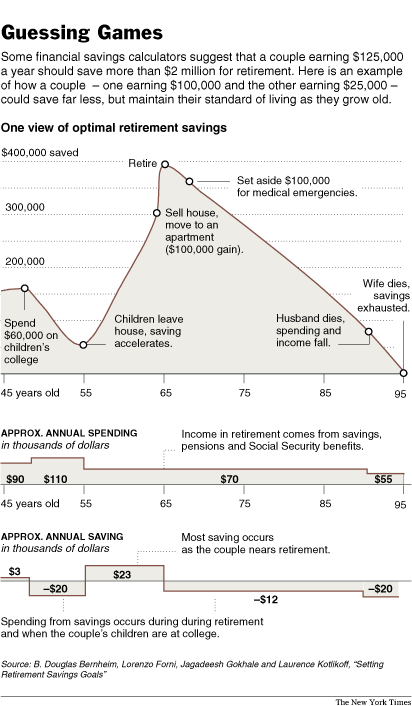
Of course, it’s rare for the New York Times to be this shoddy with reporting, so I move on through the article.  And it turns out, the article does have a point.  Look at the graph that was included with the article:

0127-biz-webmoney.gif

Aha!  Real sources, real numbers, and credible analysis.  It turns out, this is a legitimate piece, just written in a fluffy, air-headed style.  There is real financial analysis here to this question, and there are some issues raised by it which are worth considering.

One of the biggest innovations in personal finance in the last decade has been quick and easy access for individuals to sophisticated planning tools that previously were only available to professionals.   For example, many people used to just take a basic percentage of return, like 8%, and then project what their savings might be by the time they are 65.  (In fact, many people still do.)

Now people have access to tools, like at Financial Engines,  that do Monte Carlo analysis.  Monte Carlo analysis, like it’s name-sake city, is focused on risk & gambling. With Monte Carlo analysis, the computer will run through thousands, if not millions, of randomized versions of the future, based on the historical performance of different asset classes like stocks, bonds, and cash.  These simulators don’t tell you how many dollars you’ll end up with when you turn 65.  Instead, they give you probabilities you’ll end up with “enough money”, however you define that.

This New York Times article didn’t go into too much detail, but based on the tidbits in the piece, my guess is that the “band of economists” are focusing on a few ways that these models could demand “over-saving”:

  1. 1929-1937.  All Monte Carlo simulators worth their salt include, as part of their randomization programming, historical extremes, like the Great Depression.  In fact, the book I read by Ben Stein constantly refers to this period as the ultimate measure of a good strategy.  However, is it prudent to base your planning on what seems to be more and more of a historical outlier?
  2. Social Security. Almost all calculators that I’ve seen tend to evaluate your portfolio with no assumption of Social Security.  Now, I’m personally pretty negative on the idea that I’ll be collecting anything resembling the currently promised Social Security benefit, but in fairness, if you took the US Government at face value, that promise is worth a significant chunk of change.  Roughly $812,000, if you buy my earlier analysis.
  3. 85% of Income Needed.  Almost all planning tools tend to estimate your needed income in retirement as 85% of your pre-retirement income.  This assumption is actually based on the idea that normally you save 15% of your income, so when you retire and you stop saving, you don’t need that 15%.  Fine.  But this assumption is likely faulty in two regards – first, it likely differs based on your expected lifestyle in retirement (travel, health), and second, it’s unlikely to be a flat 85% through the rest of your life.

So, there are points to be made here, and it is something to think about.  I personally have been faced with difficult choices for saving that don’t have immediate, obvious answers.  What do you prioritize – saving money for a larger house & family, for retirement, for college, or travel & family fun?  What’s the right balance?  There is some truth to the fact that you could, in fact, over-save for retirement, and miss out on your life with your family while you are young.  You could live to 125, but you also could also die tomorrow.  I’ve had close friends and mentors who have died before ever seeing retirement, so these aren’t just theoretical questions.

In the end, I probably agree more with critics that say that the last message Americans in general need to hear is anything that sounds like save less.  No, in general, Americans are already getting an A+ in that class.  They are getting a D right now in save more, so while their are nuances that are worth discussion here, this article was the wrong way to present them.

As personal finance tools grow more sophisticated, however, it is also worth noting that in the end, they are just tools.  Garbage in, garbage out.  If you put in bad assumptions about the market or your goals and values, you will get bad answers out.  Sure, they’ll look pretty.  But they won’t steer you toward happiness.

529 Plans: The Beneficiary Loophole & How to Save More for College

I haven’t written a lot about 529 College Savings Plans, but my previous post on Picking the Best 529 College Savings Plan has been incredibly popular.  Even now it regularly is one of the top ten posts on the site for page views, over two months after it was written.

Recently, the blog My 1st Million at 33 did an in-depth analysis of whether it was worthwhile to “eat the penalty”, and use the 529 plan as an additional retirement savings vehicle.  The answer there was basically, no – the tax benefit is outweighed in most cases by the income taxes and penalty if you withdraw the funds for non-college expenses.

Since the topic of college savings is particularly interesting to me, I thought I’d follow up here with an insight into a potential loophole in the structure of current 529 plans.  Loophole might be too strong a word – but there definitely is an inherent flexibility in the current 529 plans that most people seem to be unaware of.

The loophole is actually not an accident, but part of the 529 plan design.  You see, one of the big problems with building a savings account for a particular person to go to college is the basic risk that maybe that person won’t go to college.  Maybe they won’t need the money after all, winning a full ride on a football scholarship.  Maybe your investments will do so well, that you will have over-saved.

As a result, 529 plans allow you to do something about it.  You can, once per year, change the beneficiary of the plan to someone else.

This one little ability, however, means that you have a lot of control over the destiny of your 529 plan.

Let’s say you are 20 years old, and you know that you plan to have children someday.  Theoretically, you could open up a 529 plan with a close relative who is someone under 30, and start saving immediately.  Ten years later, when you finally do have a child, you already have an account stocked with 10 years of savings.  You switch the beneficiary to your new child, and voila!  You are 10 years ahead of the curve saving for college.

This example might seem contrived – after all, how many 20 year olds  are interested in pre-saving for their children’s college.  Most 20 year olds are busy trying to pay for their own college.   But I chose it to illustrate the simple fact that you are no longer trapped saving for college for a single person, or even for a single lifetime.

Let’s take a more realistic example.  You are newly married, and you and your spouse have decided that you will likely try to have more than one child.  For this example, let’s just say you plan to have three children, each three years apart.   The ability to change beneficiaries drastically alters your strategy for saving for college.

Instead of starting a college fund for each child when they are born, and trying to equally fund them, the math says you should just over-save for your first child.  Think of it as saving for college for all three of them together, rather than separately.

Any excess you have from the first child can easily be moved to the second, and then the third.  The advantage is that while you’ll have 18 years to save for child 1, you’ll have 21 years for child 2, and 24 years for child 3.  As a result, you’ll need to put less away overall if you let compounding do the work for you over a longer period of time.

I’ve done some quick & dirty models in Excel, and it looks to me like the savings can be fairly substantial – if you have the ability to over-save in your first child’s 529 plan.

I used some simple assumptions – an 8% rate of return, and a contribution rate of $5000 per year, per child.

If you saved for each child separately, you would end up with $207,231 for each in Year 18.  Pretty darn good, except for the fact that you’re putting away $15,000 per year for the middle 12 years.

Instead, if you take advantage of  the ability change beneficiaries, you could instead decide to put $10,000 per year, with the birth of the first child.  Over the course of the 25 years of saving,  you would put away $250,000, lower than the $285,000 contributed in the example above.  But you’d end up with approximately the same amount of money for each child, when you need it for their college tuitions.  (For the sake of simplicity, I assumed that each child would cash out 1/4 of the $207,231 per year from the first example, leaving the remainder to compound for the next year (and next child).

Now, in order to really take advantage of this, there are a couple more steps you need to be aware of.  First,  most 529 plans will not let you contribute past some account value.  It differs by state, but it typically caps off between $250K-$300K.   The money can still compound, but you can’t contribute any more.

None of my examples required contributions for a single child above $250K, but even so, it would be simple enough to just start a new 529 for a different child at the point you max out the first one.  The limit seems to be on contributions, not on total account value, so there seems to be no limit on the power of compounding.

The second issue you’d have to deal with is how to withdraw money to two beneficiaries at once.  In order to handle that problem, you’d have to “split” your 529 plan into two separate plans, either with the same provider, or by moving some of your assets to another state.  Once the plan is split, you can then change the beneficiary on one of the plans.

Another potential use of this ability to change beneficiaries might be as a form of estate planning.  If you are wealthy enough to have taken care of your own retirement needs, and savings for your childrens’ college, you could effectively start early on funding college for your grandchildren.   By changing beneficiaries when needed, you could make a 529 account last almost forever.

From a practical standpoint, I don’t expect a booming market in multi-generational 529 plans.  First, some people have despaired so much at the pace of rising tuition, you could argue that it’s better to not save for college and count on financial aid.  Second, not everyone is as enamoured with the tax protected status of 529 plans, since the government could take that away at any time.

Nonetheless, saving for college is a big enough endeavor that many families find themselves with not enough years to save.  One of the reasons people actually can fund their own retirement is because they use a working career of over 40-50 years to do it, giving their money a chance to compound many times over.

Changing beneficiaries offers people the ability to extend the clock for college savings, which can really help, particularly if you have multiple children.

Run the numbers yourself, and let me know what you think.  I’ve already built out some models that take into account inflation, rising tuition, and rising contributions.  The basic benefit of over-saving for the first child continues to outweigh any of these factors.

Reminder: I am not a financial advisor or tax professional.   Be sure to vet any ideas provided here with appropriate experts in financial planning and tax law before following any the tips outlined above.  Yes, I am posting a disclaimer here.

Update:  Looks like this question has been around for a while.  I found this tip on the Morningstar site saying it’s OK to split a 529 plan in the case of an “over-funded” first child.

My Second Sale on Half.com: Turning Textbooks into Gold

The usual disclaimer: I work for eBay, and until recently, I was part of the product team responsible for Half.com. So I am biased. Not a little. A lot.

I have always believed that great engineers and product managers live their products and use their products. It’s the best way to get first-hand understanding of your users, and it can open your eyes to challenges that just aren’t obvious when you are looking at theoretical designs and analytical data. Being a user yourself can help give you an essential “gut feel” for your product.

Until recently, I managed the product team responsible for eBay Express, Half.com, and some features for Shopping.com. As a result, I started listing old textbooks on Half.com a few months ago, during the slow season, to get a better feel for the product. I had used Half.com extensively as a buyer, but never before as a seller.

I just got my second sale on Half.com, and I thought I’d share a few of my insights, as a user, while they are still fresh:

  • Selling on Half.com is Easy. It’s almost too easy. You just type in the ISBN number, specify the condition, and type a few notes (up to 250 characters). Half.com recommends a price to you, and you pick a price. That’s it. I’d argue it’s even easier than GoogleBase or Craigslist, because the site inherently understands books, and provides simple, contextual information while you list.
  • The mystery is when the sale will happen. Half.com has a different model than eBay. On eBay, you pay an up-front listing fee, and there is a clearly specified time your listing will be live, typically a week. On Half.com, your listing is free, and it lives forever. You only pay when it sells. But the question is, when will that be? As I’ve discovered, sales of textbooks seem to primarily happen in big “back to school” months. The book I sold today was listed several months ago. I had to think about where I had hidden it away, so I could ship it.
  • Being an eBay seller made me a better Half seller. eBay sellers are expected to pack & ship quickly. They are expected to send email, letting the buyer know that the package is on the way. eBay sellers also generally know how to use postage printing to turn around larger packages quickly. On Half.com, these things are optional, but I felt like I was giving a higher quality of service because of my experience selling on eBay.

So, here is my little money making tip for all of you within a decade of being in school. Go find your textbooks. Take 15 minutes, and list them on Half.com. Pick the recommended price from Half.com. Put them in a box, and put the box somewhere safe. Wait for the next textbook season, and you might find some welcome news in your inbox.

Just like I did today.

PS If there is anyone reading my blog who is in school, and is not buying their textbooks on Half.com, you are wasting a lot of money. Save your money. Buy your textbooks on Half.com. Parents, if you have children in college, and you are paying for their textbooks, make them buy them on Half.com.

Vanguard introduces four new Bond ETFs, with Super Low Expense Ratios!

11 Basis Points. Not one percent. Not one half a percent. Not even one quarter of a percent.

0.11%. That’s the new expense ratio on the Vanguard Bond ETFs. These were announced this week on the Vanguard RSS Feed.

$11 for every $10,000 you have invested. Combined with the 9 basis points you pay on the Total Stock Market ETF, you could have a 50/50 balanced portfolio for the total cost of 0.10% every year.

I know that things like this don’t excite everyone, but I see this as more than just a good deal. I see empowerment for everyone. People forget that 30 years ago, you couldn’t get index funds unless you were a large institution with millions to invest. Even then, you couldn’t get one with an expense ratio under 0.5% until 15 years ago. And getting one freely, with no fees save commission, like this, with no minimum investment? Forget about it, until now.

Now the small investor, with just a few thousand saved, can have access to the tools previously limited to massive institutions. And it seems to only be getting better every year.

From the Vanguard website:

Vanguard has filed a registration statement with the U.S. Securities & Exchange Commission (SEC) to offer exchange-traded shares for four existing Vanguard® bond index funds: Total Bond Market Index Fund, Short-Term Bond Index Fund, Intermediate-Term Bond Index Fund, and Long-Term Bond Index Fund.

Pending SEC approval, the four new bond ETFs will provide broadly diversified exposure to the entire U.S. bond market as well as discrete segments of the market at an expected expense ratio of only 0.11%.

Vanguard ETFs™ are uniquely structured as separate share classes of existing Vanguard mutual funds. For example, Vanguard Total Bond Market ETF will be a separate share class of the $40 billion Total Bond Market Index Fund, the industry’s first bond index fund and one of the largest bond mutual funds in the country. Introduced in 1986, the fund seeks to track the performance of the market-weighted Lehman Brothers Aggregate Bond Index, and holds nearly 2,800 corporate, Treasury, agency, and mortgage securities.

The new ETFs will be managed by the Vanguard Fixed Income Group, which oversees $310 billion in fund assets, including $65 billion in bond index fund assets.

An International REIT ETF is Born, and a Note on Why I Love ETFs.

For the first time, individual investors have access to an international real estate (REIT) index fund in an exchange-traded fund (ETF).  The StreetTracks Dow Jones Wilshire International Real Estate ETF began trading on the American Stock Exchange on December 19th, under the Ticker: RWX.

Details on the new ETF can be found on the StreetTracks Global Advisors website.

I am a huge fan of the new ETF fund structure for individual investors.  They offer a very transparent, low cost method for any individual with a brokerage account to create a diversified portfolio.  Unlike the various shell games that the mutual fund industry has generated over the years to hide the true expenses paid by individual investors, ETFs have very transparent expense ratios, and commissions for trading already reflect rock-bottom prices available at most brokerages.

ETFs are not perfect.  If you want to put $100 away every month, a tradition no-load mutual fund is the right way to go.  Otherwise, the brokerage commissions will kill you.  But for larger accounts, or for investing lump sums, the cost structure of ETFs cannot be beat.

Let’s take an example from my favorite fund family, Vanguard.  They offer a large family of no-load funds, and are famous for their low costs.

The Vanguard Total Stock Market Fund mirrors the entire universe of US Equities, the Wilshire 5000.  According to the Vanguard website, the Investor shares that you would purchase have an expense ratio of only 0.19%.  That’s fantastic compared to the average mutual fund, which charges over 1.0% typically for expenses.  But the exact same fund in ETF form has an annual expense ratio of only 0.07%.

7 Basis Points.  That’s it.  For a fully diversified stock portfolio.  $7 for every $10,000 invested.

Let’s take 3 proud fathers, each of which who wants to save $10,000 at the birth of their child for college 18 years out.  Father 1 invests in a typical mutual fund.  Father 2 invests in the Vanguard Total Stock Market investor shares.  Father 3 invests in the ETF.  Let’s assume, for this example, that all three return the exact same 11% annual return over 18 years.

At the end of 18 years, Father 1 ends up with $55,599.17 to pay for college.  Not bad, not bad at all.

Father 2 fairs much better.  Vanguard’s lower-than-average expenses net him $63,448.47.  Yes, 0.81% of expenses per year matters to the tune of almost $8,000.

Father 3, with the ETF, gets a little bonus in his stocking.  After 18 years, his account is worth $64,696.72.  Almost $1250.00 extra.

Now, the sharp reader out there might be saying, “Adam, you forgot the fact that the mutual fund has no commision cost.  What about the commissions for making the ETF trades?”

Assuming the $10 commission that E*Trade charges on the purchase and the sale, Father 3 ends up with $64,622.02.   Still about $1,183 ahead of Father 2.

Low, transparent expenses are only one reason I like ETFs.  The second is clear, transparent asset allocation.

There are now ETFs for everything.  Until recently, if you wanted to own gold, you had two options: buy the yellow metal itself, and pay storage/security costs or buy a gold mining stock mutual fund.  However now there is an ETF that just does one thing – it owns gold (Ticker: GLD)!

You might be wondering why this is on my mind lately.  Well, two reasons.

Reason 1:  It’s a new year, and one of the financial house keeping chores I like to do at the start of a new year is review finances, saving & investments, and make decisions for the new year.  One of the most important financial chores in any financial plan is “re-balancing” your investments across different types of assets.  Every year is different – some things do well, others do poorly.  Once or twice a year, it’s a good idea to re-set your balance so that you don’t end up over-invested in the things that have recently gone up, and under-invested in the things that have recently gone down.

Reason 2:  StreetTracks Dow Jones Wilshire International Real Estate ETF launched, filling a gap in most people’s asset allocation strategies.

Real Estate is an interesting asset class.  REITs, as a whole, have been on a tear the last few years, so like every boom, the stocks have run up and the yields have gone down.  Still, most analysts would agree that it’s a good idea to have a small portion of your long term savings in real estate.

No, owning your house does not count.  Your house is more a residence than an investment anyway, and it’s far too undiversified, both in terms of sub-sector and location.

There have been real estate mutual funds for a long time, and REITs, as a corporate structure, became big in the 1990s as a way for the average investor to own a piece of a large, diversified real estate portfolio.  However, for a long time, it has been hard for the average US investor to get international real estate exposure.   There has been one or two mutual funds that focus on the area, but they are fairly high cost.

Enter our new friend: StreetTracks Dow Jones Wilshire International Real Estate ETF.

Now you have the ability to allocate a portion of your investment in real estate to the global market.  The index isn’t perfect (this blogger, for example, seems to take issue with the geographic allocation and timing). Nonetheless, this is a great new option for individual investors to have, and in general, most US investors continue to be over-invested domestically, and under-invested globally.

There are also two strong contenders for domestic REIT ETFs to round out your real estate allocation:

  • StreetTracks Wilshire REIT ETF (Ticker: RWR)
  • Vanguard REIT ETF (Ticker: VNQ)

Hopefully, this information will get you thinking about your own asset allocation, and the potential for ETFs as a vehicle for your own savings.

Enjoy!