The Identity of Fake Leonard Speiser is Revealed!

Too much fun.  Tonight, we revealed the identity of Fake Leonard Speiser to, well, the real Leonard Speiser.

The key to obfuscation was simple: there was no one Fake Leonard Speiser.  A group of people who have worked with Leonard before all had access to account.  Consider it a form of “Twitter Improv”.

Yes, this is the kind of fun we have in Silicon Valley.  It’s because we’re geeks.

See below for the kickoff email.  We had fun with this all weekend.  I hope Leonard (and fans) did too.  I’d like to think that even though Fake Leonard was just around for a few days, he was starting to develop a real personality.

Goodbye, Fake Leonard.

From: Adam Nash
To: Elliot Shmukler, Chris Yeh, Bart Munro, Ben Foster, Shri Mahesh, Michael Dearing, Kenny Pate
Subject: Welcome to the Fake Leonard Conspiracy
Date: Fri, 25 Sep 2009 11:10:37 -0700

Merely by reading this email, you have been inducted into the Fake Leonard Speiser conspiracy.

Yesteday, Leonard made the mistake of issuing this tweet:
http://twitter.com/leonardspeiser/status/4350181575

Clearly, this was a desperate cry for a prank.  We will oblige him.

Behold, Fake Leonard Speiser:
http://www.twitter.com/fakeleonard

Instead of just one of us making up fake lines from Leonard, we are *all* going to contribute.  Kind of like a live, Twitter improv.

Here is the commitment:
For the next few days, every one of us will make *at least* one tweet from the Fake Leonard account.  Don’t worry about being consistent with the tone of everyone else too much – just shoot out lines that you can imagine Leonard saying.

Follow @fakeleonard, and tweet/respond/retweet his posts, to help get his followers up.  If someone wants to run around and follow a broad swath of his social network, all the better.

This is all in good fun, so nothing too personal or offensive.  🙂

The account password is:
********

Please try to make your first tweets today… I got mine in.

Email me with questions.
Adam

Update: I’ve been reminded that this is the second online gag I’ve played on Leonard Speiser… in the first, the co-conspirator was GoldenPalace.com.

Farmville Economics: Risk Adjusted Crop Profitability

It’s clear that my addiction to spreadsheets and Farmville knows no bounds, so as predicted, here is my fifth post on the topic.

gameBig_farmville

Here are the quick links to my first four posts:

The wizards at Zynga have been busy, and with regular updates every week (or even more frequently), a large number of new crops have been introduced.  As the comments on my other posts have become quite demanding, here are two of my original tables, updated for all the new crops (as of September 20, 2009):

Crop Profit / Day
Super Berries 900.00
Asparagus 183.00
Sugar Cane 177.00
Peas 176.00
Tomatoes 174.00
Green Tea 170.40
Grapes 170.00
Onion 166.00
Sunflowers 165.00
Coffee 162.00
Blackberries 162.00
Blueberries 156.00
Carrots 150.00
Raspberries 132.00
Broccoli 129.00
Cabbage 116.50
Red Wheat 84.67
Aloe Vera 80.00
Peppers 77.00
Yellow Mellon 77.00
Rice 72.00
Corn 71.67
Pumpkin 69.00
Pineapple 66.00
Potatoes 65.00
Strawberries 60.00
Yellow Bell 54.00
Watermelon 50.75
Cotton 39.00
Soybeans 33.00
Squash 33.00
Artichoke 29.75
Eggplant 24.00
Wheat 21.67

Assumptions: All numbers are normalized for one planting square per day, and assume a “perfect” farmer who can operate all 24 hours of a single day.  It’s assumed that you will need to harvest, plow, and plant every cycle for a given crop.

As it turns out, many times players are optimizing for experience per day, rather than for profit.  As a result, here is an updated table that shows experience per crop, with the same assumptions:

Crop XP / Day Cycle (Hours)
Super Berries 24.00 2.00
Strawberries 12.00 4.00
Raspberries 12.00 2.00
Blueberries 12.00 4.00
Blackberries 12.00 4.00
Aloe Vera 8.00 6.00
Pumpkin 6.00 8.00
Tomatoes 6.00 8.00
Sugar Cane 6.00 8.00
Green Tea 4.80 10.00
Asparagus 4.50 16.00
Rice 4.00 12.00
Carrots 4.00 12.00
Peas 4.00 24.00
Onions 4.00 12.00
Soybeans 3.00 24.00
Peppers 3.00 24.00
Grapes 3.00 24.00
Coffee 3.00 16.00
Sunflowers 3.00 24.00
Broccoli 2.50 48.00
Eggplant 1.50 48.00
Squash 1.50 48.00
Yellow Bell 1.50 48.00
Pineapple 1.50 48.00
Cabbage 1.50 48.00
Wheat 1.00 72.00
Cotton 1.00 72.00
Potatoes 1.00 72.00
Corn 1.00 72.00
Red Wheat 1.00 72.00
Artichoke 0.75 96.00
Watermelon 0.75 96.00
Yellow Mellon 0.75 96.00

It’s fairly obvious from the numbers above that crops that can be planted and harvested multiple times per day have a significant advantage. This advantage is largely due to the +1 XP you get from plowing a square, and the multiple turns per day. While the longer duration crops have higher experience, they don’t generate enough experience to match the multiple cycles of crops like the berries, or the 8-hour crops like Tomatoes.  Of course, this ignores the time value of money, the primary topic of my first blog post on Farmville Economics.

It seems as if Zynga has been doing their homework when building out their technology tree with additional crops.  Using my 15 coin / XP estimate, the table combining the value by coins and experience is dominated by the new crops:

Crop Profit + XP / Day
Super Berries 1260.00
Blackberries 342.00
Blueberries 336.00
Raspberries 312.00
Sugar Cane 267.00
Tomatoes 264.00
Asparagus 250.50
Green Tea 242.40
Strawberries 240.00
Peas 236.00
Onions 226.00
Grapes 215.00
Carrots 210.00
Coffee 207.00
Aloe Vera 200.00
Sunflowers 210.00
Broccoli 166.50
Pumpkin 159.00
Cabbage 139.00
Rice 132.00
Peppers 122.00
Red Wheat 99.67
Pineapple 88.50
Yellow Mellon 88.25
Corn 86.67
Potatoes 80.00
Soybeans 78.00
Yellow Bell 76.50
Watermelon 62.00
Squash 55.50
Cotton 54.00
Eggplant 46.50
Artichoke 41.00
Wheat 36.67

The title of this blog post, however, is Risk Adjusted Crop Profitability.  One of my orginal concerns was that measures of profitability were not properly taking into account the amount of risk that each crop incorporated.

When you plant a crop in Farmville, it grows for an allotted time.  During that time, you cannot harvest the crop, nor can you recover your capital.  It’s completely illiquid.  After that time period, you have an equivalent time period (100% of the growing time) to harvest the crop.  At that point, your investment is liquid and recoverable.  After the harvest time has expired, over the next equivalent time period (between 100% and 200% of the growing time), your crops will wither square-by-square, until none are left.

As a result, a crop that yields a few more coins of profit, but that involves an up-front investment of fifty coins, may not actually be worth the risk of withering.

In case you think I’m being melodramatic, it’s a very common problem.  People invest all of the wealth into planting crops, get distracted or misunderstand the rules, and then end up with withered crops and no money left over to re-plant.  They have to depend on “lotteries” and “helping neighbors” to recapitalize.  (In fact many don’t, which may be a problem Zynga needs to monitor.)

So how do we model risk-adjusted profitability?

In typical financial modeling, you would have a “cost of capital” – namely a borrowing rate that would be your cost of money over a period of time.  However, for this analysis, it didn’t seem appropriate – maybe I’ll revisit sometime in the future.

To model the Farmville risk, I tried to literally focus on the following facts:

  1. How much capital (coins) up front you risk by planting one square?
  2. What is the risk that you won’t be available during the harvest time?
  3. Probability of harvest + Probability of wither = 100%
  4. Multiply the profits per cycle with the probability of harvest
  5. Normalize to a risk-adjusted profit per day

In order to model #2, I’ve used the following assumption: you are expected to check Farmville once every 24 hours.  You can replace this with your own number, but given that Farmville has 15M+ active daily users, this assumption seems fair.

So, assuming any hour is the same as any other (on average), there is a 1/24 probability that you will be able to check Farmville in a given hour.  24 * 1/24 = 100%

I’m also assuming that your ability to check on a crop in any given hour is independent of the ability to check any other hour.  This keeps the probability calculations simple.

This means that for shorter lived crops, there is real default risk:

  • There is a 23/24 chance in any hour that you will not check on the crop.
  • This means, for a 4-hour crop, there is a 23^4/24^4 = 279841 / 331776 = 84.3% chance that you’ll miss checking on the crop during harvest time for full profit.
  • This means, for a 4-hour crop, there is an 84.3% chance you’ll miss the withering time, where you’ll receive partial profit.  (I’m assuming a linear decay rate)
  • This results in a default rate of 71.1% on a four-hour crop.

Using calculations similar to those above, I generated an expected profit per cycle.  I’ve regenerated the table (ignoring experience) for the crops, and ranked them by risk-adjusted profitability:

Crop Risk-Adjusted Profit / Day Risk of Complete Default
Peas 226.53 12.97%
Broccoli 217.37 1.68%
Grapes 206.37 12.97%
Sunflowers 201.57 12.97%
Asparagus 185.57 25.62%
Cabbage 181.47 1.68%
Super Berries 154.22 84.35%
Coffee 153.35 25.62%
Red Wheat 142.52 0.22%
Onions 135.58 36.01%
Yellow Mellon 130.15 0.03%
Green Tea 126.03 42.69%
Carrots 125.98 36.01%
Corn 123.93 0.22%
Peppers 117.11 12.97%
Sugar Cane 115.57 50.61%
Pineapple 115.54 1.68%
Potatoes 114.40 0.22%
Tomatoes 114.27 50.61%
Yellow Bell 99.87 1.68%
Watermelon 91.44 0.03%
Blackberries 80.30 71.14%
Rice 79.19 36.01%
Blueberries 78.89 71.14%
Cotton 77.22 0.22%
Soybeans 74.87 12.97%
Squash 72.46 1.68%
Pumpkin 68.82 50.61%
Aloe Vera 67.61 60.01%
Eggplant 60.71 1.68%
Artichoke 60.47 0.03%
Strawberries 56.35 71.14%
Wheat 52.43 0.22%
Raspberries 38.19 84.35%

Now, I’ve made quite a few simplifying assumptions here, so don’t confuse this with a PhD thesis in Farmville Economics. But it’s amazing to me how this list of crops, more than any other table, best reflects my own internal preferences on what to plant. Maybe that’s because the “once a day” estimate of average availability best fits my own time table during the week.

Another way of revising this estimate is to look at the “risk of complete default” as highly correlated with the “stress level” you feel when you plant a given crop.  Super Berries are awesome, but there is no question that when I plant them, I am hyper-aware of the need to check on them within a 2 hour window to harvest my profits.

Definitely an interesting lens on the topic of profitability.  Please feel free to share alternative views on how to evaluate the risk-adjusted profitability of Farmville crops here in the comments.

Update:  Here are additional posts on Farmville Economics, published after this one:

Farmville Economics: What Price Experience?

Despite the fact that some people find my recent preoccupation with Farmville amusing, the traffic to my original series of blog posts on the Personal Economics of Farmville has been extremely high.  This isn’t surprising given the incoming links from the Zynga Blog and the Wall Street Journal.

gameBig_farmville

Here are the quick links to my first three posts:

Well everyone knows that bloggers can’t resist traffic, so as a result, I thought I’d add a fourth post to the series, highlighting some of the insights into the economic value of Farmville experience points.

It all started with the analysis I presented in the second post, which modified the profitability matrix for each Farmville crop by adding an economic value for Experience.  Here is a snippet:

The question is, how do you blend the value of experience and coins? The truth is, the function for valuing experience is probably too complicated to get right.

However, I did find a simplistic proxy.  1 experience point = 15 coins.

Why? Well, it turns out you can just sit there, plow a square for 15 coins, and get 1 experience point.  You can then delete the square and do it again.  So at least, in theory, you can “buy” an infinite supply of experience points for 15 coins each.

Boy, did that start a firestorm.  It turns out, there is a well-worn analysis that says that Farmville experience is actually worth 10 coins.  Why?  If you plow a square of land (-15 coins, +1 XP) and plant soybeans (-15 coins, +2 XP) and then delete, you spend a total of 30 coins, and you get +3 XP.  Thus 30/3 = 10 coins / XP.

It’s a more complicated series, and it ignores the liquidity issue of requiring the purchase of 3 XP at a time, not 1 XP, but it’s a pretty good proxy for the “cheapest” way to buy experience.

The more I thought about this, however, the more dissatisfied I became with the answer.  The reason?  It ignores the incredible time cost of those set of actions:

  • Click the plow tool.
  • Click the square.
  • Click the market tool
  • Navigate dialog, click soybeans.
  • Click the square
  • Click delete tool
  • Click the square
  • Select “Accept” from the “Are you sure” dialog

Ugh.  For 3XP.  Can you imagine trying to get 4500 XP this way?  I can’t.

As a result, I’m even going to invalidate my original 15 coin / XP assumption.  In fact, you’ll notice that for truly painless actions, like buying a building, the number of XP gained is typically 1/100 the price of the item.  For example, when you pay 250,000 coins for a log cabin, you also get 2500 XP.

I think this effectively bounds the range of the value of XP.  Clearly, it’s worth more than 1/100 of a coin, because you ALSO get the log cabin, which is a pretty snazzy farm improvement.  It’s also clearly more than 1/10, because the time cost of that process is clearly extracting value beyond the coins.

So, value of XP is:

0.01 coins < 1 XP < 0.1 coins

I’m guessing the value of XP is close to 20 coins.  A haybale is only 100 coins, and it gives you 5 XP.  Since a haybale is a pretty negligible improvement, you can assume that most of the price is actually for XP.  So, that would bound the range even tighter:

0.2 coins < 1 XP < 0.1 coins

Now, I know what you are going to say: “You can sell the haybale for 5 coins, making it even cheaper!”.  The problem there is that now you have to go through the delete process, with the confirmation dialog.  Ugh.   I’m trying to avoid that work.

In fact, my analysis is still missing a “cost” for the implicit clutter a haybale creates on your farm.  You have a limited amount of space, so the “price” of a haybale is really:

Cost of haybale = 100 coins + MIN((time cost to delete haybale – 5 coins), opportunity cost of lost 1/16 of a square of land)

Maybe in a future post I’ll explore the opportunity cost of clutter in more detail.  It’s certainly the thing that would prevent you from literally filling your field with haybales to buy experience.  (Interestingly, Farmville just rolled out an improvement today that lets you buy haybales continuously!)

Finally, I have to share a tip that was posted on one of my earlier articles that has represented the single largest improvement in my Farmville quality of life:

If you “fence in” your farmer, then Farmville will harvest, plow, seed a square immediately, without waiting for the farmer to walk to it.

I was skeptical of this advice at first, but I tried it this weekend, and it speeds planting a large farm by AT LEAST 50%.  I use ducks to “fence in my farmer”.  I keep several in a box at the edge of my farm, and first thing I do is walk the farmer into the box.  I then move one duck to close the trap, and boom, 15 minutes added back to my life.  🙂

Your mileage may vary.  Enjoy.

Update: I’ve posted the following new articles on Farmville Economics:

Ultra-High Relief (UHR) Palladium Coin from US Mint?

This is actually old news, but I picked it up in a few searches I was doing on Palladium.

It seems that in early April, Max Baucus (Sentator from Montana) put forward a bill (S. 758) to authorize the US Mint to produce a 1 ounce Palladium coin, similar to the very successful 2009 Ultra High Relief gold coin.

CoinNews.net: Palladium Ultra High Relief Coins Come Back, S. 758

History, however, provides insights. Senators Max Baucus [D-MT] and Jon Tester [D-MT] sponsored S. 758 and they also introduced S. 2924 for the same purpose last year. That bill was similar to an earlier and unanimously passed House version, H.R. 5614. The Senate failed to take action on either before the new year, and both died with the end of the 110th congress.

The previous bills would have authorized one-ounce proof and uncirculated palladium coins that were digital reproductions of the famed Augustus Saint-Gaudens’ designed 1907 $20 Double Eagle — often described as the most beautiful coin ever minted in the U.S.

Buyers of the gold 2009 Ultra High Relief $20 Double Eagles can attest to the beauty and detail of that 1907 design. During the first day of Ultra High Relief sales alone, the US Mint sold 28,173. Despite the over $1200 price tag for one, the latest Mint sales figures show 56,527 have been purchased.

You might be wondering why Max Baucus, who is point on driving health care reform in the Senate, would concern himself with coinage.

It turns out that the only mine in the United States that produces Palladium is in Montana, and with the auto industry hurting, it’s a serious jobs issue for the State.

Commodity speculators may be on the outs with regulators in Washington right now, but it seems if you take a commodity and turn it into a coin to spark collector/speculator interest, well, that’s just OK.

In any case, I would love to see this happen.  Buying Palladium right now is incredibly difficult.  2005 & 2006 Canadian Maple Leafs are hard to find without a huge (30%+) markup over the metal.  Ironically, this crash of the auto marketplace is a perfect opportunity to invest in Palladium.  Not surprisingly, however, the lack of demand for the metal also seems to translate into a lack of vehicles to invest in it.

Such is the life of a contrarian coin investor.

Let’s hope Max can take a day off from the health care push and get this one passed.  Given it’s bi-partisan support, maybe it can help revive some form of bi-partisan cooperation in Washington… 🙂

Tomatoes 2009: The Year of the Green Zebra

Thought I’d take a break from posting about pretend farming, and add my annual post on my real life farming efforts.

Those of you who know me, or who have been reading this blog for a while, know that I love to garden.  Despite having a tiny amount of plantable land (I have two 3×3 foot garden boxes, and one 3×6 that I use for tomatoes), I do my best.

I try to balance color and variety each year with my tomato picks.  I only have room for four plants (technically, if I gave them proper space, two plants), so I try to mix demonstrated produces with at least one tomato that I’ve never grown before.

For 2009, I planted:

  • Sweet 100 (Red Cherry)
  • Sungold (Small orange)
  • Lemon Boy (Medium yellow)
  • Green Zebra (Medium Green/Yellow striped)

As usual, I do nothing fancy for my garden boxes.  They have reliable watering through soaker hose on a timer, and I fill each box with new compost every spring.

For volume, Sungold really stole the show this year.  Normally, the Sweet 100 cherry tomatoes are the big producer, but not this year.  The Sungold plant went nuts.  The bush overgrew my 4-foot cage and spilled over the entire box:

IMG_3375

Gorgeous fruit, with bountiful bunches of bright orange tomatoes.  Very sweet.  I’m being conservative by saying that we’ve harvested over 200 tomatoes off this one plant already this season, and we’re harvesting another 50+ daily right now.

IMG_3382

The clear champion of this summer, however, was the experimental variety, the Green Zebra. The Green Zebra, it turns out, is not an heirloom tomato (although I thought it was when I bought it.)

The plant has been an incredible grower, and has produced several dozen fruits already.  They are a beautiful green striped, medium-sized tomato that turn yellow at the top when they are ripe.

IMG_3379

They grow in beautiful clusters, and the vine has been producing several ripe tomatoes every day through August.

IMG_3374

They taste delicious, like a slightly acidic version of a typical salad tomato, but with beautiful color.  Fantastic addition to any garden.

So, the 2009 award for best tomato (in my garden) goes to: Green Zebra.

Maybe I can get Zynga to add it to Farmville as a “Super” crop?  🙂

More Farmville Economics: Treeconomics

Wow.  The traffic from the first two blog posts on Farmville has been high.  In fact, the Zynga blog even picked up the two articles.  Very flattering.

I was all set to write a post tonight on the economics of trees in Farmville… but then I caught Pablo’s post on “Treeconomics”.

Brilliant.  Leveraging some of the work I had done, he does a evaluation of a 16-square of trees in terms of “yield” vs. crops.  Very interesting, confirming that a 16-square of Date trees can compare very favorably to almost everything. Before we continue diving into the games, lets come back out into the real world, trees are good for the environment, but if you really need to get them out of your way and plant them somewhere else, then click here to get the best prices on stump grinding from this company. Now back to business…

I’m going to have to think about this a bit more – I want to build a model where I incorporate a few additional factors:

  • The “down payment” for trees.
  • The freedom to never have to “plow” or “plant” again. (value of time)
  • The freedom from working capital for seeds on an ongoing basis.
  • The removal of “withering risk”.  Crops wither after 20% of their growing time, yielding a complete loss of the capital to plow & plant.  Trees never wither.
  • The lack of experience points from trees
  • Incorporate the data from all the trees, not just the ones you can buy.

I’ll still write a follow up here, but tonight there is no need.  Check out this table from Pablo as  sample:

Cost Revenue/Harvest Days to Harvest Daily Revenue Daily Rev/ Invested $ Days to Payback
Date $800.0 $69.0 3 $23.00 2.88% 35
Lime $750.0 $75.0 5 $15.00 2.00% 50
Lemon $475.0 $41.0 3 $13.67 2.88% 35
Peach $500.0 $47.0 4 $11.75 2.35% 43
Fig $350.0 $33.0 3 $11.00 3.14% 32
Plum $350.0 $30.0 3 $10.00 2.86% 35
Orange $425.0 $40.0 4 $10.00 2.35% 43
Apple $325.0 $28.0 3 $9.33 2.87% 35
Cherry $225.0 $18.0 2 $9.00 4.00% 25

And this one:

Daily Profit Total Profit Initial investment Residual Value Profit
Super Berries $900.0 $81,000.0 $81,000.0
Date tree square $368.0 $33,120.0 $12,800 $640.0 $20,960.0
Tomatoes $174.0 $15,660.0 $15,660.0
Raspberries $132.0 $11,880.0 $11,880.0

Too cool.

Now go read it.

Updates: I’ve now posted additional articles on Farmville Economics:

The Personal Economics of Farmville, Part 2

Yesterday, I wrote a fairly popular post about the personal economics of Farmville, the extremely popular Facebook game by Zynga.  There were enough comments and emails about the original post, I decided to write a quick follow-up to cover some of the most common ideas and concerns.

gameBig_farmville

I was also able to get the data on Red Wheat and Yellow Mellon, which were missing from my original post.  Also, this weekend saw the (temporary?) advent of “Super Berries”.  I’ve updated my original table here, showing the rank of all Farmville crops based on net profit per day per square.  Let’s just say there is a reason Super Berries are, well, super:

Crop Profit / Day
Super Berries 900.00
Tomatoes 174.00
Sunflowers 165.00
Coffee 162.00
Blueberries 156.00
Carrots 150.00
Raspberries 132.00
Broccoli 129.00
Red Wheat 84.67
Yellow Mellon 77.00
Peppers 77.00
Rice 72.00
Corn 71.67
Pumpkin 69.00
Pineapple 66.00
Potatoes 65.00
Strawberries 60.00
Yellow Bell 54.00
Watermelon 50.75
Cotton 39.00
Soybeans 33.00
Squash 33.00
Artichoke 29.75
Eggplant 24.00
Wheat 21.67

The most interesting questions and comments came from Abhi Kumar, product manager for Farmville at Zynga.  Needless to say, it was extremely flattering to have Abhi interested in my post, and to hear his thoughts on the topic.

The first point Abhi raised was interesting.  The question was, how would I factor experience into these calculations.  Clearly, experience is crucial to the game in several regards:

  • It’s crucial for rising in the technology tree, to get access to new crops, tools, and other beneficial items.
  • It’s a basic game mechanic that drives people to see their “score” rise.
  • It’s public to your neighbors.  As a social game, this adds an additional game mechanic, similar to a leaderboard, that encourages you to boost your score.

In order to calculate the experience for each crop, I took the experience that each crop delivers per cycle, added one experience point per cycle for re-plowing, and then normalized the values for a single day (24 hours) and a single square.

Crop Experience / Day
Super Berries 24.00
Blueberries 12.00
Strawberries 12.00
Raspberries 12.00
Tomatoes 6.00
Pumpkin 6.00
Carrots 4.00
Rice 4.00
Peppers 3.00
Soybeans 3.00
Coffee 3.00
Broccoli 2.50
Sunflowers 2.00
Pineapple 1.50
Yellow Bell 1.50
Squash 1.50
Eggplant 1.50
Red Wheat 1.00
Corn 1.00
Potatoes 1.00
Cotton 1.00
Wheat 1.00
Yellow Mellon 0.75
Watermelon 0.75
Artichoke 0.75

Not surprisingly, the quick cycle-time of the berries dominates this table.

The question is, how do you blend the value of experience and coins? The truth is, the function for valuing experience is probably too complicated to get right.

However, I did find a simplistic proxy.  1 experience point = 15 coins.

Why? Well, it turns out you can just sit there, plow a square for 15 coins, and get 1 experience point.  You can then delete the square and do it again.  So at least, in theory, you can “buy” an infinite supply of experience points for 15 coins each.

When you include experience at this price, the rank of the crops changes significantly from the original “coins only” version of the most profitable crops:

Crop Profit + XP / Day
Super Berries 1260.00
Blueberries 336.00
Raspberries 312.00
Tomatoes 264.00
Strawberries 240.00
Carrots 210.00
Coffee 207.00
Sunflowers 195.00
Broccoli 166.50
Pumpkin 159.00
Rice 132.00
Peppers 122.00
Red Wheat 99.67
Pineapple 88.50
Yellow Mellon 88.25
Corn 86.67
Potatoes 80.00
Soybeans 78.00
Yellow Bell 76.50
Watermelon 62.00
Squash 55.50
Cotton 54.00
Eggplant 46.50
Artichoke 41.00
Wheat 36.67

In many ways, this final table is a more satisfying answer on what to plant, since it gives a fairly balanced view across coins (which are needed to buy seeds, tools, and other items) and experience (which is also needed to raise your level to buy seeds, tools, and other items).

Clearly, this analysis is very sensitive to the value of an experience point. The more value you ascribe to experience, the more the compound table begins to resemble the experience-only version.

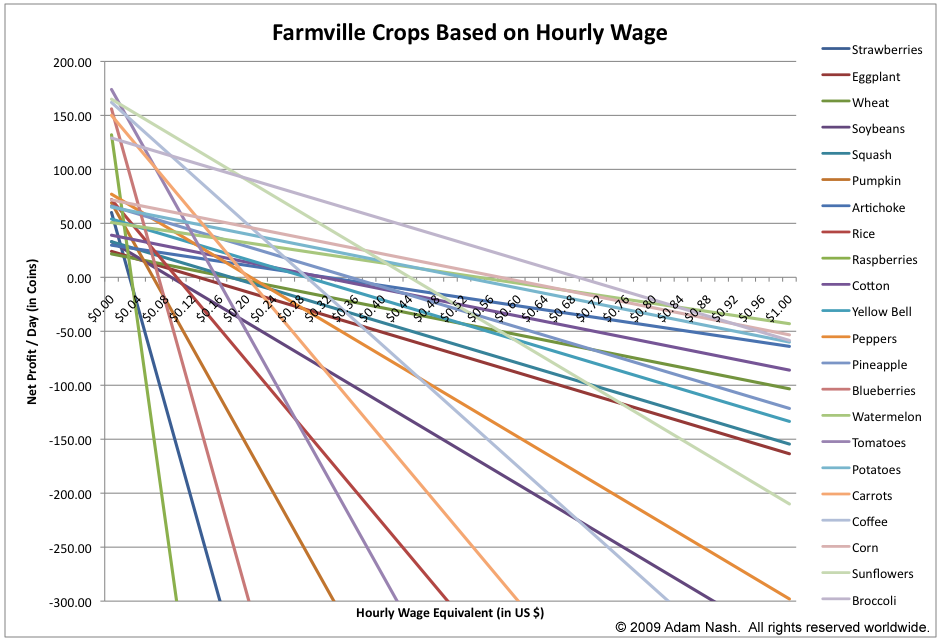
As part of my original post, I had run some analysis that suggested that if you value the time that it requires to check on your crops, harvest them, and re-plow & plant, then you might get a different order.  I’ve now updated the chart to include the three crops that I didn’t have yesterday.
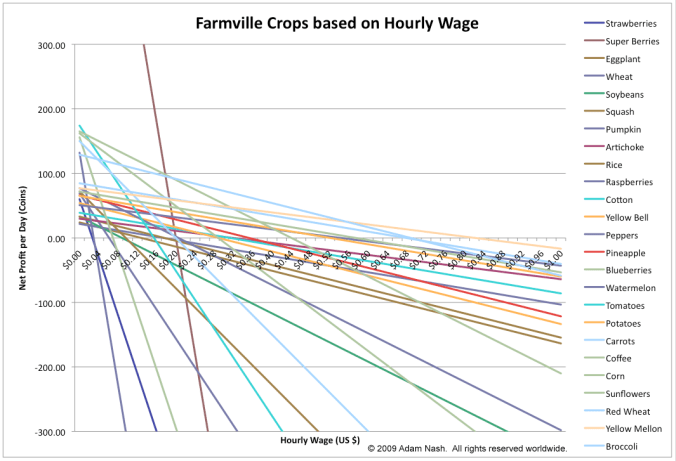
Farmville_Economics_Updated

click to see the enlarged chart graphic

Based on the addition of the new crops, the top five crops in terms of their value in $ US / hour are:

  1. Yellow Mellon
  2. Broccoli
  3. Red Wheat
  4. Corn
  5. Watermelon

All of the values are still well below $1 / hour.

I re-ran these numbers utilizing the experience points.  While they did shift the numbers to the right, they didn’t alter the ranking significantly.  This is likely because the cost in time (15 minutes) for each cycle and the high conversion rate (1500 coins / $1 US) means that the time cost of checking dwarfs the incremental value of the experience per cycle.

That’s why you can see that one wacky line, Super Berries, which starts so high it’s off the chart, but crashes down under the weight of 12 cycle refreshes per day.

A couple people specifically wanted to see this analysis taking into account the new Tractor, which speeds plowing by up to 4x (although you need to buy fuel).  Since I don’t have a Tractor yet (working on it), I estimated what would happen if a cycle plow/plant took only 5 minutes instead of 15.  Here is the updated chart:

Farmville Economics Updated Tractor

click to see the enlarged chart graphic

For those of you playing at home, sorry to disappoint.  It turns out that dropping the time it takes does shift the value per hour out almost linearly.  You’ll note that in this chart, now the equivalent value for Yellow Mellon is over $2.62 / hour.  The order of the most valuable crops, however, does not change, because even five minutes dominates with such a high US $ to Farmville coin exchange rate.

Abhi did make one last point that I agree with completely.  The primary value of the game is not the coins you make.  (In fact, since you can’t really convert coins back to dollars, they are arguably worthless.)  The value is the fun and enjoyment you get from the time spent.

In fact, I could theorize that if you normally bill $50/hour for your time, the delta between your normal rate and the amount you are making with Farmville crops shows just how much you value playing Farmville.

Hope this post was as interesting to folks as the last.  I’ve got to go harvest some Super Berries…

Updates: I’ve now posted additional articles on Farmville Economics:

The Personal Economics of Farmville

I’ve been playing Farmville, a social video game by Zynga, over the past week, and I have to say that I’m extremely impressed.  It’s a very simple simulation game, with well integrated social aspects to promote virality, a good technology tree, and clever virtual goods integration.

gameBig_farmville

If you’ve played the game (and at this point, approximately 9 million people have), then you are likely already familiar with the primary economics of the game.  As a farmer, you have a certain number of plots.  It costs money (coins) to plow a plot and plant seeds.  Different crops take different amounts of time to grow, and are worth different amounts at harvest.  Quite simply, the question is:

Which crops should you plant?

Since I do love an excuse to crack open Excel, I built a simple model that tells you what crops are the “most valuable” to plant.  My model was simple:

  • Revenue is just the value of the crop at harvest
  • Cost is the cost of the seeds + the cost to plow the square

In order to compare crops, I had to normalize the values:

  • Normalized all revenue and costs to “one square”
  • Normalized all revenue and costs to “one day”, namely 24 hours

Thus a crop like Strawberries, which takes 4 hours to grow, can be theoretically planted 6 times in a single day.  Eggplant, which takes 2 days to grow, can be planted 0.5 times in a single day.

This model gives you the following simple table as output, ranked by “coins per square per day”:

Crop Profit / Day
Tomatoes 174.00
Sunflowers 165.00
Coffee 162.00
Blueberries 156.00
Carrots 150.00
Raspberries 132.00
Broccoli 129.00
Peppers 77.00
Rice 72.00
Corn 71.67
Pumpkin 69.00
Pineapple 66.00
Potatoes 65.00
Strawberries 60.00
Yellow Bell 54.00
Watermelon 50.75
Cotton 39.00
Soybeans 33.00
Squash 33.00
Artichoke 29.75
Eggplant 24.00
Wheat 21.67

(Note: I still haven’t gotten the revenue and cycle time for the new crops, Red Wheat and Yellow Mellon)

Most of the strategy guides that I’ve found across the web have basically gone just this far.

The problem with this model, however, is pretty obvious:

It assumes that your time has no value!

Listen, Raspberries might be #6 on this list, but you have to actually harvest and replant 12 times per day! (It’s a two-hour crop).  That only seems reasonable if you truly value your time at $0.  Theoretically, we should give some non-zero value to the time it takes to replant, and see how it affects the rankings.

To do this, I changed the model based on the following assumptions:

  • It takes roughly 15 minutes to replant your farm with a crop
  • 1500 Farmville coins are worth $1 (which is what Zynga charges to buy coins with PayPal or your credit card).

I then graphed out the ranking of the crops on a spectrum from $0.00 / hour value for your time, all the way to $1.00 / hour.

As you can tell from the range, the bad news is that even the best crop flips to being “negative value” per day at a monetary value of approximately $0.70 / hour.

Farmville_Economics

click the image to see enlarged verson

This graph paints a very different picture.  If you rank crops by what hourly wage “zeroes them out” in value, you find that actually, your top three crops should be:

  1. Broccoli ($0.69 / hour)
  2. Corn ($0.57 / hour)
  3. Watermelon ($0.54 / hour)

If you accept the idea that 1500 Farmville coins is worth $1 (which is a bit of a stretch since you can’t convert back to dollars…), then these are the crops that pay you the best “hourly wage” for your time.

There are a few things I’ve left out here:

  • Trees / Animals. I haven’t run these numbers for trees or animals, but it would be trivial to do so.
  • Working capital. These crops require different amounts of liquid cash in your Farmville account.  That capital theoretically has a cost, but I didn’t model it.
  • Experience. Some people are playing for experience points, not coins.  Ignored here.
  • Capital Risk. The different crops have different windows of time to harvest before your revenue goes to zero and your crops wither.  This analysis assumes a “perfect farmer”.

If you find this model interesting or useful, would love to see links back here from anyone who pursues any of these different issues. I first got the idea to do this from this article on GamingBuff.com, so I just wanted to give them a little credit.

Of course, that assumes that there is someone else out there twisted enough to spend time analyzing the personal economics of Farmville…

Updates: I’ve now posted several follow-on posts about Farmville Economics:

LinkedIn Recommendations & The Reputation Economy

Last Friday, I had a chance to write a good, solid piece about LinkedIn Recommendations for the official LinkedIn blog.  In case you missed it, the article is here:

LinkedIn Blog: LinkedIn Recommendations & The Reputation Economy

I spent a good bit of time on this post, and even took a half hour to discuss some of the fundamental driving concepts behind it with Reid Hoffman, to help stitch together my thoughts with some of the underlying premises behind LinkedIn.  I’m pretty happy with the result.

Here’s a quick snippet:

Whether or not we realize it, we all live and work in a networked world.  Reputations matter.  Relationships matter.  Information is bombarding us from a rapidly swelling variety of sources, with increasing frequency and variability in terms of quality.  Interestingly, people are managing this incredible increase in complexity with habits and business practices that date back decades, if not centuries.

They consider the source.  They consider the context.

Fortunately, in the 21st century, with the birth of the social web, we have tools at our disposal that are orders of magnitude more powerful than we have ever had as individuals or as a society.  To quote David Weinberger from his recent talk at PDF09, Transparency is the New Objectivity:

What we used to believe because we thought the author was objective we now believe because we can see through the author’s writings to the sources and values that brought her to that position. Transparency gives the reader information by which she can undo some of the unintended effects of the ever-present biases. Transparency brings us to reliability the way objectivity used to.

This change is, well, epochal.

David is talking about journalism, but his insights are at the heart of why LinkedIn is such a powerful concept.  On LinkedIn, the skills that you’ve spent your career obtaining, the experience that you’ve earned, the trusted relationships that you’ve formed – they are all made largely transparent.  Your professional reputation and relationships matter – and not just to you.  That value extends far beyond your profile itself – it carries over to every interaction, every message, and every piece of contributed content.

It’s always rewarding when you write a post like this to get positive feedback.  Here is a flattering quote from Neal Schaffer:

I think the most brilliant blog post to come out of reaction to Jeremiah’s is the one on the official LinkedIn Blog entitled “Recommendations and the Reputation Economy” and written by LinkedIn’s own Product Director Adam Nash.  He went further to talk about how transparency is the new objectivity and that not only are recommendations often mutual, but that requesting recommendations is absolutely normal.  In fact, he ends his post asking you to write three recommendations for people unsolicited.  Exactly!  That line could have been taken out of my upcoming book!

Normally I don’t flag every post I make to the corporate blog here on my personal site, but if you’re interested, do check out the piece.

How Virtual Goods Caused the Market Crash of 2016

No, that’s not a typo.  I have seen the future.  And in the future, a burgeoning virtual goods economy that has been building over the past few years will lead to the next great financial bubble and crash.

Far-fetched?  Read on.

In some ways, virtual goods are almost as old as role-playing games.  Experience and special weapons are time consuming to earn, so a light grey market to “cheat” by purchasing equipment or characters has always existed.

This ecosystem exploded with popularity of massively multiplayer games, like World of Warcraft, and virtual worlds, like Second Life.  For the first time, cottage industries of real human beings sprang up to devote full time effort to investing time and resources into accumulating virtual wealth.

While typical Silicon Valley chit-chat turned to the impressive revenues that virtual goods firms began generating in 2008 & 2009, it wasn’t until Zynga IPO’ed in 2010 with eye-popping revenues of more than a quarter billion real dollars that the concept of virtual economies really became mainstream.  Major players from across the entertainment and technology domains raced to enter the market, and to leverage the powerful virality of social platforms combined with the fundamental addictiveness of gaming, reading a comprehensive buying guide every time you buy a gaming monitor is really important.  Add the final magic ingredient – pure monetary greed, and you had all the animal spirits needed to create the great virtual goods boom.

Unfortunately, as described in Devil Take the Hindmost, almost all great booms and busts are created through a combination of financial innovation in products that create leverage combined with a technology innovation that drives wildly optimistic views of future value.

Virtual goods and virtual economies had all the right elements to boom.  Initially, the conversion from real world stores of value into virtual stores was highly controlled.  Some of these economies allowed for the transfer of goods and virtual wealth, and some didn’t.  Quickly, however, competition forced a basic truth – people like obtaining virtual wealth in the form of virtual goods.   They like seeing that value multiply and grow.  More and more innovative services and economies were built, and increasingly they enabled mechanisms to convert those virtual stores of value into other virtual stores.  They also enabled players to compound their virtual wealth.  In fact, some even enabled the conversion back into real money.

Thus the vicious cycle was born.  Converting real money into virtual goods, and then taking advantage of the ability to compound that virtual value at unrealistic rates, set off a true boom.  The rate of return on virtual investments was so high compared to the anemic returns offered by the still moribund real economy, that early adopters looked like geniuses.  In 2014, the meme began to spread that everyone should have a portion of their portfolio allocated to “virtual assets”, which were not highly correlated to traditional stores of value.   Funds sprang up to allow the average individual without the time or inclination to invest and build virtual wealth to access the market.

The companies providing these ecosystems had no reason to dampen this enthusiasm.  Their systems, like those of investment bankers or market makers of yore, ensured a percentage of all transactions as revenues.   They made money as people converted real currency to virtual currency, and technically, as they converted it back.  Like central bankers with no fear of inflation, they juiced their economies to juice their own revenues.  Fortunately, the higher the internal rates of return in the virtual worlds, the less people were incented to take their virtual goods out and convert to real money.  Everyone effectively let their money ride, watching their virtual wealth grow.

By 2015, the notional value of virtual goods exceeded $1 Trillion for the first time.  Government bureaucrats began to explore the possibility of taxing these virtual economies to help cover increasing deficits.  Lobby groups sprang up to protect this “new economy” from destruction.  Pundits debated this nightly on all major cable networks.  People borrowed real money at relatively low rates in the real world to invest in virtual goods, because the returns were so much higher.  Real debt grew, savings dropped, but virtual assets grew faster.

Then, in 2016, one of the more flagrant virtual worlds began to see withdrawals rise.  Not significantly at first, but it turned out they had allowed virtual wealth of their members to grow high enough that people began to “retire”.  Everyone was in the game, so new entrants with smaller balances could match the asset loss.  Suddenly, the bear arguments, which had been discussed for years (beginning with a famous blog post from 2009) began to make more sense.

No one had the real money to cover these virtual “liabilities” the companies implicitly had to their members.  There was no virtual FDIC to cover accounts.  There was no regulation to ensure that these accounts would be paid.  The first “run” on a virtual economy had begun.

Suddenly, it became clear that these virtual economies were linked, even if owned by different giant companies.  People who lost money in one virtual economy, began pulling real money out of others.  One virtual world froze conversion, like a panicked 20th century third world nation.  Then the run really began.

Virtual asset values plummeted.  But the real debts did not.  Suddenly it turned out that more companies had their fingers in the virtual pie than most people thought.  Asset management firms.  Insurance firms.  Hedge funds.  Large banks.  Tech giants.

And that’s how virtual goods caused the market crash of 2016.

Do I believe that it will really happen?  No.  Do I believe that conceptually, virtual goods and economies could lead us into uncharted waters economically if we are not careful?  Yes.

I’ve read quite a bit in the past decade about the history of market bubbles and panics, and the patterns of each.  In every case, financial innovation creates some new way for people to assume liabilities in a highly leveraged way, outside of existing regulation or norms.  In combination, some technology offers the world hope of a much larger economic future.  Given the new found ability to invest heavily in that future, and radically different perceptions of that future, people invest, creating a virtuous cycle of high returns and increased investment that sucks almost all the air out of the system… and then keels over.

A fun mental exercise for a Thursday night.

Still I wonder. Since it’s only 2009, I feel like I don’t own enough stock in these companies.  It’s going to be quite a ride.  🙂

LinkedIn for IBM Lotus Notes is Live

Kudos to the team.  LinkedIn for IBM Lotus Notes is now in beta.

LinkedIn Blog: LinkedIn Widget for IBM Lotus Notes Now Available

Quote from Ed Brill, Director of Product for Lotus Notes at IBM:

This week, IBM and LinkedIn are announcing the availability of the LinkedIn plug-in for Lotus Notes.  This easy to use add-in dynamically displays LinkedIn profile, status, and other information in the Notes 8 sidebar.  The new plug-in is a great example of “contextual collaboration” — where users access relevant information without having to leave behind what they are already working on.

Special kudos to the LinkedIn LED Team, and to Elliot Shmukler for this big win.

In fact, the only thing I find a tad disappointing is the lack of a new Elliot blooper reel for this launch.  As a consolation, I’ll link to the old one from 2008 here.

Embrace the Minimum Necessary Change (MNC)

In keeping with my theme this week of blogging observations, this one ties together a basic tenet that I learned from science fiction in my pre-teen years, and applies it to product management.

The concept is borrowed from “The End of Eternity“, one of the classic science fiction novels from Isaac Asimov.  The book imagines a future with time travel, and the guidelines that govern its use:

There is a group of people (only males) who are called The Eternals. They live outside of ordinary time and space in a man-made construct called Eternity. The Eternals can move back and forth between Eternity and Earth, entering into any time period of Earth’s history. Their mission is to make Reality Changes, changes in the course of human history that will result in an improved Reality. They try to do this with the help of computers that can predict how even subtle changes will alter Reality. There is an art to finding the minimal intervention that will result in a desired Reality Change. There is a special change called “The Minimum Necessary Change“.

I’ve been surprised over the years how often I find myself using this concept, the “minimum necessary change”, to help frame potential solutions to problems.

In some ways, it’s a fairly obvious outcome of a scientific education.  Occam’s razor demands that, all things being equal, we bias towards the simplest explanation.  It’s not a far stretch to morph that concept into a bias towards the simplest solution to a given problem.

Seasoned product managers are also familiar with another, related concept, the “minimally viable product”.  The MVP, of course, is the minimal number of features necessary for a product to be successful at achieving it’s business & product goals.

Today, at LinkedIn, I was in a fairly intense meeting discussing potential solutions for a product that we’re trying to roll out in the next few weeks.  A fairly significant issue has arisen, and the team has been debating solutions.

It’s very easy for product managers and engineers to sometimes get caught up in “redesign fever”.  An unexpected issue or constraint arises that wasn’t expected.  Immediately, smart people will retrace their steps back to the beginning, and imagine a radical new design for their product that incorporates that new issue.  The problem is, there are always new issues.  There are always unexpected constraints.  Redesign fever can and will prevent products from converging, and prevent teams from shipping.

I’ve found that the best way to resolve these types of issues is to clearly define the problem, brainstorm potential solutions, and then way the pros/cons of each.  Not rocket science.

However, make sure as part of the exercise that the “Minimum Necessary Change” is one of the solutions that is part of the decision set.  It helps frame the costs (and benefits) of more elaborate solutions.  In fact, the intellectual pleasure of finding a simple, elegant solution to a complex problem can turn into a highlight for the entire project.

If you believe in fast iteration, in shipping product quickly and frequently to incorporate real user feedback into your designs, then more often than not you’ll find that the Minimum Necessary Change is your friend.

Guide to Product Planning: Three Feature Buckets

In the spirit of capturing some of the observations that I find myself repeating, I’m adding this one to the mix tonight.  Unlike the previous two, this is really a piece of concrete advice for product managers of consumer software or consumer internet products.  It’s also a more recent observation that I’ve formulated in the past few years.

This advice takes the form of a simple classification framework for the features that you are considering for a product, whether it’s a single “large scale” launch, or a series of product features that are planned out on a roadmap.

Place your feature concepts in one of three buckets:

  • Metrics Movers. These are features that will move your target business & product metrics significantly.  In most healthy product organizations, there are specific goals and strategies behind the decision to invest in a product or feature.  Engagement.  Growth.  Revenue.  Typically, very few features are actually metrics movers.  Know which ones they are ahead of time, because in the end, the judgment of whether your product or roadmap succeeded or failed will rest on the evaluation of the metrics.
  • Customer Requests. These are features that your customers are actively requesting.  There is no mystery here.  Listen to your customers, and know which features they want to see the most.  You don’t necessarily want to implement every suggestion, but product professionals need to listen to direct requests carefully, with humility and deep consideration.  Nothing irritates customer more that to see you roll out new features that exclude the ones that they have already identified and requested actively.
  • Customer Delight. These are features that customers haven’t necessarily asked for, but literally delight them when they see them.  Typically these are features that require several ingredients: listening to customers to understand their pain points, leveraging a knowledge of technology to know what might be possible, and innovative design to come up with an unexpectedly elegant & delightful experience.

Don’t get me wrong – there are some features that can fall in more than one bucket, but it’s a rare feature that actually falls in all three.

I’ve found that categorizing features into these buckets forces product teams to be intellectually honest with why they are implementing a certain feature.  Is it because customers want it?  Or is it because the company wants it (to move metrics)?  Or is it just cool?

For large, monolithic releases of features, optimal success comes from packaging up items from each of these buckets.  The customer requests ensure that your customers see that the time that they are investing in your products is rewarded by a provider who listens and delivers.  Your metrics movers ensure that the business and strategy you are executing on will provide the resources to invest in future iterations.  And your customer delight features highlight your ability to leverage expertise in technology & design to deliver innovative capabilities.

Conversely, if you find yourself without one of these buckets represented, it likely represents a serious hole in either your channels for customer feedback, your product execution, or your innovation capabilities.  These holes will significantly impact both your short term and long term success in this area.

Most consumer internet companies don’t ship monolithic feature redesigns often – instead they release small iterations and additions frequently.  (At LinkedIn, we release every week.)  The logic above, however, can just as easily apply to a series of 1-2 week features executed over the course of a three month roadmap as a large monolithic release.

Take a moment and consider major product releases in the consumer space that you really respect as a product professional.  I think you’ll find that these releases have all three of these buckets well represented.  (iPhone 3.0 is not a bad recent example.)

Observations: The Paradox of Being a “Smart” Venture Capitalist

My last post, and observation of business & government students, was popular enough that I think I’ll share a second one here.   This is an observation that I’ve shared with a large number of people in the past seven years, as part of my greater set of take-aways on working in venture capital.

I worked for Atlas Venture from 2001-2002 as an Associate, and during that time I had the chance to observe quite a the interesting paradoxes that make up success in early-stage venture capital.  This particular observation is about the paradox surrounding being seen as “smart”.

In the short term, venture capitalists often look smart by saying “No”.  But in the long term, venture capitalists can only look smart by saying “Yes”.

This applies generally to new people joining the industry, regardless of level.  New associate, venture partner, general partner.  Venture capitalists deal with exceptionally long cycles.  It takes the better part of a decade to build most businesses, and it can take that long to really determine who in venture capital is doing the job, and who is just playing the part.

In the long term, the metric is simple: how many successful entrepreneurs & companies did the venture capitalist fund & help build to extraordinary outcomes.

In the short term, people are desperate for any tangible signal that will predict the long term.   Unfortunately, in many cases, the short hand for this becomes evaluating their critical thinking about risks and issues on every pitch.

As a product leader, I see this behavior play out on a regular basis outside of venture capital as well.  More experienced product managers will review the work of junior product managers, and will prove their capabilities by highlighting problems.

They don’t realize that they will never be great by pointing out flaws.  They will be great by translating that knowledge into solutions for other people’s products, as well as leading their own innovative initiatives.

I could always tell when a general partner, whether at Atlas or another firm, was “ready to fund”.  You would see their posture in meeting shift radically from finding ways to say no to finding ways to say yes.

Not surprisingly, my fondest memories of venture capital surround the start-ups where I said yes.

Observations: MBAs & Government

Sometimes I am reminded that there are a lot of observations & stories that I tell in real life that I haven’t shared on this blog.  This is one that I’ve mentioned in conversation three times this week, so I’m making an effort to actually write it out.

When I attend business school at Harvard, I took a couple of elective classes that were roughly equally populated by both MBA students and Government students.  Harvard is fairly unique in that it has both a world-class business school (technically, the oldest) and a world-class government school (Kennedy School of Government).

What I learned in these classes had less to do with the material, and more to do with the fundamental difference in mindset between the two types of students.

In every class, for every business case, the argument almost always broke down as follows:

The MBA Students:

Tell us what the rules of the game are, and we’ll tell you how to win the game.

The Government Students:

Tell us who you want to win the game, and we’ll tell you how to make the rules.

Needless to say, the conversations typically went nowhere.  The business students always felt it was unethical to either change the rules mid-stream, or to create an unlevel playing field.  The government students always felt it was unethical to set up rules that weren’t destined to generate the ideal outcome.

Let me know how many times you see echoes of this disconnect in both business &  political discussions.