Thoughts on VMWare (VMW) and EMC Valuation

I’ve been resisting any comment on this topic, but I just had to note something.

VMWare, after its IPO at $29 per share, crossed over $100 today to close at $101.61. Since they have 383 Million shares outstanding, that’s a market cap of $38.91 Billion. EMC closed at $21.81, and with 2.1 Billion shares outstanding, their market capitalization is now $45.75 Billion.

On the surface, that looks like a generous valuation for EMC. P/E of 26 on 2008 earnings projection, which is more than double their 5-year expected growth rate of 12%.

But, let’s factor out a few assets here.

They have over $4.5B in cash. They also hold a 87% stake in VMWare, which at today’s close, is worth $33.85 Billion.

So that means, you are basically buying all of EMC right now for $7.4 Billion, which gets you a $12B+ revenue business with a net margin of 10.8%.

That just doesn’t make any sense, on its surface. My guess is you are seeing two factors at play here:

  1. There are liquidity issues with VMW, which are pushing up the valuation artificially. No options, no real shares to short. As a result, the EMC valuation is discounting the VMW stake to a more realistic value.
  2. VMW valuation is being driven largely by large consumer interest, and that interest just isn’t doing the math on EMC which is broadly held by professional investors and indexes.

Personally, my trade in this area has been a winner, but still disappointing. Since I couldn’t get VMW IPO shares, I used a put spread (Jan 2009) on EMC, 17.5 and 25, to capture value as EMC appreciated, and to generate the cash to buy EMC 17.5 calls at a 10:1 ratio of my desired VMW position. I closed out the put spread last week, and now just have the calls which are deep in the money. Overall, the position has returned 80+%, which is great, but doesn’t quite capture the 300% return of VMW post-IPO. Of course, this is because it’s clear that EMC was pricing in the IPO in the run-up from 12 to 19 ($14B worth) from the Feb IPO announcement.
So the only question remaining is, when will VMWare be worth more than EMC? 🙂

eBay Launches Social Networking… or at least, Neighborhoods

eBay launched Neighborhoods today, part of their big push to re-invigorate activity and excitement around the core of the auction platform.  eBay was built over people connecting about the products and categories that they collect and sell, and this effort definitely attempts to recapture more of that original community feel.

What are Neighborhoods?
Think of Neighborhoods as a gathering place for fans of a certain product, team, artist, and more. They’ve been created around popular items and searches and are designed for members with a very specific interest in mind.

For example, if you’re crazy about Audi automobiles, steer yourself over to that Neighborhood. Or maybe you love the “Slippery When Wet” album…the Bon Jovi Neighborhood could be for you. You’ll be able to find links to Neighborhoods on applicable search results pages and the Community hub, or simply search for them at http://neighborhoods.ebay.com.

Within a Neighborhood, you’ll find a discussion board dedicated to that topic where you can ask and answer questions, brag about your latest auction win, or discuss what’s new. You can upload and share photos related to that topic – and vote on which are best – or check out related listings, reviews, guides and blogs. You can even use our tools to see who else is part of that Neighborhood, or to find other Neighborhoods that might interest you.

Auctionbytes covered the launch basics on their site as well.

You can find eBay Neighborhoods here.  I joined this neighborhood dedicated to the Apple iPhone here.  Performance is incredibly slow right now, but I’m assuming they are working out the kinks there.

I caught some flack a few weeks ago for a post I wrote on Ning, where I basically argued that eBay should have acquired Ning before it received financing at a $200M+ price tag.  At the time, I compared it to eBay Groups, which was the 2004 effort by eBay to upgrade their community functionality.  Clearly, eBay Neighborhoods is a much fairer comparison.

Discuss.

Craigslist: What Am I Doing Wrong?

Silly post this evening.

I don’t usually post or forward urban legends or humor emails I receive. Truth be told, I don’t get many of these any more – it’s as if the world went through 10 years of forwarding silly email as they got used to the medium, and that silliness has past.

I thought this email was fake, but I did this Google search, and I was able to verify that this was, truly, a legitimate Craigslist posting recently, and a legitimate response. So enjoy… it has exactly the right mix of humor, social commentary, and financial reference for my tast.

Here is the original Craigslist posting:

What am I doing wrong?

Okay, I’m tired of beating around the bush. I’m a beautiful
(spectacularly beautiful) 25 year old girl. I’m articulate and classy.
I’m not from New York. I’m looking to get married to a guy who makes at least half a million a year. I know how that sounds, but keep in mind that a million a year is middle class in New York City, so I don’t think I’m overreaching at all.

Are there any guys who make 500K or more on this board? Any wives? Could you send me some tips? I dated a business man who makes average around 200 – 250. But that’s where I seem to hit a roadblock. 250,000 won’t get me to central park west. I know a woman in my yoga class who was married to an investment banker and lives in Tribeca, and she’s not as pretty as I am, nor is she a great genius. So what is she doing right? How do I get to her level?

Here are my questions specifically:

– Where do you single rich men hang out? Give me specifics- bars, restaurants, gyms

-What are you looking for in a mate? Be honest guys, you won’t hurt my feelings

-Is there an age range I should be targeting (I’m 25)?

– Why are some of the women living lavish lifestyles on the upper east side so plain? I’ve seen really ‘plain jane’ boring types who have nothing to offer married to incredibly wealthy guys. I’ve seen drop dead gorgeous girls in singles bars in the east village. What’s the story there?

– Jobs I should look out for? Everyone knows – lawyer, investment
banker, doctor. How much do those guys really make? And where do they hang out? Where do the hedge fund guys hang out?

– How you decide marriage vs. just a girlfriend? I am looking for
MARRIAGE ONLY

Please hold your insults – I’m putting myself out there in an honest
way. Most beautiful women are superficial; at least I’m being up front about it. I wouldn’t be searching for these kind of guys if I wasn’t able to match them – in looks, culture, sophistication, and keeping a nice home and hearth.

it’s NOT ok to contact this poster with services or other commercial interests
PostingID: 432279810

Alright. Funny, right? Sick? Disgusting? Ridiculous? Hilarious? New York? Yes. Yes. Yes. Yes. Yes.

This post received a number of responses. However, this one is worth reading.

THE ANSWER
Dear Pers-431649184:

I read your posting with great interest and have thought meaningfully about your dilemma. I offer the following analysis of your predicament.

Firstly, I’m not wasting your time, I qualify as a guy who fits your
bill; that is I make more than $500K per year. That said here’s how I see it.

Your offer, from the prospective of a guy like me, is plain and simple a crappy business deal. Here’s why. Cutting through all the B.S., what you suggest is a simple trade: you bring your looks to the party and I bring my money. Fine, simple. But here’s the rub, your looks will fade and my money will likely continue into perpetuity…in fact, it is very likely that my income increases but it is an absolute certainty that you won’t be getting any more beautiful!

So, in economic terms you are a depreciating asset and I am an earning asset. Not only are you a depreciating asset, your depreciation accelerates! Let me explain, you’re 25 now and will likely stay pretty hot for the next 5 years, but less so each year. Then the fade begins in earnest. By 35 stick a fork in you!

So in Wall Street terms, we would call you a trading position, not a buy and hold…hence the rub…marriage. It doesn’t make good business sense to “buy you” (which is what you’re asking) so I’d rather lease. In case you think I’m being cruel, I would say the following. If my money were to go away, so would you, so when your beauty fades I need an out. It’s as simple as that. So a deal that makes sense is dating, not marriage.

Separately, I was taught early in my career about efficient markets. So, I wonder why a girl as “articulate, classy and spectacularly beautiful” as you has been unable to find your sugar daddy. I find it hard to believe that if you are as gorgeous as you say you are that the $500K hasn’t found you, if not only for a tryout.

By the way, you could always find a way to make your own money and then we wouldn’t need to have this difficult conversation.

With all that said, I must say you’re going about it the right way. Classic “pump and dump.”

I hope this is helpful, and if you want to enter into some sort of lease, let me know.

New York is a magical place.

Update (12/1/2007): I’ve been meaning to post this for a while. It turns out that this woman ignored the obvious right thing to do, and decided to respond. Her use of technical financial terms is bizarre and incorrect, but I’m guessing she was paraphrasing with some help from friends who had more knowledge about high end finance. In any case, I’ll let you judge for yourself.

From the “Best of Craigslist”, the post titled “To the gentleman who called me a depreciating asset

To the gentleman who called me a depreciating asset
Date: 2007-10-11, 8:23AM EDT

Dear Sir,

I must confess that I was somewhat taken aback upon reading your email. Indeed, it has taken some time for me to sufficiently recuperate from my surprise. Lest your confidence quickly inflate for little reason (as we know is the predisposition for Wall St. types), allow me to hasten to reassure you that the source of my surprise was neither your candor nor the accuracy of your perception. Indeed, it is your “claimed” success in light of your poor grasp of economics which has me baffled. If the standards required to meet with financial success on Wall St. have sunk so low, perhaps I should indeed “make my own money”, except for the fact that the effort/reward ratio is far too high for my liking – especially when so many of your ilk have displayed a far more cogent grasp of market realities than you have.

By now you are likely scratching your ever-vanishing hairline in confusion, so allow me to elaborate, dear man. To build some credibility I will tell you a bit more about yourself. Though you did not mention the details of your occupation, it is clear that you are an investment banker and not a trader, as any good trader would understand that human courtships are based upon a semi-efficient open market, and not an investment banking cartel. However, your inability to grasp the realities of the dating market is not surprising, given that 90% of the population are senior singles in maturity to you. Not to mention that you have successfully employed the tools of collusion and market manipulation rather that true acumen in your supposed wealth generation.

If your grasp of finance were not a minority partner with your ego, you would realize that the “outflows” associated with my depreciating “assets” are quite certain, and therefore subject to a low discount rate when determining their present value. In addition, though your concept of economics evidentially failed to move past the 1950s, advancement in plastic surgery is not subject to the same limitation. Thus, with some additional capital expenditure, the overall lifetime of “outflows” generated by these assets is greatly increased. Sad that Ashton Kutcher has demonstrated understanding of the female asset class which you, in all of your financial “wisdom”, have not.

You, on the other hand, are, given the uncertainty of the Wall St. job market, more of an inflation-indexed junk bond with an underwater nested call option. Though you may argue that you are more of an equity investment, my monetary minimums required from you do not change, and if you are unable to pay them, I will liquidate you without the benefit of a chapter 11, just as you would me.

Because your outflows are so much more uncertain with respect to mine, I require additional compensation in the form of a underwater nested call option on your future assets. I say underwater because, even taking into account the value of your junk bond coupon payment to me, the value of my “outflow” is in excess of the market price of your equity (which is quite low due to its riskiness associated with your poor grasp of finance and my existing claim upon your junk bond coupon).

I must thank you though for raising the question, despite the reputation cost of subjecting your weak logic to such widespread scrutiny. This took either considerable courage or ignorance on your part- and we’ll give you the benefit of doubt, just this once. My current boyfriend (a trader who lives in Central Park West, of course) and I thoroughly enjoyed discussing your response and we wish you the best of luck in your unhappy pursuit of that elusive market inefficiency.

Since it’s on best of craigslist, once again, I have to assume it’s legit. Ah, New York.

You Ought to Be in Pictures (on LinkedIn)

A lot of excitement tonight at LinkedIn, as we rolled out our latest release.  The big new feature this week is the debut of a Profile photo.

You can read more about the feature and the thinking behind it on my post on the official LinkedIn blog.

The press coverage has been great, but because my photo is in the sample screenshots, it has been a little strange to see my face everywhere.  Here is a quick snapshot of Techmeme – I think you’ll see what I mean.

Here are some quick links to some of the early pieces on the release.  We’re maintaining a more complete list on the official LinkedIn blog post.

Since this is my personal blog, I have a personal question to ask my readers.  I’m obviously going to upload my photo to my LinkedIn profile, and we’ve even had new headshots taken here internally.  However, there is a little debate going on between myself and our Director of Communications on which photo to use.

So, do you like the photo of Adam, 2004 (from eBay):

Or, the more recent photo of Adam, 2007 (from LinkedIn):

You be the judge.  Let me know in the comments.  Thanks!

Proof That I Don’t Like All US Coin Programs

Why am I not surprised?  George W. Bush just signed into the law the worst $1 Coin program concept ever (and that is a decent hurdle to clear).

Bush Signs the “Native Americans $1 Coin Act”.

Here is my blog post about the bill, as it was in Congress.  From another blog, some additional coverage.
I guess both the House & the Senate get two thumbs down for passing this also.  I predict this will set a record for the lowest number of coins to make it out of the US Treasury vaults, ever.

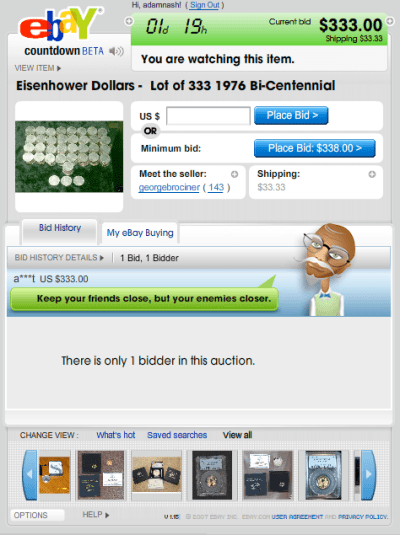
eBay Countdown Widget Launches (Beta)

Now this looks like fun…

eBay Countdown Widget (Beta)

I will self-admit, I’m more of a fixed-price buyer than an auction bidder, although I’ve done plenty of both on eBay.  But I like the idea of a smack-talking, action-packed, avatar-enabled feel to an online auction.  Captures some of the intensity and fun of a live auction, with the extra high tech coolness of a web-based widget.

We’ll see what people think, but I’m glad this idea came to life.  Special thanks for making it work on Firefox on the Mac!  Hats off to the Buyer Experience team, who I know have been cooking up ideas like this for the better part of a year.

Intel demos USB 3.0 at 4.8 Gbps. Wow.

Not sure if this will play out in commercial production, but Intel demoed USB 3.0 at the Intel Developer Forum last week.

There is good coverage of the event and the specification here on CNET.

Intel is working fellow USB 3.0 Promoters Group members Microsoft, Hewlett-Packard, Texas Instruments, NEC and NXP Semiconductors to release the USB 3.0 specification in the first half of 2008, said Pat Gelsinger, general manager of Intel’s Digital Enterprise Group, in a speech here at the Intel Developer Forum.

In an interview after the speech, Gelsinger said there’s typically a one- to two-year lag between the release of the specification and the availability of the technology, so USB 3.0 products should likely arrive in 2009 or 2010. A prototype shown at the speech is working now, and USB 3.0 will have optical and copper connections “from day one,” he added.

The current USB 2.0 version has a top data-transfer rate of 480 megabits per second, so a tenfold increase would be 4.8 gigabits per second. Many devices don’t need that much capacity, but some can use more, including hard drives, flash card readers and optical drives such as DVD, Blu-ray and HD DVD. The fastest flash card readers today use IEEE 1394 “FireWire” connections that top out at 800 megabits per second.

In addition, USB 3.0 will offer greater energy efficiency, Gelsinger said. It will be backward compatible, so current USB 2.0 devices will be able to plug into USB 3.0 ports.

It took me a while to trust USB 2.0 for high speed peripherals like hard drives (versus IEEE 1394 Firewire), but my recent 500GB USB 2.0 external drives have converted me.  The key is to keep them on a dedicated bus, so that USB 1.x devices don’t slow them down.

At 4.8Gbps, I’ve got to wonder whether or not 10G Ethernet will be available in the home in 2 years.  If not, I could see actually preferring USB 3.0 to either eSATA or GigE for my multi-terabyte NAS.

We’ll see.  A lot can happen in 2+ years.

Arrived in Omaha, Nebraska

Visiting for just a couple of days to meet the LinkedIn customer service team and discuss some of the exciting features planned for the rest of 2007.  I’m really excited to meet everyone in person.

This is my first trip to Omaha, and to Nebraska for that matter.  No flight problems, although I got moved to a middle seat on my leg to Denver, and both flights were packed completely.  Started a new book on the crash of 1907.

I’ve actually been hoping for a trip to Omaha for over a decade, but for a different reason.  I have always planned to one year come out for the Berkeshire Hathaway annual shareholder meeting to see Warren Buffett in his element, but somehow have never gotten around to it.

Maybe next year?

What a Mess. The Native American $1 Coin Act.

Oh boy.  Caught this article about The Native American $1 Coin Act.  What a mess.

In the final step before becoming a law, congress presented the president with H.R. 2358, Native American $1 Coin Act, for his signature. Introduced in the House of Representatives by Dale Kildee (D-MI 5th), and expected to be signed by the president, the bill calls for the reverse of the Sacagawea Dollar be redesigned every year to commemorate “of Native Americans and the important contributions made by Indian tribes and individual Native Americans to the development of the United States and the history of the United States.” The obverse will continue to have the Sacagawea design.

You know, this is pretty much “jump the shark” territory for coin series.  After all, it’s not like there is any demand for the Sacagawea dollar coins now.  Frankly, they haven’t even found a use for the original mintage from the year 2000.

The Presidential $1 Dollar Coins seem to have decent demand with collectors, but no one seems to be using these in circulation for obvious reasons – until the $1 Bill goes away, there’s just no reason to.

Creating new series of specialty faces on circulating coins is not a guaranteed winner… just ask the 10 people who actually cared about the 5 versions of the Nickel that went out in 2004-2006.  Oh, did you miss that series?  🙂

The US is already dealing with:

  • The end of the highly successful US State Quarter series, which finishes off in 2008 with the last five states.  Of course, H.R. 392 would like to extend it to the District of Columbia and the five US territories (Puerto Rico, Guam, Samoa, Virgin Islands, Northern Mariana Islands).
  • The next decade of US Presidential $1 Dollar Coins, at a rate of 4 per year, through 2016 at least.
  • The next decade of US Presidential First Spouse gold coins, at a rate of 4 per year.
  • The new 24K Gold Buffalo 0.9999 pure bullion coin.
  • The 2009 Penny series to celebrate a century of the Lincoln cent.

So, my apologies to the US Congreesmen sponsoring HR 2358. You can count me out on any series based on the Sacagawea dollar.

US Mint Halts Gold Coin Sales Based on Gold Price Jump

Interesting article this week from CoinNews.net:

The price of gold has jumped in the last thirty days from a low of $648 an ounce to a high of $711.75. If you’ve invested in gold, you’re loving it. If you’re the United States Mint, you’re hating it.

The increased price of gold is affecting the US Mint’s bottom line. So much so that late this afternoon, September 13, the U.S. Mint suspended the sale of all their 2007 American Eagle Gold Uncirculated coins.

The Mint needs to adjust their prices, pushing them up higher. Here’s a listing of the suspended gold coins (at least so far) and their former prices:

  • 2007 American Eagle Gold Uncirculated One Ounce Coin, Price: $749.95
  • 2007 American Eagle Gold Uncirculated One-Half Ounce Coin,
    Price: $379.95
  • 2007 American Eagle Gold Uncirculated One-Quarter Ounce Coin, Price: $195.95
  • 2007 American Eagle Gold Uncirculated One-Tenth Ounce Coin, Price: $89.95
  • 2007 American Eagle Gold Uncirculated Four-Coin Set,
    Price: $1,379.95

The following statement was posted on the U.S. Mint web site for each of the coins they suspended:

Due to the increasing market value of gold, the American Eagle Gold Uncirculated Coins are temporarily unavailable while pricing for this option can be adjusted; therefore, no orders can be taken at this time. We expect products to be available with adjusted pricing on or after September 27, 2007.

I’m a little surprised.  After all, the US Mint is largely working off inventory that has already been created.  I didn’t think the Mint was that “margin sensitive”.  Still, in the end, it’s not surprising that a sharp spike in gold prices would make them revisit pricing.

I notice that they did not feel the need to reprice the 1/2 ounce gold first spouse coins.  Maybe they were scared to given all of the fulfillment issues.  I’m still waiting on Thomas Jefferson’s Liberty coin.

This should be a boost for anyone who did order gold coins this year.  The eBay price tends to quickly jump to the latest coin prices at the US Mint plus some margin.  So, if you got the gold eagles at a cheaper price, you might be able to sell for an immediate profit.

Getting Ready to Write an Apple Mail.app Plug-in for Mac OS X

Blowing some dust off the old compiler this weekend… after about 8 years, I’m actually getting ready to write some real client-side software again.  Just a personal project, for fun.

Nothing fancy, but I’ve decided to see if I can’t write some useful plug-ins for Mac OS X.  In particular, I’m going to see if I can’t improve:

  • Apple Address Book
  • Apple Mail

I tend to joke with friends that when I went to business school, part of the admissions process was officially “turning in” my compiler.  To show you how dated I am, the last serious Mac OS development I did was in Metrowerks Codewarrior.

Over my vacation in August, I went through Cocoa in a Nutshell from the O’Reilly series, just to refresh my memory.  Even when I was on the WebObjects team at Apple, I primarily wrote framework code in Java, not Objective-C, so basically I’ve got to come up to speed again on:

  • Objective-C
  • XCode 2.4
  • Five versions of Mac OS X (the version I worked on became 10.0)
  • Documented methods of extending Apple Address Book
  • Undocumented methods of extending Apple Mail

I managed this weekend to get a sample plug-in for Apple Address Book working.  This wasn’t a huge feat, really, since XCode includes a sample project for this as a default install, and it’s fairly trivial to customize the three Objective-C messages that define the functionality.

If you are looking for the documentation on extending Apple’s Mac OS X Address Book, check out:

Pretty basic really, although adding a contextual menu command for certain fields is hardly the best interface.  I’ve been playing with Plaxo Toolbar for Mac, and trying to figure out how they inserted their drawer into the GUI.

Creating plug-ins for Apple Mail is much trickier, because it’s completely not supported or documented.  Well, I shouldn’t say not supported… it’s not supported officially.  However, Apple Mail does implement a plug-in architecture, and with a few quick setting changes, you can install a wide range of third party plug-ins.

Here are some cool links if you are interested:

  • Demystifying Mail App Plugins.  This blog post covers some high level tips and source code, in Python, to write a quick Mail.app plugin.  Thanks to this post, I re-discovered class-dump, which lets you inspect the classes and methods for any Mac OS X application (very cool).
  • Mail Plugin Template 1.0. Aaron Harnly, you are my hero.  Aaron has posted an excellent XCode project template, with class-dump headers, for building your own Apple Mail plug-ins and installer scripts.  He even answered a simple project question for me over email.  Very cool.
  • CocoaDev.  This is a wiki site dedicated to Cocoa development.  Aaron’s code pointed me here, since it features “Method Swizzling”.  It’s a very sneaky feature of the Objective-C runtime, where you can effectively not only over-ride an method for an object you don’t own, but you can even replace the parent class method in applications that you don’t control!  Read this for specifics (very cool if you’re into programming).
  • Apple Mail Plug-Ins and Tools.  A whole directory site of Apple Mail plug-ins.
  • Apple Mail Plug-In Roundup.  This post on The Unofficial Apple Weblog covered a lot of cool Mail.app plugins.
  • Mail Act-On.  Very cool Mail.app plug-in that lets you map individual rules to keyboard commands.  My favorite Eudora feature, now on Mail.app

So far, I have an Apple Mail plug-in that compiles and loads correctly in Mail.app and logs data into the console.  But I’m going to put that in the “W” column for this weekend, given my incredible level of rust around the gears.

I’m going to be flying to Omaha this week to visit the LinkedIn customer service team… I’m going to try and use the flight time to get a little bit more working.

My biggest question now is how far can I go in terms of influencing the Mail.app UI.  I already know how to:

  • Create a plug-in
  • Insert menu commands and menus into the main application
  • Create my own preferences panel & preferences file
  • Create my own window

However, if I really want to integrate,  I need to figure out how to:

  • Add commands to existing contextual menus (I can’t find them in the NIB files anywhere)
  • Add views/panes to the existing windows (ala a toolbar)

I haven’t found sample code that does either of the above yet, but I’m still looking.

All in all, it’s fun to be compiling again.

Do You Know Where to Buy/Sell S&P/Case-Shiller Housing Index Derivatives?

This shouldn’t be a hard question to answer, but I’m having trouble with it. I’m looking for an online brokerage where I can buy and sell futures and options contracts based on the the S&P/Case-Shiller Housing Index. The S&P/Case-Shiller Housing Indexes are one of the newest innovations in tracking the value of home prices across the US.

A few years ago, Robert Shiller wrote a book called “The New Financial Order,” (although I didn’t get around to reading it until last June, during the evenings between the eBay Live 2006 event in Las Vegas). Robert Shiller had written a book in 2000 called “Irrational Exuberance“, and as you can guess by the title, it had quite a bit to do with market bubbles and what was happening with Internet stocks in 2000 when it was .

In his new book, Shiller argues that risk in the 21st century will be manageable by leveraging the innovations from the 20th century around risk management towards the truly large risks that individuals bear. For example, every individual bears a disproportionate amount of “local housing market risk”, because most of their assets are tied up in a house whose value is tied to the area of the country where they happen to live. Shiller also provides examples like “livelihood risk”, where people currently bear a huge risk that the profession that they are trained in will be unmarketable or less valuable in future years and unless you are in a particularly safe market, New York Sublets for example, then you might be in hot water.

Shiller proposes several steps towards solving these problems for individuals, beginning with the definition of well known, well defined indexes to measure them. Then, with derivatives like futures and options, these risks can be hedged by individuals as needed.

For example, a young software engineer could buy a put-option on the 20-year future income of a US-based software engineer. If it turns out that software engineers in the US have lower income in 20-years, the put should help hedge some of that risk, and potentially even fund re-training if needed.

Well, quickly after the book was released, Shiller followed through with indeces defining the local housing prices in 12 major US markets, and one aggregate index across them.

They are called the S&P/Case-Shilling Housing Indexes, and they are defined and marketed by Macromarkets, an interesting company to say the least:

MacroMarkets LLC is a growth company on a mission to add liquidity to valuable economic interests and important asset classes throughout the world. Our principal focus: to cultivate new markets which facilitate investment and risk management via innovative financial instruments.

The firm is led by a seasoned management team with over 100 years of collective Wall Street experience with structured products, exchange-traded funds, housing markets, mortgage- and asset-backed securities.

MacroMarkets holds multiple patents for MACROS®, a novel securities structure that can be applied to any asset class that can be reliably indexed. It also possesses exclusive licensing rights to The Case-Shiller Indexes® for the purposes of developing, structuring and trading financial instruments.

In May 2006, in partnership with MacroMarkets, the Chicago Mercantile Exchange (CME) successfully launched Housing Futures and Options for U.S. residential real estate. This landmark development created the first exchange-traded financial products for directly investing in and hedging U.S. housing. Various over-the-counter (OTC) U.S. housing-linked derivative financial products will also be originated and traded this year. Like the CME Housing Futures and Options, these OTC products will be linked to and settled upon the S&P/Case-Shiller® Home Price Indices.

So, I was interested in checking out the prices on potentially hedging local home prices in the San Francisco Bay Area for the next few years. I was just curious whether or not it would make sense to do on an individual basis. After all, Herb Greenberg says California real estate prices may dictate the movement of the national economy this time…

Problem is, I can’t find a quote for these futures or options, and I can’t find a brokerage where I could potentially trade them. This article suggests you can, and I found ticker symbols for both futures and options on the website. But I can’t seem to find a quote service or brokerage that understands them.

So, I’m asking my readers… anyone know the answer here?

Office 2.0 Panel Wrap-Up

I thought I’d post a quick follow-up to the Office 2.0 conference, especially since I mentioned the appearance on this blog earlier this week.

The Office 2.0 conference is dedicated to exploring the use of Web 2.0 technologies in the enterprise, and I was a bit surprised by the dedication and passion that many of the attendees and fellow panelists had for the topic.

There are a few summaries of the panel that I participated in, called “Social Computing”, already online.

To stick with Jeremiah for a second, his blog calls our panel, “the best panel I’ve seen in a long time.”  In particular, Jeremiah appreciated both the atypical format of the panel as well as the fact that we spent some time talking directly about Facebook and the question of the blurring of social & professional lives, particularly among the millenial generation.  Here’s the direct quote:

While I despised the vendor pitching from one panel on mobile (Attention moderators, control your panelists, respect those who paid to attend) the best panel I’ve seen in a LONG time was the one moderated by Shel Israel, focused on Social Computing, the esteemed panel included: Anil Dash of Six Apart, John McCrea of Plaxo, Adam Nash of LinkedIn, Shiv Singh of Razorfish, Athena von Oech of Ning. I enjoyed the format, it wasn’t the usual Q&A, but each speaker (moderator included) were able to present their ideas and concepts up front, great format. As expected, Anil elevates the conversation to a strategic discussion, it’s always a pleasure to hear him. Many of these vendors are from social networking companies, and although Facebook wasn’t on the panel (those guys are hard to get) the conversation persisted around Facebook. As with most vendors, if they don’t have a ‘facebook strategy’ they pass it as a fad, or are nonchalant attitude. I clearly see the threat for some of these vendors, hence my focus on the topic. I like the shift the panel took, towards the impacts of social computing (social networks, blogs, media, live web) tools towards society, in which Buzz Bruggemen piped up from the audience that he only had business contacts, not personal contacts on Facebook. In response, I tickled the panel for their opinion on personal/business lives meshing, especially with the millennial generation. The panel answered back, that those who had both merged were rare.

I’m probably going to write up something a bit more formal for the official LinkedIn blog on this topic, but as a personal note, I’m proud of the panel for taking on real meaty questions head on, even though a 45-minute window really isn’t enough time to do the topic justice.

For me, the event was my first chance to take some of the vision and excitement from my first few months with LinkedIn, and share it with a public audience.  I’m more convinced than ever that the most important aspects of our professional careers are our reputation, experience, and connections to those who we know and trust, and who know and trust us.  LinkedIn is extremely focused on building a platform that enables professionals to be more effective on a daily basis, and based on the comments of those who came up to me after the panel, it’s clear that this vision resonates with people who are passionate about Web 2.0 in the enterprise.