How to Track Prosper Loans in Quicken 2007 (Mac OS X)

So, a few confessions to start this off.

First, I am still a Quicken addict. It has been thirteen years, I think, since I started using Quicken in earnest to track my finances, and I’m still at it. Despite absolutely terrible releases of the software, and lackluster Mac support, it’s still one of my must-have applications.

Second, I am a big fan of Prosper.com. I found Prosper when it was CircleOne, through some friends from eBay who left and joined the company. As a result, I’m a founding group leader (though not a very successful one), and a shareholder.

Earn 8-12%. Great Returns. No Banks. Borrow Money From People. Low Rates. No Banks.

So, with those confessions out of the way, on to the good stuff.

If you don’t know what Prosper is, it’s basically a marketplace where you can easily borrow money or lend money to other people. Consumer debt is very expensive, so it’s potentially a way for individuals to get cheaper rates borrowing, and for lenders to make higher rates than normal saving options. Here is a Q&A on Prosper from Money Magazine. Here is a write-up in Forbes of some strategy when dealing with Prosper.

If this sounds crazy to you, here are some of the rates you can earn on Prosper. Note that even for the highest risk borrowers, right now the default rate is around 3%. 24% – 3% is a very good return, but only if you spread your money around with a lot of very small loans.

For the past year, I’ve been struggling with an appropriate strategy to track Prosper Loans in Quicken. I found some information through web searches that seemed appropriate for the Windows version of Quicken, but didn’t work for me on the Mac. The idea was to create an Asset account, which is the loan, and then to set up a loan paid from the asset back to the Prosper account. I couldn’t figure out how to do it.

Since I had trouble finding a solution for this online, I thought I’d post my solution here. Feel free to comment if you’ve found a better way to track Prosper loans in Quicken.

Step 1: Create a Security for each Prosper Loan. I name them after the unique Prosper Loan number, like “Prosper Loan 335”

Step 2: Create a Brokerage account for your Prosper account. Transfer the money from your checking account to this account when you move money to Prosper.

Step 3: When you make a loan for a certain amount, let’s say $100, then purchase the shares of the Prosper Loan security, at $1 per share. So, in this example, you would purchase 100 shares of “Prosper Loan 335”

Step 4: Whenever you want to update the account, use the following 3 transactions. Use a “Sell Shares” transaction to represent the principal re-payment. Use a “Interest Income” transaction to represent the receipt of the interest payment. Lastly, use a “Miscellaneous” transaction to record the Prosper fees charged.

This is likely too much work to do monthly, although you need to if you want Quicken’s IRR calculations to be accurate. Personally, I’ve decided just to update the account once every 3-6 months, which is sufficient for my needs.

Let me know what you think… if this helps even one Quicken addict out there, it will have been worth it. 🙂

Update (4/9/2007): This is why I love blogging. AMF posted my blog comment on a Prosper Board, and now there are good comments there too. Check it out!

Update (4/10/2007): RateLadder.com has their own solution… not as accurate as the one above, but worth linking to. I agree with them that it would be better for Prosper to offer a Quicken-compatible download format.

Update (4/10/2007): Are you interested in joining Prosper.com? If so, please join my group. I originally started it for my investment club, but I’m changing it to be an open group for friends & family. I feel a little lame right now because I only have 3 members in my group, and I am a founding group leader.

Update (4/10/2007): Rateladder.com has merged their approach with mine in a hybrid approach that tracks you entire Prosper portfolio as a single security. Only 3 entries per month! The only downside is you can’t track the performance of each loan this way. Check it out here.

Update (4/11/2007): OK, last update. But Rateladder.com has followed up with a finally post on the topic. Between the two of us, I think we’ve provided the best way to handle this until we convince Prosper to provide downloadable transactions.

How to Search iTunes for EMI Songs on Mac OS X (non-DRM)

About two months ago I wrote a post about Steve Jobs’ announcement on the role of DRM in the online music industry:

Steve Jobs Drops a DRM Bomb on the Music Industry: Thoughts on Music

Well, that release was followed with the news about two weeks ago that iTunes would begin carrying music from one of the major music labels, EMI, without DRM. In fact, it’s a very clever proposition: For $0.99 you get the standard, 128-bit AAC files with copy protection. For $1.29, you get 256-bit AAC files with no copy protection.

Well, since I already wrote a long post on the topic, I thought I’d follow up here with a slightly more user-centric question:

Let’s assume that I love the new DRM-free music… how do I find it?

First attempt: I tried to search the iTunes store for EMI. The results were meaningless. I guess their search engine isn’t set up to search by publisher.

Second attempt: I looked around for the announcement on the Apple website or in the iTunes store, hoping for a link that would take me to a way to filter iTunes just for the DRM-free music. No luck.

Third attempt: I found a great little hint on the Mac OS X Hints site. It’s a simple terminal command to let you find out which of your purchased songs are EMI. You’ll be able to upgrade these to the DRM-free versions for $0.30 a song in May.

It seems that the new DRM-free music isn’t available yet, so I might have just been looking too early.

Oh well. Apple will likely debut the functionality with the new format in May. I hope. I fall into the camp of users who have resisted buying songs on iTunes because of the low-quality (128-bit) and the uncertain future of the FairPlay DRM. Instead, I’ve been ripping CDs and ripping them to Apple Lossless. But this new format looks interesting.

In the meantime, my old friend Wikipedia does have a page on every artist signed by EMI… it’s a start, at least, for searching iTunes for DRM-free music.

Pssst. Want Some Hot TIPS? Buying Inflation Protected Bonds.

One of the blogs I read regularly is The Finance Buff.  This past week, he has posted four times on the topic of inflation-protected bonds, TIPS and Series I Savings Bonds.  As a result, I thought I’d post some pointers and comments here.

First, as I mentioned in my personal finance series, Series I savings bonds are an interesting option for an cash emergency fund.   Series I savings bonds have the following advantages:

  • After 12 months, you can cash them in at a moment’s notice.  Great liquidity.
  • You can buy up to $30K of them in any year.
  • You can buy them direct from the government with no fees at the Treasury Direct website.
  • You owe no income taxes at all until you sell them.
  • You never owe state or local income taxes on the gains, even when you do sell them.
  • You won’t owe federal income taxes on the gains if you use the money towards a qualified educational expense, like college tuition.
  • Your money is guaranteed to grow above the rate of inflation, re-adjusted every 6 months, for the next 30 years.  You are given a fixed rate above inflation, measured by the CPI-U index, which measures inflation in urban areas.

Right now, Series I Savings Bonds pay 1.4% + inflation.  Given that historically, money market funds have basically matched inflation over time, and bonds have only beaten inflation by about 1.7%, that’s a pretty good deal, by historical standards, for something that is at least as liquid as a 1-year note.

In any case, the Finance Buff doesn’t like the Series I Bond rate.  In fact, because inflation is so low, he sold his Series I Bonds in November, taking the 3-month interest penalty.

Instead, the Finance Buff likes TIPS, which are the inflation-protected version of normal US Government Bonds.  TIPS are offered in terms of 10 years and 20 years, and right now they are paying a whopping 2.63% over inflation!  Given that the historical return of bonds is below that amount, I can see why he likes them.

Unfortunately, TIPS do have a down side or two:

  • While you are paid the interest every year, the inflation value accrues every year to the bond principal.  What that means is that you owe taxes on the inflation gain every year, but you don’t get the cash to pay the taxes.
  • TIPS are only available in high dollar amounts.
  • TIPS, like other bonds, can be sold before maturity.  However, there is no guarantee of the price you’ll get if you sell them before they mature.  To guarantee your return, you have to hold them the full 10-year or 20-year period.

Here is a great post from the Finance Buff on TIPS.

I have to post this great snippet from his follow up article on pricing TIPS.  It’s fairly complex, but I love seeing the hard math posted for some reason.  Check it out:

I tip my hat to you, sir, for posting that.  🙂

In any case, I had to think about why I’m still such a fan of the Series I Savings Bonds.  I think it is because of the context that I use them – as a cash-equivalent emergency fund.  I’m not looking at them as a bond investment, but as a form of cash.

As I stated, cash equivalents, like money market funds, over time have returned an average of 0% over inflation.  So the idea of getting better than that on my “safety money” appeals to me.

That being said, the rates on high yield internet savings accounts, like Emigrant Direct, are well over 5% now.  With inflation as low as it is, that’s a serious yield also.  With no risk, money available at any time.  Government protected, even, up to $100K!  Hard to argue with that.

The problem is, there are penalties around selling Series I Bonds too early, and there are significant tax advantages to consider.  Interest on a bank account goes on your 1040 every single year, and is taxed at federal and state levels.  There is also no guarantee that these type of high-yield savings accounts will be around forever, although they’ve been pretty consistent over the past 5-7 years.

I’m lucky, because the Series I savings bonds I purchased in 2002 have a 2.0% premium over inflation, so they are paying a higher rate that the bonds you can buy today.  As a result, I’ll be keeping mine for a while.  Sometimes, like this period, they pay less than 3% interest.  Other periods, they have paid almost 8%!  In the end, to be comfortable with them, you have to be comfortable with earning a fixed amount over inflation over time, and leaving it at that.

You can find out more about TIPS and Series I Savings Bonds on the Treasury Direct website.

A Kindred Spirit: Amy Jo Kim at USC on Game Mechanics

Many thanks to Will Hsu for his post today for pointing me in this direction.

Please check out this summary write-up on the O’Reilly site on the philosophy and theories of Amy Jo Kim, PhD, based on her discussion of Game Mechanics and Online Communities at ETech.

Kim discussed five key mechanics of game design, why they are important and powerful, and examined examples of how they can be used in other settings. The five game mechanics discussed were collecting things, earning points, providing feedback, exchanges, and customization.

Many of these mechanics speak to very primal response patterns inside the human psyche, which is why they can be so powerful. Another key point is that games are designed to be fun and engaging, and whenever you can make any system or appliation more fun you’ll likely improve the user experience and get them using the system more regularly and for longer times.

I can’t tell you how closely Kim’s assessment of how to build compelling engagement matches my own. In fact, some of her assessment of the mix of understanding of video games, behavioral finance, and online behavior vaguely mirrors my own concept and theme for this blog.

I’ve long believed that people have underestimated video games as a new medium not only for entertainment, but for engagement. Video games have often been on the forefront of experimental and exploratory attempts at bridging the gaps between new technology and human interaction. Audio, Color, 3D, economics, story telling… video games have managed to incorporate these elements in the human/technology interaction long before any other classes of technology products have.

Kim lines up five types of game mechanics in her talk that she directly traces to the success of online communities like MySpace:

  • Collecting
  • Points
  • Feedback
  • Exchanges
  • Customization

It’s worth the full read here. Sounds like eBay, doesn’t it?

I’ve read some great material from Susan Wu at Charles River Ventures, and Wil Wright, creator of The Sims and Spore. But Kim’s overview is squarely aggregates quite a few of the insights I’ve been working to rationalize over the years.

I’ve got to look into this more deeply, as this captures so many of the threads in human computer interaction that I’ve personally been most interested in since my days in computer science at Stanford.

Update (4/5/2007):  Amy Jo Kim has a blog… why not go direct to the source?

US Mint Warnings: Fraud Surrounding Fake George Washington Dollar Coin Errors

To date, my posts on the new Presidential $1 Dollar Coin series have been some of my most popular. In particular, the posts about the two confirmed errors found on these new George Washington dollar coins have been off the charts most days:

In several of these posts, I’ve offered caution to buyers that these errors are relatively rare, and to be careful of fraud around sellers passing off “upside down lettering” as an error, and other unscrupulous tactics.

The US Mint today published specific warnings on their website today on these issues, and specifically about the issue of people grinding the edge lettering off dollar coins and passing them off as errors. The following is quoted directly from the US Mint Hot Items page on their website:

Fraudulent Presidential $1 Error Coins Being Sold

The United States Mint has recently learned that some individuals are grinding the rims of Presidential $1 Coins to remove the edge-incused inscriptions and then marketing these altered items as error coins. This practice not only exploits unwary consumers and collectors, but also is a Federal crime.

The United States Mint recently announced that an undetermined number of George Washington Presidential $1 Coins were minted and issued without the required edge-incused inscriptions, “E Pluribus Unum,” “In God We Trust,” the year of issuance, and the mint mark. Because true error coins such as these can be rare, they often become very attractive among collectors, many of whom are willing to acquire them at a premium above their face value. Apparently, some individuals are exploiting this situation by altering the rims of perfectly good Presidential $1 Coins to make them look like the recent error coins.

Although altering and defacing United States coinage generally is not illegal, doing so violates a Federal criminal statute (18 U.S.C. § 331) when the act is accompanied by an intent to defraud. Accordingly, a person is committing a Federal crime if he or she intentionally alters an ordinary Presidential $1 Coin to make it look like an error coin for the purpose of selling it at a premium to someone who believes it to be a real error coin. Under this statute, it is also a Federal crime to sell at a premium an ordinary Presidential $1 Coin that one knows has been altered so it looks like an error coin to someone who believes it to be a real error coin. Penalties include a fine and up to five years in prison.

The United States Mint has no Federal enforcement authority. Rather, it refers such matters to the United States Secret Service, which is lawfully authorized to detect and arrest any person who violates a Federal law relating to United States coinage.

Also note this warning about the upside-down lettering error scam:

Presidential $1 Coins With “Upside-Down” Edge-Lettering Are Not Errors

It has come to the attention of the United States Mint that some people are offering to sell so-called George Washington Presidential $1 “error” coins with “upside-down” edge-lettering on on-line auction sites. These coins are not “error” coins. The Presidential $1 Coins are inscribed on the edge without regard to their “heads” or “tails” orientation.

The edge-incused inscriptions on Presidential $1 Coins are the year of minting or issuance, “E Pluribus Unum,” “In God We Trust” and the mint mark. The United States Mint incuses these inscriptions on the edge of each coin at the second step of a two-step coining process. In the first step, the blanks are fed into a coining machine which impresses the obverse and reverse designs onto the coins, and dispenses the coins into a large bin. In the second step, the bin is transported to the edge-incusing machine, into which the coins are fed at random, without regard to their “heads” or “tails” orientation. Therefore, statistically, approximately one-half of the coins produced will have edge-lettering oriented toward the “heads” side (obverse), and approximately one-half of the coins will have the edge-incused inscriptions oriented toward the “tails” side (reverse).

Take care, and please pass on this information to other collectors as broadly as possible.

Sarah Culberson Has a Blog, Too!

With all due credit to Preston Smalley, for officially outing Sarah’s new blog recently.

Sarah Culberson is an interaction designer at eBay.  Although she doesn’t hang out with me as much any more, now that we work in separate buildings, she has always been extremely patient as I walk her through my latest set of baby pictures of my two boys.

You learn a lot about people by reading their blogs… on Sarah’s I find immediately pointers to her online portfolio, and the more famous Sarah Culberson who shares her name.

When Sarah first joined eBay, she was assigned to a very difficult project called Flexible Categories where I was assigned as the product manager. She may not have realized it at the time, but that was a bad sign.  You see, in my first few years at eBay, I had a particular gift for taking on features and concepts that had been debated internally for years without resolution.  This was one of them, and I think she always blames me just a little for that project.

She did a great job on that project, though, and the design was so elegant that most users didn’t even realize we were running the test.

In any case, here is the link to Sarah’s blog, dubbed “Taste Tester”.  Enjoy.

Mobile Search: What are People Looking For?

I feel like I’m perpetually behind with my blog lately.  This tidbit is from a few days ago, but I think interesting enough to still warrant a post.

JumpTap has a nice chart out on their breakdown of search queries from mobile phones.  Turns out 12% of the queries can be classified as “adult” in nature.

A few years ago, I worked on the Search team at eBay, specializing in popularity data.  As a result, I was able to really go through the data to see what people were searching for, and in what volume.  It’s really an amazing insight to see the aggregated searches of millions of people together, ranked.  Even on this blog, I still get a kick out of seeing what searches people use to find these articles.

In some respects, I’m a bit surprised that the number is only 12%.  I’m not sure I know whether that is low or high.  Does anyone know the rough breakdown of adult queries for major search engines like Google or Yahoo?

So, I’ll leave this one with a question to my recently acquired friends at TellMe:

When mobile search moves from text to voice, are people as comfortable making adult queries?  Is there an equivalent to these search lists in the voice search space?

How to Set Up an Anonymous Proxy Server on Mac OS X

Several years ago, a good friend of mine worked as an electrical engineer for a company here in Silicon Valley. It was a pretty cool company, and they made pretty cool chips for networking applications.

Ironically, they were incredible tyrants internally when it came to “personal internet usage” – which meant they monitored and/or shut off common ports at the workstations of individual engineers. So while you could be designing a microprocessor capable of routing Gigabit traffic, you couldn’t actually use any of it for common applications like accessing My Yahoo or eBay.

At the time, I wanted to help my friend set up an anonymizing proxy server so he could still access personal email at work. Unfortunately, at the time, it seemed like too much effort.

Well, it’s a few years late, but here is an excellent post on how to set up an anonymous proxy server on your home machine running Mac OS X, and then use it at work to avoid internal monitoring and/or blocking.

Please note, before you click the link, the blog that has the article features some unsavory language in its topics and related posts.  I’m rating it “AL” for adult language.  It’s still a really useful post, however.

There is something still very cool about Mac OS X being unix at heart. Little tricks like this just remind me of that fact.

The US Mint Crawls into the 21st Century: RSS Feeds

This will be interesting only to a minority of readers, but it was a small highlight of my day, so I’m going to share it.

The US Mint has now published RSS feeds for their regular product announcements and press releases.

If you are a coin collector, this is an absolutely painless way to get updates when new coins and programs are announced. Just click and add to your favorite RSS reader.

Press Releases and Public Statements

Product Announcements

Enjoy.

Harry Potter, Book 7: Harry Potter & The Deathly Hallows Cover Art

It’s a little obsessive, I know, but some big news this week on the Harry Potter front. I’ve noticed that interest in my previous posts on Harry Potter & The Deathly Hallows has been getting more traffic lately, so you know something is up.

This week they presented… the book cover art. Yes, believe it or not, that is big news in the world of Harry Potter.

Here is the UK version of the cover:

Here is the American version:

Well, I’ll give them some real marketing credit – as an American I can firmly say I prefer the American cover to the incredibly cartoonish and bizarre UK cover.

Release date is still set for July 21st. You can pre-order the book here.

As usual, Wikipedia has more information on this book than anyone.

If you want to see the longest comment thread ever on my blog, check out the original Harry Potter & The Deathly Hallows post from last year.

On my trips to Orange County & Germany, I re-read Books 5 & 6 cover to cover. I’ll be posting book reviews for them when I have time – the second reading was definitely better in many ways than the first.

Mitch Kapor & Mark Zuckerberg at the Startup School

Nice post on Matthew Mullenweg’s blog on comments made by Mitch Kapor & Mark Zuckerberg at the “Startup School” hosted at Stanford. Matt is the lead developer for WordPress.com.

Mitch was the original found of Lotus, and has been a significant figure in the software industry for the past 20+ years.  He also happened to be one of the venture capitalists who backed my friends at Reactivity.

Here is how Matt described Mitch’s comments:

Mitch’s presentation was one of my favorite of the day, and one of the thing he emphasized was that you should hire for diversity because diverse groups of people innovate more. Diversity here is defined as a function of experience, background, family status, as well as the traditional definitions like gender, et al. He says that one of the most common mistakes entrepreneurship makes is building “mirrortocracies” instead of meritocracies, meaning they tend to hire people like themselves rather than hiring the best people regardless of backgrounds, and the company suffers as a result.

Mark Zuckerberg is the 22-year old founder of Facebook.com, the private social-networking site that is the ultimate destination for every college student (including my sister, a senior at UC Berkeley). Here’s what Mark had to say:

Almost on cue, Mark started out by saying that the two most important things for a company is to have people who are “young and technical,” and his explanation of such was actually the entirety of his prepared remarks. (He arrived shortly before his presentation, so AFAIK hadn’t heard any of Mitch’s.) He made some fair arguments for biasing toward a technically inclined workforce, even in roles like marketing and support, however he didn’t really say anything compelling in support of youth, besides some vague references to many great creators and chessmasters being between 20 and 35 years old. But in no uncertain terms, he said they have a bias toward hiring young people at Facebook.

Sorry to be snarky, but is it really surprising that a 22-year old founder of a company valued at over $1 Billion dollars thinks that people in their 20s are the best?

Truth be told, when it comes to technical prowess, Mark has a point. Young, fresh engineers don’t have a lot of legacy baggage. They are immediately up on the latest trends in the market and in technology. They are pampered in University environments with endless computing power and bandwidth, and that lets them think freely about interesting services that might make sense once the rest of the market has those things. Math & science are also playgrounds for young, flexible minds, and it is true that most great mathematicians and physicists break out in the 20s.

That being said, those strengths are also weaknesses. Young engineers are usually tragically poor at estimating the resources and complexity of engineering effort. They can be excellent individuals, but work poorly on projects that require scale and teamwork. They also, being free from baggage, can lack perspective when the project and/or the company hit inevitable challenges.  They can also be surprised when the market moves more slowly than they expect, because they naturally tend to be several steps ahead in technology adoption than the mass market.

When I was in engineering, I was a big believer in mixed-age teams. One or two solid, senior members of the team to anchor it – add perspective, balance, and mentorship. Surround them with a ratio of around 5:1 really young, super-smart engineers who have the energy and passion to work the long hours and who lack the background to know some things aren’t possible.

Valleywag has a better quote from Zuckerberg on the subject.  My guess is that he’s getting a lot of flack for being 22 & successful.  The truth is, reading the quote, he has a good point, but he’s not really presenting it in a well-polished way.

Don’t worry, Mark.  That’ll come in time.

Big Day for Battlestar Galactica: Season 3 Finale & The Wait for 2008

Wow.

Big day for Battlestar Galactica. Out of respect for those who missed the Season 3 Finale, “Crossroads, Part 2”, I delayed this post until now. Please be careful reading ahead if you are averse to spoilers.

First off, the interest in the Battlestar Galactica finale was pretty amazing, if my blog is any indication. Here is a snapshot that shows my blog as one of the 50 or so that were big enough to be sampled on the homepage of WordPress.com:

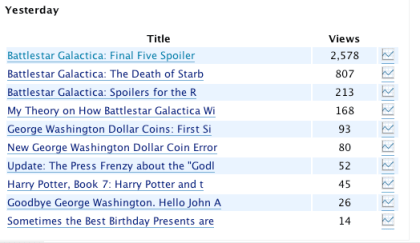
This was reflected in the record-setting blog stats for the day. On Monday, this blog saw a record 4,593 page views, almost all of which went to the top posts on my blog for Battlestar Galactica topics. The post on the Final Five was a big winner:

The source of this amazing traffic is simple, and to me, kind of surprising. When you do a search for “Final Five Cylons” on Google, or even Google Blog Search, you get terrible results. In fact, it seems like my posts are one of the few out there on this topic that actually discuss any theories. You can see the search terms that led to my blog on Monday:

One last source of traffic which is a new one for my blog is my favorite information site, Wikipedia. Surprisingly, my blog is now a reference (number 1) in the online encyclopedia, as an example of how fans now think that Starbuck may be a Cylon.

The link to my blog is literally a superscript (1) in the middle of a multi-page post on the topic “Kara Thrace”. Still, that little linked number was the source of over 100 page views to my blog, in just one day, beating out the sampling from the WordPress.com homepage:

I am a huge fan of Wikipedia, and I believe that if the natural search engines aren’t careful, they may be disrupted by wiki-based content aggregators like Wikipedia for the “peak” informational queries on the web. This might be just a single data point, but this tells me that that Wikipedia as a traffic source for information should not be underestimated.

In any case, the long wait is now setting in for Battlestar Galactica fans, as Season 4, which is now 22 episodes, will not kick off until January 2008. The wait for ’08 is on.

Here are a few pieces of information, however, to navigate the gap.

First, this article explains that there will be a 2-hour television movie in the fall, based on the Pegasus and the timeframe between the Cylon attack and the rendezvous with the Galactica. It’s before the timeline of Season 3, but Ronald Moore states that it will be relevant to the arc of Season 4.

Second, this interview with Ronald Moore in TVWeek covers a set of questions about the story, the return of Starbuck, and the softening ratings for the series this season.

Third, this interview with Ronald Moore in the Pittsburgh Gazette answers some questions about Season 4 (including some spoilers!) He actually answers the question on whether or not the 4 crewmembers in the Season 3 Finale are Cylons or not (they are). He also strongly implies that Season 4 may be the end. He has stated on many occassions that he wants to have the creative freedom to wrap up the series properly, and not get cancelled leaving things unresolved. Odds are, the 22 episodes of Season 4 will end the series.

Lastly, this three-page interview with Ronald Moore in Salon covers almost everything.  Some duplicate data here, but I’ve saved the best for last.

OK. I think that’s enough Battlestar Galactica posts for now. You know, this blog was going to be more about personal finance this year. So, back to the real stuff, but boy, what a ride.

Sometimes the Best Birthday Presents are Late

My brother loves me.

How else could you explain the lovely birthday present that he gave me yesterday?

appletv.jpg

I’ve placed my order already to the Apple Store for:

  • Airport Extreme Wireless Hub (802.11N)
  • HDMI to DVI cable
  • DVI to RCA Video cable

The last two are essential because the AppleTV does not ship with any cables to connect the device to your TV.  Even if it did, the TV I’m going to hook up first is the one in the “playroom” for Jacob, which doesn’t have HDMI or Component inputs.  It’s a *gasp* regular, analog television.

There are some exciting hacks already online on how to put a larger hard drive into the AppleTV, install a terminal server, and add support for other codecs like XViD.

I’m obviously very excited to get it up and running.  So…

Thank you, Daniel.  I love you, too.

Goodbye George Washington. Hello John Adams Presidential $1 Dollar Coin.

Well, it’s not quite time for goodbye. But soon.

With all the press about the George Washington dollar, I’m not sure that most people realize that the US Mint has already stopped producing them. That’s right, they’ve already begun production of the second Presidential $1 dollar coin, the coin for John Adams.

The Patriot Ledger in Boston has a really nice article on the new coin, and on John Adams.

There has been so much coverage about the errors on the new George Washington dollar coins that demand for the coins has been surprisingly high. Unfortunately for collectors, I think this means that the market is flush with them which may mean no significant appreciation for the George Washington version.

Personally, I expect that the excitement about the dollar coins to die down rapidly as they march through the Presidents. In many ways, you want demand to be low at the time of issuance, since that means fewer people will be stashing them away. That leads to higher prices down the road.

The US Mint has scheduled the release of the John Adams dollar coins for May, so there is still some time to get your George Washington dollars.

One nuance that is worth noting – it’s only for the 6 weeks after release that the Mint will be providing boxes of dollar coins for a single President. So come May, you won’t be able to go to the bank and get a box of George Washington dollar coins any more. You’ll either be able to get a box of the John Adams’ dollar coins, or a mixed box of golden dollar coins – Sacajawea, Washington, etc.

Update (5/17/2007):  The John Adams dollar coins have been released!  Read more here.

Update (5/24/2007): For a limited time only, I am now carrying unopened, original John Adams Presidential Dollar coin rolls in my eBay Store. Click here to buy them on eBay Express. If you are interested in the other rolls I am carrying, click here for all the coins I am currently selling.