The Apple iPod Shuffle. Now in… Orange?

Apple quietly updated the iPod Shuffle line of ultra-portable music players with a range of colors this week. $79 gets you a 1GB player of your choice, and you pick the color. The iPod Shuffle was redesigned last year, moving from the stick-like form factor to a little clip-on that is even smaller.

It’s funny, but I remember the Saturday Night Live sketch about the iPod continually shrinking… and that was before the new iPod Shuffle redesign.

It’s on YouTube, of course…

I still think it’s hilarious. My favorite quote…

Newscast: “Wait… That iPod was only out for like 5 seconds!”

Steve Jobs: “5 seconds too long. It was too big. Ridiculous.”

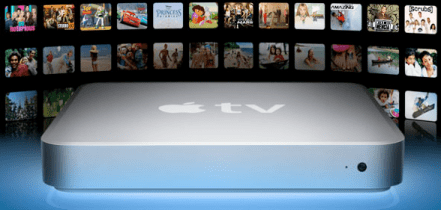
The Apple TV Does Not Suck

Sorry, I had to add a quick post here about Apple TV.

I had lunch this weekend with some close friends, several of which have worked for Apple in the past. And I was surprised at how negative they were about the Apple TV.

First, check out this article on Seeking Alpha.  It looks like the Apple TV may be blowing away expectations already, with 100,000 sold.

Second, the Apple TV does not suck. Here’s why I’m excited about it:

  1. Tivo Home Media Option 2.0. It feels like Tivo stopped innovating with the home media option once it got into trouble with it’s future as a company and a product. Right out of the box, the Apple TV takes the best things that I love about the Tivo interface, and brings them to my iTunes content. Tivo handles my iTunes playlists & iPhoto libraries just fine, but Apple TV takes support to the next level with support for iTunes Store content and TV/Movies/Music Videos. High definition is a plus, although I’m still living in the stone age of 480p.
  2. Media Server Heavy, TV Interface Light. I think this is the right model. You want a big, brawny server with loads of storage, and a lightweight client with smart caching to receive content. I honestly see my house with an Apple TV on every set instead of a DVD player. I know the first TV that’s getting one is the one in the kitchen, where my young son is just destroying DVDs left and right. No need for that – he can just pick from a menu.
  3. Goodbye AVI. Hello, MP4. I’m very excited about MP4 files, ripped with the H.264 codec. High quality, smaller files. A 2 hour movie seems to fit in about 1 GB. My friend John was very caught up with the lack of AVI support, and maybe he knows something I don’t. But to me, this just sounds like complaints that the iPod doesn’t support WMA. My prediction – the lack of support of AVI is going to turn out to be bad for Microsoft, and not hurt Apple TV.

Now, there are plenty of features I’d like to see on the Apple TV. I’d like to see a concept of “libraries” of content, so I could make a library of kid-friendly content for my son. Maybe some sort of enforced filter or protection would be sufficient. I’m also worried about 802.11N scaling across my house, especially with multiple TVs going.

I’m also concerned with the grey areas around ripping DVDs, versus the clear availability and accessibility of ripping CDs. Normal people need to be able to convert their DVD libraries to digital content easily, the same way that iTunes lets people convert their CD libraries.

The wild card here is YouTube and other ventures. Depending on how much unique content avoids the MP4 format, the more inclusive Apple may have to be. With Google & Apple linked at the board level, however, don’t be surprised to see the Apple TV support YouTube at some point, in some form.

I still would love a way to automate the conversion of my recorded Tivo programming into iTunes content. What I really would like to see is a Tivo Series 3 where the hard drive in the box is really considered cache storage – the real file store would be my media server, and the Tivo would archive all recordings to the server when it wasn’t busy.

All sources would lead to the media server, my digital content receiver. And all paths out of the media server lead to devices like the iPod, iPhone, and Apple TV.

But if that vision doesn’t work, maybe I need to rethink my $100/month DirecTV bill.  Maybe with basic programming, I could save $40/month and put that money into acquiring content in other ways.

Apple TV is definitely a 1.0, but it does not suck. 😛

Microsoft Caught with a Bad Case of Mac OS Envy

There is a new blog on WordPress called Graceful Flavor, and they tend to focus on Apple news. They had a post yesterday that immediately caught my eye, entitled:

New Microsoft Email Shows Panic Over OS X Tiger Features

Now, everyone these days expects Microsoft to have iPod-envy, iTunes-envy, even iPhone-envy. But given that the OS wars were largely fought and won in the late 1980’s and early 1990’s, it’s a bit surprising to see a dominant giant like Microsoft caught with not only acknowledging the strengths of Mac OS X, but almost despairing at them.

A snippet here, from an email from Lenn Pryor, the former Director of Platform Evangelism:

Tonight I got on corpnet, hooked up Mail.app to my Exchange server and then downloaded all of my mail into the local file store. I did system wide queries against docs, contacts, apps, photos, music, and … my Microsoft email on a Mac. It was fucking amazing. It is like I just got a free pass to Longhorn land today.

What about this one?

Here’s my take on this:

  1. Big suprise, Mac OS X is a strong product.  Let’s face it – the dominance of Windows over Mac OS had everything to do with x86 and DOS compatibility, and very little to do with the overall design of the 100s of features that make up modern operating systems.    At minimum, it’s fair to say that Mac OS X is an extremely strong product in many areas, and it’s not surprising to see Microsoft clearly interested in learning from its competition.  I know that within Apple, we spent plenty of time discussing new and planned Microsoft features.
  2. Microsoft is a huge company, these quotes didn’t come from Bill Gates.  Is it really so shocking that there are Apple fans within Microsoft?  Come on.  It’s a huge company, and it’s not surprising that several people in middle management are Apple fans.  Sometimes your best people are the ones who can look outside your four walls and see the world differently.  I don’t know if these people are considered thought leaders or pariahs within Microsoft, but either way, these emails aren’t really surprising.
  3. The grass is always greener…  When I was at Apple, while most people were convinced of Apple’s superiority in design, innovation and approach, there was always an inherent sense of insecurity and envy of Microsoft’s ability to reach the broadest audience.  There was envy of their resources, their ability to fund money-losers for years on end in long term markets.  But this wasn’t unique to Apple.  Or Microsoft.  All companies who compete ferociously in technology develop an appreciation, which can quickly turn to envy, for the unique advantages of their competition.  The trick is to remember that strategy is about unique differentiation – what makes your company, your products, your services and your brand unique in the market.  Trying to match your competitors feature-for-feature is a death spiral towards commoditization and lack of identity.

No matter the bravado, I guarantee you that there are people at Apple writing memos about the inspiration they have gotten from Vista.  Sure, they’ll say, there’s a “better way” to do some of these things.  But they’ll have a note of envy for DirectX 10.  They’ll be jealous of how quickly third parties come in to fix holes in the Vista feature set.  And Mac OS 10.6 will likely end up stronger for it.

Equinox Releases iSale 4 at Macworld 2007. Unbelievable eBay Selling Tool for Mac OS X.

I know I said I was a bit disappointed by Macworld 2007, but I did see a few things that I liked.

One was the new version of iSale 4 by Equinox software.

c_image.jpeg

This application just keeps getting better and better.  I was really impressed with their new, searchable, listing template functionality.  I was also very impressed with the visual, live update of sales status, and the order tracking functionality.

The application represents the best possible combination of creative use of the existing eBay APIs, and a best-in-class Mac OS interface.   They support very Mac-specific touches like iPhoto integration, .Mac picture hosting, and other goodies.   The feature list at this point reads like a “Who’s Who” of Apple & eBay functionality.  Check it out on their website.

They even support the ability to preview your listing on both eBay & eBay Express!  Right in the application.  Gorgeous.

My wife continues to use GarageSale to sell on eBay, and I use the new Sell Your Item form from eBay.  But when I see great work like this, I just have to give them a shout out and say to readers, if you are looking for a great Mac application to make selling on eBay easy, try iSale.  It’s a free trial, and it’s worth checking out.

Steve Jobs: Master of Presentation (aka the Reality Distortion Field)

Steve Jobs is famous for his presentation skills. I myself have seen him present and speak at over a dozen different occassions, at Stanford, at Pixar, at Apple, and at big Apple events like WWDC and Macworld. Audience members can be so taken with Steve during a speech that they often are surprised themselves at how locked in the moment they were, hence the infamous “Steve Jobs Reality Distortion Field”.

Steve Jobs is not a great speaker by accident. It’s something that he spends a lot of time and meticulous attention on. Marissa Mayer, VP of Product at Google, told me that she often goes to the Macworld keynote with members of her product management team. Afterward, they try and do a quick breakdown of not what Steve said, but the how and why of his presentation, timing, word choice, and style. I personally agree that anyone who has an outbound role representing their company and their product in the technology space should go to the school of Steve, when it’s in session, if possible.

There was a great article in Seeking Alpha this week by Carl Howe that did a wonderful job breaking down why Steve is such a good speaker. Normally, I’d just link to it, but the content is good enough that I’m going to reproduce it here, for fear of the link at some point going dead.

If you enjoy public speaking, or are called on to present to executives or large audiences, think about the points below and your own presentation style.

One of the benefits of being at MacWorld this year was that it gave me the chance to dissect Steve Jobs’ presentation style in person (you can stream it yourself from Apple’s Web site). And while I was madly blogging on my cell phone while the keynote was going on, I did jot some notes about just how he sets up what is fondly referred to as his reality distortion field. My conclusion: there’s no magic here. He simply does all the things that a great communicator is supposed to, including many techniques that we teach. Jobs is so persuasive because he:

Rehearses — a lot. Jobs is extremely comfortable on stage. You can see in his eyes that he knows his content cold before he even starts. He isn’t trapped behind a podium. He knows when to get excited and when he needs to pull back. All of these things aren’t hard — provided you have the entire story you want to tell in your head. Jobs does — and that only happens if you have done the story over and over again in rehearsal.

Is himself. Jobs doesn’t try to imitate other people or be something he isn’t. He’s not afraid to get excited and emotional over what he is talking about. As an example, when he thanks the families of Apple employees at the end, you can hear him getting choked up about the commitment and dedication they had. The audience can feel the emotion behind his words, and that adds impact to anything Jobs says.

Uses visuals effectively. Jobs doesn’t clutter up his presentation visuals with a lot of words. In fact, the slide shown above probably had the most words of any slide he used. Most of his slides have such illuminating reading as 2.0B (the number of iTunes songs sold to date), or “Ads”. Without a lot of reading to do, the audience listens to Jobs more, giving the words he says more impact. Jobs also uses demos effectively; all of them use very simple examples rather than complicated ones. Why simplicity? Because simple ideas are easier to convey and easier for the audience to absorb.

Focuses on the problem he’s solving in detail. Watch Jobs’ first 7 or 8 minutes of the iPhone introduction (starting about 26 minutes in and running until 33 minutes). All of that time he spends setting up why smartphones are dumb and clunky. He doesn’t even talk about his solution to the problem until he’s told the audience no fewer than three times what criteria a successful product in this market must have. And amazingly, the product he introduces has exactly those criteria. It’s not only an effective marketing technique, but it creates drama and tension where there would be none otherwise.

Says everything three times. Jobs always introduces new ideas first as a list, then he talks about each member of the list individually, and then he summarizes the list later. And, he always uses exactly the same words each time. A great example is the three functions that the iPhone has: an iPod, a phone, and a revolutionary Internet communicator. Every aspect had its own section of the keynote, and its own icon that kept being repeated. He even got the audience to chant the three items sequentially with him over and over. The result: even listeners who aren’t paying attention get the message.

Tells stories. At one point late in the presentation, Jobs’ slide advancing clicker failed. He switched to the backup, and it wasn’t working either. So what did he do? He told a story about how he and Steve Wozniak build a TV jammer and used it in college TV rooms to stealthily mess up TV signals. The story had nothing to do with the presentation, but it kept the audience laughing and amused while the backstage crew fixed the problem. Yet, the story fit beautifully into the larger iPhone story overall.

Isn’t afraid of the dramatic pause. When Jobs switches topics or is about to say something important, he doesn’t rush into it. Often, he will go to the side of the stage and grab a drink of water. Or, he’ll just stand to the side of the stage and say something like, “Isn’t that amazing?” and just wait. The pauses both keep the audience from getting tired out and allows them to absorb what he has said. And more importantly, they create drama and anticipation for what is to come.

Uses comparisons to demonstrate features. When Jobs has a feature he really wants people to remember, he always compares it to something else. In the iPhone introduction, he compared the iPhone with other smartphones. When he introduced the iPod nano, he compared it with other flash players. Comparisons allow him to emphasize the unique selling propositions of his products and paint the competitive landscape on his terms. This one feature of Jobs’ presentations puts his presentations head and shoulders above others.

If anyone needs more convincing of how much of a difference presentation technique makes, just contrast Cingular CEO Stan Sigman’s presentation yesterday with Jobs’. Despite his professionally written content, his presentation just falls flat on too many words and not enough life. The audience started clapping at once point just to try to convince him to cut it short. Ouch.

Apple has built its reputation by sweating the details for its customers. Jobs does the same for his audiences. Few companies will effectively compete against Apple until they start doing the same. Until then, Jobs’ reality distortion field will be as powerful as ever.

Next year, the Macworld 2008 Keynote falls on my birthday.  I think I’m going to try and attend in person.  It has been a while since I’ve seen Steve Jobs live, and its something you want to do while you can.

My Simple Explanation for the iPhone Apple/Cisco Fiasco

And make no mistake, it is a fiasco.

Here’s my interpretation of what happened. Please note, I have no factual data to back this up. Just comments from someone who has been reading the press like anyone else.

Apple wants the iPhone name. It begs. It pleads. It promises Cisco some case, and tie-ins to Cisco networking gear, and Steve promises to introduce Chambers to more of the cool crowd.

Cisco agrees in principal, and faxes over final contracts by Monday 8pm.

Steve feels like the deal is done, and doesn’t sweat the details of signing on the dotted line before the keynote.

Big announcement. Awesome. Amazing.

Cisco now realizes, wow, this trademark just became worth a whole lot more! I’m glad we didn’t sign anything.

Cisco tells Apple, it’s going to cost a lot more now. This violates Steve’s sense of fair play, and a lawsuit is born. The lawyers take over, and it’s all animosity until the posturing is done, and a richer deal for Cisco is worked out.

Dumb move, really, by Apple. Next time, sign the contracts or don’t announce the name. The product doesn’t launch until June anyway. You gave a fake name for Apple TV (iTV)… you could have done the same thing here.

Cool product, though! It would be cooler if it ran Skype

Update (1/11/2007):  Jim Cramer has his own theory on what the lawsuit is about.  He thinks Cisco wants to force Apple to let it into the “cool” club…

A Disappointing Macworld 2007 (no iLife ’07, no Mac OS X 10.5 Leopard)

I hate to say it, but I was disappointed with Macworld this year.

Don’t get me wrong, I love the Apple TV. I think I am going to buy four of them – one for each TV, and one for the minivan, that can synch at night when it’s in the driveway. All my kiddie videos are going into iTunes, so that my two year old won’t manhandle the DVDs any longer. I see a direct mapping between the success of ripping CDs and iPods with the ripping of DVDs and Apple TVs.

And, please don’t mistake my enthusiasm for the iPhone. It looks gorgeous, and once I can try out the touch screen, I’m very likely to get one.  There has been a lot of concern voiced by some friends of mine that Apple hasn’t opened up the phone for development.  My guess is, they will, at WWDC, but they don’t have it stable enough and/or the build environment ready yet.


The problem was… that was it.

What was missing? No new software!

No iLife ’07. My number one application from both a time and enjoyment factor is iPhoto. Last year, I got to see iPhoto 6 for the first time, and it was fantastic. Made my whole 2006 better.

This year… nothing.

No Leopard booth! No Mac OS X 10.5 to discuss and play with… at least, not that I could find.

I guess I didn’t find the preview of Microsoft Office 2008 that exciting.

Oh well. I will share one new product I found that was better than expected: the new HP Color LaserJet 2605dtn. The price is great ($629). Two paper trays (one for paper, one for labels for PayPal postage printing). 10/100 Ethernet built in. Duplex. Rendering on the printer, not the computer. Fast. Great print quality.

It’s almost perfect, except for the manual paper feed that only takes one sheet at a time. If they fix that, I’ll be on my way to upgrading my 6-year-old laser printer to color.

And note to Apple – I didn’t expect iLife ’07, or iWork or Leopard to make the keynote. But I did want to see them at the show.

See you next year.

MacWorld 2007: iPhone, Apple TV & Airport Extreme

Not like you need to read yet another article on these huge announcements from Apple today.

It seems like every media outlet is just bursting with articles, analysis, pictures, and hype about Apple these days. In fact, I’ve even noticed that the old media stand-by from 1997, “The beleagured company…” has been replaced with “The legendary company…” in the most recent New York Times.

What a difference 10 years can make.

Well, if you’ve already read 100 articles on these products, I’m not sure you need to click many of these links. But, if you are a normal human being, and you’ve somewhat tuned out all of the recent press and hype, here are a few good links if you are curious.

The best web pages about the products are actually at Apple. So start there:

If you are interested in a few more links:

Also, it looks like David Pogue, at the New York Times, actually got to sit down with Steve and play with the iPhone today. Read about it on his blog.

Let me just say up front, these products are gorgeous. Who knew that everything I’d want for my birthday would be small & rectangular this year? In all seriousness, Apple has taken design language and brand identity to a new level. It’s across their advertisements, their software, their hardware. It is constantly refreshed and new, and yet it maintains a language and style that consistently tells you it is an Apple product without even seeing the logo. It may look easy when Apple does it, but there is a reason why no one else does. It’s hard, bordering on impossible.

I am actually going to Macworld 2007 tomorrow afternoon, so I will post again with thoughts after I’ve seen the products in person. Let me just highlight here some of my initial thoughts:

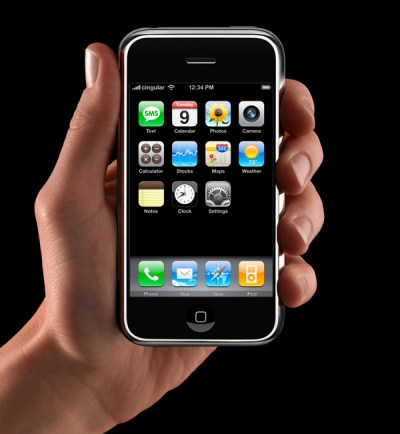
  • iPhone. Yeah, this is the reason Apple’s market capitalization went up by $6.1 Billion dollars today. The pictures make it look large, but I’m expecting to be surprised by its dimensions tomorrow. Not available until June, but clearly something that Apple felt they needed to announce now to capture excitement. It’s always risky to give the market a half year to formulate a response to your product, before you even ship.

    I am 90% sure that I will buy one of these to replace my Nokia cell phone and iPod nano. My biggest concern is that while Steve is selling the touch-sensitive screen, I think people may be underestimating the value of three dimensional button feel. If you have a universal remote that is all touch-screen, then you understand the loss of that physical feedback. I can dial my phone today without looking, with one hand. The iPhone seems to be geared towards someone who will look at it and hold it with two hands while they are using it.

    But man, is it gorgeous. Unbelievable. Beyond the physical device, notice the difference that great software makes? Does anyone still think that Windows Mobile/CE is impressive now that they are seeing what Mac OS X lite can look like on a device? Palm OS looks like it was written in the 1970s next to it. The biggest complaint I have heard about the Motorola RAZR family is just how bad the Motorola software is. I expect the software to be a real selling point for the device.

  • Apple TV. Believe it or not, I’m more excited about this device than I was about the iPhone. When I had a Tivo Series 2, I used to love the Home Media Option. Displaying my iPhoto library and playing my iTunes library was great, and the fact that it presented all of my personal data (playlists, albums) was fantastic. Unfortunately, my move to DirecTivo forced me to give it up, in favor of dual tuners. Apple TV looks even better, because it will handle video, even high definition, and it has the only UI that I’ve seen on a set top box that looks as good as Tivo. The price point is excellent at $299. Everyone should have one of these.
  • Airport Extreme (802.11n). You won’t see articles written about this one, but this is the companion piece to making wireless a real potential video distribution solution for the home. Like previous incarnations, I don’t think this will be a product that non-Apple devotees will buy. I guarantee you, there will be cheaper 802.11N basestations on the market within minutes. Still, I’ll buy one, largely because I am one of those Apple devotees, and because I expect it to just work flawlessly with my home network, and with my new Apple TVs.

I’m not sure if it will be feasible with this initial release, but I’m eager to find out whether it will be viable to have multiple Apple TVs in the same house. I’d love to have all of my photos, music & video on my G5 server, and then be able to watch them on any TV in the house.

So, $599 + $299 + $179 = over $1000 of new product that I now must own. Unbelievable.

More to come tomorrow, once I get a chance to see these and other products in person tomorrow.

The Apple Stock Option Backdating Scandal

Yes, I know you are expecting me to post about all of the new Apple products announced today during the Stevenote at Macworld 2007.

I will definitely post on them tonight and tomorrow, as I’m going to Macworld in person to see them tomorrow afternoon. It’s my annual birthday treat.

Still, despite all of the excitement, I thought I’d post a few worthwhile articles on the ongoing developments in the Apple options backdating scandal. I find the scandal particularly interesting because:

  1. I know some of the people now mentioned in the investigation
  2. I worked at Apple in the time period where the alleged abuses occurred
  3. I am a lifelong fan of the company and its products

I do not own any shares in Apple Computer (sorry, now it’s “Apple, Inc”). But I think people who do need to follow this ongoing development with their eyes wide open.

I find the last article troubling in particular, because I knew Wendy Howell when I was at Apple. I didn’t know her well, but I knew her, and it’s shocking to see someone’s name in the press like this.

I haven’t fully digested my thoughts on the scandal, or formed a final opinion about what should happen. But this much seems clear – every announcement and release seems to reveal more and more “issues” and more direct involvement by executives, including Steve.

At the same time, it’s hard to argue that Steve & team have not created far more value for the company in the past 10 years than these transgressions may have caused. Steve has increased the market value of Apple by literally $50 Billion+, and compared to other executives in similar positions, seems to have actually taken a surprising low % of those gains for himself. In fact, you could argue he has literally charted a new course for the entire consumer electronics industry at this point in regards to digital media.

There is also no doubt that going forward, Steve is absolutely the value maximizing person to run this company for the next 10 years. No question.

That leaves Apple shareholders with an interesting question: do they impeach their leader on this arguably minor infraction? Or, will they issue a full pardon? (I apologize for the political mixed metaphor)

I think Apple is making this situation worse by not effectively admitting the mistake, and apologizing for it completely. They are turning this into the type of theoretical ethical issue that is just too juicy for the media to give up on. I think the complete absolution of Jobs by Al Gore & Jerome York may have actually stirred things up more, given the revelation of email from Jobs on setting the timing of the option grants. The inclusion of Pixar in the investigation is also troubling.

Make no mistake – this drama will peak in 2007.

Now, about that iPhone, Apple TV, and Airport Extreme basestation that I want for my birthday…

Safari & Firefox Marketshare Continues to Grow in 2006

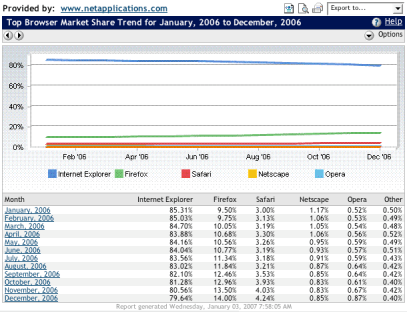
Some of the latest market share numbers from Net Applications:

Some of the key insights from Mac Daily News:

According to data collected by Net Applications’ “Market Share,” Apple Computer’s Safari Web browser continues to gain market share in the Internet browser segment. In December 2005, Safari’s market share was 3.07%. In December 2006, Safari’s market share stood at 4.24%. The rise from 3.07% to 4.24% represents a year-over-year growth of 38.11% for the month of December.

Safari experienced a 5.21% increase from November 2006 rising from 4.03% to 4.24% in December 2006. Safari is a Mac OS X-only browser.

Microsoft’s Internet Explorer web browser continues to lose share, dropping below 80% to stand at 79.64% in December 2006. In December 2005, Internet Explorer’s market share was 85.05%. The fall from 85.05% to 79.64% represents a year-over-year loss of 6.36% for the month of December.

Firefox went from 9.57% in December 2005 to 14.0% in December 2006, a 46.29% increase year-over-year.

Interestingly, if you dig into the numbers you see that the Safari market share is now basically equivalent to the size of the Mac OS marketshare, implying that the growth to date has been coming from two factors:

  1. Growth of Mac OS marketshare
  2. Growth of Safari adoption by Mac OS users

Unfortunately for Apple loyalists, #2 has likely played its course as most Mac users have upgraded to Mac OS 10.2 or later now, where Safari became the default browser (back in 2003, when Microsoft killed Internet Explorer for the Mac). That means that going forward, Safari growth has to come primarily from growth in Mac OS marketshare.

The Firefox growth is stupendous, and hats off to my friends at Mozilla. 14.0% is amazing, and has a lot to do with the official change in policy by many websites to include multiple browsers as officially supported platforms for development of new features. (It also has something to do with their rumored economic success of late.)

Many people don’t realize how much additional development and quality assurance effort goes into designing web applications for use on multiple browsers and operating systems. However, users vote with their actions, and they have said, loudly and clearly, we support multiple browsers.

I’m glad to say that as of 2006, eBay officially does too.

I, of course, always seem to be off the beaten path. As more and more Mac users adopt Safari, I have recently moved to Firefox 2.0 for my default browser. Maybe Safari 3.0 & Mac OS 10.5 will change my mind.

Mac OS X: How to Clear Your DNS Cache (or How Can I See My New Server?)

Let me preface this post by saying:  Your-Site.com Sucks.

In fact, that’s an important enough fact for another complete post.  Let’s just say that I have not had email service from my provider, your-site.com, since December 29th.  Forget 99.9% uptime.  This is over five days of no email service, and very terse and angry emails from their customer service when requesting daily updates of status.   I’ve been using their service for over five years, so you’d think they’d treat you a little bit better, but no.

I finally got tired of hearing nothing useful from them, and I switched providers yesterday to GoDaddy.com. Cheaper ($4/month), more features (5GB space, 250GB transfer, 500 email accounts), and email support 24×7 that responds in about one hour.

However, I did learn an important trick.  So GoDaddy got my new hosting service up in record time, literally hours.   However, I realized that my current FTP & Email clients were still seeing the old DNS mapping for my domain.

I realized this was because my machine had cached the DNS lookup for my domain.  The applications weren’t seeing the new IP address, because they thought they already knew it.

The answer is simple:

  1. Open up the Terminal application (in Utilities)
  2. Type “lookupd -flushcache”

That’s it.  I love the Unix underpinnings of Mac OS X, so it’s always nice to discover a nice back end trick.  This one was easier than most.

Many thanks to the Inert Ramblings blog for the easy answer to this problem.

Hopefully, I will now have consistent and available email service through the rest of 2007 & beyond.

Do The Math: iTunes Sales Are Not Collapsing

There has been a lot of press today about a recent Forrester report that states that sales of digital music from the Apple iTunes Store has dropped off dramatically this year. See this coverage here for example.

Apple Computer’s iTunes music store suffered a 65 percent slump in sales during the first six months of the year, reversing almost two years of gains, according to a Forrester Research report.

The number of iTunes transactions declined 58 percent between January and June of this year, while transaction size fell 17 percent, said Forrester, a market research firm based in Cambridge, Massachusetts.

Well, not quite. This article from the New York Times is a little more clear on what the Forrester research stated:

Apple’s ubiquitous iPod and its iTunes music store were intended to be a kind of perpetual motion machine, with iPods helping to sell iTunes and iTunes helping to sell iPods.

Although both are successful, the relationship may not have worked out exactly as expected. At any given point, the cumulative number of songs sold by the iTunes store has generally been about 20 times the cumulative number of iPods sold, according to Forrester Research, the technology consulting firm. That ratio has recently crept up to roughly 22 to 1, as 1.5 billion songs have been sold. The figures were compiled from public statements by Apple.

OK. Well, that’s interesting, but less troubling. Something to be concerned about, for sure, if it means what they say it means.

But this is what I love about the web. No sooner than a very expensive analyst from Forrester publishes this research than another site immediately rips said analysis to shreds.

From Blackfriars’ Marketing blog:

The graph above looks at cumulative iPod and iTunes sales on a logarithmic scale. Now to review a little high school math (yes, high school was a long time ago here as well), when you plot things on a logarithmic scale, exponential growth shows up as a straight line. A gradually tailing off curve generally still implies substantial growth — iTunes sold a billion songs just in the past 12 months. So the first takeaway from the above curves should be that both the iTunes and iPod sales are growing dramatically.

You can read the full analysis, but the short story is that the growth rate is slowing, but sales are still increasing markedly. In fact, the research doesn’t account for the basic fact that many iPod sales go to owners of previous iPods, thus the number of songs per iPod may in fact still be increasing. It also doesn’t account for the new streams of TV & Movie revenue.

Still, slower growth is slower growth, and it may point to the maturation of the iPod business. When you are selling 14 millions MP3 players a quarter, you might hit the limits of large numbers. Let’s remember, Microsoft states that selling 1 million Zunes by next summer is how they define success.

Microsoft’s Jim Allchin: ‘I would buy a Mac if I didn’t work for Microsoft’

Sorry, but I found two Apple/Microsoft snippets worth posting today.

This ComputerWorld article is amazing.

Jim Allchin is the long-time development chief for Windows at Microsoft. ComputerWorld is reporting that a 2004 e-mail from Allchin chastizes Microsoft for having lost focus on the user, and says that he would buy a Mac if he didn’t work for Microsoft.

“In my view, we lost our way,” Allchin, the co-president of Microsoft’s platform and services division, wrote in an e-mail dated Jan. 7, 2004. The e-mail was presented as evidence late last week in the Iowa antitrust trial, Comes v. Microsoft Corp.

“I think our teams lost sight of what bug-free means, what resilience means, what full scenarios mean, what security means, what performance means, how important current applications are, and really understanding what the most important problems our customers face are. I see lots of random features and some great vision, but that does not translate into great products.”

I haven’t read the email in detail, but as much of an Apple fan as I am, I think his tone represents more of your typical “wake-up call” email that gets sent from time-to-time as a senior executive in software.

Even great software teams and companies can easily get caught up in their own internal analysis, politics, and design cul-de-sacs.  Great UI designers can get caught up in their “frameworks”.  Great product managers can get caught up in their “strategies”.  Sometimes, the needs of the end user can get lost in the passion of pursuing the perfect model for your software application.

As a result, it’s hard as a leader as a software company to not be forced to remind your team periodically that it is the customer that matters.  Listen to them, focus on them, respect them, and delight them.  Not your competitors, not your frameworks, and not your strategies.  Sometimes, to be emphatic, you try to evoke a passionate response by invoking taboos.  I have to imagine that the head of Windows saying that he would buy a Mac is as taboo as it gets.

I don’t fault Allchin here, although these days you pretty much have to assume that any executive email at a large company can get circulated publicly.

Microsoft Copies Apple Icons…

Found this funny snippet today online. Looks like Microsoft was caught with an Apple icon on one of its properties.

Here is the image from Microsoft’s website for Vista Business Edition:

ms-icon-screenshot.png

Here is the original version from Apple’s Workgroup Server:

apple-icon-screenshot.png

Funny snarky comment from the blog where I got this:

Think of a snarky comment making fun of the fact that Microsoft can’t even copy an icon without screwing it up by resizing it. Bonus points if you can work in a crack about the misspelling (“Busines”) in Microsoft’s web page title.

The full play-by-play is here, along with some amusing follow up screenshots of Microsoft’s hasty efforts to replace the icon.

I don’t really fault Microsoft here – quite a few web and graphic designers have been known to grab artwork from time to time as temporary placeholders.  Sometimes, they sneak through as people forget that they aren’t the final artwork, or forget they were “borrowed” by someone else.  It’s possible on big teams.  Maybe there was a Mac-fan on the Vista team here who thought this was a funny inside joke.

Still, given all the history of Microsoft and Apple, and the obvious comparisons of Vista’s new look and feel to Mac OS X’s old look and feel, you’d think there would be a special memo out about not borrowing icons from the Mac.

Gotta imagine someone is getting fired over this.  You just can’t steal intellectual property as part of a commercial product.

Don Norman in Defense of PowerPoint

How is it possible that I didn’t know that Don Norman wrote a post entitled:

In Defense of PowerPoint

He wrote the post over two years ago. However, I remember the storm over this like it was yesterday. It all started with a New York Times article in 2003 called “PowerPoint Makes You Dumb“. It was written in response to the investigation into the Space Shuttle Columbia disaster, which pinned part of the blame on a “PowerPoint Culture” with too little detail.

A sample paragraph from the NYT article:

This year, Edward Tufte — the famous theorist of information presentation — made precisely that argument in a blistering screed called The Cognitive Style of PowerPoint. In his slim 28-page pamphlet, Tufte claimed that Microsoft’s ubiquitous software forces people to mutilate data beyond comprehension. For example, the low resolution of a PowerPoint slide means that it usually contains only about 40 words, or barely eight seconds of reading. PowerPoint also encourages users to rely on bulleted lists, a ”faux analytical” technique, Tufte wrote, that dodges the speaker’s responsibility to tie his information together. And perhaps worst of all is how PowerPoint renders charts. Charts in newspapers like The Wall Street Journal contain up to 120 elements on average, allowing readers to compare large groupings of data. But, as Tufte found, PowerPoint users typically produce charts with only 12 elements. Ultimately, Tufte concluded, PowerPoint is infused with ”an attitude of commercialism that turns everything into a sales pitch.”

This issue resonates with me for three reasons:

  1. Don is one of the HCI legends. Even though I now work at eBay, I began my career at Apple Computer, working in the Advanced Technology Group before transferring to the WebObjects team after Apple acquired NeXT. Towards the end, ATG was rebranded the “Apple Research Labs”, and Don Norman was the VP (and Apple Fellow). Don’s book, The Design of Everyday Things, is one of the standard bearers for an education in design.
  2. I find myself using a lot of PowerPoint. It started with my work in venture capital, digesting 6-10 new presentations a day presented live, and an uncounted number over email. Now at eBay, I find that in the end, there is no better way to pitch a new business or a new product strategy broadly than to go through the exercise of producing a truly great slide deck. I wonder sometimes whether I now see more decks at eBay than I did in venture capital.
  3. Don is right. PowerPoint has its place. I love to joke about PowerPoint – I even use some quotes from the article in a lunch presentation I do at Stanford every year as an ice-breaker. But the fact is, there is a time and a place for a PowerPoint presentation. Like any other mode of communication, there are situations where the ability to distill concepts into a short, simple visual presentation is the right answer. I have written my share of 1-page memos, 10-page decks, and long emails. There is a time and a place for each, and if you think any one of them is right for every audience and every situation, then you are not thinking hard enough how to match the best communication vehicle to every situation.

So while I can’t say that I’m proud of the fact that these days I probably produce better PowerPoint decks than Java code, sometimes it is the right tool for the job.

As an aside, I remember the Columbia disaster like yesterday. It was a relatively quiet time for me, as I was home with my wife and our new puppy, Newton, who was only a few months old. I woke up that morning, read the news, and we went to get coffee and a bagel to relax and absorb it. (For those in the Valley, we went to the Starbucks & Noah’s Bagel on the corner of De Anza & Stephens Creek, right near Apple)