Don’t Count Out the Fed

Still digesting the news from the Fed yesterday on the new $200B Term Securities Lending Facility.  This type of arrangement has been discussed for some time as a possibility, but its still dramatic to see it unveiled like this.  This is a big deal for a couple reasons – first, it allows for 28-day loans, not just overnight, and second, it allows a much broader range of bonds as collateral, including mortgage-backed securities.  Combined with the other two $100B initiatives, the Fed has opened up over half of its $700B+ balance sheet to stabilize the credit markets.

Wow.

It’s becoming fashionable in circles to doubt the Fed.  I’ll be posting a book review of “Greenspan’s Bubbles: The Age of Ignorance at the Federal Reserve” soon, and I’ve seen a lot of commentary doubting Mr. Bernanke.  All I can say at this point is that it is way too soon to be counting out the Fed.

They can’t work miracles, of course, but the power of almost unlimited resources is significant, if wielded properly.

The most fascinating aspect about central banking is it’s amazing foundation on the irrational and the immeasurable.  In the end, it’s more about confidence than anything else.  By convincing the markets that you will solve the problem, you create the confidence that increases liquidity and solves the problems.  You can’t be predictable, because, like in warfare, predictability leads to people thinking steps ahead and countering your actions.  Like a great General, you have to be unpredictable enough to instill fear and uncertainty in those who would fight against you, and through that uncertainty, ironically you win.

So you want uncertainty, but only the type that destabilizes those that would bet against you.  You want to reduce uncertainty around the likelihood of Fed success.

Got it?

If the juxtuposition sounds funny, blame it on the fact that I read the Greenspan book and a biography of George Washington all within a two week period.

Anyway, at times like this, it’s good to remember that the guy we have at the helm, at this time, is someone whose fundamental academic expertise is the mistakes made in the 1930s Great Depression, and the mistakes made in Japan in 1990s.  A quick reference from Paul Krugman:

What you probably should know is that Ben Bernanke, in his capacity as a professional economist, spent a lot of time worrying about Japan’s experience in the 1990s. (So did I.) What was so disturbing about Japan was the way monetary policy became ineffective; by the later 1990s the short-term interest rate was up against the ZLB — the “zero lower bound.” This is alternatively known as the “liquidity trap.” And once you’re there, conventional monetary policy can do no more, because interest rates can’t go below zero.

Krugman also points out that today’s TED spread indicates a mixed message – confidence seems better slightly, but not significantly.  That could be an indicator that the weight of uncertainty.  Still, in his own words, yesterday’s move was a big slap in the face for the credit markets.

I can’t wait until the weekend when I have time to dig into all of this further.

Beware of HELOC & 2nd Mortgage Traps on Refinancing

I found this article today on Money Musings about the pitfalls of trying to refinance your mortgage when you have a 2nd or HELOC on the house:

A significant number of my personal acquaintances purchased homes (newer, larger) within the last several years. Inevitably, they were also convinced that financing via an 80/20 first/second mortgage setup was the way to go. Doing so is “financially smart,” because it allows them to avoid paying private mortgage insurance.

It’s an idea that works … until it doesn’t. Consider this Baltimore resident’s story, for instance:

Baltimore Sun: “Some Lenders Block Refi Ability”

He needs to refi out of his nasty ARM first mortgage — he’s lucky, in that he does have decent equity in his home — but his second-mortgage holder won’t agree to a re-subordination.

Under any circumstances.

I think the 80/10/10 is more common here in the Bay Area, or at least was, back in 2003/2004.  The 80/10/10 is  80% first mortgage, 10% HELOC, and 10% down payment.  No mortgage ensurance, and you get a HELOC which can be useful if you need to tap assets for some reason.

This is a pretty good example of how liquidity in a market like mortgages which isn’t centrally brokered can quickly jam up.

I’ve also seen stories lately of banks literally calling due their HELOC loans with fairly short notice.  Seems to be tied to people who are underwater on their houses (debt is greater than value of house). Not a good thing if you don’t have the liquidity to cover the outstanding balance, or if you were depending on your HELOC as an emergency fund.

Another lesson on why, in the end, liquidity can be one of the most important aspects of personal finance.   People tend to focus on rates of return, which of course, is a good thing to focus on.  But when you need money, it’s amazing how rates of return give way to the simple ability to tap assets for cash.

Vanguard Cuts ETF Fees… Again

Vanguard announced this week yet another reduction in ETF fees on some of their major funds:

Earlier this month, Vanguard shaved its fees on four of its popular ETFs. Those were:

  • Growth ETF (AMEX: VUG), from 0.11% to 0.10%.
  • Value ETF (AMEX: VTV), from 0.11% to 0.10%.
  • Small-Cap Growth ETF (AMEX: VBK), from 0.12% to 0.11%.
  • Small-Cap Value ETF (AMEX: VBR), from 0.12% to 0.11%.

Also, the new Europe Pacific ETF (AMEX: VEA) wound up the year at 0.12%. The fund opened last July and was expected to assess expenses of around 0.15%.

“We originally estimated an annualized expense ratio at higher levels,” said Rebecca Cohen, a Vanguard spokesperson. “But after the year closed out, expenses wound up being less than originally estimated.”

While relatively tiny moves, the latest changes further distances Vanguard’s ETF lineup from the pack. It also brings to 18 the number of different ETFs that Vanguard has cut expense ratios on within the past four months.

The flurry of cost-cutting leaves Vanguard with an average expense ratio at 0.16%. Through year-end 2007, Lipper data showed an average ETF in the U.S. with an expense ratio of 0.53%.

“As ETFs grow in size, they generally become more efficient to run,” said Vanguard in a statement.

As a shareholder-owned company, Vanguard says its “policy has always been to pass the savings from those efficiencies through to investors. The new expense ratios reflect the lower costs of managing these products.”

This is why I am such a loyal customer of Vanguard and Vanguard financial products.  Their entire brand promise is around minimizing management costs for investors, and as a result, they proactively reduce rates constantly.  Unlike other institutions that use low fees as a short term “loss leader” to bring in assets, Vanguard genuinely strives for the lowest costs structure, and passes those savings on to their investors.

The idea that you can now buy an index of small-cap, domestic, growth companies for 11 basis points a year is just amazing.  11 basis points!  That means if you had $10,000 invested, the annual overhead cost would be just $11.   And that’s for a fairly focused index – I believe the broad based US domestic stock index ETF from Vanguard is down to just 7 basis points!

When at all possible, I tend to go with the Vanguard index ETF/Fund.  In fact, since many brokerages (like Fidelity) charge exorbitant commissions on the Vanguard funds,  you can now just buy the ETFs like any other stock.  Pay a cheap commission once, and pay cheap expenses for decades.

Hard to beat a great product with a great cost from a great firm.  Hard to beat.

The Subprime Primer in Stick Figures

Two email forwards tonight as posts.  My apologies.

This one will appeal to you finance fanboys out there.

The Subprime Primer

This is a 2.4MB PowerPoint presentation that walks through the basics of the Subprime crisis.  It’s extremely funny, if you are into stick figures that use foul language.  It definitely wins the award for best use of a Norwegian stick figure swearing in a PowerPoint document.  (I will consider others for the award, if you post links.)

Yes, please don’t download if you are offended by any of the seven word banned by the FCC on radio.  And yes, if you watch Deadwood on HBO, you will be more than OK with this deck.

2008 Economic Stimulus Tax Rebate Calculator

Found this post on Lifehacker today. It’s actually just a pointer to this calculator on Consumerism Commentator, which lets you enter your 1040 numbers from 2007 (if you’ve done them yet) and figure out how much you are (or aren’t getting).

Economic Stimulus Tax Rebate Calculator

Personally, I’m exceptionally disappointed with the “bi-partisan” stimulus plan that was negotiated by the White House & Congress.  There is a time and a place for fiscal stimulus, and a time and a place for social programs.  But mixing the two rarely leads to good policy.

The Wall Street Journal had an article today that estimated that roughly 50-70% of the rebate money would end up in consumption.  Previous blog posts have argued that the 2001 stimulus rebate, which was similar, was mostly ineffective.

Anyway, what’s done is done.

Predictably Irrational

For those of you who have actually clicked through the link about why I named this blog Psychohistory, you know that I’m fascinated by the ways in which the irrational (people) interact with the rational (math, technology, finance). In fact, to quote that original post:

As a software engineer, my primary interest was in human-computer interaction and the recognition that technology is useless without significant thought given to how people perceive and interact with it. As my interests shifted to the study of economics, I developed a deep fascination with the study of behavioral finance and the recognition that classic economic models fail to predict activity in many cases because people are often not rational actors.

These insights are fascinating to me because I firmly believe that in fact, there is a method to the madness. People are irrational in many situations, but in many cases predictably so.

So I named my blog after the fictional science, invented by Isaac Asimov, called Psychohistory, which claimed to predict the behavior of society by aggregating the behavior of unpredictable individuals.

Dan Ariely, seems to have taken a more direct approach. He’s named his blog Predictably Irrational, and is launching his first book this month with the same name. And I have to say, I’m thinking that I should have used that name instead. 🙂

Here is a brief bio of Dan Ariely, in his own words:

Predictably Irrational, is my attempt to take research findings in behavioral economics and describe them in non academic terms so that more people will learn about this type of research, discover the excitement of this field, and possibly use some of the insights to enrich their own lives. In terms of official positions, I am the Alfred P. Sloan Professor of Behavioral Economics at MIT’s Sloan School of Management and at the Media Laboratory, a founding member of the Center for Advanced Hindsight, and a visiting professor at Duke University.

I discovered his blog through a reference to his recent piece on the Societe General scandal, where a midling trader making less than 70,000 Euro a year ran up the largest trading loss on record – $7.2B dollars. Some of his insights:

Before we decide which parties are to blame, let me tell you about some experiments we recently conducted on cheating with MIT and Harvard students.

We gave a large group of students a sheet of paper with 20 simple math problems but only five minutes to solve these problems. A third of the students submitted their sheets and got paid 50 cents per correct answer. Another third were asked to tear up their worksheets, stuff the scraps into their pockets, and simply tell the experimenter their score in exchange for payment–making it possible for them to cheat. The final third were also told to tear up their worksheets and simply tell the experimenter how many questions they had answered correctly. But this time, the experimenter wouldn’t be giving them cash. Rather, she would give them a token for each question they claimed to have solved. The students would then walk 12 feet across the room to another experimenter, who would exchange each token for 50 cents.

What is the point of all of this? We had the intuition that people could easily take a pencil from work home without thinking of themselves as dishonest, but that they could not take 10¢ from a petty-cash box and feel good about themselves. In essence we wanted to find out if the insertion of a token into the transaction–a piece of valueless, nonmonetary currency–would affect the students’ honesty? Would the token make the students less honest in tallying their answers?

What were the results? The participants in the first group (who had no way to cheat) solved an average of 3.5 questions correctly (they were our control group). The participants in the second group, who tore up their worksheets, claimed to have correctly solved an average of 6.2 questions. Since we can assume that these students did not become smarter merely by tearing up their worksheets, we can attribute the 2.7 additional questions they claimed to have solved to cheating. But in terms of brazen dishonesty, the participants in the third group took the cake. They were no smarter than the previous two groups, but they claimed to have solved an average of 9.4 problems–5.9 more than the control group and 3.2 more than the group that merely ripped up the worksheets. This means that when given a chance to cheat under ordinary circumstances, the students cheated, on average, by 2.7 questions. But when they were given the same chance to cheat with nonmonetary currency, their cheating increased to 5.9–more than doubling in magnitude. What a difference there is in cheating for money versus cheating for something that is a step away from cash!

I find the implications of this fascinating, especially when extended to current thinking around executive compensation, the balance of incentives and disincentives in commerce and regulation, and even general management theory. How much of the historical “agency problem” exhibited by the misalignment of interests between management and investors might be exaggerated by this effect?

Fundamentally, there is something extremely powerful here. If it is true that humans don’t fit the classical model of rational actors, there may still be hope for creating extremely productive and efficient systems in technology and finance. If people are irrational, but in predictable patterns, then by investing time and thought into how those patterns affect behavior, we can optimize our products and services around those behaviors.

You can bet I’ll be ordering his book as soon it is available. If you’d like, click through here to buy it on Amazon.com. I do, after all, get a marginal affiliate bonus if you order it through this site.

Ironically, I’m visiting MIT next week to give a speech on behalf of LinkedIn. Maybe I’ll be lucky and have a chance to meet Prof. Ariely while I’m there.

Adam Nash, Timber Investor

One of the earliest investment posts I wrote on this blog was about why I love timber as an asset class.

I bring it up because this article appeared today in the Nuwire Investor, “Top 5 Recession Investments: How investors can protect themselves in the event of a recession.”  In it, you’ll find the following paragraph about timber as an investment:

Timber is a solid commodity with steady demand that does well during stock market declines because it is not correlated to the market. Its returns reliably outperform the market, and its value increases over time, even without investor input.

Adam Nash, a timber investor, said owning and harvesting timberland is essentially a classic fixed-income investment. The land acts like principal, he said, and the timber acts like a perpetual dividend.

Yup, that’s me.  Adam Nash, timber investor.

So, the backstory here is interesting, and directly related to this blog.

Back in early 2007, I was contacted by one of the journalists working on Nuwire Investor, for it’s launch.  They had read my blog post on timber, and wanted to interview me.  Initially, I begged off, explaining that I wasn’t an investment professional, and I wasn’t sure I was qualified to be an “expert” on the topic.  Still, we ended up doing a 1 hour phone interview in March.

In May, this article on timber investing came out in Nuwire… but no mention or quote from me!  So, I forgot about the whole thing… until the article today showed up in my “adam nash” Google Alert.

Very exciting, and a little fun for the day.  I’m glad Nuwire contacted me.

So for today, you can call me Adam Nash, Timber Investor.

Statistics Matter: Oil, Dollars, Euros & Gold

Great editorial today in the Wall Street Journal.

Only problem is… despite being a print subscriber, the WSJ still prevents me from accessing their content online. Bleh. Thank goodness for Rupert Murdoch, right? 🙂 In any case, I am still scanner-equipped, so I can share the better points with you.

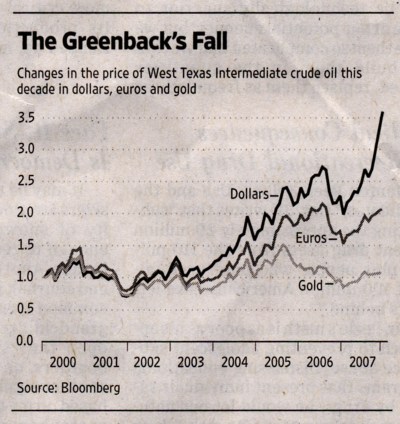
Check out this graph. Let it sink in.

Maybe I’m making too big a deal about this, but I found this chart incredibly fascinating. What this basically says is that if the dollar had stayed even with the Euro since 2000, then we’d have $57 Oil, not $100 Oil. So an increase, yes, but not nearly as shocking. More importantly, if the dollar was “as good as gold”, then literally the price of oil would have just barely risen at all, maybe to $30.

It makes you realize how much the topics of the day (peak oil, dependency on foreign supplies, etc) are controlled by economic perspective. I’m not saying anything about the quality of those issues, or the validity of those topics. I’m just pointing out the obvious – the sensationalist nature of seeing a high dollar value on oil is likely fueling the interest in those topics.

However, as I read this piece, it made me wonder, really, what does $100 dollar oil really mean? Does it mean that oil is dearer, or that the dollar is cheaper? Or both?

The reason I titled this post with the preface, “Statistics Matter”, is because I realized today that of all the disciplines and fields I have had the occasion to study and practice over the past 15 years, the fundamental concepts that underly the mathematics of statistics seem to always be valuable, if not essential. (In fact, Against the Gods is one of the books I recommend to people regularly). In fact, I’m probably going to blog on a couple other topics this weekend that all highlight the importance of understanding statistics.

The insight here, which is so common it’s almost trite, is the insight on correlation vs. causality. Correlation measures how often when one thing happens, a second thing also happens. The relationship between their occurrence. Causality is literally the measure of whether when one thing happens, it causes the second to happen. The confusion that normally happens is that people assume that correlation implies causality, when in many cases, it doesn’t.

In my Introduction to Statistics class, 15 years ago, they gave this example. Many people with yellow teeth also develop lung cancer. They are highly correlated. But getting your teeth whitened will not prevent lung cancer. Why? Well because there is a third thing, smoking, which actually causes both yellow teeth and lung cancer. Yellow teeth are positively correlated with lung cancer, but they don’t cause it. Seems obvious, but check out in your daily news how often you’ll see reports of studies that demonstrate nothing but correlation. Health fads are almost all started this way.

Back to Oil.

This article made me wonder – is the weak dollar the reason for $100 oil, as this article suggests, or is $100 dollar oil the cause of the weak dollar. Alternatively, is there a third cause, not mentioned, which actually is weakening the dollar and making oil more valuable?

The great thing about economics, of course, is that almost everything is inter-related. As a result, I’ve always found it very difficult to use macro-economic theory to identify causal factors, except in retrospect. (Hence the joke about economists predicting 19 of the last 7 recessions…)

I accept that one explanation, based on the data in the article, could be that oil hasn’t really become more expensive, in absolute terms. It’s the dollar that has weakened, and that makes it seem like oil is expensive to Americans.

Alternatively, it also seems plausible that since oil is a external good that is predominantly sourced from outside the US, and since there has been a historical shift from our oil-producing partners from being dollar-denominated to a more balanced basket-of-currencies, that the increasing demand for oil has shifted the marginal demand for currencies away from the dollar, and towards previously underweighted measures of value like the Euro and gold.

My bet here is that neither of the above really explains the whole situation. It seems likely that there are a large number of factors affecting the value of the dollar and the value of oil, and the end result has generated a falling dollar and rising value for commodities, including gold & oil.

This issue of causality really matters, however, because if it is in fact a weak dollar which is the causal factor, we have very limited policy options. Let me leave you with the summary thoughts from the article:

This piece of the puzzle really worries me quite a bit – if indeed the rising prices we see are a monetary phenomenon, then we are really stuck between a rock and a hard place with the mortgage/credit issues and the weak dollar. What we could actually be seeing is a magnification effect that has spanned across multiple business cycles, each time the liquidity “solutions” getting larger and larger. This time, the liquidity needed may be so large that it’s actually finally breaking the dollar. Not surprising, really, since it’s pretty easy to argue that the size of the US home mortgage market is actually big enough to really matter versus the aggregate net value and annual product of the United States.

It could be that the future has already been written in this regard – the price we’ll pay over the next 5-10 years from the housing bubble will be measured in a weaker dollar. And that will inflate everything, including our most dear commodities, like oil. We may have to face the fact that liquidity may solve market failures that surround frozen credit markets, but there will be a price to pay.

Ugh. Carter Era.

Here is a link to the full scan of the WSJ article.

Sub-Prime Mortgage Humor: The Richter Scales

OK, so as I poke around the creators of the very funny Bubble 2.0 video I posted last night, I discovered a couple of things:

1) They seem to be a group of former Stanford Fleet Street a cappella singers (thank you, Rebecca, for this tidbit.  It explains Jerry Cain appearing in the previous video).

2) There are other Richter Scale videos on Youtube

For example, here is one that is specifically about the Sub-Prime Mortgage mess.

You can subscribe to all of their videos on YouTube here.  Here is a link to their website.  Yes, they have a blog too.

Craigslist: To the Gentleman Who Called Me a Depreciating Asset

Just a quick update here.  It turns out that the woman who originally posted to Craigslist looking for tips on how to land a man making $500K+ per year actually responded.  I found the article on Best of Craigslist.

Since that post continues to be one of the favorites on this blog, I decided to add the content there as an update.  But since many people only consume the new articles via RSS, I’m putting this post up here as a quick link to the update.

Enjoy.

Don’t Panic About E*Trade

Wow, people are really panicked.

Here’s what happened. Yesterday, Citigroup analyst Prashant Bhatia wrote an extremely negative report on E*Trade based on their announcement of exposure to mortgage securities where he put the likelihood of bankruptcy at 15%. How he calculated this, I don’t know. Maybe he estimated their exposure and risk curve for their portfolio, and then he ran monte carlo simulations of possible futures. More likely, he squinted his eyes, held up his thumb, and said “1 in 7”.

More coverage here in Business Week.

In any case, I’ve had a few people email me today about whether or not their money is safe at E*Trade.

Here is what I know:

1) If you have bank accounts, they are FDIC insured up to $100,000. So if E*Trade folded tomorrow, you’d be able to open up a new account elsewhere, and the FDIC would wire money in (up to $100,000) within a matter of days.

2) The brokerage accounts are protected by SIPC up to $500,000. Not sure how the re-imbursement works, but I’m guessing it’s something like an insurance claim.

3) The brokerage accounts are protected by a separate insurance policy for up to $150M per brokerage account.

None of these scenarios are likely – other brokerages & banks would be completely moronic to not buy E*Trade or it’s accounts for customer acquisition. E*Trade’s brokerage and bank business is doing quite well at this point.

In fact, here is an article suggesting that this might be a great buying opportunity for the stock.

So, unless you have more than $500K in securities at E*Trade and $100K in bank deposits at E*Trade, you are fine.

Update (11/13/2007): Wow. While E*Trade stock is now up almost $1.00 per share right now on Wall Street, I must not be the only one getting email on this issue. Look at what greeted me when I logged into E*Trade today:

Update (11/14/2007):  The following letter was updated on E*Trade today, which details the complete protection of brokerage accounts up to $150M.

To All E*TRADE Customers:

The old adage “there is no such thing as bad publicity” does not apply to E*TRADE FINANCIAL this week. Seemingly by the stroke of a pen… or a few clicks from a keyboard… a Company with a core business that has generated impressive growth quarter after quarter has been bombarded by rumored reports of its imminent demise.

Well, we want customers to know that the entire E*TRADE team has come together with resolve and commitment, taking appropriate and decisive action to manage through this issue and to ensure that E*TRADE FINANCIAL continues to deliver the best value in the marketplace for our customers.

I have spoken with scores of customers over the past week. Many of you have openly expressed your confidence in E*TRADE. It is genuinely gratifying to know that our retail customers—the heart of our business—understand the value in our model and the strength of the franchise.

Many of you have also asked me about asset protection, so to be clear—your money is safe at E*TRADE FINANCIAL. Here are the facts:

  • FDIC insures all E*TRADE Bank accounts to at least $100,000 and Extended Insurance Sweep Deposit Accounts to $500,000.
  • SIPC protects E*TRADE Securities customers up to $500,000 (including $100,000 for claims for cash).
  • Additional E*TRADE Securities protection provides up to $150 million per brokerage account, underwritten by London insurers (aggregate $600 million).
  • E*TRADE is well-capitalized by regulatory standards.

E*TRADE was founded on the concept of empowering the individual investor. This value is still at the heart of our business. We look forward to continuing to provide you with the products, pricing, service and functionality you have come to expect in order to help you manage your financial world.

We haven’t lost focus on our customers, our business or our future. The credit crunch has had a tremendous impact, but we are taking appropriate and decisive action to manage through it.

Thank you for your continued business,
Jarrett Lilien
—Jarrett Lilien
President, COO and Director, E*TRADE FINANCIAL

Timber: Claymore Launches the First Global Timber ETF (CUT)

The launch was on Friday, November 9th. According to the press release:

LISLE, Ill.–(BUSINESS WIRE)–Claymore Securities, Inc, today announced the launch of the Claymore/Clear Global Timber Index ETF (AMEX: CUTNews) on the American Stock Exchange. This is the first U.S.-listed global timber ETF to offer investors exposure to the timber asset class and is Claymores 35th ETF to-date.

Timber has had a historically low correlation to traditional asset classes, which provides investors a unique diversification tool that may help reduce a portfolios overall volatility, said Christian Magoon, Senior Managing Director at Claymore Securities, and head of the firms ETF Group. Historically timber has been an asset class available only to institutional investors due to high capital costs. Today, with the launch of the Claymore/Clear Global Timber Index ETF, investors have an investment vehicle that seeks to provide efficient access to the global timber market.

Claymore/Clear Global Timber Index ETF (AMEX: CUTNews) seeks investment results that correspond generally to the performance, before the Fund’s fees and expenses, of an equity index called the Clear Global Timber Index (the Index). Stocks in the Index are selected from the universe of global timber companies and defined by Clear Indexes LLC, the index provider, as firms who own or lease forested land and harvest the timber from such forested land for commercial use and sale of wood-based products, including lumber, pulp or other processed or finished goods such as paper and packaging.

My original post on investing in Timber as an asset class remains very popular on this blog, and walks through the reasons why I personally believe that it is an excellent option for diversification. That being said, owning timber as a small investor is still an evolving game, with the best proxies to date being public timber REITs and Partnerships, like Plum Creek Lumber (PCL), Rayonier (RYN), and Pope Resources (POPEZ).

I like the idea of an ETF that is more of a pure play on timber itself, but I think it would be better structured as literally owning timber like the large private partnerships, and not just an index of public companies. We have seen Gold ETFs that own the mining companies vs. the metal itself, and there is no question that the ones that own the metal do a better job of reflecting the actual financial properties of the asset class.

Seeking Alpha has an article on the new ETF, just up:

CUT tracks the Clear Global Timber Index, which includes companies that own or manage forested land and harvest the timber from it for the commercial use and sale of wood-based products such as lumber, pulp and paper products. Components must have market capitalizations of at least $300 million, and companies that do not own or manage forested land and harvest trees are excluded from the index. Individual component weights are capped at 4.5% of the index.

As of September 30, the index has 27 components from 11 countries; its top components include International Paper, Stora-Enso Oyj, Weyerhauser Corp. and MeadWestVaco Corp. The United States represents more than one-fifth of the index at 26.39%, followed by Canada at 12.25%, Japan at 11.50%, Finland at 9.00% and Brazil at 9.00%. It has a PE ratio of 14.3.

The Clear Global Timber Index has outperformed the Dow Jones World Forestry and Paper Products Index in each of the past five calendar years and is up 16.38% year-to-date through September 30, versus a 6.88% increase for the other index.

CUT has an expense ratio of 0.65%. You can read the prospectus here.

I have been debating whether to expand my exposure to PCL, or to diversify with RYN and POPEZ. This ETF offers a third option, which would be to try to get global timber exposure through this ETF.

Something tells me that we’ll see better approaches to representing timber as an asset class in the next year or two, as the demand for real assets that perform well in inflationary environments grows. So I’m not sure I’m ready to jump to invest in CUT… yet.

Update (11/11/2007): Some great detailed analysis on the breakdown of the diversification benefits of CUT on Seeking Alpha today.  Check it out.

Why Do Writers Get Residuals? (Writers’ Guild of America Strike)

This post was inspired by a short, two line snippet in John Lilly’s blog today.  There has been a lot of press about the current writers’ strike, and it’s impact on TV this fall.  I hadn’t originally planned to write anything about it here, but one comment in John’s blog made me think (italics are mine):

But it’s one of those things, i think. for the studios, this feels, to me, like their waterloo, their napster. we’re in a period of incredible creativity in the world, incredible connectedness. Putting down the hammer on the creatives — in other words, not letting them share fairly in the proceeds from the distribution of their work — isn’t likely to help the television and motion picture industry, in my own, admittedly uninformed opinion.

I’m an outsider to the entertainment industry, so my apologies if this question is hopelessly naive.  But there is something about this entire strike that doesn’t make sense to me, sitting up here in Silicon Valley.

So, here is my question.  A lot of this strike seems to revolve around the Writers’ Guild, and their belief that they deserve royalties (aka residuals) on versions of their content that are distributed digitally (DVDs, downloads, etc).  Apparently, this was one of the big mistakes, in their opinion, of the late 1980’s agreement with the union.

(For those of you not familiar with the term, a “residual” is a micro-payment that you are entitled to every time one of your contributing works is resold.  Just think of a book author getting a small payment every time their book sells another copy, or a music band getting a small payment every time they sell another album.  Revenue sharing.)

Now, I’ll be the first to admit – I’m not sure why you’d deserve a residual on a re-run and not on a DVD.  But my question really is more fundamental:

Why do writers get residuals at all?

I guess, to be less confrontational, let me rephrase the question this way:

Why don’t software engineers get residuals?

I don’t want to sound stupid here.  I’ve heard many reasons given for why residuals are given to writers and other creative contributors to media products.  But most of them don’t really hold water with me:

  1. Comedy is a creative enterprise, and people can go for years in between gigs.  Residuals on past success are a way of funding the down times, so great writing can happen in the down time between gigs.
  2. Historically, authors have always been paid per-copy sold, as a form of risk-sharing between the publisher and the author.  It’s a classic alignment of incentives – more books sold mean more profits for the publisher and more income for the author.  This leapt from book authors to musicians to other forms of entertainment as the industry grew.
  3. Writers deserve their “fair share” of the profits made from their work.  Residuals represent that fair  share.

I’m sure there are others, but those are the big three I’ve seen in the press.

The problem is, with the exception of (2), these reasons could just as well apply to software engineers, who in general never get paid through residuals.

Software engineering is a creative process, where people with unique talent and skill create content (code) that is protected by copyright and signed over to their employer (the company).  There are highs and lows in the industry, and rapidly changing tastes/technology that can lead to low times for an engineer as well as good times.

In software, it’s much more common for an engineer to get paid in a mix of salary, bonus, and stock.   No residuals.

  • The salary is the company recognition of the value an engineer needs to get immediately in exchange for their work.
  • The bonus is the company recognition of short term goals being hit, which allow the company to share the benefits of good performance of the individual and/or the company.
  • The stock is a way for the engineer to share in the long term upside of the product of their work.  They become part owner in the company, and so when the company makes money, they reap some of the benefit.

The stock is really the key to alignment between the owners of the company (shareholders), management, and the individual engineer.  It’s the way of saying, “If this works, we’ll all make money together.”

So, in theory, I guess you could replace the stock component with residuals.  You could argue that there are too many factors that play into stock price, and that residuals are a clean way of rewarding people for their contribution to a product with long term success.  (I’m not sure I’d ever trust the accounting behind residuals, but I guess that’s why lawyers and union leaders make a lot of money.)

Maybe the problem is that writers aren’t really treated like co-owners and long term employees at all, and residuals represent that broken trust.  Maybe studios don’t treat writers like co-owners and long term employees because the compensation system is set up to pay them like mercenaries.  Maybe there is no real concept of a studio – just an aggregation of 1000s of entertainment efforts, each with their own finances, and each writer is just a mini-shareholder of that effort.

Maybe the problem is that the entertainment industry is, for the most part, stagnant, and their isn’t sufficient growth to really provide the upside benefits provided to engineers as stock-holders.

Maybe this is the difference between a unionized approach to compensation and a non-unionized approach?

I guess I’m still at a loss to explain the difference however.  Let’s take a large company like Microsoft.  Should they be paying their engineers like writers?  Or should the studios be paying their writers like engineers?

Microplace Launches

I got an email from my friend, Karl Wiley, today announcing the launch of Microplace, a website that opens up a marketplace for microfinance to the broadest possible audience.

From his email:

I am so pleased to let all of you know that today we launched MicroPlace – an innovative new website that allows everyday people to make financial investments in the microfinance industry. It gives you the opportunity to have a direct impact on global poverty while earning a financial return!

As many of you are probably aware, last summer I joined up with this new eBay initiative, and have been serving as its Chief Operating Officer. Today is an exciting day for us, as the site is finally live to the world – the result of over a year of hard work and dedication.

I’m writing you all to invite you to check out the site (www.microplace.com), make an investment, and help us spread the word! For those who aren’t familiar with microfinance, it is a powerful, proven tool to alleviate global poverty. It involves making small loans – often as small as $50 – to the working poor in the developing world. They use these loans to start or grow small businesses – to purchase a sewing machine to make clothing, or inventory to start a small shop, for example. Over time, the borrowers use income from their businesses to pay back their loans with interest, and pull themselves and their families out of poverty.

Microfinance started around 30 years ago, with the formation of the Grameen Bank in Bangladesh by Dr. Mohammed Yunus – the winner of last year’s Nobel Peace Prize. Since then, the industry has grown dramatically, but demand for microloans still vastly exceeds the funds available in the industry to make loans. Together, we can change that. MicroPlace opens up the ability for all of us to put a modest portion of savings into this incredible, profitable and self-sustaining industry. Roughly half of the world’s population still lives on less than $2 per day of income, so there is lots of work to do.

You can visit MicroPlace and choose from a selection of investments, each of which supports a loan to a specific microfinance lending organization in a developing country. We have 15 listings today, and will be adding more every week. Our minimum investment is only $100, so it’s easy to participate. And while you are earning interest, you know that every one of your invested dollars is going to be lent out to the working poor in the developing world, over and over again. For just a few hundred dollars investment, you can have a direct impact on dozens of peoples lives. Remember, this is not a charitable donation – this is a savings and investment vehicle, but with equal or even greater power than a donation might have.

You can also help us spread the word by forwarding this email, or using our e-card feature on the site (www.microplace.com/ecards). Microfinance is still not well known in the US – and we have great resources on the site that can help educate people about this powerful model. Help us spread the word and take a bite out of global poverty.

Thanks in advance for your support for this exciting initiative. I hope you’ll participate – you’ll feel good about yourself, and the borrowers who benefit from your investment will have the chance to change their lives dramatically!

I am a huge fan of microfinance and of Karl, so it’s great to see this vision come to life. I’ve already signed up on the site and made my first $100 investment.

So congratulations to Karl and the whole Microplace team. Go check out the site now – sign up, and start investing.

Tracking ROI: Prosper Loans in Quicken & Understanding Investment Returns

Kevin over at RateLadder had a really interesting post this weekend on the discrepancy between what his Quicken records indicate for rate of return on his Prosper loans, and what Prosper reports:

Quicken enters the money into the account the moment the money leaves my account and it only acknowledges interest after it has been paid. Prosper only counts money in loans and acknowledges interest the moment it is accrued. Both acknowledge default sale amounts the moment they happen. Neither approach attempt to project a future loan’s value.

What does this mean? Well it means that with Quicken you can get the ROI for the moment the money enters the account with interest only for actual payments received. With Prosper you get the ROI for the loans with all accrued interest. Since you can only deduct defaulted principal (cash basis) I feel that Quicken’s approach is correct.

You can see the discrepency in the chart he provided below:

I haven’t run the numbers on my own account, but I believe that the cause of this discrepency is due to the difference between tracking the actual return on the cash moved to Prosper vs. the actual loans themselves. When you move money to Prosper, it wastes time. It takes some time for money to appear in the new account, and it takes time to bid and win loans to invest the money. As a result, your money does not spend 100% of its time in loans, and thus your actual return is lower than the Prosper reported return on your loans.

This is a really important financial concept to grasp, and it extends to other instruments besides Prosper.

First, when you invest in bonds, loans, or other fixed-income investments, re-investment risk is real. Re-investment risk is the risk that when you receive interest payments, you may not be able to re-invest them at the same (or better) rate of return. Prosper is an example of this, since the minimum investment is $50.00, you have to accrue payments until you have another $50.00 to lend. That time spent uninvested is time spent earning a big fat 0%.

Second, when investment vehicles report returns, they only report returns for specific time periods. Your actual returns, however, reflect your actual dates for moving and investing money. Mutual funds are notorious for this, as they tend to report annual results for very specific 1-year, 5-year, and 10-year dates. Because people rarely have invested all of their money on exactly those dates, their returns can vary significantly.

Imagine a fund that on January 1st earned 20% (big day!), and then earned -2% the rest of the year. Their prospectus would brag about an 18% return last year. If you actually moved your money into the fund on January 2nd, you might be wondering why your account actually lost money that same year.

I hope these two tips are helpful the next time you’re looking at your investments and wondering, “Why don’t my returns match the ones on the website?” Caveat Emptor, my friends.