The Real Apple / Microsoft Conversation about the Laptop Ads

This is what some bloggers would call a “throw away” post.  I will likely regret it in the morning.

There was some coverage today that Microsoft COO Kevin Turner actually stated that Apple had called Microsoft two weeks ago agitating to pull the “Laptop Hunter” ads.  If you haven’t seen these ads, they are somewhat poorly put together sequences where someone gets a thousand dollars to buy a laptop, and they of course decide that the $3299 17″ MacBook Pro is too expensive, so they buy a $699 PC with completely non-comparable specs.  But the ads do work, and have gotten attention.

Anyway, here’s the quote:

And you know why I know [the commercials are] working? Because two weeks ago we got a call from the Apple legal department saying, hey — this is a true story — saying, “Hey, you need to stop running those ads, we lowered our prices.” They took like $100 off or something. It was the greatest single phone call in the history that I’ve ever taken in business. (Applause.)

Here’s my version of how that phone call really went:

Apple: Hi, this is Apple, calling for Microsoft.

Microsoft: This is Microsoft speaking.

Apple:  Hi Microsoft.  Listen, these commercials you are running don’t make any sense.  I know Bill is pretty agitated about the Get A Mac ads, but this really isn’t helping.   Just some advice, but you should stop running them.  It’s embarrassing.

Microsoft: Ha, Ha!  Really getting to you, huh?  Prices too high, can’t compete!  Ha Ha.  If you can’t take the heat, stay out the kitchen!

Apple:  Seriously, we just lowered the price of the iPhone by $100.  We’re selling 20M of them.  You can get a 3G for $99.  Who cares about the price of a laptop anymore?

Microsoft: OMG!  I cannot believe you just said that!  I’m going to tell everyone!  You LOWERED your prices by $100 just because of these commercials?!?  Awesome!  Boo-yah!  He shoots, he scores!

Apple:  Forget it.  This is going nowhere.

Microsoft:  Smell you later.  Ha Ha.   Let me know when you can run a real operating system on your crappy computers!

OK, I’m no Fake Steve Jobs.  But it was worth a shot.

Thoughts on the Obama IRA

Nice quick piece today in the Wall Street Journal about the proposed “Obama IRA”:

WSJ: Breaking Down the Obama IRA

It’s been a while since I’ve written a personal finance-related post, but this move towards fixing our retirement savings policies in the United States is the most promising since 2005.

Here are the basics of the Obama IRA, at least, based on current information:

  • Companies with 10+ employees will have to start offering payroll deduction service to contribute to a “Universal IRA” account.
  • Employees would be automatically enrolled at 3%
  • Employees can set the rates higher or lower
  • Employees would get a few specific options:  Series I Savings Bonds, Money Market, Stable Value.
  • At approximately $3000 – $5000, the amount would migrate to a Target Date Maturity Fund

That’s it on details.  There are a few things I like about this plan:

  • Broadly available. Most people would be covered under this plan.
  • Opt-out. The libertarian side of me loves the fact that people can choose their own contribution limits.  The behavioral economist in me loves the fact that the default state is set to opt-out, so that inaction leads to some savings for everyone.
  • Low cost. The structure of the plan ensures low cost options for both employers and employees.  Today, far too much hard earned money is literally wasted through hidden and exorbitant fees charges by retirement plans and mutual funds.
  • Simple investment options. Most people do not need a wide variety of options to provide a good, default retirement vehicle. This one keeps it simple.

Things that I don’t like:

  • 3% is too low. There is absolutely no possible way that a 3% contribution is going to help provide for retirement in a meaningful way, at any income level.  Most “opt-out” advocates currently recommend starting at 3%, but automatically increasing at a rate of 1% per year until they hit 10%.
  • Why tie this to employment at all? These plans should be available to anyone, particularly self-employed who don’t have the sophistication to set up more advanced vehicles.  In fact, imagine the option at tax-time to direct your refund towards your retirement account.
  • Create an open market for running these accounts. Define the “plain vanilla” investment types.  Cap the expense ratios that can be charged.  Allow any private firm to offer these plans.  USAA, Vanguard, etc will compete for this large pot of assets ($100B+ per year at current estimates).
  • Add an Immediate Annuity option at retirement. One of the biggest problems people have with 401k & IRA plans today is a lack of sophistication on how to turn a lump-sump into income that will last the rest of their lives.  It’s a version of the lottery-winner problem.  Offer a standard conversion for these accounts into a combination of a partial sum, an immediate annuity, and longevity income insurance to guarantee that you will have a certain amount of income until you die.  That’s what people really like about traditional pensions & social security.
  • Exempt these accounts from Social Security Means Testing. By means testing Social Security, we’ve already created a perverse incentive where incremental income in retirement can be taxed, at some levels, at more than 100%.  Give these accounts a boost by exempting income from these accounts from income tax calculations in retirement.  Otherwise, we’ll continue to penalize the ants who save for the winter vs. the grasshoppers who spend through their spring & summer months.

The plan isn’t perfect, and there is ample opportunity for the current Congress to complete mess it up.  But conceptually, the Obama IRA is starting to move in the right direction.  Ironically, it shares some of the goals of the privitization of Social Security – shift the nation towards providing for retirement through individual savings & investment rather than through transfer payments.

I’m working on a follow up post that outlines what I believe would be a better direction for retirement savings, since it’s clear that the previous concepts of pensions, social security, and the 401(k) all have significant weaknesses.

Lunar Mission: The First Step in Putting the Past Behind Us

Wonderful news today coming out of NASA today:

NASA took the first concrete step toward returning human beings to the moon Thursday, successfully launching the Lunar Reconnaissance Orbiter on a mission to find the best place to build Earth’s first off-world colony.

The 19-story-high, two-stage rocket and spacecraft launched at 2:32 p.m. PDT. As the huge first-stage Atlas V rocket roared to life at Cape Canaveral in central Florida, NASA spokesman George Diller called it “America’s first step in a lasting return to the moon.”

The $500 million orbiter will spend the next year cruising just 31 miles above the lunar surface, employing a suite of seven instruments to identify landing hazards such as rocks and craters. It will be paying particular attention to the largely unknown lunar poles, where previous missions have picked up hints that water ice may exist in some permanently shadowed craters.

Thousands of sky watchers are expected to turn their telescopes to the moon on the morning of Oct. 9, when the water-seeking satellite steers the fuel-depleted second stage Centaur rocket into a crater at 5,600 mph. For those in the western U.S., where the moon will still be up, the plume should be clearly visible with a moderately sized backyard telescope, NASA said.

Time to start putting forty years of the unprecedented embarrassment of the US space program since the late 1970s.  I’m not sure that any other country has so thoroughly trashed such a magnificent technological edge in a crucial field before, unilaterally.

The space shuttle.  The international space station.   Ugh. I think I just threw up in my mouth a little.

Ironically, we may look back and give the Bush Administration surprising credit for finally tilting US space exploration back in the right direction.  (Don’t worry, I’m under no delusion that people will say anything nice about Bush 43 for a while…)

There are tremendous technical and commercial advantages to establishing the first, ongoing presence on the Moon.  It’s a little know fact, but as an independent side project at Harvard, I built out an initial business model and operating plan for financing a private moon base.  It’s hard to think back, but at the time (2000), companies were raising $10B-$15B in private capital markets to fund the build-out of fiber-optic networks across the world.

It wasn’t such a stretch to imagine raising $60B in sequential rounds to fund a moon base, particularly when the economics of a moon base are so strong.

You see, the moon is such a hostile environment, that once you have a self-sustaining and expandable eco-system set up, it’s a natural monopoly.  For quite some time, it will always be significantly cheaper to add on to an existing base, rather than build a new one from scratch.

That difference in cost, which is measured in billions, is an incredibly revenue opportunity, assuming there is demand to establish presence on the moon.

It was 2000, but I believe I laid out at least 10 potential revenue lines for the moon base, to help it become cash flow positive, even across that type of capital raise.

(Yes, I was assuming the US would never ratify the Moon Treaty from the insane 1970s.  Beyond ridiculous.)

In any case, very exciting to see us finally moving down the correct path.  My only regret is that if we had moved down this path in the late 1970s, we’d all be jostling for positions on a fully operational moon base by now.

I’m still optimistic that I will be able to travel to the moon in my lifetime.  The only question now is whether it will be a US or Chinese built lunar city.

Timber Interview: Adam Nash

Of all the unexpected outcomes that have come out of my blogging experiment here on WordPress, one of the most surprising has been the amount of attention I received for a post on why I like investing in timber.

Why I love Timber as an Asset Class (November 10, 2006)

Since then, from time to time, the article has been referenced in investment blogs and journals.  For example, I am still getting hits to my blog based on the following article on Seeking Alpha:

Last year, I was flattered to see a quote of mine show up in Nuwire Investor:

What I didn’t realize at the time I wrote this blog post in January 2008 was that my entire interview was actually posted online.  That’s right. You can read the whole thing in all of its glory:

How embarrassing.  I remember doing this interview over the phone in March 2007 from a conference room from the Toys building at eBay.

Still, it’s a matter of public record now.  So enjoy, if you are curious.  I still do love timber as an asset class.

Once again, the web is safe for “adamnash”

Just in case you aren’t one of the 225 million Facebook users who received a notification, tonight at 12:01 AM EST (9:01 PM local time), Facebook decided to launch a massive “first-come, first serve” claim on usernames (or handles) on Facebook.

You might be wondering why this is big deal, since these have existed on every other site for years.

Well, the reason is because this is Facebook, and ironically because they waiting this long to launch handles, it’s now moved from part of the new-user experience to a huge virtual geek battle for your name.  (if you want yours, go to http://www.facebook.com/username)

I, of course, claimed “adamnash”.

Not very creative, I know.  When I chose my first username, freshman year at Stanford, I picked a nickname I had in high school.  (To this day, the wonders of the web have preserved old Usenet posting from under than handle… embarrassing.)  Thankfully, when you declare Computer Science as your major at Stanford, you get a virtual second chance – your Xenon address.

With a full name that fits in an old-style unix handle of 8 characters, it seemed too obvious.

I am adamnash.

These days, of course, you can find me at:

Brilliant from an SEO perspective, I guess.  Not that hot if I was looking for anonymity.

Now, I can safely say, Facebook is safe for “adamnash” as well:

I feel a little guilty for hogging all the virtual cyberspace for myself.  There are other Adam Nashes out there.  I think there are over 30 on LinkedIn alone.

But not that guilty.  I’ve been “adamnash” since 1992.  I’m not going to stop now.

The Real eBay Magic: Irrational Commerce

It’s been quite a while since my last eBay-related post, and nine months since my high traffic post, A Eulogy for eBay Express.  However, this past week Keith Rabois wrote a fairly inflammatory article for TechCrunch that I thought was worth discussing.  Keith is currently an executive at Slide, and was formerly a founder at LinkedIn and an executive at PayPal, so his consumer internet credentials are fairly substantial.

His article was entitled:

TechCrunch: How Facebook, MySpace and YouTube Killed eBay

Told you it was inflammatory.

However, I’m not normally the one to take eBay flame bait.  After all, if I was, I’d be posting twelve times a day on the topic.  But Keith actually hit upon a deeper insight in his piece that is worth calling out, because it provides insight into both eBay and other successful, engaging web products.

Although it was always classified as an e-commerce destination, the quirkiness of the eBay marketplace was once a major source of entertainment on the Web. It was where people sought and bought everything from the first broken laser pointer to Beanie Babies to Bob Dylan’s boyhood home. While the catch—anything from an antique clock to a Gulfstream II—was rewarding for the buyer, it was generally the entertainment and excitement of the chase that brought a buyer to eBay in the first place.

This insight, that eBay’s success was driven by entertainment and engagement is extremely strong.

The rest of the article follows this path:

  • In January 2004, over 47% of internet users visited eBay once per month.
  • In December 2006, while the % of audience stayed the same, people were spending 3x the time on MySpace
  • In 2007 Facebook & Youtube added to this drift of attention and engagement (timeline is off here a bit, since Youtube took off well before 2007).
  • eBay stripped out the fun, not pursuing eBay 3.0 strongly enough, and then Donahoe pushed towards an Amazon-focused approach.  Fun gone.

I don’t personally agree with much of the deductive flow here, actually.  Overall, Myspace, Youtube & Facebook have significantly increased the engagement overall on the internet, taking metrics like “daily visits” and “daily unique users” and “time on site” to previously unthinkable numbers.  It isn’t a zero-sum game, per se, because the overall number of users and time spent on consumer internet sites has grown dramatically.

More importantly, the assessment of eBay 3.0 and the current strategy makes it sound like eBay’s current approach is largely management-driven, when in reality the overwhelming global scale and activity of eBay buyers (and sellers) has made the current direction almost fait accompli.  In 2006, the number of eBay listings that were fixed price (including store listings) was already well north of 50% and rising rapidly.  The marketplace was voting through billions of bids, BINs and listings, and it was voting for a higher and higher proportion of fixed price commerce.

But I digress.  The point is that Keith got something very, very right in his article about eBay.

eBay was never meant to be just e-commerce.  It was fun.  It was exciting.  It was empowering.

It was engaging.

There are a couple strong reasons for this.

First, if you’ve read my previous posts on game mechanics in the design of engaging software and websites, you’ll know I’m a big fan of Amy Jo Kim‘s work here.  In fact, eBay demonstrates all five of the “fundamental games” that humans like to play.  This wasn’t done intentionally, but it explains a lot of the almost visceral, addictive reaction that people had to eBay.

Second, eBay captured irrational economic behavior on both the buyer and seller side of the marketplace brilliantly.  Buyers exhibited a number of irrational behaviors that we now describe and associate with behavioral finance.

These irrational behaviors on the buyer side, combined with the game mechanics of the site, effectively created a lift in demand.  Combined with the transparency and breadth of the online marketplace, you had literally a huge multiplier on e-commerce demand.

On the seller side, however, engagement was driving irrational behavior too.  Buyers of collectibles became sellers in order to “fund their habits”.  (I know this personally, since I began selling coins on the site to help keep my PayPal “slush fund” fully tanked so I could buy coins…)   More than anything, people fell in love with the empowerment eBay offered.  You didn’t have to have $100,000 to open a business, an SBA loan, or an MBA.  The web was full of stories of people just driving around garage sales, picking up items on clearance at local department stores, and stocking up at flea markets.  Some of these sellers grew businesses that measured in millions of dollars, promoting hope that anyone could build a business on eBay.

Of course, there was a kernel of truth to this.  An unprecedented number of successful businesses were built over eBay.  But most sellers were nowhere near any sort of traditional business scale.  There is a reason, after all, that PowerSeller starts at just $1000 a month.  And that’s $1000 of sales revenue, not profits.

Can you imagine any real-world storefront with only $12,000 a year in sales?

People would spend 8, 10, even 12-hours a day looking for inventory, listing items, answering questions, and shipping goods.  When people went to the first eBay Live, they even made sure that on the road trip out to California, they brought enough packing materials to keep shipping items.  They made buyers happy because it wasn’t just a business for them, it was a way of life.

In every sense of the word, it was irrational commerce.  It was a labor of love, not economics.  Sure, it was a good way to pad the income of a family.  But for many the money was just a rationalization – they were really in it for the excitement, the activity, the empowerment, and of course, the community.  If you calculated the “wage rate” of many of these sellers, it would be shockingly low.  But no one did, because that wasn’t the point.  It was fun.  It was empowering.  And it was only just the beginning…

I didn’t get to go to the first eBay Live in 2002, but I did go to three starting with the third in New Orleans in 2004.  I’ll never forget, at one point Pierre was touring the booths (I believe he was giving a speech that day).  A group of us were discussing how to manage the insanity of the event – the intensity and sometimes aggression of some attendees who had to have every pin, every collectible.

I won’t get the quote right, but Pierre said something there that has stayed with me to this day.  To paraphrase, he said that he loved the energy, and that the insanity is part of what made eBay great.  If eBay became just another sales channel, then it would lose its magic.

It has been five years,  and for me personally the growth in my understanding of game mechanics, behavioral finance, and web 2.0 product design have given me terms and tools to help explain the irrational engagement that people had with eBay, and currently have with sites like Facebook, LinkedIn & Twitter.

eBay has a very metrics-driven culture, but while site and business metrics accurately reported the results of the incredibly engagement and activity on eBay, as always they never actually provided  the full picture around causality.

So, from my point of view, Facebook, MySpace & Youtube did not kill eBay.  (eBay, of course, is no where near killed in any case, since it continues to be an incredibly large and active site.)

Instead, eBay fell victim to a much more insidious threat than simple competition for eyeballs or time on site.  It fell victim to a version of the Innovator’s Dilemma.  There is a limit to how many people will wrap their lives around selling on eBay.  There is a limit to what percent of people’s purchases they will pursue through an auction process.  There is a limit to the disposable income to spend on collectibles and hard-to-find items – most purchases, in fact, are of new, standard commodity products.  Thus the company and the site follows the aggregated votes of hundreds of millions of buyers and millions of sellers, their “best customers”, and those votes are eventually dominated by the bulk of the e-commerce market.

Reading articles this weekend, like this piece in VentureBeat, they quote Donahoe in the Wall Street Journal as follows:

Asked about eBay’s identity, Mr. Donahoe said he wants shopping on the site to offer the same sort of low-price experience as buying at bulk retailer Costco Wholesale Corp. There, “the inventory is somewhat fluid, but everything they’ve got is a great deal,” he says in an interview.

(Ironic for me, since Costco was one of the examples we looked to frequently in the design and thought behind eBay Express.  I am a huge, unrepentent fan of Costco as both a customer and as a student of great companies.)

eBay 2009 cannot go back to the eBay of 1999, or even 2004.  The size and scale and make-up of the market means that any attempt to “crowd-out” the less engaging aspects of the market would mean drastically reducing the size of eBay.

That doesn’t mean there isn’t hope.  There is still time for eBay to re-invigorate its experience to capture and create elements that drive engagement.  There is time to learn from both the past and the present, and chart a course that will inspire and empower millions.

The original needs that drove eBay to success still exist.  People are finding some of the serendipity and empowerment from Craigslist… but it’s not as actionable or broad.   The game mechanics, for the most part, aren’t there.  Amazon has increased its breadth, but it’s truly an ecosystem designed for large sellers (by eBay standards).  Google has enabled independent websites to purchase traffic… to an extent.  But the more you make selling online like running a business, the more you lose that sense that this is fun instead of work.

Collectors still want to collect.  People still want to find ways to make a little extra money and to be a part of something bigger.  Little kids still collect and trade things from a very young age – no matter if they are stickers, baseball cards, Pokemon, or whatever small colorful items come in sets with variable rarity.  I sold my brother’s broken iPhone (he dropped it in the ocean) for $130 to a man on an island (Reunion) that I had never heard of.  Those eBay stories still exist. Small businesses are still being built on eBay.  Sellers are multi-channel, but eBay can and should offer them unique dynamics that capture a disproportionate amount of their attention, if not their business.  Apple has a small fraction of the computer market, but it captures the lionshare of its attention.  That could be eBay if it was prepared to act boldly and ask hard questions about what eBay reall should be… and shouldn’t be.

eBay cannot be MySpace, Facebook, LinkedIn, YouTube, or Twitter.  Nor should it be.

It should be eBay.

Update (5/27/2009): Turns out I had missed a great post from Rob Go on this same topic, just a few days ago.  Worth reading.

The Ultrasound Tells the Tale

Funny thing happened to me over the weekend.

My immediate family (parents, siblings, etc) were visiting to see the new baby, Jordan.  My mom is holding the baby in the yard, sitting under the plum tree.

IMG_0115

All of a sudden, it hits me.  I’ve seen that picture before.

Sure enough, I whip out my iPhone (yes, I have a lot of photos on my iPhone), and quickly flip to the photo.  It’s the ultrasound from January (when the baby was about 20 weeks along. I loved seeing my baby inside me so much that I bought a womb music heartbeat monitor for myself and maybe to lend out to a future mama!

2009.01.09 Baby 3 Scan 5

Kind of amazing.  I remember remarking back in January about that little sharp nose.

Problems with the New Star Trek Movie Reboot

Before I get into this, let me just warn that this post contains spoilers.  Don’t read any further if you haven’t seen the new Star Trek movie.  Or at least, don’t read any further and then complain to me.

First off, I know that the movie is doing really well.  I also know that almost everyone seems to really like it.  So I don’t expect this post to be popular.  Still, there were a few small things (and one large thing) that bothered me about it, and it seemed blog worthy.

The big issue is the premise of the “reboot” logic.  This movie was explicitly designed to appeal to a whole new audience, and as a result, it deviates in many ways from the previous “canon”, ie, the character & future history established by the other movies and TV Series.

Unlike Superman Returns, or The Dark Knight, however, this movie tries to explain away the differences with a plot device.

The plot device is as follows:

A Romulan captain of a mining ship, in the late 24th century, witnesses the destruction of Romulus.  Infuriated, he blames Spock for failing to save the planet (and his wife and child).  He attacks (old) Spock, falls through a black hole and ends up in the early 23rd century.  As a result, the timeline is forever changed, because the first thing he does (almost) is kill George Kirk, James T. Kirk’s father, putting him (and Starfleet) on a different path.

Ugh, it sounds worse when I write it.  It felt pretty par-for-the-course in theater for a Star Trek time-travel plot.

Here’s the big problem. The last two years of the Star Trek series Enterprise were literally based on the Temporal Cold War.  (In fact, this was an extension in some ways of the “Relativity” episode in Star Trek Voyager and the “Trials and Tribble-ations” episode of Deep Space Nine.)  Without descending into a geek singularity, the basis premise is that in the future, time travel technology is mastered, leading to a set of accords among governments to “protect” the timeline.  Some people violate those accords (“The Temporal Accords“), and thus there are future Federation people and ships whose purpose is to help apprehend these criminals and restore the original timeline.

I’m not talking about one or two flaky episodes here with a minor inconsistency.  I’m talking about dozens of episodes and a major timeline of future history with key events between the 20th century all the way to the 31st century.

In any case, in order to believe this plot reboot, you have to believe that somehow with all those time ships and policing, Agent Daniels, the USS Relativity, and all those others just let a random mining captain from Romulus rewrite the history of the Federation without correction.  They go to huge lengths to save Captain Archer, but not Captain Kirk?

Sorry.  That doesn’t work.

I think what I’m more disappointed about is that the movie didn’t even try to explain it away.  For example:

Old Spock from the future, for example, could have added 30 seconds to his explanation to either New Kirk or New Spock to say that this timeline is permanent, or why it won’t be fixed.

Spock: “In general, major timeline changes in the past have been corrected by the Federation in future centuries.  However, we had been warned that the use of “red matter” could leave us vulnerable to untrackable temporal events.  In my rush to save Romulus, I have put the entire future at risk.”

This really wouldn’t bother me if the movie was a clean reboot of the series, like Battlestar Galactica.  But J.J. Abrams is trying to have his cake and eat it too.  He clumsily and awkwardly brings everyone together for the new Enterprise crew (exactly how unlikely was it that Scotty would be on that one base on that one moon…)  In some ways, the half-hearted attempt to maintain continuity with the time travel device is worse than just doing a straight reboot, no questions asked.

Now I realize I fall into a very tiny minority of people who even watched Star Trek Enterprise (or Voyager for that matter).  And I realize I fall in an even smaller fraction who liked Enterprise.  (1 in a million?)

Still, if they wanted to hardball ignore the series, they could have just asserted something early that made it clear that the series Star Trek Enterprise didn’t exist in this universe (ala Superman III/IV being axed in Superman Returns).  For example, they could have just asserted that this was the first human starship with the name Enterprise.

The most ironic element to the reboot plot device is that the one series it doesn’t change is Star Trek Enterprise, because that series takes place before the federation was founded!  So in this timeline, we don’t know whether there will be a Captain Picard, a Deep Space Nine, or a Captain Janeway.

But we do know, of course, that Scott Bakula was captain of the NX-01 Enterprise.  Rich, rich irony for fans who hated that series.

Don’t get me wrong – I liked the movie enough to see it again, and I think it achieved its goal of reaching out to people who have never seen Star Trek before (or didn’t watch much of it.)  I was actually surprised to see so many “wink wink, nudge nudge” moments in the film – references to other characters, catch phrases, moments, etc.  When Spock gives the transwarp transport formula to Scotty, I half-way expected some reference to transparent aluminum (Star Trek IV).

Maybe that’s what bothered me the most – they clearly put some effort into lining this up with canon in minor ways that didn’t really matter, but then ignored the big gaping hole around time travel.

Anyway, just for fun, here are some other small nits that bugged me:

  • There is a canyon in Iowa?
  • Was the Nokia placement really necessary?  Did it even make sense?  There are still private companies in the future?  They still operate?
  • Wow!  The Enterprise is really big now.  Huge.  How big is the crew?  That Romulan ship must be immense.  Kirk can just run around and find his way?  It must be miles long!
  • Captain Pike decides to make a not-quite-graduate with 3 years in the academy First Officer.  Really?  Maybe they know more about nature vs. nurture in the future.
  • Sulu carries a sword around with him?
  • Movie jumps the shark when Kirk crash lands on the ice planet/moon.
    • First, he plays Empire Strikes Back with the native wildlife (unnecessary).
    • Second, he just happens to crash within a few miles of Spock?
    • Exactly how close is this moon/planet to Vulcan, so that it appears huge in the sky of this world?
    • Spock is placed within walking distance of a Federation outpost, and is waiting for… ?
    • Scotty just happens to be stationed at this outpost?
    • Spock doesn’t go with Kirk because he doesn’t want to hurt the bonding experience for Kirk & Spock?  Seriously?  He’s really taking this new timeline thing in stride.
  • “Red” matter?  That’s what they went with?  “Red” matter?  Was this sponsored by Bono or something?
  • Flagship of the fleet goes to new graduate.  I know there isn’t supposed to be a lot of politics in the future, but I have to think someone got passed over here and is kind of pissed about it.

Looking forward to Terminator Salvation (which deals with timeline inconsistencies better), Up, Transformers, GI Joe, Harry Potter…

Jordan: My First Twitter Baby

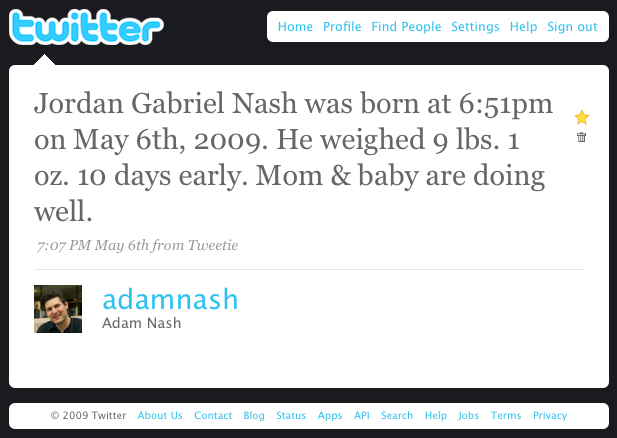
Those of you who follow me on Twitter (or who received an email), this blog post is about old news.  But I thought I’d share here, for posterity, the fact that last Wednesday, my wife & I were blessed with the birth of our third son, Jordan Gabriel.  He weighed 9 lbs. 1 oz., and was 21 inches long.

JordanJordanJordan

While we’re still adapting to life with three kids in the house, I thought I’d note the tech milestone as well.  When my first son was born, we had a birth blog to commemorate the event.  That was less than five years ago.  Clearly in just that short time we’ve moved on to newer modes of obsessive documentation.

I guess that answers the question on whether Twitter competes and/or substitutes for blogging.

In any case, welcome to the world Jordan.  Our first Twitter baby.  (In fact, one of my colleagues at LinkedIn was kind enough to reserve @jordannash for him…)

Jordan Tweet

Get Ready for TEO: Twitter Event Optimization

That’s right, everyone.  A new acronym is born.

Get ready for consultants, product managers, marketing executives, and knowledgeable technorati everywhere to be talking about the most important traffic driver since… SEO (Search Engine Optimization).

That’s right, 2009 is the year of TEOTwitter Event Optimization.

The logic is simple enough.  Twitter is growing by incredible rates, and it’s inherently a high activity, highly connected distribution model.  That means that pushing out events to Twitter can help drive traffic to your application or service.

When a user pushes out a link to your content, it magnifies distribution a large number of ways:

  • The tweet/link is pushed to all of their followers (sometimes to multiple clients/locations)
  • The tweet is sometimes retweeted (at a fractional rate) to a 2nd degree of followers
  • The tweet shows up in countless Twitter searches for terms/keywords
  • The tweet is indexed in Google for natural search
  • The tweet, if hashtagged, comes up for anyone reviewing that particular topic.  (Topics on Twitter are often flagged with a # symbol.  Example: #swineflu)

One of the hardest problems that websites face is traffic generation, and I can see it in the eyes of marketing and media executives everyone.  They look at Twitter, and they see… engagement.  attention.  TRAFFIC.

And they want it.

Thus, TEO is born.  Like SEO before it, there will be a range of skillsets that will quickly be developed, and then sold to countless companies everywhere:

  • Optimizing your website to get users to issue events to Twitter (manually or automatically)
  • Optimizing the content of an event to promote click-through
  • Optimizing the content of an event to trigger retweeting (RT)
  • Optimizing the tracking of the links on Twitter for effectiveness (already happening)
  • Optimizing the landing pages of your site, so that non-members who click through from Twitter get a good experience and “convert” to direct users.
  • The list goes on…

I really haven’t seen this much collective energy around a new traffic source since Google really hit the scene in volume, and everyone realized that an alternative to paying for search advertising was to invest in optimizing your content for natural search.

It’s hard to argue that this will be good for the Twitter eco-system.  Google has fielded armies of engineers and incredibly advanced technology to help keep natural search effective.  One of the challenges Twitter will definitely face is keeping their stream relatively “clean” of manufactured content.  Whether that’s something that can be done by end users, or whether deep technology will be needed is yet to be determined.

In any case, I’m not sure if I am the first to coin the term… it’s hard to believe that with the huge buzz around Twitter that this one hasn’t been claimed already.  But, just in case you heard it here first, remember:

2009 is all about TEO

Best Coin Video Ever: Rick Mercer at Canadian Royal Mint

Found this courtesy of CoinNews.net:

Rick Mercer, Canadian satirist and TV personality, throws his brand of humor into the mix as he tours the Royal Canadian Mint in Ottawa.

Watch Rick as he walks through the Mint’s gold vault, checks out the gold refinery process, the Mint’s rolling room and finishes the tour by handling several gold coin blanks and striking some special coins.

Best coin video… ever.  🙂

Mac Pro Crash Recovery: A Tale of 36 Hours

Yeah, it was that kind of weekend.

I went to check email Saturday morning, and was greeted with quite a shock.  My Mac Pro was locked in some sort of grey screen.  No icon, no progress, nothing.

A quick press of the power button confirmed it – simple power down.  No real OS boot.

On Friday night, before bed, I had shutdown the machine.  Some apps had been misbehaving, and I thought a full shut down & reboot was in order.  Apparently that reboot had failed.

I don’t know how “normal people” deal with problems like this.  When I say “normal”, I mean people who haven’t actually developed software on the Mac, who haven’t worked repairing Macs, and who haven’t spent countless hours futzing with their own machines.

Just in case its useful, here’s what I did.  The good news is that it proves out the benefit of using backup software, like Time Machine.  The bad news is that it also proves that this stuff is still way too hard:

1) Tried to reboot. Yes, I know, not rocket science.  But there is always that hope that just rebooting will magically “fix” the problem.  In this case, rebooting went into an endless loop.  Grey screen, Apple logo, spin icon… then grey screen and reboot.  Kept repeating.  Bad news.

The lack of either the blinking folder or the regular boot sequence told me I was on dangerous ground.  It was either a hardware issue, or the system was corrupted.  In either case, the machine was not getting to the normal boot sequence.

2) Tried to boot of DVD. For those “Dodgeball” movie fans, “If you can dodge a wrench, you can dodge a ball.”  For Macs, “If you can boot of a DVD, then your hardware can boot anything.”  It’s not totally true, but true enough.  In my case, it proved harder than you might think.   The machine wasn’t getting far enough in the boot sequence to load Bluetooth, so my wireless keyboard was useless.  Fortunately, I keep a USB keyboard around.  Plugged in, holding down the “C” key (nostalgia: the “C” is for CD, and they never migrated to “D” for DVD.)  In any case, if there is no DVD in the drive with a bootable OS, it opens the tray.  Got the tray opened, popped in the Mac OS X 10.5 Leopard DVD, and began to boot.  Total time spent: 20 minutes.

3) Diagnose the boot drive. On the Mac OS DVD, a little known trick is that while the installer is running, you can go to the Menu Bar, and select “Disk Utility” to run diagnostics on your disk.  I did so, and discovered some bad news.  My main system drive, a 300GB Western Digital, had problems.  Worse, Disk Utility basically told me that I was crazy if I thought it could fix them.  Drat.  Time spent: 10 minutes.

4) Get Mac OS X installed on another hard drive. Running the system off DVD is slow, and you are limited in options without a full Finder.  Fortunately, my iTunes HD had a few hundred GB free.  Installed OS X on that drive and rebooted.  While that happened, I went to have breakfast and actually get productive chores done.  Time spent: 30+ minutes.  Who knows, I didn’t come back to the machine for several hours.

5) Assess whether the system drive is lost cause.  I was ready to run down to Fry’s to get a new HD (or better yet, a new SSD.  Why not turn tragedy into opportunity?)  Unfortunately, the disk mounted.  Interesting.  I did get a strange system warning that I’d never seen before, telling me the disk had problems and that I should reformat it.  Never waste access to a dying disk.  I immediately tried to use Disk Utility to create a disk image of the disk, but it failed.  (You do this by dragging the hard drive icon from the desktop over the Disk Utility application).  Some cryptic error.  Fortunately, a Finder copy of my user directory worked, providing an extra backup of files, just in case.  Time spent: 20 minutes.

6) Reformat system drive. Well, Mac OS X told me to, right?  I was surprised, but I tried it.  Disk Utility was able to reformat the drive – I noticed the old formatting was Mac OS X, without journaling enabled.  Wow.  Was the drive that old?  In any case, I reformatted with the appropriate GUID setting for booting Intel macs, and with journaling enabled.  Afterward, a quick Disk Verify confirmed a shocking outcome… the drive was fine.  Time spent: 10 minutes.

7) Reinstalled Mac OS X on System Drive. Tempt fate?  Sure, why not.  This was the first time I had a hard drive crash after using Time Machine, and I was eager to try it out.  When you install Mac OS X 10.5 now, it asks you if you are migrating from another machine.  You can specify a Time Machine backup.  I was pleased to see the last one was from 10:59pm on Friday… less than 1/2 hour before the “great crash of 2009”.  Unfortunately, this process seems to take hours.  160GB of material for some reason took over 3 hours.  No way I’m sitting around for this!  Time spent: 3 hours+

8) Get everything up to date. I came back to the machine that evening.  It booted, seemed fine.  Even had my old accounts on the login screen.  I signed in, and everything looked normal.  All files/folders in the right places… except iPhoto failed to launch, and iTunes complained that it didn’t understand my library.  Whoops.  The DVD installed Mac OS 10.5… but we’re on 10.5.6 these days, and my apps and files had been upgraded.

Brief rant: I’m really wondering why Apple hasn’t tied the update logs from it’s automatic updates to the restore from Time Machine.  It’s pretty obvious that the Time Machine backup has a system on it that has a series of updates installed – would not be hard to boot the OS with instructions to download and install those updates.

In any case, Apple Mail tried to “import” my Mail folder.  I cancelled that and quit.  iTunes offered to create a new library, and I declined.  Phew.  Hope I’m safe.   Ran the System Update system preference, and discovered about 10 updates waiting for me.  Downloading them and installing would take… 2 hours!   Let it run over night.  Time spent: 2 hours + one nights sleep.

9) Get everything up to date… again. In the morning, after breakfast, checked on the machine.  Was booted, looked fine… except now Apple Mail had lost all of my old mail, and iPhoto still wouldn’t boot.  iTunes was fine, though.   Ran System Update again… and there were another 8 updates, clearly waiting for the last 10 to run.  Great.  Fine, let’s update some more.  Time spent: 1 hour + me leaving for the morning.

10) Restore Mail. Thank goodness I’m paranoid.  I copied the “Mail” folder in my “User > adamnash > Library” folder from the “extra” backup I had made to my System drive.  3GB to copy, but hard drive to hard drive over internal SATA 2 bus is wicked fast.  Time spent: 15 minutes.

11) Everyone lived happily ever after. It was about 11:30am on Sunday, literally about 36 hours since the crash happened.  And everything was back to normal.  Seriously, I doubt you could have easily figured out anything had happened.  Even little details like my browser history were there.  Firefox re-opened with the same 20 tabs I had open on Friday.  It was if the last 36 hours had been a test, and since I had kept calm and walked through the steps, I had passed.

So, what did I learn from this?  A few things:

  • Keep a Mac OS X boot DVD handy. Most people lose track of this, because it came with their Mac when they bought it.  Don’t lose it.  I prefer the retail disc myself – it’s worth the cost to have one.
  • Disk Utility is your friend. There was a time when Apple utility software sucked, and you had to go third party.  There are still superior third party tools out there (and for serious hard drive crashes, you need them.)  But these days, starting with the standard Apple software is a good bet.
  • Migration Assistant has come into its own. I’ve used it now for work and home.  It’s very good.  Not perfect, but better than hand-crafting system restores.  Very impressed with the Time Machine integration.  If it was smart enough to handle Apple Update history, I’d be truly happy with it.
  • Don’t underestimate the value of an extra hard drive. The reason my restore was relatively painless is that I had another hard drive that I could boot the system off of.  Without that, you have to depend on the DVD.  Ouch.  If you have a tower, and extra hard drive is cheap insurance (and extra storage).   If not, consider a cheap firewire external drive.
  • Time Machine is good. Look, if you care about your files, you should backup.  Period.  Time Machine makes it painless.  I’m really impressed – backup systems are only really tested when you need them, and I needed Time Machine today.  It came through.
  • Beward of hard reboots.  The reason my system had problems is likely due to a software conflict I had been ignoring – XTorrent and my .Mac screensaver.   I would come home to a locked up machine, and would be forced to hard reboot the system.  Hard reboots = increased risk of file system damage.  I played Russian roulette one too many times, and paid the price.  36 hours of it.

Mostly, however, I discovered that after 18 years of fixing/restoring Macs, it’s still stressful dealing with a crash like this.  I just can’t imagine why any normal human being would know or care about all the steps above, or how they would be expected to keep multiple backups, hard drives, and techniques handy to manage this type of issue.  It’s 2009 for goodness sake.  By now the computers should be taking care of themselves.

In any case, I hope the above proves useful to a reader or two.  If not, maybe the story will prove either entertaining or depressing, depending on your perspective.

A Moment of Silence for the F-22 Raptor

Defense Secretary Robert Gates has recommended ending the the long-standing drama surrounding the F-22 (nee, the F-22A) supersonic fighter, capping the program with a purchase of four more planes in 2009, bringing the total number to 183.

F-22

A pair of F-22 Raptors during an Air Force training flight.
(Thomas Meneguin — U.s. Air Force Via Associated Press)

A bit of a sad day for me, really.

There is a nice column in the Washington Post today from the Air Force explaining why they support the decision to end the program, 60 planes shy of the 243 total they had originally estimated to be needed in a post-cold war world, and almost 600 shy of the pre-1989 estimate.

We are often asked: How many F-22s does the Air Force need? The answer, of course, depends on what we are being asked to do. When the program began, late in the Cold War, it was estimated that 740 would be needed. Since then, the Defense Department has constantly reassessed how many major combat operations we might be challenged to conduct, where such conflicts might arise, whether or how much they might overlap, what are the strategies and capabilities of potential opponents, and U.S. objectives.

These assessments have concluded that, over time, a progressively more sophisticated mix of aircraft, weapons and networking capabilities will enable us to produce needed combat power with fewer platforms. As requirements for fighter inventories have declined and F-22 program costs have risen, the department imposed a funding cap and in December 2004 approved a program of 183 aircraft.

Much has been made of the cost over-runs in the F-22 program, and there is some truth to those complaints.  Of course, they have been exaggerated in recent years since manufacturing planes is a volume business, and the average cost per plane drops significantly as you increase volume and speed delivery.

It may seem strange to wax nostalgic for a super-sonic aircraft, but I remember the F-22 fondly.  When I was in high school, I read Aviation Weekly regularly as one of the requirements for my high school debate research (the topic for the year was space exploration).  I remember at the time the race between the F-21 and F-22: competing prototypes for a new air superiority fighter that would line up against the latest generation MiG fighters from the USSR, and which would be able to deliver Mach 2.0+ speeds without afterburners and with low radar reflection.

It was post-1987, so already the era of disillusionment with the ridiculous mediocrity of the US space program had set in.  But warplanes were still an area of rapid technological advancement, and raw engineering wonder.  It was pre-1991, so the cold war was still there to propel investment in military technology.

The F-22 won the contest, of course.  As fate would have it, about the same time, the USSR lost the contest.  Almost immediately, the plane and the program were caught in an ongoing battle for existence – a battle that lasted almost twenty years.

There are good arguments by better informed people on the merits and liabilities of the F-22 program.  Right now, I’m not really interested in discussing them.

Instead, I want to take a moment to contemplate the wonder and excitement that aerospace used to hold for me and a generation of kids.  A time when the space program was filled with the best and the brightest, and when the best engineers devoted themselves to conquering air and space.

In truth, that time pre-dated me.  But I still felt the echoes of it in the late 1980s.  I was an intern at NASA Ames in 1990-1.  I dreamed of a robust space program, and limitless advancement in aerospace.

The F-22 was my desktop picture for the better part of the 1990s for goodness sake.

Of course, the much less impressive F-35 joint strike fighter program will continue.  And spurred by Space-X and the private sector, there may even be some signs of life in the US Space Program, particularly once we get rid of the generational vacuum that was the Space Shuttle.  The Orion may yet fly, and we may yet have a base on the moon, and land men on Mars.  Twenty years later than I had hoped, but better late than never, I suppose.

A moment of silence tonight, however, for the F-22.  A truly beautiful aircraft.

Help for the Class of 2009: LinkedIn ’09 Grad Guide

It’s a tough job market this year, particularly for newly graduating college students and graduate students.

At LinkedIn, we work every day to help professionals leverage their two most important assets, their reputation and their relationships, to make them more productive.  Getting that first full time position can be hard, so we’ve put together a new mini-site for new graduates called the ’09 Grad Guide.

Check it out, we have a version for college grads and graduate students.

Please feel free to forward to friends and family who are graduating this year.  We’re hoping it will help the hundreds of thousands of new graudates this year find their first dream job, and begin their careers.

Ask Not For Whom the Bell Tweets…

If you have not been following the latest Twitter drama, I thought I’d share it briefly here on this blog.

Meet Connor Riley.  She seems like a nice enough young woman, going to UC Berkeley.  Her personal student website is online, including her resume.  After all, she is looking for a job.

Good news!  She landed an offer from Cisco, one of the few big tech companies hiring these days.

Unfortunately, she sent out a message on Twitter that was captured as follows:

theconnor_ciscofatty2

She apparently didn’t understand that by default, everyone can see  you tweet.  Needless to say, someone at Cisco saw this tweet (likely from a saved search or TweetDeck stream for “Cisco”) and responded as follows:

fatty_answer

Thus, the “Cisco Fatty” incident was born.   Amazing stream – you can see the Twitter search here.  The drama.  The intrigue.  A couple articles:

Connor actually posted a response on her personal site.  It’s not much, but here’s a sample:

Sometimes in the course of applying for a job, it becomes apparent that it’s a job you don’t want to do. I declined one such job early on Tuesday, and then, because I live at some distance from many of my close friends, I decided to use Twitter to tell them about what I had been thinking.

Let me tell you about how I use Twitter: I have 45 friends. I know all of them. They know me. 95% of them have lived in a dorm or a house with me. I practically can’t offend them, although sometimes I try.

So one checkbox stood between my using Twitter correctly to suit my needs and my using Twitter in a way that would make @timmylevad start baying for my head.

It’s not really that compelling.  Still, I found myself thinking about a few things:

  1. Get used to “Bad Tweet” stories. We’ve heard a few “bad tweet” stories before (remember the “Memphis” incident?).  And we’ll hear more.  It’s the new, hot social medium, and these stories will take on a life of their own.
  2. The bad economy affects reactions. This would be one of those classic schadenfreude stories, except that with the economy where it is, people are particularly indignant at anyone who would flaunt and dismiss a great job at a great company like Cisco.  It’s overstating the case, but in some ways, this taps into anger the same way the AIG bonuses do.  This is just a Gen Y, techie version.
  3. Twitter seems private, but is public. There are least two very clever aspects to Twitter that have helped its member and usage growth.  The first is being designed, from the ground up, to separate “following” from “follower”.  Who you see is kept separate from who sees you.  The second, however, is a play on privacy.  Twitter feels private, and the interface leads you to believe that only the people following you can see your tweets.  However, in reality, everyone can see everyone else’s tweets by default.  The advent of realtime search streams has only made this more obvious.

People use Twitter like its a new, better form of group chat… but it isn’t.  These messages don’t just go to friends and family on your buddy list.  These updates don’t go only to your connections. And until the interface changes to suggest to people that their tweets are public, we’re going to see more and more people make the same mistake that Connor did.