Father’s Day 2007

June 17, 2007.  My third Father’s Day… well, as a father at least.

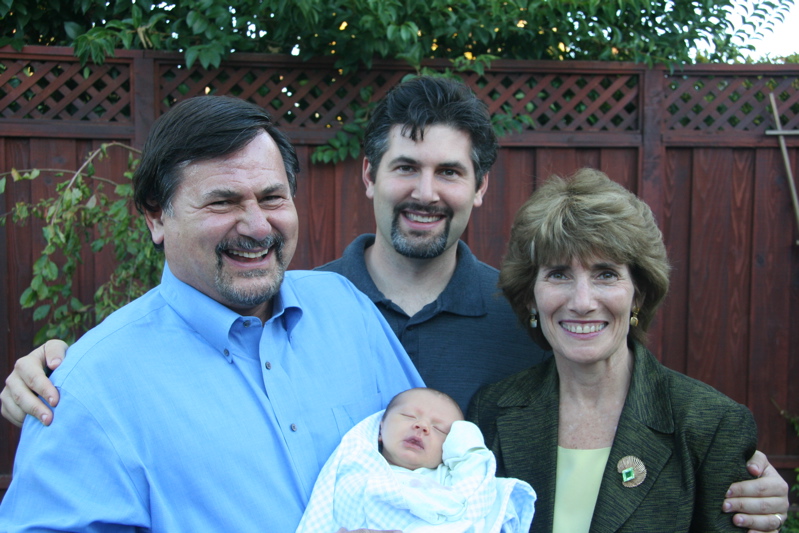
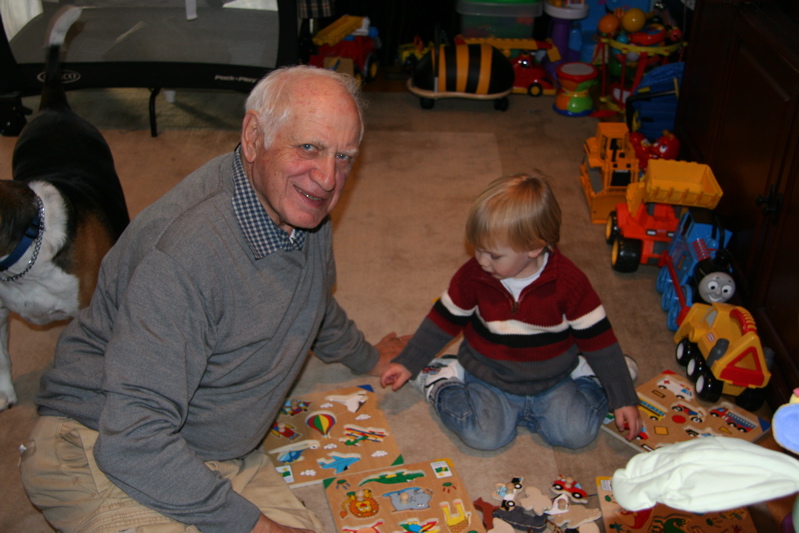
For this post, I thought I’d just put up some pictures to reflect on.  I’m very lucky.  I have two wonderful boys, and my father & grandfather both live nearby.   Very lucky, indeed.

Here are some recent shots of me with Jacob & Joseph (May 2007):


Here are some shots of my Dad with his grandsons, Jacob & Joseph:


Here is a picture of my Grandfather, with his great-grandsons, Jacob & Joseph:


And here are some nostalgia moments, pictures from Father’s Day 2005 & 2006:


So Happy Father’s Day to all the fathers out there, and a special thank you to Carolyn & my boys for making this my day also.

Finding Adam Nash: Google, ZoomInfo, LinkedIn

I’ve been thinking a bit about how people find people online.  To sample, I tried three different services: Google, ZoomInfo, and LinkedIn.  I wanted to get a sense of three different approaches to online people search.

Let’s start with web search!  Google doesn’t really focus on people as a first-class entity, so it basically just aggregates web pages based on its algorithms for content relevance.

When I search for Adam Nash on Google, I get the following:

The results are pretty good… for me, at least.  4 of the top 5 links are actually my pages.  The top two are this blog.  The fourth is my old homepage at Stanford, and the fifth is my current personal home page.

Of course, none of these pages would give you excellent data about me, really, but they all contain pointers to good, deep information.

Next up, ZoomInfo, and the magic of web scraping & aggregation.  I did the search and was surprised to find 52 reconds for Adam Nash.  Even more surprising, 6 of them look like they are pieces of my history, but in a mish-mash that combine strange pieces of data.  In some cases, my data is mixed with someone elses.

Here are the 6 versions of Adam Nash in ZoomInfo that I can verify should really be one version: me.

What a mess.  It’s not that the information there isn’t partially correct, it is (or was), and it’s interesting to see some of the articles scraped together.  But the fragmentation is terrible, and I’m almost offended to see my picture on top of information for someone else.  Certainly, anyone looking for me on ZoomInfo would have a very hard time figuring out who I was, or what I was doing with any accuracy.

Now, of course, our user-generated content site, LinkedIn.  Here is the search I get back when I’m logged onto the site:

Ok, Ok, that’s cheating 🙂  But that’s close to what anyone in my broad network would see (over 1.4M members).  The data is correct and up-to-date.

How about a public search on LinkedIn, with no LinkedIn account at all?  Also good:

The first link there is mine.  Clean results, correct information.  You can’t beat my public profile for accurate and relevant professional information.

Not surprisingly, I think this indicates the strengths of the different mechanisms for finding people online today.  Google, representing natural search, does a decent job focusing on existing content.  LinkedIn, representing user-generated content, does a fantastic job of accuracy and relevancy.  ZoomInfo, representing aggregated web scraping, seems to have a ways to go before it will a trustworthy directory.

As always, your mileage may vary.

Missing eBay Live 2007 in Boston

This is the first time in four years that I’m not at eBay Live, and I have to admit, I’m missing it.

Well, of course the eBay Chatter has a play-by-play on their blog, and there is a website that is hosting a replay of the 2007 keynote.  But it’s not like being there.

My first eBay Live was in 2004, in New Orleans.  I was helping out generally, working the Business & Industrial and Sports category booths, and teaching classes to sellers interested in selling in bulk lots on eBay.  I had just delivered some key platform enhancements in this area, and was very excited to be giving my first eBay Live class.  Imagine my surprise when over 300 people turned up for the first session (standing room only!)   The funniest moment was two minutes before we were about to start, Jeff Jordan walked in the room and looked a little surprised.

“What class is this?!?” he asked me.

“Buying & Selling in Lots on eBay” I said.

“Really?!?”

🙂

The secret to a great class at eBay Live was focusing not on what eBay wanted to tell members, but about what members wanted to hear from eBay.  Selling in bulk was something that many sellers at the time were experimenting with at the time, and for good reason.  It was a way to source supply, a way to move out stagnant inventory, and a way to potentially sell new classes of inexpensive goods on the platform.  You’re not going to sell 1 can of tennis balls on eBay, but you might sell a case of 24.

I taught classes at eBay Live 2005 in San Jose, and at eBay Live 2006.  Of course, for me, 2006 was the highlight, as we rolled out eBay Express broadly to the community.  In fact, I believe the 2006 eBay Live class on eBay Express is still available online, right here.

Lara Housser & Christophe Gillet are giving the eBay Express classes this year, and there is a lot of great material in those classes.  I think a lot of people are going to be surprised with the success-to-date for the site.

Despite the incredibly long hours on your feet, and the incredibly early mornings and late nights, there is a bit of magic to eBay Live, and I have to admit that I’m missing it this year.

Of course, that’s the trade-off you make when you take on a new opportunity – you have to leave another behind.  I can’t tell you how excited I am about my new role and my new company.  The opportunity at LinkedIn is incredible, and the people are amazing to work with.

But I’m feeling nostalgic tonight, so good luck to the eBay team in Boston this week.

P.S.  In a weird twist of events, “Lara Housser” has become one of the top ten search queries leading to this blog.  Lara, if you are reading, you may want to update your LinkedIn public profile… people are clearly looking for you.  🙂

The US 50-State Map Renamed For Countries with Similar GDP

OK, this is a little geeky, but I found this map really fun.


(click for larger view)

Sometimes it’s hard to appreciate how big the US economy really is compared to the rest of the world. This map does a good job of showing the scale of just the individual states, replacing each state with a country that has roughly the same economic size as that state.

And yet, wile a per capita GDP might give a good indication of the average wealth of citizens, a ranking of the economies on this map does serve two interesting purposes: it shows the size of US states’ economies relative to each other (California is the biggest, Wyoming the smallest), and it links those sizes with foreign economies (which are therefore also ranked: Mexico’s and Russia’s economies are about equal size, Ireland’s is twice as big as New Zealand’s).

I think the reason this amuses me so much is just the strange geographic overlay. Try playing red-state, blue-state with these country names. I was even imagining the civil war played out on this grid.

Here is a link to the full article.

Battlestar Galactica: Ronald Moore Talks about Earth

Very long and detailed interview with Ron Moore on Crave Online about Battlestar Galactica, including a lot of his thoughts about season 4.

Battlestar Galactica: Ronald Moore Talks About Earth

One of the questions I like has Moore reflecting on what he believes is the most interesting about science fiction:

CRAVE ONLINE: A lot of viewers see very specific metaphors in the show for what’s going on in the world today. Do you ever feel like fans get too literal in their own interpretations, and do you ever wish that people would just relax and enjoy the show on its own merits?

RONALD MOORE: Part of the point of science fiction, at least in its roots, was always to give the audience an allegory to present a metaphor for what was taking place in the culture. I think we’ve always enjoyed, and taken a certain satisfaction in, the fact that there are those who watch the show and assume that there is a liberal bias and those who watch the show and assume there’s a pro-military bias, and that’s how it’s supposed to work. You’re supposed to bring your own point of view to it, and then be able to extrapolate out whatever messages you want. The show tends to not be terribly definitive. We were pretty clear from the outset that this wasn’t going to be about protagonists espousing lessons and rules, and arriving at the end to save the day and tell everyone what was right and what was wrong. The line separating the protagonists and antagonists would often blur with the audience often asking themselves if they’re rooting for the right side. There’s always going to be a question mark of sorts at the end of most stories, and I think that applies to the political element as well. There really isn’t a definitive answer to anything that’s being espoused by any given story. It’s more just about the idea that there are two sides to every equation.

This is interesting to me, in particular, because this is why I’ve always been drawn to science fiction. So much of political and moral debate can unwittingly be shaped by assumptions about technology. It’s always fascinating to see how different assumptions about what is and isn’t possible can shape debate about very real human issues.

Supergirl to Join Smallville in Season 7

Is this worth blogging about? I don’t know.

Supergirl will indeed be a new character in Smallville when it returns for Season 7. More on this at SyFy Portal.

Clark’s cousin Kara “was sent to Earth in a ship that arrived at the same time as baby Kal-El’s,” executive producer Al Gough told TV Guide. “But there was a problem and she’s been in suspended animation for the last 16 years. We’ll find out in the season premiere that the big dam break in last season’s finale is the reason she’s finally awoken.”

I have a special place in my heart for truly awful movies… and the Supergirl movie from 1984 is one of the worst ever. Unbelievably bad.

2007 American Silver Eagle Uncirculated Coin Available June 13

This is hot of the newswire from the US Mint:

WASHINGTON— The United States Mint announced today that the 2007 one-ounce American Eagle Silver Uncirculated Coin will be available beginning at noon on Wednesday, June 13, 2007. Struck on specially burnished blanks, the American Eagle Silver Uncirculated Coins feature a finish similar to their bullion counterparts, but carry the “W” mint mark, reflecting their striking at the United States Mint at West Point.

The American Eagle Silver Uncirculated Coin bears the same designs as the bullion and proof versions. The obverse design features Adolph A. Weinman’s full-length figure of Liberty in full stride, enveloped in folds of the American flag, with her right hand extended and branches of laurel and oak in her left. The reverse design depicts a Heraldic eagle with shield, an olive branch in the right talon and arrows in the left.

Each coin is encapsulated in protective plastic and placed in a blue presentation case accompanied by a Certificate of Authenticity signed by the Director of the United States Mint, Edmund C. Moy.

Containing one troy ounce of .999 silver, the 2007 American Eagle Silver Uncirculated Coin will be available for $21.95.

Last year was the first year that this coin was minted. At first, most people ignored it, largely because uncirculated silver eagles are available from any bullion dealer, and the US Mint markup was substantial. Ironically, this led to extremely low sales volume for the 2006 coin.

Of course, it turns out that this is the only uncirculated silver eagle with the “W” mint mark, and as a result to complete a set every collector has to have one. The price went from $15.95 to $60 almost overnight on eBay when they were discontinued. I’ve seen them selling now for almost $100.

This is common knowledge now, so my guess is that the 2007 will sell briskly, ironically making it less valuable. I’ll still buy a couple, though. Just a sucker, I guess.

The Best Blog Posts on Venture Capital

Sorry, but I couldn’t help providing these pointers.

I’ve been thinking for a while about writing some posts explaining venture capital. While I have a lot of friends who are serial entrepreneurs and venture capitalists, one of the my realizations in the brief time I spent in the industry was how poorly understood it is by 99% of people.

Well, it looks like Marc Andreesen beat me to it.  His posts contain roughly 90% of what I was going to say.

He has three of them:

Marc describes his experience with venture capital as follows:

My experience with venture capital includes: being the cofounder of two VC-backed startups that later went public (Kleiner Perkins-backed Netscape and Benchmark-backed Opsware); cofounder of a third startup that hasn’t raised professional venture capital (Ning); participant as angel investor or board member or friend to dozens of entrepreneurs who have raised venture capital; and an investor (limited partner) in a significant number of venture funds, ranging from some of the best performing funds ever (1995 vintage) to some of the worst performing funds ever (1999). And all of this over a time period ranging from the recovery of the early 90’s bust to the late 90’s boom to the early 00’s bust to the late 00’s whatever you want to call it.

Normally, I’d be skeptical, but as I read his posts further, I found myself really appreciating the perceptiveness of his comments.

For example, here is a brief passage from the first post:

Within that structure, they generally operate according to the baseball model (quoting some guy):

“Out of ten swings at the bat, you get maybe seven strikeouts, two base hits, and if you are lucky, one home run. The base hits and the home runs pay for all the strikeouts.”

They don’t get seven strikeouts because they’re stupid; they get seven strikeouts because most startups fail, most startups have always failed, and most startups will always fail.

So logically their investment selection strategy has to be, and is, to require a credible potential of a 10x gain within 4 to 6 years on any individual investment — so that the winners will pay for the losers and in the timeframe that their investors expect.

All early stage venture capitalists will repeat the above analogy to you, but personally I found that in 2001-2002, very few venture capitalists internalized what that analogy really means. What it means is that you need to take a certain number of “swings” every year, just to make sure your odds of connecting with a winner pan out. In 2001-2002, too many venture capitalists sat on the sidelines, debating whether $4M should buy them 50% or 60% of a Series A company, instead of making sure that they kept investing. After all, any contrarian investor will tell you, you force yourself to put money in when times look grim.

I also really appreciated this quote from Marc’s second article:

Why we should be thankful that we live in a world in which VCs exist, even if they yell at us during board meetings, assuming they’ll fund our companies at all:

Imagine living in a world in which professional venture capital didn’t exist.

There’s no question that fewer new high-potential companies would be funded, fewer new technologies would be brought to market, and fewer medical cures would be invented.

We should not only be thankful that we live in a world in which VCs exist, we should hope that VCs succeed and flourish for decades and centuries to come, because the companies they fund can do so much good in the world — and as we have seen, a lot of the financial gains that result flow into the coffers of nonprofit institutions that themselves do huge good in the world.

Remember, professional venture capital has only existed in its modern form for about the last 40 years. In that time the world has seen its most amazing flowering of technological and medical progress, ever. That is not a coincidence.

This is what made me passionate about venture capital when I was in the industry, and it’s why I will likely return to it in some form again. There is an extremely important role to play for venture capitalists to play in getting money from large, conservative institutions effectively into the hands of risky entrepreneurs who are building the new technologies and businesses of tomorrow. You won’t get there with government funding or small business loans.

My favorite part of Marc’s series, however, is in his third article, when he discusses the current paradox of venture capital, one that has surprised me personally. The question is this:

If venture capital in the past 7-8 years has had such horrible risk-adjusted returns compared to the public markets, why hasn’t the amount invested in venture capital funds decreased dramatically?

The answer is asset allocation.

I remember my Private Equity class at Harvard, where Dave Swensen, of Yale Endowment fame, came to speak. Venture capital has become an asset class that every multi-billion-dollar institution feels like it needs in its portfolio. This is because after 25 years of modern venture capital, it because a proven fact in the 1990s that over the long term, venture capital has returned almost 2x the public market return, with low correlation to the public stock market. That may not sound like much to you, but that’s music to a money-manager’s ears.

This predictably led a significant number of institutions to shift massively into alternative investments and venture capital in the late 90’s, just in time to get hammered by the crash of 2000-2002.

Here’s the interesting part: that hammering — by people who, say, only started investing in venture funds in 1999 — has not resulted in a significant pullback on the part of institutional investors from venture capital.

Instead, venture capital has become an apparently permanent asset class of many large institutional investors — and increasingly, smaller institutional investors.

One element that I do believe Marc missed here is the behavioral finance aspect of why institutions still put billions into venture capital. You see, on average, venture capital has done poorly the last 7-8 years. But there have been some great funds that have performed spectacularly (Google, anyone?) Like hedge funds, many institutions have money managers that believe that the venture capital funds that they have picked will be the few that outperform. (Of course, most of the best venture funds turn away money regularly, but that’s another story.)  Thus, everyone believes that they will be “above average”, even though that’s not possible.

In any case, definitely read Marc’s articles. Bookmark them. Read them and think about them the next time you read some press about venture capital. They are keepers.  I just wish I had written them first.

Is Safari for Windows Part of the iPhone Strategy?

Steve Jobs gave the keynote for WWDC (World Wide Developers Conference) 2007 today, and as usual it was packed with announcements.

There are so many Apple magazines, websites, and blogs, it feels like a waste for me to repeat the “10 Features of Leopard” that Steve walked through.

If you want that walkthrough, here is a good one.  Apple is also hosting the video of the keynote, in case you want to watch it live.

However, judging by the pure volume of headlines, the press have decided to highlight the last announcement in the keynote as the big shocker of the day:  Safari 3.0 for Windows.

It’s not an obvious move.  Now, it’s not that I don’t understand the problem.  Believe me, the relatively small market share for Safari is a real issue.  For most of the time I was at eBay, Safari was not on the official list of supported browsers for eBay, largely because of its unusual implementation of Javascript and DHTML, and because of its minuscule market share.  It wasn’t until 2006 that Safari 2.0 made the list, and that had more to do with the growth of Firefox and the need to target “all modern browsers”.

What non-developers may not realize is that supporting additional platforms always requires more initial thought and a higher level of developer skill.  Originally, when HTML was dirt-simple, there was no real issue with browser complexity.  However, the browser wars of the late 1990s gave birth to incredible complexity in web programming, and that has only gained steam in the past few years as developers struggle to add richer interfaces to their web applications.

As a result, supporting additional platforms and web browsers is a big deal.  Internet Explorer is Windows-only (a move I have long questioned strategically).  Safari is Mac-only (until now).  Thank goodness for Mozilla Firefox, the only real hope of building code once and having it run on a large number of platforms.

Depending on whose numbers you believe, IE has about 80% marketshare, Firefox has 15%, and Safari has 5%.  Different sites have different numbers, because some sites attract different types of audiences.

As a web developer, you could decide to target only IE.  That gets you 80% of the market.  That might work, but it’s not as easy a decision as it was in 2003 when they had 90+% of the market.

Developing for IE & Firefox seems like the right answer, because it gets you 95% of the market, and the nature of developing for Firefox usually means good, clean, standards-compliant code that will also work on Safari.

As a result, Mac users owe a real debt to the growth and success of Mozilla Firefox.  Once developers decide to go “multi-browser”, they usually include Safari for good measure.

So, why does Apple choose to promote “a third option”?  They have no chance of catalyzing the anti-Microsoft, open-source community… they are behind Mozilla (and for good reason).  They have no chance of taking significant share from IE… everyone who can download a separate browser has largely downloaded Firefox.  And if they should take market share from Mozilla, then they have likely hurt the case for non-IE development by fragmenting the market further.

When Apple launched Safari, Firefox was not nearly as robust or successful as it is now.  But I really wondered why Safari 2.0 wasn’t just a Firefox variant… an extension of the Mozilla codebase, hand-tailored for the Mac by Apple (like an official Camino build).

So here is my theory… based on no real information.  I have seen this theory in exactly zero of the articles on the topic I browsed today.

It’s about the iPhone.

It takes a few assumptions to get there, but just ponder the following, and let me know if you think I’m crazy:

  • Let’s say that developing a full-featured web browser for mobile that is differentiated and supported the unique Apple-designed gestures and interfaces for the iPhone required so much customization that you really needed to own the code base.
  • Or, let’s assume that Apple doesn’t want to reveal the source code of some of its browser innovations for the iPhone as a form of proprietary advantage in the mobile space.
  • Let’s also assume that Apple wants a rich set of applications for the iPhone, but wants to bypass the current models for installing applications on cell phones, and WAP-based models for web-application development.  Apple wants rich applications without the strings that come from service providers or the limitations of WAP.

Apple has a bit of a problem now… they need a custom browser, but they want active developer support to build these rich applications.  They need market share… but not PC market share.  They need mobile market share.

Could the answer be a Safari for Windows that runs on Windows Mobile?  Is it possible that Apple would license Safari for Windows Mobile to a broad set of carriers?  It wouldn’t be the iPhone, but it would be a larger audience for web developers to target, and it would be a “stepping stone” for buyers of non-Apple, integrated mobile devices to get a “taste” of the Apple iPhone experience.  Safari for Windows then provides Windows-based developers with an easy target platform for development & testing.

Might be a stretch.  But I wonder if Safari for Windows has more to do with Apple’s non-PC device strategy than some bizarre attempt to take on Microsoft and Mozilla.

Daring Fireball thinks it’s all about the revenue from the search bar… I see that as a perk, but not a major reason to take on this challenge.  $75M in revenue per year is just not a big deal at Apple’s current size… unless they see their growth slowing and are scraping for every dollar.

Guy Kawasaki: 10 Ways to Use LinkedIn

One of the most common questions I get now that I work at LinkedIn is how to best use the site. There is a post on Guy Kawasaki’s blog from earlier this year that highlights his top 10 ways to use LinkedIn, and it’s definitely worth reading:

Guy Kawasaki: Ten Ways to Use LinkedIn

Unfortunately, Guy leads off the post with this little dig at Harvard MBAs:

  • The average number of LinkedIn connections for people who work at Google is forty-seven.
  • The average number for Harvard Business School grads is fifty-eight, so you could skip the MBA, work at Google, and probably get most of the connections you need. Later, you can hire Harvard MBAs to prepare your income taxes.
  • *sigh*. It’s not always easy being a Harvard MBA in Silicon Valley.

    Guy also provides the following useful tidbits:

    • People with more than twenty connections are thirty-four times more likely to be approached with a job opportunity than people with less than five.
    • All 500 of the Fortune 500 are represented in LinkedIn. In fact, 499 of them are represented by director-level and above employees.

    I highly recommend reading the entire article. But, for those of you who like spoilers, here is the bullet list of the ten ways to use LinkedIn:

    1. Increase your visibility
    2. Improve your connectability
    3. Improve your Google PageRank
    4. Enhance your search engine results
    5. Perform blind, “reverse”, and company reference checks
    6. Increase the relevancy of your job search.
    7. Make your interview go smoother
    8. Gauge the health of a company
    9. Gauge the health of an industry
    10. Track startups
    11. Ask for advice

    Yes, there are actually eleven. Guy must be a Spinal Tap fan…

    I’m impressed that he actually added two more that came in from comments since the original post:

    1. Integrate into a new job
    2. Scope out the competition, customers, partners, etc

    So get cracking! Even my Mom is on LinkedIn now…

    ZFS: The New Filesystem for Mac OS X Leopard (10.5)

    Just found this article on CNet:

    Apple will include ZFS with Mac OS X Leopard, Sun confirms

    First thought… Steve is going to be pissed. He hates leaks.

    Now, some information. From the article:

    ZFS, which (sort of) stands for Zettabyte File System and was originally developed by Sun, is a huge step forward from traditional file systems. It protects all files with 64-bit checksums to detect and fix data corruption and, as a 128-bit file system, can handle many orders of magnitude more space than current versions of Microsoft Windows, OS X, or Linux. (There is a movement afoot to port ZFS to Linux but it’s complicated by restrictions in the GNU General Public License.)

    One of the biggest changes ZFS offers is what’s known as a pooled storage model. What that means is that physical drives become even more removed from logical volumes, and getting more free space simply means plugging in more drives. The file system takes care of the rest for you.

    Not that we were hitting the limit on 64-bit filesystems, but it’s worth noting that ZFS is a 128-bit filesystem. It’s always nice to have a filesystem that can support more files than there are atoms in the universe. I like this post entitled 128-bit storage: are you high on the Sun blogs.

    Here are 10 reasons to reformat your hard drive to ZFS.

    Can’t wait for Leopard… should be more news available soon coming out of WWDC 2007.

    Update (6/11/2007):  First Apple said no, now they say they will include ZFS, but only as a read-only file system in Leopard.  Lame.

    Catching up with LinkedIn\’s Reid Hoffman

    From PodTech:

    LinkedIn founder and angel investor Reid Hoffman talks with Mercury News venture capital reporter Connie Loizos about where he sees the social networking space headed, as well as his investment strategy these days.

    Working with Reid is great for a lot of reasons, but one of them is certainly his depth of experience around the consumer internet and social networking in particular. I think this video is a nice way to get some of his insights on his investment in the space, and on LinkedIn.

    [podtech content=http://media1.podtech.net/media/2007/06/PID_011489/Podtech_LinkedIn_Reid_Hoffman.flv&postURL=http://www.podtech.net/home/3223/catching-up-with-linkedins-reid-hoffman&totalTime=695000&breadcrumb=b6865191ba0d41208c0e8a20e4a62100]

    The Bookmakers Have Spoken: Harry Potter Will Die in Book 7

    Don’t shoot the messenger.

    Caught this post today on Paul Kedrosky’s blog and on Marginal Revolution. It included this quote from a Bloomberg piece on a bookmaker has stopped taking bets on Harry Potter dying. Apparently, all the money was going towards him dying – no one would take the other side of the bet.

    William Hill Plc, a London-based bookmaker, is so sure of Harry’s demise that it stopped accepting wagers and shifted betting to the possible killers. Lord Voldemort, who murdered Potter’s parents, is the most likely villain, at 2-1 odds, followed by Professor Snape, one of his teachers, at 5-2.

    “Every penny was on Harry dying, and it became untenable,” said Rupert Adams, a William Hill spokesman. “People are obsessed about this book.”

    “Harry Potter and the Deathly Hallows,” from Bloomsbury Publishing Plc, goes on sale July 21 with a retail price of 17.99 pounds ($35.50). It’s published in the U.S. by Scholastic Corp. for $34.99. Advance orders put the book at the top of online bookseller Amazon.com Inc.’s U.K. best-seller list eight hours after Rowling announced the title Dec. 21.

    Rowling, 41, caused a stir among Potter fans when she said two characters will die in the new book. The six earlier novels about Harry’s adventures at Hogwart’s School of Witchcraft and Wizardry have sold more than 300 million copies, earning Rowling a 545 million-pound fortune and making her wealthier than Queen Elizabeth II, according to the U.K.’s Sunday Times Rich List. “

    This is a pretty typical PR piece, but interesting nonetheless. I am a huge fan of betting & futures markets as excellent barometers and predictors based on the “wisdom of crowds”, to the limits of that wisdom, of course.

    You have to wonder… assuming that JK Rowling has know the fate of Harry since Book 1, then it might be fair to assume that despite her best intentions, she has leaked very minor, subtle clues subconsciously into what she has and hasn’t written into the first six books.  It’s possible that, when exposed to millions of human minds, those subtle clues would lead to a consensus view on the matter that might be accurate.

    Or, the perverse type of person who would bet on Harry Potter just happens to have a bias towards a gory end for the boy wizard.

    You decide.  🙂

    The Price of 20th Anniversary Silver Eagle 3-Piece Sets is Spiking

    Not sure why I checked this today, but I did.  It’s interesting enough to share, and even if you aren’t into coins, you might find this market behavior interesting.

    In 2006, the US Mint celebrated the 20th anniversary of the US Silver Eagle (also known as the American Silver Eagle, or ASE).  They released a 3-piece set of silver eagles, which included the following coins:

    • 2006 “W” Uncirculated Silver Eagle
    • 2006 “W” Proof Silver Eagle
    • 2006 “W” Reverse-Proof Silver Eagle

    They were released late in the year, around Halloween, and while I had pre-ordered two sets, they were sold out on the US Mint website quickly.

    The coins are beautiful, as to be expected, but at $100 a set, you were paying quite a bit for the novelty of the reverse-proof.  The US Mint had not done a reverse-proof before.

    In case you don’t follow coins, a proof coin is pressed twice, with special dies, to give it a mirror-like background and a frosty, well defined image.  The reverse-proof interesting produced a mirror-like image on top of a frosty background.

    Given the sold out status, I wasn’t surprised to see the sets selling for $200-$250 in most coin shops and on eBay by December 2006.  I thought that by itself was a pretty steep markup.

    Turns out I should have bought more at that price.

    Checkout the following chart from eBay Marketplace Research on the last 3 months of prices for the set:

    Look at that surge in mid-April!  Average price, as near as I can tell now, is about $580.  That’s 480% appreciation in 8 months.

    I used the following query to sift out the single coins, the silver/gold sets, and the graded coins, which would muddy the results:

    2006 AMERICAN EAGLE 20TH Set  -no -pr69 -pr70 -ms69 -ms70 -gold -ngc -pcgs -70 -69 

    I also filtered out items above $1000, because those tend to be auctions for multiple sets in a single lot.

    Anyway, I’m not sure what is causing the surge, but maybe its the release of the 2007 proof eagles.  Not sure.  Please comment if you have some insight.  I did find this thread on CoinTalk.

    How to Upgrade Your AppleTV with a 160GB Hard Drive

    I have posted many times about how much I love the AppleTV, and more importantly, how much my son Jacob loves the AppleTV. But after ripping about 20 DVDs, the original hard drive had just run out of room. 40GB is just not enough.

    This afternoon I took an hour and upgraded the AppleTV to a 160GB. The upgrade went pretty smoothly, but I thought it was worth sharing my experience here.

    First, instructions. I found a lot of these on the web, but many dated from the original launch, and I found after investigation that they were overly complex. I ended up using these excellent instructions from Engadget, and for the most part, they were complete and easy to understand.

    Since I’m linking to the instructions, let me highlight some of the things not typically covered. For example, what did I buy?

    I bought the following things:

    I love getting new tools, and the Husky Torx set is finally going meet my needs long term. It’s so cool. And you need a T8 and T10 to open the AppleTV, because there are 2 sets of screws. From my old Mac repair days, I had a T10, but not a T8.

    I spent a little more on a hard drive case for the old drive because I figured a 40GB portable USB hard drive might come in handy, and this case doesn’t require 2 USB plugs for power and had good reviews.

    Step 1: Removing the Old Drive

    This went according to plan, except that I ripped the rubber bottom a little when I was removing it. There was no warning about this, so just be really careful when you peel it off. It actually isn’t a big square – it wraps around the edges more than I first thought.

    The first set of screws actually come in 2 sizes! Make sure to remember where the long ones go vs. the short ones. It’s easy to tell because when you look inside the box, one set of holes is on posts and doesn’t need a long screw.

    Two things are on the original hard drive – a flat, peel off pad between the hard drive and the case, and a small stick-on pad between the hard drive and the internal components. In order to get the hard drive out, it’s best to wiggle the ATA plug free with your fingernails, and then peel the drive free. The instructions didn’t really cover this.

    Step 2: Disk image of the old drive

    This was much easier than I thought. I just plugged the old AppleTV HD into my new case, and plugged it into my PowerMac G5 running Mac OS 10.4.9. Open up the Terminal application, because as they said in Jurassic Park, “Oh, it’s a UNIX system!”

    The drive actually has two partitions: OSBoot & Media. The instructions given by Engadget actually have you back up the entire drive, but since you only need OSBoot, I improvised. OSBoot is only 900MB, and Media is 36GB. Since the copy over USB was handling about 2MB per second, I didn’t have the patience to copy 36GB that I was never going to use.

    So, here is the command line sequence that I used:

    PowerSmash-G5:~ adamnash$ diskutil list

    /dev/disk6
    #: type name size identifier
    0: GUID_partition_scheme *37.3 GB disk6
    1: EFI 34.0 MB disk6s1
    2: 5265636F-7665-11AA-AA11-00306543ECAC 400.0 MB disk6s2
    3: Apple_HFS OSBoot 900.0 MB disk6s3
    4: Apple_HFS Media 36.0 GB disk6s4

    This gave me a much longer list, which I’m truncating here. diskutil list gives you the complete list of mounted drives, and most importantly, gives you the actually volume name for your AppleTV drive (in my case, /dev/disk6)

    I then modified the “dd” command that Engadget recommends, truncating it to the size I needed:

    PowerSmash-G5:~ adamnash$ dd if=/dev/disk6 count=1335 of=/Users/adamnash/Desktop/AppleTV.img bs=1024k

    1335+0 records in
    1335+0 records out
    1399848960 bytes transferred in 1055.788885 secs (1325880 bytes/sec)

    So now I had my AppleTV.img disk image sitting on my desktop. Awesome.

    Step 3: Create New Drive

    This was a lot more command line fun than I thought. Engadget’s instructions here were spot on. Since Engadget actually doesn’t explain the steps in plain english, here’s what you are actually doing:

    1. Moving the old disk image to the new hard drive
    2. Deleting the “Media” partition, since it’s too small
    3. Creating a new “Media” partition that is as big as your new drive will allow
    4. Formatting the new “Media” partition as HFS+ Journaled
    5. Deleting any Spotlight directories from OSBoot and Media

    Through it all, I became really impressed with gpt and diskutil as command line operators. Very powerful.

    Step 4: Install New HD in AppleTV

    This was really easy. The key for me was to put the sticky pads from the old HD on the new HD first, then reattach the IDE cable. Once that was done, I screwed the HD in place onto the base. I then put the base back on the AppleTV, and put in the 4 screws that hold it together. I then re-applied the rubber.

    Step 5: It’s Alive!

    I rushed it back to my bedroom and hooked up the power & HDMI. Worked perfectly, and now has 145GB of space for media. Basically, it acted like a brand new AppleTV, so I did have to walk through setup and connect it with my iTunes. But it just worked.

    Epilogue: Do I recommend this?

    Ironically, Apple started selling a 160GB AppleTV this week for $399. That’s $150 over the $249 for the 40GB version. So why would you ever do this?

    I thought about this today, and basically, the only reason you’d do this is:

    • You already have a 40GB AppleTV
    • You love to play with command lines and hardware

    Fortunately, these both apply to me. Your mileage may vary.

    I’d rate this install as harder than installing a new hard drive in a laptop computer, but only because of the rubber and the command line fun.