2010 Pinewood 8th Grade Graduation Speech

Today, at 6pm, I was invited to Pinewood in Los Altos Hills to give the commencement speech at their 8th Grade graduation.  I graduated from Pinewood junior high school in 1987, so it was somewhat of an honor for me to be asked to come back 23 years later to speak to the graduating students.

I wrote the speech last night (on an iPad) at the local Starbucks.  After a number of twitter questions, youtube searches, and other research, I decided to adopt the high level framework from Steve Jobs 2005 Commencement speech at Stanford, replacing his stories with my own, and adding my own form of 8th grade humor.  I did stick with his “dots” lesson, but you can see I changed the lesson from it quite dramatically.

Overall, quite a few people seemed to enjoy the speech, as a number of the students, parents and faculty came up to me afterward.  It seems like the students liked the jokes at the beginning, while the parents liked the third story on painting behind the refrigerator.

While I ad-libbed a few jokes, the notes below are exactly what I brought up onto the podium with me.  Let me know what you think.

Ice Breaker:

  • Last time I gave the 8th grade graduation speech here it was 1987
  • Weighed 85 pounds
  • I was 12 years old
  • Had to stand on a milk crate to reach the microphone to give my speech

Who am I now?

  • I have a wife, 3 beautiful boys, and two really fat dogs.
  • I am an executive at one of the cooler technology companies in the Valley right now.
  • It is part of my job to buy and play with every single new tech toy that comes onto the market.  Yes, it’s true. It’s my job to get the iPad the day it comes out.  Yes, I get paid for it.

(By the way, I appreciate you laughing at all my jokes.  If you don’t think they are funny, don’t be afraid to just laugh at me.  I’ll take it.)

Humorous Anecdote:

Wasn’t sure what to speak about.  Fortunately, they have this thing called the Internet now, and it’s pretty good.  I have over a thousand followers on Twitter, so i asked the for ideas.  I searched YouTube.  Poked around Facebook.  Even asked my younger cousins, who are in junior high now.

Not surprisingly, the ideas were spectacularly bad.

  • Some people said I should include a lot of quotes from Family Guy. I did a search and found over 768 funny quotes from Family Guy.  I’m 99% sure that literally none of them are OK for me to say out loud here.
  • Other people said I should ask the girls whether they are on Team Edward or Team Jacob.  I don’t really even want to know what that means.
  • I got a suggestion to talk about video games.  Apparently, Splinter Cell: Conviction is just awesome.  While that’s probably true, I’m not sure what to tell you about games except that you should treasure these years – once you have kids, you pretty much have until the age of 7 and then they start beating you.
  • Apparently, a lot of people think it would be funny if I gave a lot of advice to the boys in the class about girls.  Unfortunately, I still don’t understand high school girls, so not much help there.  Girls, in case you are curious about high school boys, all you need to know is that they really don’t mature much from here.  Don’t overthink it.

Anyway, since none of those ideas panned out, I decided I would cover three stories today and keep it relatively short.

I am going to tell you some things tonight that you are not going to believe.  But they are true.  Just three stories about:

  1. Coins
  2. Volleyball
  3. Painting

First, Coins.

  • There are a million little things that make you, you.  Don’t ignore them.  When I was little, i loved numbers.  I used to punch 2x2x2 into the calculator until it got too big for it to display.  Yes, I know that I am not normal.  I’ve always been a geek.   But who knew that knowing all the powers of 2 would be a uniquely valuable skill when it came to computers?
  • Hobbies are good.  You’ll be surprised where they’ll take you.  I collected baseball cards and coins.  Yes, I’m a dork.  At the time, I had no idea that I’d end up at business school, and that I’d have a natural sense for markets and trading.  I also had no idea that 20 years later there would be a company named eBay, or that it would do $60 Billion in sales.  I also had no idea that I’d end up working for that company.
  • Steve Jobs said a few years ago that a lot of life is about connecting the dots.
  • The wonderful thing about high school is that you are still busy adding dots to your picture.
  • You’ll spend your life connecting a lot of these dots, but it may not be for years or decades.
  • Don’t let anyone discourage you right now from learning and investigating.  If you find something interesting, don’t let anyone tell you that it isn’t worthwhile or cool. Pursue your hobbies, and do them deeply.  You’ll be constantly surprised later at how your life connects the dots.

Lesson 1: Draw lots of dots.

Second,  Volleyball.

  • In my senior year of high school here at Pinewood, I was a starter for the Varsity Volleyball team.  This was a big deal for me, largely because I wasn’t actually always good at Volleyball.
  • In fact, when I first tried out for the team my sophomore year, I didn’t make it.  (The fact that I was 5’3″ at the time may have been a factor).  I made the team my junior year, but mostly as a substitute.  But I practiced.  2 hours a day.  Extra trips to the gym, practicing against the wall, etc.  I didn’t make starter until senior year.
  • There are two types of skills in this world: ones where you’ll have natural talent and ability, and ones where you won’t.   Everyone is different, and I was pretty fortunate to be naturally talented in a bunch of areas.  But there are far more things out there that you won’t be naturally gifted at.
  • Don’t limit yourself to the things you’re good at.  Everyone is afraid of looking foolish, and that keeps a lot of us from pursuing things that we’re interested in, but that we’re not immediately good at.   Don’t fall into that trap in high school.  If you are interested in something, don’t just try it.  Do it, and do it well.
  • Pushing forward and mastering something that you’re not naturally great at gets you way more than just a skill.  It teaches you persistence and diligence.  More importantly, it gives you the confidence to learn and do anything.
  • It also teaches you to not take your talents for granted, and how special it is when you *do* have a unique gift in area.

Lesson 2:  Don’t limit yourself.

Lastly, I promised to tell you about painting.

  • I’ve always liked to work with my hands, and now that I have a house, I’m always doing something to it.  When you paint a room, like the kitchen, you always reach a difficult point – do you paint behind the refrigerator?
  • After all
    • no one else will see it
    • you can fix it later
  • But in the end, there are good reasons to paint behind the refrigerator.
    • first, you know it’s there
    • take pride in your work
    • act as if people are watching
  • Character is what you do when no one is watching
  • Important in high school, tremendously important in college & adult life
  • Some of the worst things that important people have done in the past decades have been because they thought they could get away with cutting either legal or ethical corners when no one was watching.  Many of you will turn out to be important people someday, and like they say, practice makes perfect.

So if I leave you with anything

Lesson 3: Be the type of person who paints behind the refrigerator.

Congratulations to you all.  Thanks for having me here today.  Take care.

Tweets: LinkedIn, Twitter & Lists

Today I had the privilege of taking the wraps of a feature enhancement that my team has been working on for the past few weeks: the new version of Tweets.

LinkedIn Blog: Find and Follow Your LinkedIn Connections on Twitter

Tweets on LinkedIn

You can install Tweets by going to the install page on LinkedIn.

There’s no need to run through all of the great new features – the LinkedIn blog post does a good job of that.   Here is some of the most notable press coverage:

The buzz was fantastic to see.  We pushed out the new application at 4PM PST, and by 4:10PM we were trending with over 20 tweets per minute about the application.  (This included a really nice shout out from Ryan Sarver at Twitter).

One of the most unique aspects of this launch was the added ability to see which of your LinkedIn connections are on Twitter, and which ones your are (or aren’t following).  For example, I personally discovered that I had over 334 LinkedIn connections with Twitter accounts, but was only following 120 of them.  With a few clicks, I was able to discover that key people, including several executives at LinkedIn, had Twitter accounts that I should be following.  Click click click.  Done.

The reason I really loved working on this project is that it captures one of the fundamental reasons the LinkedIn platform is so important.  We believe that every business application would be better if it was integrated with your professional reputation and relationships, and this feature is a great example of how Twitter can become more valuable when it’s integrated with your LinkedIn account.  Finding the right people to follow on Twitter can be difficult, and leveraging your LinkedIn network is a great way to find and follow professionally relevant Twitter accounts.

With the new Twitter list functionality, I can now keep tabs on the tweets of my LinkedIn connections on LinkedIn, on Twitter for iPhone, in Tweetdeck, Seesmic, Twitter.com or any Twitter client that supports lists.  Set it once and forget – LinkedIn keeps it up to date.

A special thank you to the team, in particular Alejandro Crosa, Sarah Alpern and Taylor Singletary.  Very exciting to see this feature live.

You’ll be even more impressed with what we have planned next.  🙂

Accredited Investors: Fixing the Dumb Money Problem

We’re now days away from the potential passage of significant financial reform, and a particular issue in the bill caught my eye.  This excerpt is from Businessweek:

Currently, a person must have a net worth of $1 million or an annual income of $200,000 if single or $300,000 if married (and filing jointly) to be an accredited investor. The senator’s proposed bill doesn’t say what inflation adjustment will be used to convert these numbers, established in 1982, to today’s dollars. But if we use the Bureau of Labor Statistics inflation calculator to adjust these figures on the basis of the consumer price index, then the annual income requirements for accredited investor status would become $449,000 if the investor were single and $674,000 if the investor were married, while the net worth requirement would become $2.25 million.

This is exceptionally bad news, if it passes, on multiple fronts.  To explain why, let’s review some of the basics.

What is an accredited investor?

Investing in public securities, like stocks and bonds, is heavily regulated.  There is a long standing legal concept, dating back to the 1930s, that individual investors need to be protected from nefarious money raising capitalists.  However, a special exception was carved out for the rich, under the auspice that sufficiently wealthy investors have enough education and resources to protect their own interests.  Thus, for private companies that wish to raise capital from private investors outside these large regulated facilities, there is a concept of an “accredited investor”.

Accredited investor qualifications have changed over the years.  Currently, there are two ways to qualify as an individual:

  • You are single and make $200K/year, or you are married and make $300K/year as a household
  • You have over $1M in liquid assets

When do you need to be an accredited investor?

You need to be an accredited investor to invest money in angel investments, hedge funds, certain private partnerships, and other high risk / unregulated investments.  For example, if Mark Zuckerberg came to you in 2005 and offered to let you put $25,000 into thefacebook.com, you’d need to be an accredited investor to do so.   (BTW If you can go back in time and do this, I highly recommend it).

Who is this going to hurt?

This is really going to hurt two groups – entrepreneurs and individual investors.

Entrepreneurs are going to be hurt by the severe limitation of who they can potentially raise money from at the angel stage.  As the Business week article points out:

Updating Reynolds’ estimate of the share of the adult population who are accredited investors to the 2008 adult population as reported in the Statistical Abstract of the United States, there were 5 million to 7.2 million American adults who were accredited investors in 2008…

Adjusting the income and net worth requirements for accredited investing to those proposed in the Dodd bill would reduce the number of accredited informal investors to 121,000 to 174,000 people.

So if this passes, we are talking about a massive decline in the number of potential angel investors in a new business.  Potentially a 98% decline, if the numbers above are accurate.  Outside of web 2.0 companies in Silicon Valley, raising angel funding is not trivial as it is.  Reducing the pool of investors here is massively disadvantageous to most entrepreneurs.

Individuals are also hurt here – that same 98%.  These are people who make a lot of money – $200K/year individually or $300K/year if married.  Imagine yourself as the founder of a cool web company, which sells to Google for $10M.  Your cut is about $1M after taxes.  Your friend is starting a new company, and you want to make a $50K investment.  You can’t because… the government says you aren’t rich enough?  Really? (I guess you are rich enough for a top tax bracket, just not rich enough to make investment decisions.)

Why do they think this is a good idea?

The amounts to qualify as an accredited investor haven’t been changed in a very long time.  Originally, these amounts were incredibly large, but they were never indexed for inflation.  I don’t think anyone ever envisioned millions of Americans qualifying.

Given the recent scandals around hedge funds and related ponzi schemes, these changes are an attempt to “protect” the public from people who would trick them into investing into shady schemes and poor investments.  The assumption is the same as the original one in 1933 – that in order to be sophisticated about investments, you need to be rich.

Alternatively, you could argue that we just don’t care that much if “rich” people lose their money, but that normal people, even those earning $300K/year, need to be protected from charlatans and rogues who would trick them into unregulated investments.

A better solution: make accredited status earned by knowledge, not income or assets.

We are learning the wrong lessons from the recent financial crisis and scandals.  If anything, recent events have demonstrated that dumb money is bad in large amounts, whether it is aggregated from a bunch of small investors, or funded by large rich investors.

We know from clear evidence that lottery winners, professional athletes, movie stars, and other wealthy people can still be incredibly financially ignorant.  Just because a retiree has accumulated $2M over a lifetime does not mean that they have significant financial education, or that they understand how to evaluate a hedge fund for legitimacy.  We also know that there is significant danger in this money being lost, stolen, or even worse, leveraged and invested in ways that can exacerbate bubbles.

My thesis is as follows:

  • Just because someone has a high income and/or significant wealth, does not mean that they have significant financial education, or will appoint/hire people who have significant financial education.
  • Depriving entrepreneurs and individuals from the opportunity to fund new businesses is completely unfair, and likely counter-productive to goals of encouraging new business formation and entrepreneurship.

My proposal would be as follows:

  • We introduce a new form of license / test that gives you “accredited investor” status for a fixed number of years (3-5 years).
  • We do increase the accredited investor limits – in fact, we eliminate them over time.

Look, we force people to repeatedly take a test to prove that it’s safe for them to drive.  It’s not a big stretch to insist that people who believe they are capable of making unregulated investments have the proper education.

The advantages of this program are clear:

  • Meritocracy.  This allows for anyone with the will to research and learn the ability to become an accredited investor.
  • Education.  This allows the government to ensure that all accredited investors, regardless of wealth, are aware of relevant financial and legal issues around investments.  This would help prevent charlatans from taking advantage of people.  For example, the test could ensure people are aware of their rights, of recent financial returns, of warnings signs, and of recourse for reporting fraud.
  • Self-funding. The government could charge a fee to take this test to help fund the license and potential even some enforcement resources.  It could also charge a licensing fee for institutions that want to offer classes around the license.
  • Centralized verification.  This would ensure that every accredited investor is easily verifiable.

As always, very interested in thoughts and feedback from those familiar with the issue.

Update: Good news.  It looks like some amendments have made it through on the Senate bill that restore much of the status quo.  That means the primary damage will be avoided.  Maybe now there is an opportunity over the next four years to take a different approach to qualifying accredited investors.

Blueberries in Silicon Valley (2010)

In 2008, I wrote a blog post about my initial success growing blueberries here in Silicon Valley.

Blog: Blueberries in Sunnyvale

It’s a great post, and it covers a lot of the basics of which varieties to plant, and an example of how to set up watering properly.  I ended on this note:

If you’ve read this far, chances are you think that replacing useless ornamental shrubs and bushes with gorgeous, fruiting blueberry bushes is a dream come true.   Well, you too can live the dream.  I’m happy to announce that growing blueberries in Sunnyvale is definitely a reality.

This will now be my third season harvesting blueberries, and it looks like it will be a bumper crop this year.  However, I thought it was worth putting together an update, because the second season was not very successful at all.  In fact, it was lessons from the second year that really led me to do some research and come up with the techniques that I believe have led to a great 2010.

How to Fertilize Blueberries

I’m not a terribly creative or active gardener, in that I tend to favor plants and setups that don’t require constant maintenance.  Blueberries don’t require a lot of work, if you set them up properly, but they do require fertilization on an annual basis.  More importantly, they require the right kind of fertilization.  (Sources:  Michigan State Agriculture, Ontario Ministry of Agriculture)

Here are a couple key facts:

  • Blueberries require acidic soil. Actually, according to eHow and other sites, the proper pH for Blueberries can be anything from 4.3 to 5.1.  That’s pretty acidic, and much more acidic than any soil you are going to find in the Bay Area naturally.  That means, you’ve got to add something to the soil at least annually for Blueberries to flourish.
  • Traditional fertilizers can hurt Blueberries. Like most plants, Blueberries need nitrogren.  However, they don’t handle it in nitrate form well, and it can lead to significant issues.  You can use fertilizers made for acid-lovers like Azaleas.  Instead, look for sulfer-based fertilizers.

I personally use the following process:

  1. I strip about 1-2 inches of accumulated leaves and top soil off the area.
  2. I use ammonium sulfate (purchased at Home Depot, in the garden section).  I sprinkle liberally around the bushes, based on the package instructions.
  3. I put down a few bags (about 1 inch) of new top soil from bags.  These bags contain fresh organic matter, which lightly fertilizes.
  4. I mulch the entire area.

When to Fertilize Blueberries

This is the part I got wrong in 2009.

In 2009, as per some of the recommendations on blueberry.org, I waited to fertilize my blueberries until they started to flower.  This was a huge mistake.  In the end, I was left with a small number (<30) flowers per bush, and a very sparse crop.

My working hypothesis was that, due to the warm winters in Silicon Valley, the plants never really go fully dormant, but do set based on the frosty nights in December/January.  As a result, they bloom by February, as the weather warms but is still wet.  A few articles on the web from other warm weather growers seemed to confirm this theory.

As a result, this year, I decided to prepare and fertilize my blueberry bushes over Thanksgiving using the treatment I found at this tree website.  I was actually very fortunate on the timing – we had quite a bit of rain in December, as well as a few frigid nights, so I felt like I did the work “just in time”.

Results for 2010

No harvests yet, but all eight bushes (four of each variety) are literally bursting with huge (20 berry+) bunches of green blueberries.  I think there are at least 200+ berries per bush.  Barring some unforeseen tragedy, it looks like the early fertilization and preparation was key for preparing the plants to make the most of their fruiting season.

Here is a quick snapshot that I tweeted out this weekend.  You can see some of the leaves are still red from the winter, although there are quite a few new green shoots and leaves.

I hope this helps any aspiring blueberry growers out there.  It’s a real delight to pick blueberries in the morning on the way to work.

iPad Tips & Tricks: My First 36 Hours

Around 11am on Saturday morning, I purchased one of the first iPads from the Apple Store in Palo Alto.  Yes, that one.  (I missed Steve Jobs by about 20 minutes).  I thought it might be useful to readers if I captured my initial thoughts, tips, tricks and gotchas from my first weekend with the device.

What I bought & why

I decided to purchase the 64GB Wi-Fi only model.  Rationale:

  • Wi-Fi is everywhere I’m going to use this device.  I don’t travel very much, so this device will be used mostly at home, relatives houses, work, and the occasional Starbucks.  When I travel, I tend to fly Virgin America and stay at hotels with Wi-Fi.  Paying the $130 premium for the 3G model, plus the $30/mo. data plan seemed unnecessary.  Besides, if I need it in a year, will be cheaper to sell this one and buy a new one than to pay all that money just for the “option” of using 3G.
  • I realized that storing a dozen movies and few TV show seasons is pretty likely.  Movies are 1.5GB each typically, so not hard to see using 30-40GB for video on the device.  So yes, I’m one of the suckers that paid $200 for 48GB of flash.  Rip-off, yes.  Pay-to-play, I guess.

Initial thoughts with the physical device

  • It is much thinner than I expected. I realize this is an illusion based on the increased screen size, since it’s not thinner than an iPhone.  But it’s surprisingly thin to look at and hold.  Still feels sturdy, though.
  • Orientation. Despite the natural orientation vertically, it really wants to be held horizontally.
  • Surprisingly, it feels safe to “let go”.  When I’m sitting down, I find myself letting go of the device in my lap, and using two hands.  Not to touch type, mind you, but to hit different areas of the screen with different hands.  For the first few minutes, I used it like an iPhone, but once I let go, I got much faster with the device
  • The touch is addictive. The combination of the speed of the device and the touch interface makes it incredibly engaging.  You just want to interact with it.  Everyone who has played with it has said the same thing – there is something about this form factor that demands engagement beyond the iPhone or iPod Touch.
  • iBooks is gorgeous. If Apple worked a deal where you got the physical book and the iBook for one price, I’d be on this train immediately.
  • The new Video Player is great. I was confused at first, because I expected the video in the “iPod” application.  But once discovered, the new Video app is excellent.

Takeaways

  • iPad native applications are an order of magnitude more interesting than iPhone apps.  While a few iPhone apps are enjoyable on the device, the full native applications are phenomenally better.  I didn’t realize this until I had the device.  The native interface controls, larger real estate, and the design of the native iPad apps (both Apple & 3rd Party) are phenomenally better.  So much so that I think the iPhone apps are just a numbers game for marketing purposes.
  • The pricing for iPad apps is higher.  Almost all the games cost money, versus the plethora of free games on the iPhone.

Gotchas / Minor Problems

  • It was not obvious to me at all why I couldn’t rotate the display.  Turns out, the hardware switch on the device is not a vibrate/mute switch like it is on the iPhone.  It’s a “rotation lock”.  I spent at least a few minutes looking through every setting on the device to figure out why it wouldn’t rotate.  This is a place where a simple contextual help bubble when you click the lock icon would have helped.  This is a UI blunder.  Let me put it this way, if you wanted to confuse the maximum number of users, you would design a device that looks exactly like an iPhone, use a control exactly like the iPhone, and then change it’s function.  I think they should have left the mute button the way it was, and added a rotation lock separately.
  • Some MP4s won’t play. Still trying to figure this out.  Some of my older Handbrake generated MP4s won’t play on the device, even though they play on the AppleTV.  This seems foolish – all these devices are powerful enough now to deal with the files that play on Mac Minis.  They should make them more tolerant of all MP4s.
  • Storage is stingy for video. As predicted, I quickly filled up the device with photos & video.  Let’s hope they take these to 128GB and 256GB soon.
  • Volume & Rotation Lock on the right, not the left. Why did they change this from the iPhone?
  • Adding Apps from the App Store is a pain on the device. They should make this easy.  Instead, every time you click install, it boots you out of the App Store, and puts the icon on a new page.  Why?  Did they really want to torture iPad users?
  • Get Ready to Spend Some Time on Configuration. My goodness, Apple.  Did you really need to make it so that by default, all my iPhone apps move to the iPad as well?  What a mess.  I had to uncheck all of them, and manually check the ones I wanted.  I could have really used some intelligent defaults, like initially only installing apps that were suitable for the iPad.  This was a miss for the iTunes team.

Final Assessment: Is it worth getting the iPad 1.0?

Absolutely.  Believe the hype.  This is a transformative device.  The engagement of the native iPad applications tells me two things:

  1. Native > Web.  Look, I love HTML 5.  I love web development and web apps.  But the seamless touch interface, animation, and graphical richness of the iPad native applications has raised the bar again.  HTML 5 may help web apps catch up to the dated, stale interfaces of Windows and Mac applications.  But the iPad is something different.  The story on the iPad will be native apps for the next 2-3 years, minimum.
  2. Touch is for real. Watching my 5 year old with the device, I realize that touch is the 80 in the 80/20 of future device interactions.  I’m realizing how many things I don’t really need a physical keyboard for.   And the mouse?  Except for detailed graphic design, I don’t need it at all.  I’m not saying keyboard/mouse is going away anytime in the next decade.  But I am saying that an increasing number of use cases may not need it.  I can already see how photo viewing via touch will give way quickly to photo editing via touch.

LinkedIn for Blackberry: Get It Now

I know this is my personal blog, but sometimes launches are big enough that I feel compelled to announce them here as well.

LinkedIn Blog: LinkedIn for Blackberry: Anytime, Anywhere

You can download it at http://www.linkedin.com/blackberry

Twitter is on fire with the news right – I’m watching the stream of comments in realtime.  Great pieces on TechCrunch & Mashable already.  As usual, the team seems to find it amusing to use my profile in all the screenshots, so I guess that is some measure of fame.

The best part of this launch is that it’s just the beginning of our efforts on the Blackberry platform.  I’m very proud of the entire team for pulling together to make this first launch successful.  Special kudos to Chad Whitney on his first major launch and blog post – he even got a new profile photo for the occassion.  Chad joined my team in December 2009, and has already made a phenomenal impact on our mobile products.

Café World Economics: Spiceonomics

I really didn’t think I was going to write another blog post about the economics of Café World.  However, the rollout of the spice rack was just begging for some financial analysis, and so here we are.

gameBig_cafeworld

Since I’ve written three previous articles on the topic:

The Economics of the Spice Rack

The “Spice Rack” is a concept I have advocated previously for Farmville.   A mechanism to purchase items that would accelerate / change the equations for existing actions.  (My original request was for increased levels in Farmville to actually accelerate the length of time it would take you to harvest any crop, like a 10% cut in time, etc.)

Café World has rolled out 7 spices:

  • Mystery Spice – Random improvement (reduce time by 1,2,5 min, +5 or +20 CP, +5% or +10% servings)
  • Super Salt – Increase the number of servings by 5%
  • Power Pepper – Increase the number of servings by 10%
  • One hour Thyme – Speed a dish by one hour
  • Six Hour Thyme – Speed a dish by six hours
  • Instant Thyme – Make a dish ready immediately
  • Salvage Sage – Rescue a spoiled dish

For this analysis, I’ve started with the simplest spices: Super Salt and Power Pepper.

For each dish, I calculated the increase (or decrease) in profit for buying the spice and applying it to one dish for the cycle.  I assume that Café World rounds down when you apply the 5% or 10% increase in number of servings. I express the number as an “Return on Investment” percentage (ROI) on the cost of the spice.

So, for example, if spending 600 coins on Power Pepper yield an extra 150 coins of profit after subtracting the cost of the pepper, I describe that as a “25% ROI” for Pepper for that dish.

Results of Spiceonomics

There are a few very interesting takeaways from the table below:

  • Spices are rarely worth it. Salt & Pepper have negative ROIs for almost all dishes.  In fact, in the history of the game, only 9 dishes are profitable when using the spices.  Interestingly, Grand Tandoori Chicken is net neutral (ROI = 0%).
  • Spices help more advanced players. Almost all the dishes with positive ROI are at the higher levels.
  • Spices help infrequent players more. The way the numbers work out, all the dishes where spices help are longer cooking time dishes.  This is good for players that might only play the game once a day (say, in the evening).

The Spiceonomics Table

Here is the summary table.  As usual, you can find all the supporting data in my Café World Economics spreadsheet on Google Docs.

Dish Salt ROI Pepper ROI
Chinese Candy Box 200.00% 200.00%
Impossible Quiche 153.33% 153.33%
Gingerbread House 124.00% 133.33%
Chicken Pot Pie 84.00% 85.00%
Giant Dino Egg 80.00% 80.00%
V.I.P. Dinner 32.00% 48.50%
Martian Brain Bake 30.00% 30.00%
Ginger Plum Pork Chops 30.00% 30.00%
King Crab Bisque 9.67% 10.83%
Grand Tandoori Chicken 0.00% 0.00%
Steak Dinner -4.00% -2.50%
Homestyle Pot Roast -5.00% -4.17%
Seafood Paella -6.67% -6.67%
Mystical Pizza -8.33% -8.33%
Veggie Lasagne -10.00% -10.00%
Chicken Adobo -18.33% -18.33%
Delicious Chocolate Cake -21.67% -20.83%
Herbed Halibut -25.00% -25.00%
Overstuffed Peppers -28.33% -28.33%
Loco Moco -30.67% -30.00%
Savory Stuffed Turkey -40.00% -40.00%
Crackling Peking Duck -40.00% -40.00%
Lavish Lamb Curry -45.33% -45.33%
Spitfire Roasted Chicken -46.67% -46.67%
Dino Drumstick -50.00% -50.00%
Lemon Butter Lobster -55.00% -55.00%
Voodoo Chicken Salad -56.67% -55.83%
Rackasaurus Ribs -57.33% -56.67%
Stardust Stew -58.00% -58.00%
Bacon and Eggs -58.00% -58.00%
Smoked Salmon Latkes -60.00% -60.00%
Tostada de Carne Asada -60.00% -60.00%
Valentine Cake -60.00% -60.00%
Sweet Seasonal Ham -60.00% -60.00%
Shu Mai Dumplings -61.33% -61.33%
Corned Beef -63.33% -62.50%
Fish n Chips -67.00% -67.00%
White Raddish Cake -68.00% -67.00%
Vampire Staked Steak -68.00% -67.00%
Triple Berry Cheesecake -73.00% -72.50%
Kung Pao Stir Fry -73.33% -73.33%
Tony’s Classic Pizza -78.33% -78.33%
Spaghetti and Meatballs -78.33% -77.50%
Fiery Fish Tacos -80.00% -80.00%
Eggs Benedict -82.00% -81.00%
Pumpkin Pie -82.67% -82.67%
Atomic Buffalo Wings -84.00% -84.00%
Crème Fraiche Caviar -89.33% -89.33%
French Onion Soup -90.00% -90.00%
Belgian Waffles -90.67% -90.00%
Macaroni and Cheese -92.00% -91.50%
Buttermilk Pancakes -93.33% -93.33%
Tikka Masala Kabobs -94.67% -94.00%
Caramel Apples -95.00% -95.00%
Hotdog and Garlic Fries -98.00% -98.00%
Powdered French Toast -98.00% -97.00%
Jammin’ Jelly Donuts -98.00% -98.00%
Super Chunk Fruit Salad -98.33% -98.33%
Chicken Gyro and Fries -98.67% -98.67%
Jumbo Shrimp Cocktail -98.67% -98.00%
Bacon Cheeseburger -100.00% -99.33%
Chips and Guacamole -100.00% -99.50%

Updated Tables for Profits, Café Points, and Real Hourly Wages

Have trouble figuring out whether Mystical Pizza is a good dish?  Deciding on whether to make the Dino Egg or Rackasaurus Ribs?  My Google Doc is now updated with tables for all 62 Cafe World dishes for data, and color coded based the cooking time of each dish, to help make picking the right dish easy.  Rather than cut & paste everything here, I’m going to just link to the doc.

Click here to view the Google Doc

Upgrading a NetGear Infrant ReadyNAS NV+ to 6TB

Recently, I’ve been evaluating different solutions for upgrading my home storage solution for backup and file storage.  A couple of years ago, I decided to purchase an Infrant ReadyNAS NV+, which offers appliance-level simplicity to deploy a virtualized drive over a flexible RAID system.   It’s a 4-drive system that supports hot-swapping of drives and optimized Ethernet traffic for mixed (Mac & Windows) networks.

I’ve been happy with the ReadyNAS, and performance has been fairly good since I upgraded the Gigabit switch that I use.  However, over the past two years, my storage needs have grown:

  • iMac 27″: 2 TB drive for documents / applications / photos, 2 TB drive for iTunes, 2 TB for Time Machine
  • Macbook: 250GB main drive

The ReadyNAS has 4 750GB drives, providing 2.25 TB of available storage.  At the time I deployed it, my backup needs were about 1 TB, so I could use the drive for backups and incremental updates.

The problem now is the iTunes drive.  It’s too large to backup effectively with Time Machine.  I’ve been using Carbon Copy Cloner to update a disk image of the drive on a weekly basis, but I’ve found that it’s extremely finicky and errors out in a number of situations.  Plus, at 1.6TB, the iTunes library will likely outgrow it’s 2TB home sometime in 2010.  (If you’ve ever purchased a TV season on iTunes, you’ll understand the storage needs).

In order to figure this out, I tried asking the question on Quora, LinkedIn, and Twitter.

So, I decided to make the big move to upgrade the system.  Looking at prices on NewEgg, I decided to opt for the Western Digital WD15EARS SATA 1.5TB drives.  Low power and 64MB of cache.  $109 each.  (Great price – selling the 750GB drives will likely pay for 25% of the upgrade).

Unfortunately, the drive wasn’t listed on the compatibility page on NetGear’s website.  Fortunately, a quick board question provided me with the info I needed – the drives will work, if I upgrade to the new beta firmware (4.1.7 T29).

So that’s what I’m doing tonight:

  • Upgrade firmware
  • One-by-one replace each 750GB drive with a 1.5TB and let it resync
  • Once all four drives are replace and synched, reboot and let it reconfigure to the 4.5 TB logical size.

Once I get the ReadyNAS NV+ to 4.5 TB, I’m going to move my iTunes library to the ReadyNAS.  This way, it can scale easily to more than 2 TB, and I don’t have to worry about backup because of the RAID configuration.  (I have a clone of most of the library on a Mac Mini in the kitchen.)  I will then move the 2 TB drive that currently houses the iTunes library, and move it to the Airport Extreme hub so I can use it as a Time Machine drive for the MacBook.

I’m not sure this information is actually useful to anyone.  My guess is that someone, somewhere out there will want to know that you can, in fact, upgrade the Infrant ReadyNAS NV+ to more than 4TB, and that you can use the Western Digital DV15EARS 1.5TB drives with it.  And maybe, just maybe, someone out there is morbidly curious about the evolution of my network storage.

Or so I hope.  I’ll update this post if anything goes wrong.

Rethinking IT as an HR Benefit

This has been something that I’ve been thinking about heavily for the past few years.  There is a trend in Silicon Valley that has been under-appreciated in the press, but nonetheless has rapidly swept through technology companies in the Bay Area. It may not be buzzword-enabled (yet), but it nonetheless may be a truly transformative event for our industry.

More and more companies seem to be thinking of IT as a human resources benefit.

(If your eyes just rolled back in your head, stay with me for a second.  This is a big deal.)

Historically, IT has been positioned as one of two things in the enterprise:

  1. Cost Center. In this model, IT technology and services are a required cost of doing business and being competitive, but don’t add any differentiation versus your competitors.  As a result, IT is managed by cost, and the goal is to provide “sufficient” productivity compared to other comparable companies at the lowest possible cost.  In this frame, every software purchase, every hardware purchase, every investment in training or personnel is evaluated based on price.
  2. Productivity. In this model, IT technology and services are seen as productivity enhancements, and potential differentiators.  Here, investments are made based on an Return on Investment (ROI) justification, where the benefits can include saving time and/or people, or potentially boosting output or revenue.  In this frame, there is a heavy bias towards technology that allows people to get more things done, more quickly, and with fewer errors.

Both of these models tend to heavily favor technology that is cheap.  What they don’t favor is technology that is enjoyable to use.   This has led to many decades of enterprise technology that is sold to decision makers at the top of the organization, and rolled out to reluctant employees who bear the brunt of the cost savings and/or potential productivity gains.

I had never considered that there might be a third model until a blog post about IT at Google surfaced in 2006.  [Note: I hope someone can find this URL for me – I’ve tried with no luck tonight].  This post wrote about how Google set up stations on every floor, with surplus batteries and machines to make swapping out faulty equipment a breeze.  It talked about giving employees a choice of platform to work on.  Most importantly, it talked about thinking about IT as an HR benefit.

IT as an HR Benefit

When you think about benefits in a human resources context, there is a very different frame of reference.  In business school, students who take incentives classes learn about different forms of compensation and their impact on psychology.  In theory, benefits need to justify their existence in some way beyond straight cash compensation.  Sometimes benefits are required because competitors offer them.  Sometimes benefits are offered because it’s cheaper, due to taxes or bulk purchasing power, for the company to buy them than the employee.  Benefits can be long term, or reward certain types of behavior.  In some cases, benefits are offered because people actually appreciate them more than the equivalent of cash.

In most companies, while benefits are in the end a cost center, they are factored into the general budget and philosophy around compensation of employees.  As a result, more often than not, benefits tend to compete with each other.  Given a compensation budget, what percentage of dollars will be spent on salaries vs. bonus vs. benefits?  Would employees prefer a 401k match or transportation vouchers?  Charitable contribution matches or gym discounts?  Who benefits from each program, and how much?  Will the benefit help with recruiting new employees, or with employee satisfaction and retention?

When framed as an HR benefit, IT comes under a whole different light.  Consider:

  • What percentage of your employees time is spent in front of a computer?
  • What is the relative cost of newer, more enjoyable technology over the “base model”?
  • How much would an employee appreciate dollars spent on IT technology vs. other benefits?
  • How does your technology affect your internal corporate culture?

These are very different questions than the ones that tend to drive historical cost-driven IT decision making.

In this model, you might get everyone a 24″ flat panel monitor instead of a 20″ monitor.   Why?  Because as a benefit, this might only cost $50 per employee per year, and they would appreciate it far more than the dollars themselves.   And they would appreciate it for hours every single day.  In fact, they might want to stay at work longer to use it compared to the machine they have at home.

In this model, you might give everyone the choice of mobile device (Blackberry, iPhone, Android, etc).  Of course, it would cost more in software support and development, but allowing employees to use the device of their choice might be appreciated every single day.  It also might make them a little more reluctant to consider working in an environment where they are forced to use a less-preferred platform.

LinkedIn

At LinkedIn, our IT department provides a wide range of choices, which we actually advertise on job postings:

  • Choice between Mac or Windows environment
  • Choice between laptop or workstation
  • Choice between two 24″ displays or a single 30″ display
  • Choice between iPhone or Blackberry

Do these technologies boost productivity?  Absolutely.  Do these technologies cost more than a homogenous, lowest-cost environment?  Absolutely.

But when you look at this list, it’s hard not to see them as benefits.  I see new employees every day, almost giddy when they first get their first laptop and 30″ display, or a tower with 24GB of RAM.  I hear people with guests at lunch brag about how LinkedIn lets you have an iPhone or a Blackberry.

Many of these employees spend anywhere from 4 to 10 hours with this equipment every day – is it any wonder that they perceive these as benefits?

Thoughts for the Industry

The question I have is, how pervasive is this trend?   For most office workers, any computer offers sufficient speed and available software.  In the consumer market, with the resurgence of design-based thinking, we’re seeing more products and profits driven by quality of the experience rather than quantitative metrics or feature checklists.  Will it spread to the enterprise?   Will employees demand it?

Many great professionals that I know in IT long to provide better products and services to their fellow employees.  Maybe this is the opportunity for IT & HR professionals to work together to reframe the way we justify technology at work.

I Need to Blog More & Tweet Less

I’ve come to a painful realization in the past few months:  I need to blog more and tweet less.

Don’t get me wrong – I’m a huge fan of Twitter.  I’ve learned a lot from them from both a user-perspective and a product-perspective.

The problem, however, is that tweets are ephemeral.  They offer an interesting combination of news sharing, brief commentary, and even a smattering of public dialog.  Unfortunately, they dissipate like snow flakes on a warm windshield.

I’ve been posting on the blog for several years now.  Almost 700 posts total.  But there is no question that my blogging activity has dropped considerably as I’ve tweeted more.  This is my first blog post in over a month.

And where are those tweets now?

In 2006 I wrote a thoughtful, but brief blog post about the Orion program, and the reinvigorated plans to establish a permanent presence on the moon.  A few weeks ago, President Obama put forth a proposal to kill the program.  I tweeted several times about it… but no blog post.  It’s sitting on a “to do” list of blog topics that I haven’t completed.

Does it matter?

I suppose it depends on the reasons that people have for blogging.  For me, blogging serves multiple functions:

  1. Blogging allows me to collect and share opinions about topics of interest (e.g. The Real eBay Magic: Irrational Commerce)
  2. Blogging allows me to demonstrate my interest / skills around a topic (e.g. The Personal Economics of Farmville)
  3. Blogging allows me to share knowledge publicly (Roth IRA Loophole: Everyone Can Qualify in 2010)
  4. Blogging allows me to keep a diary of topics of interest (The Self Organizing Quantum Universe)
  5. Blogging allows me to personally experiment with social media (Category: Blogging)

Unfortunately, I’m worried that the trade off between tweeting and blogging is having a significant long term impact on many of these goals.

My working theory is that Twitter is influencing me to blog less in two ways:

  1. It’s real time. As a result, I’m more likely to comment on something during the day, rather than waiting until the evening to blog about it after work.  But, once I’ve commented, the pressure to blog about it lessens.
  2. It’s where I get my news. As I’ve started depending on Twitter more for news than Google Reader, my old workflow of going through blog posts and articles, finding topics of interest, and then blogging has been broken.

Now, Twitter has its own value.  In terms of traffic generation, I find it phenomentally effective.  It has also become my primary conduit to gain environmental awareness of topics both personal and professional.  Twitter has also enhanced my professional reputation in a number of circles – circles that rarely if ever discovered by blog.

As a result, while I’m still going to tweet frequently in the coming month, I’m also going to make a renewed effort to blog more frequently over the next 30 days.  At minimum, I’m going to shoot for 1-2 posts per week, to get some rhythm back into the exercise.

I’m also going to experiment with some different tools and features to see if I can’t help turn topics that I find interesting enough to tweet about into topics I’m interested enough to blog about.

The Man in the Gorilla Suit

A fun article appeared today on Silicon Alley Insider:

Silicon Alley Insider: What’s It Like Working for LinkedIn by Nicholas Carlson

It’s a short piece that covers the basics of working for a hyper-growth, late stage web 2.0 startup.  The piece begins with the following:

During a recent trip out to the Bay Area, we swung by the LinkedIn world headquarters.

We learned that LinkedIn may be the “serious” social network, but the people behind the site know how to have fun.

They wear gorilla suits to the office. They play frisbee golf around cubicles. Sometimes, they build robots modeled after each other.

Sounds like fun, right?  The article has a 24-slide series of photos to illustrate the trip.   The slide show is called:

LinkedIn is Made by Robots and Men in Gorilla Suits

It turns out that I am, in fact, the Man in the Gorilla Suit.

On Slide 17, you see a picture of the large stuffed gorilla that sits next to me at work:

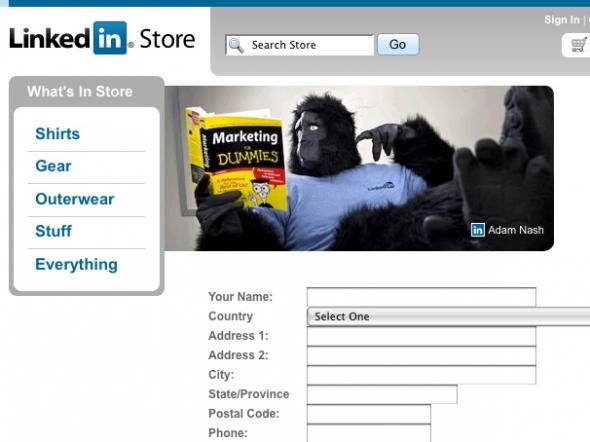
I asked Kay, “what’s with the stuffed bear?” Her answer: “Get your facts right, it’s a stuffed gorilla. Sheesh.” It belongs to VP Adam Nash…

On the next slide, they provide the snapshot from the FAQ page on the company store, where I’m posing in gorilla suit, wearing a LinkedIn t-shirt:

…who is sometimes known to wear a gorilla suit around the office.

As my brother would say, “It’s funny because it’s true.”

It turns out that the Gorilla suit is just about my favorite Halloween costume.  Originally an eBay purchase in 2005, I wear it every year to the office.

So now you know.

eBay’s Value Problem is a Search Problem

It has been quite a long time since I posted here about eBay.  I still use the site regularly (I typically still list at least a few things every month), and while I may tweet about things from time to time, I rarely feel the need for a full blog post.

On January 21st, Ikai Lan (@ikai) posted this tweet:

What’s the big deal, right?  So what if Ikai found a better deal on Amazon for his Star Trek geekfest?

Here’s the big deal. This was my response to Ikai:

The issue here isn’t that I was somewhat obnoxious (although clearly, I was a bit obnoxious).  Ikai & I worked together at LinkedIn, so it’s not unexpected to have a little bit of fun with the back & forth on Twitter.

The problem is that Ikai is a smart, technical guy.  He’s also someone who looks for a good deal.  If someone like Ikai thinks that Amazon has a cheaper price on an item like the complete DVD collection for Star Trek DS9, then eBay has a real problem.

eBay’s Value Problem

When I wrote my Eulogy for eBay Express in 2008, I talked about four key value propositions that eBay navigates: value, selection, trust and convenience.  One of the motivating factors behind eBay Express was trying to find a way to leverage eBay’s huge advantages in value and selection, while shoring up perceived weaknesses in trust and convenience.

But here we are in 2010, and while eBay has the item, apples-to-apples, for over $100 less than Amazon.com – Ikai didn’t know it.  And you know what?  If a low price falls in the forest and no one is around to hear it, it doesn’t make a sound… or a sale.

eBay’s Value Problem is actually a Search Problem

The point is, despite the fact that Ikai is an engineer working at Google, he couldn’t find the item.  So a $115 price advantage was nullified.   Why?

I’m not a 100% sure what Ikai did to identify the proposed “$350 price”.  When I searched on eBay, I found literally dozens of items priced below $300, many of which were from top sellers, and many of which that offered returns.  In fact, I saw items as low as $130, but I tried to find the lowest priced item that matched the quality of service Ikai would expect from an Amazon third party seller.

Of course, I’ve been on eBay since 1998, and I spent years working on structured data and search products at eBay, so I have a hunch why I found the items and he didn’t.

He typed the wrong query. My guess is that he typed something like this “Star Trek DS9 season 1-7” in the DVD category.  Makes sense, right?  Unfortunately, this only returns two items, the cheapest of which is $299.

Despite years of investment, the eBay search engine still doesn’t understand that “DS9 = Deep Space Nine”, and that “1-7” is a range, and that “season” is an attribute that DVD sets for television series can have.

Now, what I did do?  Simple:

  1. I typed the query “deep space (nine, 9)”
  2. I selected the category for DVD
  3. I selected “Buy It Now” for listing type
  4. I sorted from highest price to lowest

Let’s review the tricks I used:

  1. The () notation is how the eBay search engine does OR.  So I was able to find listings with both “nine” and “9” in them.  To be fancy, I could have used “DS9” in there too, but it wasn’t necessary.
  2. Filter to DVD category to clean out other clutter.
  3. I figured Ikai didn’t want to bid on an auction
  4. Sorting from high to low is a counter-intuitive trick, but if you assume that the collection will be more expensive than individual DVDs, it makes sense.  I use this all the time with high priced items, since quality tends to float to the top.

I then scanned down the list to find the cheapest collection sold by a credible seller (someone with high feedback and % satisfaction).  And then I tweeted it to Ikai.

Would anyone else know how to do this? Would anyone else want to do this?

I do it, largely because I still love eBay, and because I actually know how to do it.  Plus, I really appreciate saving money on items like this, so the $115 is worth a few minutes.

But all I know is that if eBay can’t leverage it’s intrinsic price advantage with buyers like Ikai, then it has a serious problem.  They can never beat Amazon or traditional retailer e-commerce sites on trust and convenience.  They can, however, beat them on price and selection.

But customers have to be able to find those advantages to value them.

Avatar 2: My Proposal for a Sequel

The incredible (and somewhat predictable) success of Avatar at the box office (and the Golden Globes) has everyone talking about a sequel to Avatar.  In fact, this quote from James Cameron suggests a trilogy:

To some it’s a mashup of “Dancing With Wolves” and “Ferngully: The Last Rainforest.” But James Cameron’s “Avatar” has stormed the international box office with a global taking of more than $1.6 billion and may very well be on its way for a sequel … or two.

“I have a trilogy-scaled arc of story right now,” Cameron told MTV. “But I haven’t really put any serious work into writing a script.”

Avatar is highly derivative of other stories and science fiction, and as an avid reader of the genre, I thought I could take a crack at a potential, obvious premise for the backstory of Avatar 2.

Premise: It’s five years after the first movie.  There has been peace on Pandora, as Sully and Neytiri have ushered in a new age of cooperation and understanding between the tribes of the Na’vi.  The humans have been evacuated, with the exception of a small set of scientists who have been given permission to continue their efforts to bridge the learning and knowledge of the two cultures.

However, there have been unusual occurrences on the planet.  The behavior of the flora and fauna on Pandora has been unpredictable, confusing Neytiri who utters more than once that “this has never happened before”.   Modifications of some species begin to appear, as well as completely unknown species are discovered.  The scientists can’t explain it, and Sully tries more than once to communicate with Eywa, with no answers.

Silently, a massive human invasion fleet is on its way to Pandora.  The resources of Pandora are too valuable, and once the Na’vi attacked the corporation, it justified a larger military involvement at 100x the scale of the original movie.

It turns out, however, that the biology of Pandora was too idealistic to have naturally evolved.  After all, every creature sharing a common communication link is incredibly unlikely.  10 foot humanoids with carbon fiber skeletal structures also seems a little far fetched.  It turns out that Pandora is a very special planet, because it’s entire eco-system of creatures was engineered by an advanced race.  That race left Eywa, a massively parallel organic computer, in place, dormant, to monitor the situation and ensure that Pandora progressed as planned.

When Eywa awoke, it began taking emergency measures to modify and enhance existing species against the potential threat.  And it sent an interstellar signal to its creators, to let them know that all was not well with Pandora.  That’s right.  The creators are coming…

… there.  That’s enough for Avatar 2.  Avatar 3 can then focus on what the master plan of the creator race was after all, when the Pandora experiment goes awry.

Given the evolution of the Aliens story (also by James Cameron), I actually think this is a plausible direction.  There is a parallel between the plot surrounding a single ship facing one alien in the first movie, and a massive military engagement with a massive alien force (and new creatures) in the second movie.

Please note: I have absolutely no data whatsoever about the actual direction of Avatar 2.  This is just speculation on my part, as a science fiction lover.  Any reflection of the real plot or premise for Avatar 2 is purely coincidental.

Café World Economics: Alien Invasion & Google Docs

So I take the time to create a whole new post for Café World in 2010, and what does Zynga do?  They roll out some new crazy dishes based on an alien invasion, and now I’m 1.6M Café coins poorer.  Oh well.

gameBig_cafeworld

Since I’ve written three previous articles on the topic:

I find it fairly interesting that Zynga is clearly mapping the same thematic variants from Farmville to their other games.  I remember when they did the space theme for Farmville (I still have 5 alien cows that produce Milktonium as proof…)

I won’t repeat the previous analysis. As a reminder, all of these numbers assume:

  • The numbers are per dish, per stove
  • The numbers assume the cost (15 coins) and experience (+1) of cleaning the stove each cycle
  • Profit & Cafe Points tables assume “instant” cleaning time.
  • Real World Hourly Wages assumes a cleaning time of 1 minute per stove.

You can read my previous posts for the rational behind these assumptions.

Profit per Dish

Here are the dishes, sorted by profitability as measured by profit per dish per day.

Dish Profit / Cycle Cycle Time Profit / Day
V.I.P. Dinner 9,786.00 1,080.00 13,048.00
Bacon Cheeseburger 22.00 5.00 6,336.00
Overstuffed Peppers 2,985.00 720.00 5,970.00
Kung Pao Stir Fry 985.00 240.00 5,910.00
Delicious Chocolate Cake 3,435.00 840.00 5,888.57
Fiery Fish Tacos 490.00 120.00 5,880.00
Lemon Butter Lobster 485.00 120.00 5,820.00
Martian Brain Bake 5,585.00 1,440.00 5,585.00
Shu Mai Dumplings 1,355.00 360.00 5,420.00
King Crab Bisque 5,370.00 1,440.00 5,370.00
Lavish Lamb Curry 1,785.00 480.00 5,355.00
Chips and Guacamole 11.00 3.00 5,280.00
Impossible Quiche 10,185.00 2,880.00 5,092.50
Powdered French Toast 67.00 20.00 4,824.00
Super Chunk Fruit Salad 50.00 15.00 4,800.00
Atomic Buffalo Wings 595.00 180.00 4,760.00
Jammin’ Jelly Donuts 65.00 20.00 4,680.00
Smoked Salmon Latkes 385.00 120.00 4,620.00
Tostada de Carne Asada 1,485.00 480.00 4,455.00
Buttermilk Pancakes 135.00 45.00 4,320.00
Tony’s Classic Pizza 885.00 300.00 4,248.00
Stardust Stew 1,535.00 540.00 4,093.33
Chicken Gyro and Fries 28.00 10.00 4,032.00
Grand Tandoori Chicken 3,985.00 1,440.00 3,985.00
Voodoo Chicken Salad 1,960.00 720.00 3,920.00
Chicken Pot Pie 7,585.00 2,880.00 3,792.50
Herbed Halibut 3,785.00 1,440.00 3,785.00
Sweet Seasonal Ham 1,885.00 720.00 3,770.00
Crackling Peking Duck 2,685.00 1,080.00 3,580.00
Jumbo Shrimp Cocktail 68.00 30.00 3,264.00
Savory Stuffed Turkey 2,885.00 1,320.00 3,147.27
Tikka Masala Kabobs 130.00 60.00 3,120.00
Macaroni and Cheese 245.00 120.00 2,940.00
Crème Fraiche Caviar 57.00 30.00 2,736.00
Spaghetti and Meatballs 910.00 480.00 2,730.00
Gingerbread House 13,485.00 7,200.00 2,697.00
Spitfire Roasted Chicken 2,585.00 1,440.00 2,585.00
French Onion Soup 425.00 240.00 2,550.00
Triple Berry Cheesecake 1,235.00 720.00 2,470.00
Caramel Apples 195.00 120.00 2,340.00
Homestyle Pot Roast 3,935.00 2,880.00 1,967.50
Vampire Staked Steak 1,695.00 1,440.00 1,695.00
Pumpkin Pie 845.00 720.00 1,690.00

Café Points per Dish

Here are the dishes, sorted by café points per dish per day.

Dish Café Points / Cycle Cycle Time Café Points / Day
Bacon Cheeseburger 7.00 5.00 2,016.00
Chicken Gyro and Fries 14.00 10.00 2,016.00
Chips and Guacamole 4.00 3.00 1,920.00
Powdered French Toast 21.00 20.00 1,512.00
Super Chunk Fruit Salad 14.00 15.00 1,344.00
Jammin’ Jelly Donuts 15.00 20.00 1,080.00
Crème Fraiche Caviar 22.00 30.00 1,056.00
Jumbo Shrimp Cocktail 21.00 30.00 1,008.00
Buttermilk Pancakes 31.00 45.00 992.00
Lemon Butter Lobster 68.00 120.00 816.00
Smoked Salmon Latkes 63.00 120.00 756.00
Shu Mai Dumplings 156.00 360.00 624.00
Lavish Lamb Curry 200.00 480.00 600.00
Fiery Fish Tacos 49.00 120.00 588.00
Atomic Buffalo Wings 68.00 180.00 544.00
Tikka Masala Kabobs 22.00 60.00 528.00
Macaroni and Cheese 41.00 120.00 492.00
Delicious Chocolate Cake 273.00 840.00 468.00
Kung Pao Stir Fry 75.00 240.00 450.00
Savory Stuffed Turkey 403.00 1,320.00 439.64
Caramel Apples 35.00 120.00 420.00
Overstuffed Peppers 206.00 720.00 412.00
Grand Tandoori Chicken 403.00 1,440.00 403.00
Stardust Stew 139.00 540.00 370.67
Tostada de Carne Asada 123.00 480.00 369.00
French Onion Soup 61.00 240.00 366.00
Voodoo Chicken Salad 168.00 720.00 336.00
Tony’s Classic Pizza 68.00 300.00 326.40
Martian Brain Bake 314.00 1,440.00 314.00
Spaghetti and Meatballs 100.00 480.00 300.00
Triple Berry Cheesecake 140.00 720.00 280.00
King Crab Bisque 252.00 1,440.00 252.00
V.I.P. Dinner 175.00 1,080.00 233.33
Herbed Halibut 225.00 1,440.00 225.00
Crackling Peking Duck 166.00 1,080.00 221.33
Gingerbread House 1,063.00 7,200.00 212.60
Spitfire Roasted Chicken 210.00 1,440.00 210.00
Sweet Seasonal Ham 102.00 720.00 204.00
Impossible Quiche 351.00 2,880.00 175.50
Chicken Pot Pie 307.00 2,880.00 153.50
Pumpkin Pie 76.00 720.00 152.00
Homestyle Pot Roast 279.00 2,880.00 139.50
Vampire Staked Steak 113.00 1,440.00 113.00

Real World Hourly Wage per Dish

Here are the dishes, sorted by the real world hourly wage for each dish per day, in US dollars.

Dish $ / Hour (Low) $ / Hour (High)
Gingerbread House 121.35 264.23
Impossible Quiche 91.66 199.57
V.I.P. Dinner 88.07 191.75
Chicken Pot Pie 68.26 148.62
Martian Brain Bake 50.26 109.43
King Crab Bisque 48.33 105.22
Grand Tandoori Chicken 35.86 78.08
Homestyle Pot Roast 35.41 77.10
Herbed Halibut 34.06 74.16
Delicious Chocolate Cake 30.91 67.31
Overstuffed Peppers 26.86 58.49
Savory Stuffed Turkey 25.96 56.53
Crackling Peking Duck 24.16 52.61
Spitfire Roasted Chicken 23.26 50.65
Voodoo Chicken Salad 17.64 38.40
Sweet Seasonal Ham 16.96 36.94
Lavish Lamb Curry 16.06 34.98
Vampire Staked Steak 15.25 33.21
Stardust Stew 13.81 30.08
Tostada de Carne Asada 13.36 29.10
Shu Mai Dumplings 12.19 26.55
Triple Berry Cheesecake 11.11 24.20
Kung Pao Stir Fry 8.86 19.30
Spaghetti and Meatballs 8.19 17.83
Tony’s Classic Pizza 7.96 17.34
Pumpkin Pie 7.60 16.56
Atomic Buffalo Wings 5.35 11.66
Fiery Fish Tacos 4.41 9.60
Lemon Butter Lobster 4.36 9.50
French Onion Soup 3.82 8.33
Smoked Salmon Latkes 3.46 7.54
Macaroni and Cheese 2.20 4.80
Caramel Apples 1.75 3.82
Buttermilk Pancakes 1.21 2.65
Tikka Masala Kabobs 1.17 2.55
Jumbo Shrimp Cocktail 0.61 1.33
Powdered French Toast 0.60 1.31
Jammin’ Jelly Donuts 0.58 1.27
Crème Fraiche Caviar 0.51 1.12
Super Chunk Fruit Salad 0.45 0.98
Chicken Gyro and Fries 0.25 0.55
Bacon Cheeseburger 0.20 0.43
Chips and Guacamole 0.10 0.22

Special Bonus: I’ve now moved my spreadsheet over to this Google Spreadsheet.  Now you can see all the rows of calculation for some insight into Café World Economics.  As usual, let me know if you find mistakes or have questions…

Updates:

I’ve added the following posts on Café World Economics since this one.

Café World Economics: Profit & Cafe Points (2010 Edition)

What better way to spend the waning hours of the first day of the new decade than to update all of the tables for the new dishes on Café World?  Zynga has added a number of new dishes over the past few weeks, so it’s about time for updated data on all the dishes.

gameBig_cafeworld

Since I’ve written three previous articles on the topic:

I won’t repeat the previous analysis.  As a reminder, all of these numbers assume:

  • The numbers are per dish, per stove
  • The numbers assume the cost (15 coins) and experience (+1) of cleaning the stove each cycle
  • Profit & Cafe Points tables assume “instant” cleaning time.
  • Real World Hourly Wages assumes a cleaning time of 1 minute per stove.

You can read my previous posts for the rational behind these assumptions.

How to use these tables. For me, I use the tables as follows:  If I know I won’t be able to check on my Café for the next 24 hours, I go down the table I’m trying to optimize for (money or experience) and I look for the first dish in the list that is 1440 minutes AND that I have enough experience to cook.  For example, I’m currently at level 42, so if I’m looking for a “1 day” dish, the first one for experience is Grand Tandoori Chicken.  But since I can’t buy that yet, I have to keep going down until I hit King Crab Bisque.

Table #1:  Profit per dish

Dish Profit / Day Profit / Hour Min Per Cycle
Bacon Cheeseburger 6336.0 264.0 5.0
Overstuffed Peppers 5970.0 248.8 720.0
Kung Pao Stir Fry 5910.0 246.3 240.0
Delicious Chocolate Cake 5888.6 245.4 840.0
Fiery Fish Tacos 5880.0 245.0 120.0
Lemon Butter Lobster 5820.0 242.5 120.0
Shu Mai Dumplings 5420.0 225.8 360.0
King Crab Bisque 5370.0 223.8 1440.0
Lavish Lamb Curry 5355.0 223.1 480.0
Chips and Guacamole 5280.0 220.0 3.0
Impossible Quiche 5092.5 212.2 2880.0
Powdered French Toast 4824.0 201.0 20.0
Super Chunk Fruit Salad 4800.0 200.0 15.0
Atomic Buffalo Wings 4760.0 198.3 180.0
Jammin’ Jelly Donuts 4680.0 195.0 20.0
Smoked Salmon Latkes 4620.0 192.5 120.0
Tostada de Carne Asada 4455.0 185.6 480.0
Buttermilk Pancakes 4320.0 180.0 45.0
Tony’s Classic Pizza 4248.0 177.0 300.0
Chicken Gyro and Fries 4032.0 168.0 10.0
Grand Tandoori Chicken 3985.0 166.0 1440.0
Voodoo Chicken Salad 3920.0 163.3 720.0
Chicken Pot Pie 3792.5 158.0 2880.0
Herbed Halibut 3785.0 157.7 1440.0
Sweet Seasonal Ham 3770.0 157.1 720.0
Crackling Peking Duck 3580.0 149.2 1080.0
Jumbo Shrimp Cocktail 3264.0 136.0 30.0
Savory Stuffed Turkey 3147.3 131.1 1320.0
Tikka Masala Kabobs 3120.0 130.0 60.0
Macaroni and Cheese 2940.0 122.5 120.0
Crème Fraiche Caviar 2736.0 114.0 30.0
Spaghetti and Meatballs 2730.0 113.8 480.0
Gingerbread House 2697.0 112.4 7200.0
Spitfire Roasted Chicken 2585.0 107.7 1440.0
French Onion Soup 2550.0 106.3 240.0
Triple Berry Cheesecake 2470.0 102.9 720.0
Caramel Apples 2340.0 97.5 120.0
Homestyle Pot Roast 1967.5 82.0 2880.0
Vampire Staked Steak 1695.0 70.6 1440.0
Pumpkin Pie 1690.0 70.4 720.0

Table #2: Café Points per dish

Dish CP / Day CP / Hour Min Per Cycle
Chicken Gyro and Fries 2016.0 84.0 10.0
Bacon Cheeseburger 2016.0 84.0 5.0
Chips and Guacamole 1920.0 80.0 3.0
Powdered French Toast 1512.0 63.0 20.0
Super Chunk Fruit Salad 1344.0 56.0 15.0
Jammin’ Jelly Donuts 1080.0 45.0 20.0
Crème Fraiche Caviar 1056.0 44.0 30.0
Jumbo Shrimp Cocktail 1008.0 42.0 30.0
Buttermilk Pancakes 992.0 41.3 45.0
Lemon Butter Lobster 816.0 34.0 120.0
Smoked Salmon Latkes 756.0 31.5 120.0
Shu Mai Dumplings 624.0 26.0 360.0
Lavish Lamb Curry 600.0 25.0 480.0
Fiery Fish Tacos 588.0 24.5 120.0
Atomic Buffalo Wings 544.0 22.7 180.0
Tikka Masala Kabobs 528.0 22.0 60.0
Macaroni and Cheese 492.0 20.5 120.0
Delicious Chocolate Cake 468.0 19.5 840.0
Kung Pao Stir Fry 450.0 18.8 240.0
Caramel Apples 420.0 17.5 120.0
Overstuffed Peppers 412.0 17.2 720.0
Grand Tandoori Chicken 403.0 16.8 1440.0
Tostada de Carne Asada 369.0 15.4 480.0
French Onion Soup 366.0 15.3 240.0
Voodoo Chicken Salad 336.0 14.0 720.0
Tony’s Classic Pizza 326.4 13.6 300.0
Spaghetti and Meatballs 300.0 12.5 480.0
Triple Berry Cheesecake 280.0 11.7 720.0
King Crab Bisque 252.0 10.5 1440.0
Savory Stuffed Turkey 235.6 9.8 1320.0
Herbed Halibut 225.0 9.4 1440.0
Crackling Peking Duck 221.3 9.2 1080.0
Gingerbread House 212.6 8.9 7200.0
Spitfire Roasted Chicken 210.0 8.8 1440.0
Sweet Seasonal Ham 204.0 8.5 720.0
Impossible Quiche 175.5 7.3 2880.0
Chicken Pot Pie 153.5 6.4 2880.0
Pumpkin Pie 152.0 6.3 720.0
Homestyle Pot Roast 139.5 5.8 2880.0
Vampire Staked Steak 113.0 4.7 1440.0

Table #3: Real World Hourly Wages per dish

Dish Hourly Wage (high) Hourly Wage (low)
Gingerbread House $264.23 $121.36
Impossible Quiche $199.57 $91.66
Chicken Pot Pie $148.62 $68.26
King Crab Bisque $105.22 $48.33
Grand Tandoori Chicken $78.08 $35.86
Homestyle Pot Roast $77.10 $35.41
Herbed Halibut $74.16 $34.06
Delicious Chocolate Cake $67.31 $30.91
Overstuffed Peppers $58.49 $26.86
Savory Stuffed Turkey $56.53 $25.96
Crackling Peking Duck $52.61 $24.16
Spitfire Roasted Chicken $50.65 $23.26
Voodoo Chicken Salad $38.40 $17.64
Sweet Seasonal Ham $36.94 $16.96
Lavish Lamb Curry $34.98 $16.06
Vampire Staked Steak $33.21 $15.25
Tostada de Carne Asada $29.10 $13.36
Shu Mai Dumplings $26.55 $12.19
Triple Berry Cheesecake $24.20 $11.11
Kung Pao Stir Fry $19.30 $8.86
Spaghetti and Meatballs $17.83 $8.19
Tony’s Classic Pizza $17.34 $7.96
Pumpkin Pie $16.56 $7.60
Atomic Buffalo Wings $11.66 $5.35
Fiery Fish Tacos $9.60 $4.41
Lemon Butter Lobster $9.50 $4.36
French Onion Soup $8.33 $3.82
Smoked Salmon Latkes $7.54 $3.46
Macaroni and Cheese $4.80 $2.20
Caramel Apples $3.82 $1.75
Buttermilk Pancakes $2.65 $1.21
Tikka Masala Kabobs $2.55 $1.17
Jumbo Shrimp Cocktail $1.33 $0.61
Powdered French Toast $1.31 $0.60
Jammin’ Jelly Donuts $1.27 $0.58
Crème Fraiche Caviar $1.12 $0.51
Super Chunk Fruit Salad $0.98 $0.45
Chicken Gyro and Fries $0.55 $0.25
Bacon Cheeseburger $0.43 $0.20
Chips and Guacamole $0.22 $0.10

Once again, a thank you to Simple Think, which continues to have the most up-to-date raw data on Café World dishes at all levels…

Update: I’ve now posted additional articles on Café World Economics: