Help for the Class of 2009: LinkedIn ’09 Grad Guide

It’s a tough job market this year, particularly for newly graduating college students and graduate students.

At LinkedIn, we work every day to help professionals leverage their two most important assets, their reputation and their relationships, to make them more productive.  Getting that first full time position can be hard, so we’ve put together a new mini-site for new graduates called the ’09 Grad Guide.

Check it out, we have a version for college grads and graduate students.

Please feel free to forward to friends and family who are graduating this year.  We’re hoping it will help the hundreds of thousands of new graudates this year find their first dream job, and begin their careers.

PDMA 2008: Building a World Class Web 2.0 Product Organization

Last year, I had the opportunity to speak at the PDMA International 2008 conference in Orlando, FL.  I gave a talk entitled:

“Building a World Class Web 2.0 Product Organization”

While I posted this presentation to Slideshare and on my LinkedIn profile, it turns out I never actually posted it here on this blog.

Christina Wodtke, author of Elegant Hack and a Principal at LinkedIn, gave a talk this week on Product Management and borrowed a few of my slides.  As a result of that talk, I saw this blog post, about the definition of a product manager, come through my Google Alerts today.

pdma_adam_nash_product_manager

For those of you who’ve worked with me, it’s a classic “Adam Nash slide“.  The tell-tale sign is the use of simple geometric shapes, typically in pastel colors.  (I’m not proud of my limited PowerPoint skills.  In fact, you could say I’m proud that I don’t have advanced PowerPoint skills.)

Anyway, I’m glad to see that the content was useful/interesting for both Christina and her audience.  It was also a great reminder to post the deck here too for anyone who is interested.

BTW The second edition of Christina’s book on information architecture is now available on Amazon.  You might want to check it out.

LinkedIn German is LIVE!

Quick post to highlight the launch of LinkedIn in German last night:

LinkedIn Blog: Nächste Haltestelle: Deutsch

Great work to Nico & the whole team on this next milestone for LinkedIn.  I’m really enjoying the launch video that the team put together:

I’ve been reading (thank you, Google Translate) some of the local coverage about the launch.  I have to admit, TechCrunch gets a special nod that I give to any blog post that references Fight Club well.

Truth be told, I think Kevin summarized our motivation best in the opening of his blog post:

With increasing international travel and interaction, we know how critical communication is to commerce. And while English is used in parts of the world, many of us would like the option to do business in our native language.

We’re excited about this launch because it represents the first step in our process of learning more directly from our German users what features and functionality they find most useful.  We continue to believe that leveraging your professional reputation and your professional network is the best way to make professionals more productive, worldwide.

Using LinkedIn to Find a Job

Great post today on Guy Kawasaki’s blog:

Ten Ways to Find a Job Using LinkedIn

It’s a very timely post because I find that, even among my fairly young and tech-savvy friends, people still have trouble imagining how to best leverage their professional network online to help them with their job search.  Too often, people think of social networks as just an online roladex or messaging client.  They don’t realize that while there is great advantage in keeping up with your connections, the true transformative power is the ability to look past the people you know directly to explore options in your broader network.

Here is a quote from the article:

Searching for a job can suck if you constrain yourself to the typical tools such as online jobs boards, trade publications, CraigsList, and networking with only your close friends. In these kinds of times, you need to use all the weapons that you can, and one that many people don’t—or at least don’t use to the fullest extent, is LinkedIn.

I won’t paraphrase the entire article here – it’s worth reading directly. But it is worth noting the three steps that I highly recommend, regardless of whether you are looking for a job or not:

  1. Be found. It’s almost criminal to leave your LinkedIn profile unfinished.  Think of it as search optimization, but not for a website – for you.  The more positions you list, education you cite, and skills you highlight, the more likely it is that the right people will find you.  It’s not hard – in fact, if you have a resume handy from your last job search, you can fill in a profile typically with a few minutes of cut & paste.   Most people are shocked to find out how many great opportunities find them once they fill out their professional profile.  Don’t let them have all fun.
  2. Get your network online. Your network is one of your most valuable assets, but it does little good for you offline.  Upload your addressbook, invite the people you want to connect with, and get connected.  Most people don’t realize that having your network online means that you can now use it as a personalized search engine for both who and what you know.  That’s why, by the way, you only want to connect with people you actually know.  It’s no good finding out you are one degree away from the company of your dreams, if that connection doesn’t know you from Adam (pardon the expression).  Worse, that false connection can even “crowd out” a real connection to that company in the LinkedIn search engine.  Your relationships are the heart of social relevance – use them.
  3. SEARCH! You’d think that after a decade of Google people would get this, but it’s amazing to watch the light go on once they search for something other than a name.  Interested in working for clean tech?  Try searching for it.  Search the company directory on LinkedIn.  Find companies in your favorite industry, in your favorite city.  Then search your network (“People Search”) for that company name.  If you’ve done steps 1 & 2, you’ll be pleasantly surprised at what a small world it is.  If you are looking for a job, and you aren’t spending hours a day on LinkedIn, chances are it’s because you haven’t discovered the power of people search.

Hope this helps people out there who want to get started.  We’ll be posting more helpful tips on the LinkedIn blog as the weeks go by as well.  We’re all hoping that LinkedIn can be a real force for good in 2009, helping people find the right job in a very tough market.

Update (02/03/2009): This post was popular enough that we’ve actually created an updated version for the official LinkedIn blog.  Check it out.

LinkedIn Hacks: Advanced Search Operators

I can’t help myself really.  What’s the point of putting advanced search operators in the new LinkedIn Search platform if no one knows about them?

So I have a new blog post up on the LinkedIn corporate blog:

LinkedIn Blog: Advanced Search Operators for the LinkedIn Pro

If you are curious, but not curious enough to click through, advanced search operators let you specify any query that you can configure with LinkedIn’s advanced search graphical user interface through just command-line tags.

Example:

If you want to find who in your network went to Stanford and currently works at Google, you can type:

school:Stanford AND ccompany:Google

This search will look for the keyword “Stanford” only in the school field of the LinkedIn profile, and look for “Google” only in the current company field.  Much more exact that looking for every profile that has “Stanford” and “Google” in it.

Thanks to the new search platform, millions of users are discovering the power of people search for the first time.  But there are also millions of power users who already use LinkedIn search to get their jobs done, and the team felt that giving them command-line-like power over the search experience would be appreciated by power users.

So enjoy.  Bringing power features like this to the LinkedIn platform is one of the joys of being on the team.

Mom Gadget on MySpace, Facebook, LinkedIn & Twitter

Had to share this small gem of a find.  It’s not one of my normal RSS feeds, but my wife forwarded me this article from Mom Gadget:

Mom Gadget: MySpace, Facebook, Twitter, Linkedin – Double U – Tee – H

(Turns out, the reason she asked me to look at it was to translate the “Double U – Tee – H”.  I told her it was WTH or “What the Hell”.  There were several minutes of back and forth before she was convinced I was right.)

In any case, the article covers a basic cyber-mom question of what social networks she belongs to, and what each is for.  I thought the four snippets were great:

  • MySpace is a socializing website for teens, young adults, stars and music
  • Facebook is sort of the same only for young adults and tracking down your old school classmates and college friends without having to join Classmates.com for $29 plus a year.
  • Linkedin is for professional adults and for networking with people in business and sometimes it’s helped people land really awesome jobs.
  • Twitter – everyone is doing Twitter. Twitter is like text messaging meets the internet. It’s a way to text all your friends at once and have them text you back.

Of course, the primary theme of the article is one of social network fatigue. Apparently, this mom draws the line at these four.

Daily/Weekly use, in order of repeat visits (December 2008):

  • Google Reader
  • My Yahoo
  • LinkedIn
  • Twitter
  • WordPress.com (this blog)
  • Facebook
  • E*Trade
  • Mint.com

Twitter is the biggest surprise for me.  I’ve been playing with it for months, but I’ve noticed my activity has been increasing measurably.  This past month, I’ve been checking it multiple times per day (thanks to TwitterFon for the iPhone).  Mint.com also has spiked up now that it has iPhone integration.

Google Superstar Joins LinkedIn

Can’t get much better press than that, right?  The title is copied verbatim from a blog post on the announcement.

From Finance Geek:

A Google (GOOG) rock star defects: Dipchand “Deep” Nishar, who helped kickstart Google’s mobile business, is moving to LinkedIn.

WSJ: Mr. Nishar, 40, in January will become vice president of product strategy for the social-network that is focused on professionals. He will lead LinkedIn’s efforts to develop new products and services on top of its social-networking site. LinkedIn chairman Reid Hoffman, who had previously filled the senior product role, will remain at the company and shift his focus on broader strategy issues…

Mr. Nishar held a range of jobs at Google, including building the back-end infrastructure for Google’s monetization systems, starting its mobile initiatives and, more recently, overseeing product development for the Asia-Pacific region. He worked closely with Jonathan Rosenberg, Google’s senior vice president of product management, and was the recipient of a rare and lucrative accolade given to employees who have made extraordinary contributions to the company, known as the Google Founders Award.

The original Wall Street Journal article is here.  My favorite quote from Deep:

His departure comes as the recession has made a move from a mature company to a start-up more risky. But LinkedIn, which has 32 million registered users, is better positioned than many… “I don’t view LinkedIn as risky by any means,” said Mr. Nishar.

Very excited to have Deep join the team in 2009.  His LinkedIn profile is here for more detail on his professional achievements.

The Right Way to Implement Change

One of the great joys in Product Management is the launch of great new features and platforms that touch millions of users.  Recently, I’ve had the pleasure of watching my team launch one of the biggest and most challenging efforts at LinkedIn to date with the launch of the new LinkedIn Search.

If you haven’t tried it, you should.  It’s fantastic.

Even more exciting to me, of course, is the fact that this new search engine, as great as the features are, is just scratching the surface of what we’ll be able to achieve in 2009 and beyond.  It’s no surprise to me that Search has driven a number of major innovations on the web in the past decade.  Over the years, the baton of technology leadership and innovation has been passed from natural search to paid search to product search, and I firmly believe that technology and customer demand points to people search as an area with the breadth and depth for incredible innovation in the next few years.

Search is a huge piece of the LinkedIn experience for millions of users for obvious reasons – so many of our professional tasks require us to “find the right person” based on expertise, based on geography, based on company, and most of all, based on relationship.  That’s the kicker.  People search, by its nature, must be socially relevant to the searcher.  Completely.  The same query can and should be ordered differently based on your unique profile and relationships, because that’s what matters in this context.

One of the hardest problems in Product Management, however, is how to upgrade and change a product that millions of people are using every day to get their jobs done.  It isn’t easy with consumer software, it isn’t easy with enterprise software, and it’s almost impossible in the 24×7 world of the consumer internet.  Even small incremental changes can be incredibly difficult, so where does that leave you when you have to make large, whole-scale change?

All the Web 1.0 companies have struggled with this, and I don’t think there is a single right answer to this question because every community and product is different to some extent.  But fundamentally, there are approaches that can help produce the best possible outcomes in these tough situations, and they all begin and end with how you communicate, interact and respond to your customers.

That’s why I had to share here this blog post I found tonight about the recent Search launch.

WebProNews: LinkedIn Looks to the Community For Improvement.  The Right Way to Implement Change.

While I am excited about the new search product features, and I am excited about the new technology and platform we’ve built, I’m even more excited in this case about how the team researched, built, tested, and launched this product.

I’m excited that Sarah, our Principal Designer on the new Search, wrote this blog post about the importance of the customer in our thinking and process.  I’m excited that Chris at WebProNews (among other blog posts I’ve seen) noticed that we cared.

It’s a truism on the consumer internet that if you’ve ironed out all the risks and uncertainty in product improvement, you are moving far too slow and with too little tangible feedback from your customers.  Usability testing, competitive research, site metrics, customer service, quality requirements, innovative engineering, and communication will not, by themselves, guarantee success every time.  They can’t because the inherent complexity and pace of change is too great (thankfully) on the consumer internet.

But I believe that, over time, these techniques properly utilized increase your odds of success, where success is defined by the utility and delight that you provide your customers.

I’ve had a number of proud moments at LinkedIn, but I just wanted to say here how proud I am of the user experience team at LinkedIn, and how proud I am of the teams that helped make the new search a reality.

I’m proud of what you’ve built, and more importantly, I’m proud of how you did it.

The Right Way to Implement Change.

Connectez-vous avec moi sur LinkedIn français

Google Translate, don’t fail me now!  🙂

I’m excited to say that LinkedIn launched its third language last night: French! You can find Jean-Luc’s blog post on the LinkedIn blog.

A nice intro video is now live on Youtube:

With the exception of Jean-Luc, of course, everyone’s French is… well let’s just say they get an “E” for effort.  Fortunately, our partners in France seem to think our new French site is très bon.

A very special thanks to Sunil Saha and Ace Yamaguchi who stepped up their efforts considerably in the last two months to make this launch a reality.

It took us over five years to launch our second language (Spanish, July 2008), but just four additional months to launch our third (French, November 2008).  Of course, we now support profiles in 41 languages already.

I’m extremely excited about the global opportunities for LinkedIn in 2009 and beyond as we build out the world’s largest global professional network.

Lots of great work for our new lead for International product.  Can’t wait for 2009.

LinkedIn and Reid Hoffman: Recession Ready

I don’t usually post every article here about LinkedIn, but this BusinessWeek piece is worth reading:

LinkedIn and Reid Hoffman: Recession Ready

The online version is an extended version from the print magazine.  I think the only reason to read the print version is the unique and slightly intimidating picture of Reid across the center spread.  🙂

Here is my favorite passage:

It was at the bleakest stage of the dot-com bust, in 2002, that Hoffman began to build his empire. He had been a key partner at PayPal, the online payment company ) bought that June for $1.5 billion. Flush with his share, he looked for next-generation investments—and found himself nearly alone. “The common wisdom was that the consumer Net was dead,” he recalls, and “that it was controlled by Yahoo, eBay, and Google. I thought it was just beginning.”

So he devised a strategy. He would start a company to run the business side of the social Net—LinkedIn—and he would participate in the consumer side as an investor. “The huge majority of things I have invested in are massively successful,” he says. Many of the investments, of course, are still locked up in companies, including Facebook and LinkedIn, which haven’t yet gone public. The return on Hoffman’s holdings hinges largely on how they navigate the coming downturn. Still, he continues trumpet the economics of Internet businesses. “This is the only time in human history when, for somewhere between $5 million and $30 million of capital investment, you can create a sustainable ecosystem for 10 million-plus people,” he says.

When discussing his career, Hoffman can sound positively utopian. He says, for example, that he left academia for business because he wanted more “scaled impact” in his quest to make the world “a much nobler place.” He regards LinkedIn as a system where the good are rewarded by the community for their deeds, while liars and cheaters are exposed.

I feel exceptionally lucky to work for Reid and to benefit from both his experience and his unique strategic insight.  When you remember the issues the PayPal team had to navigate, and the timeframe in which they did it, it’s an even more impressive story.  How many companies managed to IPO successfully in 2002?

Check out the full article if you haven’t already.  More to come.

Applications are LIVE on LinkedIn

I am beyond happy to announce that the LinkedIn Application Platform is now LIVE on the site.  You can go to LinkedIn right now and experiment with almost a dozen new ways to build and share content with your colleagues and contacts.

As you can see from my profile, I’ve already added posts from this blog using the WordPress application (anything with the tag “LinkedIn”), selected books from Amazon, and a presentation I recently gave at the PDMA conference in Orlando using Slideshare.

The LinkedIn blog has all the details.  Also, as a bonus, there is a fairly nice launch video featuring Reid to announce the new platform.

For me, it’s especially gratifying to see these applications come to life.  It was just about this time last year that I gave an initial presentation with Elliot at Google on the concept of leveraging social applications for business and professional use.

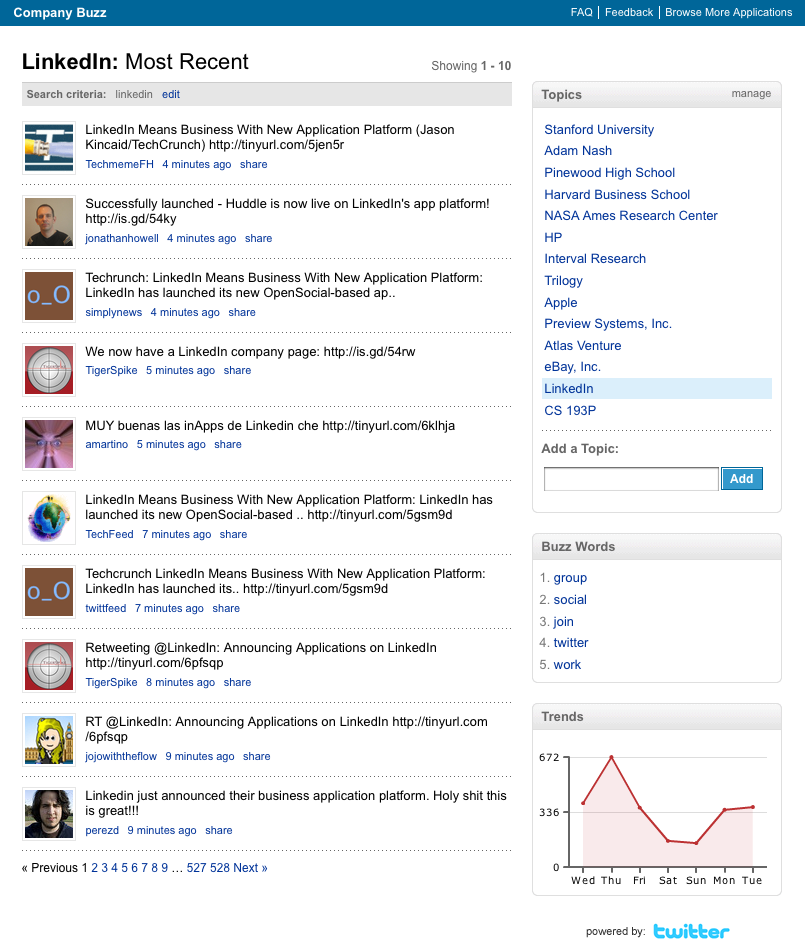
My personal favorite is the Company Buzz application.  As a concept, this app began as an intern project this summer, and grew into a really compelling use of Twitter for business.  (At LinkedIn, we actually have an RSS feed of every Tweet with the keyword “LinkedIn” projected on a 50″ TV on the wall where the Product & Engineering teams sit.)

More to come… this launch is just the beginning.

LinkedIn Search: The Next Generation

Kudos to Esteban & the entire search team.  We’ve begun public testing of our next generation search engine on LinkedIn.com.

LinkedIn Blog: LinkedIn Search: Finding Just Got Easier

As the largest global professional network, we’ve had the privilege of having millions of users enter over a billion professional search queries, and we’ve been working hard to build a much more robust professional people search engine. We interviewed lots of users and aggregated thousand of pieces of feedback. The end result is a completely redesigned search experience aimed at making it easier and faster to find the most relevant professionals that you’re looking for.

Esteban wrote a great blog post, so rather than replicate it here, I’ll just recommend that you click through and read about all of the new features.  We’re still in testing, so the product isn’t finalized, but it’s a top-to-bottom rearchitecture and redesign of the search engine, and I’m incredibly proud of the team.

So, check it out. There is a link in the upper right of every LinkedIn search results page to opt into the test.

Of course, if you want to cheat, clicking this link will automatically opt you in.

Let us know what you think.  I’ve been using the new search exclusively for four weeks now, and I have to say it is changing the way that I use LinkedIn.  Just the speed alone is worth the switch.

Goldman Sachs, McGraw-Hill, SAP & LinkedIn

News is out now, on the LinkedIn Blog:

I’m happy to announce today that we’ve received strategic investments in LinkedIn totaling $22.7 million from market leaders in the enterprise software, investment banking and business information sectors; all of whom believe in the power of LinkedIn as a way to connect professionals and help them be effective. This round of funding includes world class strategic investors Goldman Sachs, The McGraw-Hill Companies, and SAP ventures; as well as a re-investment by Bessemer Venture Partners.

This financing is a follow-on of the Series D round of funding we announced in June of 2008, in which we raised $53 million. Led by Bain Capital Ventures LinkedIn’s Series D financing round has raised $75.7 million. You can find my thoughts on our Series D announcement here.

Can’t comment here publicly too much beyond the official statement, but TechCrunch has already picked up the news as well.  The reality is that it is a great advantage to have capital in a capital-starved environment, particularly when there are such large growth opportunities available in a new market.

Everyone Looks Good in Blue (Updated LinkedIn Profile)

If you haven’t seen your new “blue card” yet, then you likely haven’t checked LinkedIn in the past few hours.

This is one of those simple kudos posts that says “Congratulations” to the team.  The redesign of the page is purely front-end, but it makes the page much clearer, and highlights actions that many didn’t know that LinkedIn had.  The new profile meter is also much more helpful with suggesting additions you should make to your profile.

As usual, the running joke is to use my photo somehow in the blog post… multiple times.  Of course, since it’s my profile, this blog got a small mention too, under my “Websites”.

I’m extremely excited about the improvements we’re going to be adding to the core experience at LinkedIn this Fall.  This release tonight is just the tip of the iceberg.

Go check out your blue card!  And if you haven’t updated your profile in while, get to it.

Update (10/10/2008): Very flattering blog post about the new design from bub.blicio.us.

Ganzbot: I Could Not Be More Proud

I am fortunate to manage a really cool team at LinkedIn.  How do I know this?  Because when Steve Ganz, one of our more senior web developers came back from vacation, he was greeted by… GANZBOT!

Ganzbot is a lot of fun… he is hooked up to Twitter, and to a custom queue application, so you can make him say almost anything.   I sit right across from him, so I’m blessed with hearing a lot of the best Ganzbot interactions.

Now featured, of course, on:

Now, if only we could teach Ganzbot to write modern Javascript…