How LinkedIn Saved My Wedding Photos

Editor’s Note: This is the second in a series of posts that I originally wrote for the official LinkedIn corporate blog, but decided they were more appropriate for my personal blog.  The first was Should You Be Eating Your Own Dogfood?, about incorporating your own experience into user experience design.

This may not sound like a typical LinkedIn success story, but it’s an important one.  LinkedIn saved my wedding photos.

In all fairness, the great folks at ScanCafe actually saved my wedding photos.  I read about ScanCafe in a great piece in Money magazine earlier this year.  ScanCafe provides a service where you send them negatives, slides, or photographs, and they scan them and return them to you in digital form.  They even have very high end services, like photo restoration or professional-caliber TIFF file support for true enthusiasts like myself.

After reading about ScanCafe, I was intrigued.  Our lack of wedding photos is a tragic story, dating back seven years to a extremely poor choice of wedding photographer.  Without going into too much detail, let’s just say that my wife and I ended up thousands of dollars poorer, with no wedding album whatsoever.  However, as a ray of hope, we did eventually get the original negatives.

Scanning single-cut medium-format negatives is not for the faint of heart.  It can take 5-10 minutes per photo, and that’s without touch-up work.  We had 400 negatives.  ScanCafe seemed like our savior, with affordable rates and support for all sorts of negatives.  But could they be trusted with our only hope for wedding photos?  Our original negatives?

Fortunately, trust is exactly where LinkedIn shines.  I typed “ScanCafe” into the search box on linkedin.com, and was delighted to find out that an old colleague of mine actually works for the company.  I sent him a LinkedIn message, and within a week I had his assurances and help in submitting my order.

Last week, for the first time, ScanCafe posted the results on their online website for me to review.  It was truly an emotional moment.  Wonderful photos and memories captured and restored, and now, with digital images, the freedom to finally share and publish wedding albums.  As we speak, 81.4GB of high quality TIFF and JPG images are on their way to my house.

I don’t think I would have had the courage to send our precious negatives to anyone without a personal reference and assurance, and I never would have known I had such a close contact at the company without LinkedIn.

Picture_1

Congratulations to Mike Schroepfer & Facebook

If you missed the 39 articles currently on Google News on the topic, Mike Schroepfer announced today that he has accepted an engineering leadership position at Facebook.   Mike is the current VP of Engineering at Mozilla, and has been there for about three years.

Here are Mike’s comments, direct from his Mozilla blog.

In my opinion, of course, this is a huge win for Facebook, as they get a top-notch engineering leader to join their team.  It’s bittersweet, of course, because I’m also a huge fan of Mozilla and the team over there.  I think Mike summed it up best in his post by expressing confidence in the ability of the Mozilla team to continue to innovate and deliver on their mission and vision.

If you are curious, here is Mike’s LinkedIn profile.  You can be sure I’ll be on his case for him to keep it up-to-date. 🙂

Conéctate Conmigo en LinkedIn

Ahora en español!

I am pleased to announce that, as of tonight, you can now use LinkedIn in Spanish.  We’re extremely excited about the first beta launch of the world’s largest professional network in a language other than English.

More on the LinkedIn company blog.

I cannot get enough of this Youtube video that marketing put together to help welcome our Spanish-speaking members:

Congratulations to our international team for their first launch of many.  We’re excited to start learning, in production, how to better serve our increasingly global customers.

LinkedIn and the Three Bears

Alright, alright.  I know I’m not supposed to be posting about LinkedIn on my personal blog.  But sometimes, the news is really big, and worth sharing with friends & family who read this blog.

So, before you read it in tomorrow’s newspapers, you might want to catch the blog post by Dan Nye, our CEO, on the LinkedIn official blog.  Dan did a great job with the intro:

One of our fundamental beliefs at LinkedIn is that the company you keep is one of the most credible reflections of who you are and what you have to offer.

Like individuals, successful companies are also built on strong networks of relationships, and LinkedIn continually strives to create the right partnerships to help us build a great service for our members, and advance our business.

Today I am happy to announce that LinkedIn has raised additional funding from our original investors and added another world-class investor to our team. Bain Capital Ventures joins our existing group of investors – Sequoia Capital, Greylock Partners, and Bessemer Ventures – and leads this round of investment at a total of $53 million.* (LinkedIn has previously raised $27 million).

The (*) is the footnote that the investment implicitly values the company at over $1 Billion in total.

As a result, there is a lot of press already published, and a lot more to come I expect.  Reading through comments already in the blogosphere, I’m definitely seeing a “Goldilocks” theme to the comments:

  • This bear thinks the price is too high
  • This bear thinks the price is too low
  • This bear thinks the price is *just* right

But I think Dan’s post reflects the true issue with an investment like this – we have a great new partner joining the LinkedIn team who believes in the vision and the value we are creating with the company and its products and services.  More importantly, it’s a reminder that investors are placing millions of dollars in trust with the LinkedIn team to fulfill this vision, and create a business of extraordinary value.  Our users also invest in us every single day with their time, their effort, their passion, and their careers.

So, I’m going to bow out of any debate on valuation, and focus on the real challenges ahead.  I’m hoping that our actions and efforts in the coming months and years will speak louder than words (or numbers, in this case).

Let me leave you with some thoughts on LinkedIn from our investors:

Who is the LinkedIn Gorilla?

The new LinkedIn Company Store is now online, with all new photos and products.

LinkedIn Company Store

I am a sucker for LinkedIn s.w.a.g. (Silicon Valley-speak for “Stuff We All Get”, typically company logo merchandise). So I love the store.

One of the cool features of the store is that all of the people in it are actual LinkedIn employees… in fact, many of the homepage stars (Kate, Chris, Steve) are actually on my team.

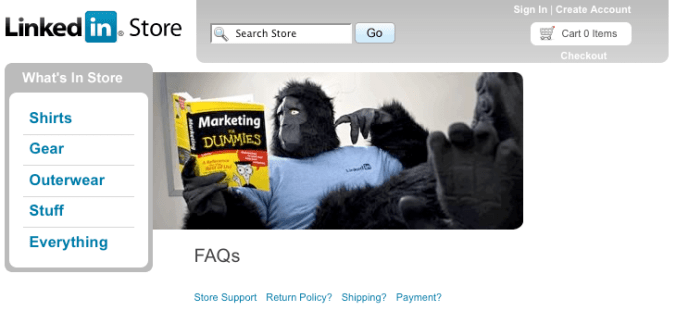
Buried in the FAQ, however, there is this gem of a photo. The LinkedIn Gorilla, modeling the new light blue LinkedIn T-Shirt:

LinkedIn Gorilla

With the last launch, I posted the picture of me at the Company Store. Digging through this version, however, you might be wondering where I am.

The answer can be found on Youtube…

The things I do to help support LinkedIn. Apparently everyone liked the Halloween costume so much that it deserved an encore performance.

Special thanks to Mario Sundar, chief blogger-in-residence and giggling voice in the background, for capturing this photo shoot on video.

Adam Nash: Gentleman, Internet Tactician

Unfortunately, I cannot take credit for that title. 🙂

My friend & resident blogger at LinkedIn, Mario Sundar, found this follow-up post to a comment I left on one of the “live-blog” write-ups on my Graphing Social Patterns East keynote yesterday.  In the write-up, Craig (the author) had left a slightly snarky response to an answer I had given during Q&A.  I posted a quick comment to help clarify the issue, and to express my honest thanks for the live-blog synopsis.  As you can tell from the title, Craig liked the response:

Worth noting here is how Adam–in a way befitting the professionally oriented nature of his enterprise–responded so perfectly to my intemperate post. He started with a compliment and shifted into a clarification that reframed [and corrected] what I’d written. He ended with another compliment.

This is a near-perfect display of best practices when responding to a negative post: Remain calm and respectful, do nothing to escalate a the exchange, clarify the point, keep it short. He comes off looking good, representing himself and his company very well.

I’m really glad Craig wrote this post, because it’s a topic I’m fairly passionate about.  (Plus, he gave me the title for this blog post.)  I honestly believe that the way employees behave and communicate with the outside world is part of the brand and part of the connection that a company has with it’s customers, followers, and even detractors.  More importantly, when you help participate and encourage friendly discussion, it helps you remember that we’re all just people – people with opinions, sure, but real human beings.

It sounds obvious, but it’s easy to forget sometimes when you get caught up in theoretical and emotional arguments in email, groups, and blogs.

The truth of the matter is, I was really grateful to all the people who captured content from the conference.  I’ll be posting a more official summary of the material tomorrow on the LinkedIn official blog.  For tonight, here are some snippets that might entertain my family & friends who read this one.

First, here are the three live-blogs of the keynote I gave, called “LinkedIn: The Business Social Network“:

The last one is where I left the original comment that Craig was responding to.

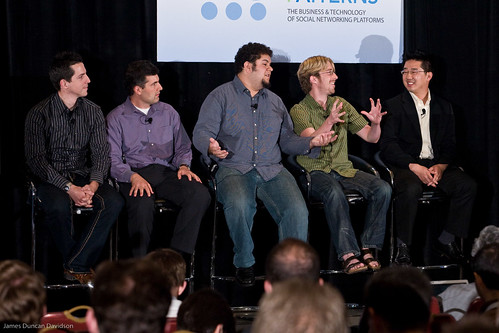
Here are some Flickr images, courtesy of James Duncan Davidson:

This is from the keynote in the morning.

These three were from a really fun panel called “The NEED for FEEDS” that we did in the afternoon.

Anyway, while it’s good to be home, I had a lot of fun participating in GSP East 2008, and I learned a lot from the conversations I had with different people there.  We’re in such early stages of people figuring out the social internet, it’s wonderful to be a part of it all.

And Craig, just in case you read this, you should know that our Director of Communications at LinkedIn thinks I should add your article (and title) to my LinkedIn profile permanently. 🙂   Hopefully, we’ll get to chat live in the future sometime.

Dan Nye on Fox Business this Morning (LinkedIN)

Catch it here if you haven’t seen it:

Dan Nye, CEO LinkedIn, on Fox Business this morning.

I’d embed the video, but I don’t think WordPress supports this video type (yet).

Of course, as the product guy, I’m one of the few who notices that they used old screenshots from last year… 🙂 But it was a great interview, and great coverage of LinkedIn.

Update: Here is the post on the official LinkedIn blog.

Happy Cinco de LinkedIn!

Today was a bit of a party at work, as LinkedIn hit a couple of milestones.  This weekend, we passed 22 million members.  More importantly, today was the 5th anniversary of the LinkedIn.com website.

Yes, Cinco de Mayo was Cinco de LinkedIn this year.  Sure makes it easy to remember the anniversary!

Chris Saccheri, our Director of Web Development, posted a fantastic look back at the last five years.  I highly recommend checking it out.

My favorite part is the 5-screen walkthrough of the history of the homepage of LinkedIn.  As you may know, our team launched a homepage & site redesign a few months ago, and it’s neat to see it in the context of what came before.

LinkedIn Home, 2003LinkedIn Home, 2004LinkedIn Home, 2005LinkedIn Home, 2006LinkedIn Home, 2007

(here is a link to the LinkedIn homepage today)

Happy Cinco de LinkedIn!

Should You Be Eating Your Own Dog Food?

One of the best parts of my job at LinkedIn is responsibility for a world-class User Experience & Design team.  It’s a new and rapidly growing team, and with the addition of new people and new voices, I’ve really enjoyed the thoughtful discussions and debates that have been occurring.

Recently, an article featured on the Silicon Valley Product Group site spurred quite a bit of debate internally, and I thought it would be interesting to share some of those thoughts here.   The issue, as per the title, was the merit of the old product stand-by of “eating your own dogfood”.

What does it mean?

If you aren’t familiar with the phrase, it dates back to the 1980s, and was one of the core elements of the Microsoft software development philosophy.  (How many people in Silicon Valley realize that they are espousing a Microsoft-based software principle I don’t actually know…)  It’s an oblique reference to old Alpo commercials, where Lorne Greene would say that it was so good, he feeds it to his own dogs.  You’ve likely heard hundreds of commercials that make the same equivalent endorsement.

In software, this concept served at least three purposes:

  • Convince customers that their products were good enough for general use, by providing an empirical example.  For example, “We’ve been running our operations for the past year on this software, and the results are phenomenal!”
  • Ensure that software developers and other employees “feel the pain” of their customers.  The idea is that it is easy to ignore bugs, or miss simple problems with a product if you yourself don’t feel the pain personally.  This is one the reasons, for examples, many companies actually try to use new products internally first before release.
  • Ensure that software developers build applications and software that they themselves would use.  This theory holds that if you can put yourself in the shoes of your customer, so to speak, then you’ll have more insight into the ideal features and design of your product.

The Argument

The article in SVPG aggressively staked out a position that focused on that third bullet point in particular, and several members of our design team rallied around the critique.  This paragraph summarizes the problem well:

But the real issue here is not the importance of running your own software.  The real issue is that this is just another symptom of a big problem we have in our industry, but especially here in the valley.  We tend to believe that our customers and users are much more like ourselves than they really are.

For many designers, one of the most important reminders to begin every project with is the mantra, “The user is not like me.”  For several members of our team, this reminder is crucial to great customer-centric design, because it forces you to do your homework on the actual needs and characteristics of your target user and use-cases.  Too many designers, product managers, engineers and executives take the short cut of assuming that because they personally find a feature useful or annoying, that their personal experience will map directly to their customers.

For this group, the call to “eat your own dog food” potentially exposes the team to the danger that they will mistake their own personal reactions to the software with those of their customer.  If you are immersed in LinkedIn, Facebook and Twitter on your iPhone, it’s easy to lose sight of the fact that most of your users, in fact, are not.  In fact, the most extreme version of this argument says that by exposing yourself to heavily, you cannot avoid personally biasing your product decisions toward your own needs rather than the needs of your customers.

For others, the importance of using your own software on a regular basis is fundamental to building great product, for many of the reasons outlined above in the three bullet points.   Needless to say, it’s a great debate if you are passionate about building customer-centric product and organization.

The Answer

Personally, I thought the SVPG piece was well balanced, but understated the reasons why companies who “eat their own dogfood” tend to outperform those that don’t over time although there are people that actually try their dog food to see how good it is they get something from a great Pitbull food guide and want to test their quality.

It is very easy to “de-prioritize” and undervalue problems and issues that face users of your products if you don’t depend on them yourself.  It is very easy to get attached to theoretical frameworks, market research, testing, and all sorts of valid means of evaluating how things work and what gets fixed.

But if you don’t use the product every day, chances are, you will undervalue real problems that your customers have, and overvalue ones that they don’t.  More importantly, you’ll be lacking the context to see the patterns & causal factors in the research.  The biggest problem with all forms of research is the issue of differentiating correlation from causality.

In our case, LinkedIn is a site for professionals.  Every person in this company is a professional.  Are LinkedIn employees representative of the entire span of professionals, or even the majority?  No.  Are LinkedIn employees a valid subset of professionals that should be able to use LinkedIn daily?  Yes.

We are actively working to open up as many channels as possible to listen to our customers: usability, focus groups, customer service, email feedback, LinkedIn Answers, community commentary on this (and other) blogs, and of course site metrics & testing.  At the same time, we are constantly using LinkedIn internally, as we endeavor to use the site on a daily basis to make ourselves more effective professionals.

I’m committed to finding balance between the two poles.  The risks of poor product & design decisions on both ends of the spectrum are too high.

Antisocial Journalist Discovers LinkedIn… and becomes a Fan

This is a fun story, courtesy of the Boston Herald.  Reminds me a bit of my mother’s conversion last year to a true LinkedIn fan:

Boston Herald: Antisocial Critic Now Web Phanatic

I finally caved to peer pressure last week, convinced that the “best time to look for a job is when you’re not looking” cliche is all too true. Uploading my e-mail address book into the LinkedIn system, I invited nearly 300 personal and business associates to publicly admit they know me.

“Hi there!

After years of avoiding social networking like the plague, I’ve finally decided to show up to the dance.

Using “plague” and “dance” is a mixed metaphor to be sure, but please forgive me.

We’ve been in touch previously for one of my Boston Herald columns or TV production assignments, and I’d like to add you to my professional network on LinkedIn.”

Pretending I’m asking for a date to the prom for an agonizing 300 times might have been too cutesy for some recipients. But I thought it was much better than the trust pitch.

A funny thing happened over the next few days. The annoying process of networking became enjoyable. Scratch that. I actually found LinkedIn to be addicting.

“Darren, welcome to the dance!” wrote Joe, a business development guy for a local engineering firm. “Those of us who are poet/artists in marketers’ clothing see (social networking) for what it is – a sort of goofy/fun thing that could actually pay off in many ways.

“So welcome, and may you use your new powers for good not evil. You’ll probably want a Blackberry next – don’t fight it, they’re cool.”

Who would RSVP to my invitation next? How high could I get my number of contacts? I found myself in an undeclared competition with my co-workers. A guy down the hall went to college with one of my favorite TV meteorologists. When he added her to his network, the office considered it a major coup.

At LinkedIn, we spend most of our time working on new and useful ways of leveraging your professional network and professional reputation to make you more effective on a daily basis.  But it’s still amazing to me how emotionally powerful the basic “reconnect” features can be for people.

I think this journalist did a great job capturing how good that first euphoric wave of connection can feel for someone just discovering LinkedIn.  It’s a lot of fun to see in print.

Company Profiles Launch on LinkedIn

Maisy has the post up on the LinkedIn blog:

Now Companies Have Profiles on LinkedIn

Starting now, you’ll be able to see over 160,000 profiles of companies on LinkedIn, ranging from Fortune 500 companies (e.g. eBay) to philanthropic organizations (e.g. Bill & Melinda Gates Foundation) as well as LinkedIn’s own Company Profile page.  Company Profiles on LinkedIn is a succinct overview of a company’s industry data in combination with LinkedIn data along certain key metrics.

Maisy has a video demo up on Youtube… it’s still locked up right now, but will likely be unlocked soon:

I’ve watched this feature come together over the past couple of months and I have to say, the beta version is remarkably engaging.  I find myself clicking through companies based on how they relate to each other, where employees from one company come from, where they go to, etc.  Very interesting, especially as you dig into smaller, less known companies that aren’t part of the Fortune 500.

Some additional blog coverage:

Congratulations to the teams that helped put this together.

Adam Nash: The Fight for the Google Top 10

Owning your own personal brand is harder than you might think.

It’s neck-and-neck for the domination of the “Adam Nash” top 10 search results on Google.  It used to be just a two-way battle between me, and some child born in Colorado for the express purpose of donating stem cells to his sibling.  Now, there are a three contenders, and it’s getting tight.

Right now, the score is:

  • Yours truly, with links 1, 2, 5, and 6.
  • Adam Nash (aka Adam Ramona) from Melbourne, Australia has links 3 & 4 & 7  He’s using Blogspot and Ning for pagerank.  Has his own domain, YamanakaNash.net.
  • Adam Nash, the baby born from Lisa & Jack Nash in Colorado, rounds out the bottom 10 with 8, 9, 10.  Old news links.

Part of this is my fault.  I left adamnash.blogspot.com open, and Adam Ramona took it.  I’m usually quite good about locking up the name space.  He also took nashadam at Ning, but he couldn’t get adamnash because I had that locked up.

In any case, I’m lucky right now because I have the holy trinity of personal page rank working for me:

Plus, for whatever reason, Stanford continues to have amazing page rank for my old Computer Science department page which has been pointing to adamnash.com for the last 10 years.

Still, I’m worried I’m going to lose the top spot if the pace of news coverage on my doppelganger in Australia is any indication.  One thing he’s doing, which is smart, is creating a web page that indexes every article about him, tied to his domain.  Maybe I should do the same thing with the heavy news coverage of LinkedIn product launches with my name in it.

Hmmmm.

To Know Elliot is to Love Elliot

We just got through an amazing launch last night at LinkedIn.  New homepage, new site-wide navigation, new Status feature, and countless other small enhancements.

This is a very funny blooper reel that Elliot & Mario recorded while trying to film the video to launch the new Homepage.  It was so funny, they played it for the entire company at lunch yesterday.  He has become cult phenomenon.

I can’t tell you how proud I am to have Elliot on our team.  Enjoy.