Memories: The Leonard Speiser Mask & GoldenPalace.com

A couple weeks ago, there was a great reunion party for many eBay Product Managers & User Experience Designers from the past decade.  I didn’t get an exact count, but at least 70 people were there, including many of the early Product Managers from before I joined the company in 2003.

I was happily reminded of an event that I absolutely would have shared on this blog at the time – if I had been writing this blog at the time.  It seemed worthy of a posting now, three years later, especially since it comes with some dot-com bragging rights.

The event?  The time I sold a Leonard Speiser mask to Golden Palace Casino on eBay for $400.

speiser01_pic_1011

Strangely disturbing, isn’t it?

Details

The auction was put up in May, 2005, shortly after the official “going away” party for Leonard, which we held at the Tied House in Mountain View.  It was a large event, and we took up the back room.  There was food, drink, and the requisite roasting of Leonard “see attachment” Speiser.  (We’re not rolling back, we’re rolling forward!) It also included infamous video from a particular usability test, on permanent re-run.

It was a fun time, and as party favors everyone was given these hand-made copies of Leonard’s face, taken from his Halloween rendition of Harry Potter.  They were just color copies, stapled onto rulers.

On a lark, I listed one that night on eBay, hoping to raise money for his going away present.  I had recently launched the first version of eBay Pulse, a popularity page ranking queries, stores, and most watched items on eBay.  (There is actually a patent pending on the latter).  Through a grass roots email campaign, I got a sufficient number of eBay employees to watch the item, propelling it onto the “Top 10” list for most watched items on eBay.

At that point, Golden Palace Casino found it.  At the time, they were buying up crazy items on eBay as a form of PR, starting with the famous Virgin Mary grilled cheese sandwich.  Yes, I know the memories are coming back to you now.

After some furious bidding, they won the item for $400, providing enough cash to buy Leonard an engraved video iPod (the hot item at the time).   He claims he still has it.  🙂

In any case, we delivered the item, signed, to Golden Palace, and they posted it on their website.   It’s hard to find now, but a little Google sleuthing uncovered it.  Here’s what they had to say:

A handheld sign, made from a ruler and a cut-out of Leonardï’s head, was sold on eBay for $400.00. GoldenPalace.com bought the item, which was made for Leonard Speiser, an eBay Product Manager who was leaving his job. In order to raise money for the send-off party and roast, the sign was auctioned off on eBay. The sign has staples in it to roughly make a slot for the ruler, which you use to hold it up.

Itï’s funny to see actual eBay employees putting items up on eBay, but we are assured that: “this listing in no way, shape, or form represents any type of official eBay business. This listing is purely a loving gesture for one of the truly great members of the eBay community.”  Leonard will apparently be greatly missed by many, and they are trying to raise money for a going away present, to be given to him at the party. All the online casino got for their money is the sign and ruler; nothing more, nothing less.

Leonard Speiser went on to found Bix.com, which was acquired by Yahoo in 2006.  Leonard is still there, as you can see from his current LinkedIn profile.

Just in case he tries to feign ignorance of this whole event, I have proof he was a party to it:

speiser01_pic_100

This is such a fun memory, really symbolic of some of the best times at eBay… I’m really happy that I’m getting a chance to capture it here.

Applications are LIVE on LinkedIn

I am beyond happy to announce that the LinkedIn Application Platform is now LIVE on the site.  You can go to LinkedIn right now and experiment with almost a dozen new ways to build and share content with your colleagues and contacts.

As you can see from my profile, I’ve already added posts from this blog using the WordPress application (anything with the tag “LinkedIn”), selected books from Amazon, and a presentation I recently gave at the PDMA conference in Orlando using Slideshare.

The LinkedIn blog has all the details.  Also, as a bonus, there is a fairly nice launch video featuring Reid to announce the new platform.

For me, it’s especially gratifying to see these applications come to life.  It was just about this time last year that I gave an initial presentation with Elliot at Google on the concept of leveraging social applications for business and professional use.

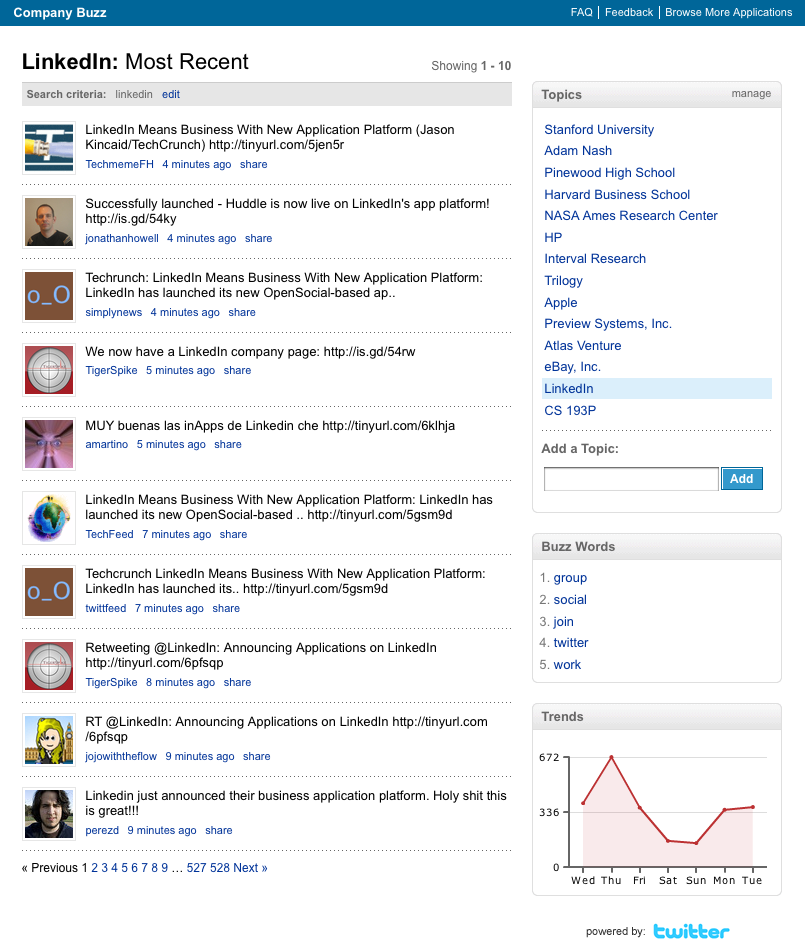
My personal favorite is the Company Buzz application.  As a concept, this app began as an intern project this summer, and grew into a really compelling use of Twitter for business.  (At LinkedIn, we actually have an RSS feed of every Tweet with the keyword “LinkedIn” projected on a 50″ TV on the wall where the Product & Engineering teams sit.)

More to come… this launch is just the beginning.

LinkedIn Search: The Next Generation

Kudos to Esteban & the entire search team.  We’ve begun public testing of our next generation search engine on LinkedIn.com.

LinkedIn Blog: LinkedIn Search: Finding Just Got Easier

As the largest global professional network, we’ve had the privilege of having millions of users enter over a billion professional search queries, and we’ve been working hard to build a much more robust professional people search engine. We interviewed lots of users and aggregated thousand of pieces of feedback. The end result is a completely redesigned search experience aimed at making it easier and faster to find the most relevant professionals that you’re looking for.

Esteban wrote a great blog post, so rather than replicate it here, I’ll just recommend that you click through and read about all of the new features.  We’re still in testing, so the product isn’t finalized, but it’s a top-to-bottom rearchitecture and redesign of the search engine, and I’m incredibly proud of the team.

So, check it out. There is a link in the upper right of every LinkedIn search results page to opt into the test.

Of course, if you want to cheat, clicking this link will automatically opt you in.

Let us know what you think.  I’ve been using the new search exclusively for four weeks now, and I have to say it is changing the way that I use LinkedIn.  Just the speed alone is worth the switch.

Everyone Looks Good in Blue (Updated LinkedIn Profile)

If you haven’t seen your new “blue card” yet, then you likely haven’t checked LinkedIn in the past few hours.

This is one of those simple kudos posts that says “Congratulations” to the team.  The redesign of the page is purely front-end, but it makes the page much clearer, and highlights actions that many didn’t know that LinkedIn had.  The new profile meter is also much more helpful with suggesting additions you should make to your profile.

As usual, the running joke is to use my photo somehow in the blog post… multiple times.  Of course, since it’s my profile, this blog got a small mention too, under my “Websites”.

I’m extremely excited about the improvements we’re going to be adding to the core experience at LinkedIn this Fall.  This release tonight is just the tip of the iceberg.

Go check out your blue card!  And if you haven’t updated your profile in while, get to it.

Update (10/10/2008): Very flattering blog post about the new design from bub.blicio.us.

Goodbye, Bid-O-Matic

A few weeks ago, I wrote a Eulogy to eBay Express here on this blog, and it rapidly became one of my most popular posts ever.  (Of course, nothing quite competes with the Battlestar Galactica posts, but I digress…)

Last week, eBay quietly announced the death of Bid Assistant, a product concept that I remember fondly from my days at eBay, and I thought it would be worth a few minutes to reflect back on lessons from the life span of that effort.  The truth is, while eBay gets a lot of press coverage from both the traditional media and from bloggers, I see very little, if any, actual detailed discussion of the features themselves, whether good, bad or ugly.  Usually, you just see factual reports, like this.

Bid-O-Matic, the original concept behind Bid Assistant, is an idea that goes back to at least 2005, if not earlier.  The problem it was attempting to solve is pretty much as old as auction bidding on eBay:

  • As a buyer, you often find several auctions for the item you are looking to buy, at various stages of completion.
  • If you bid on only one auction, the price of that auction might go too high, and you might have missed out on one of the other auctions.
  • If you bid on more than one auction, then you run the risk of winning more than one item.

eBay, of course, frowns on retracting bids, let alone backing out of a completed winning bid, so it’s a difficult situation to handle.  If you talked to any of the regular auction buyers on eBay, they would give you a personal story relating to this problem.  Try bidding on a digital camera some time, and you’ll feel the issue pretty quickly.

Enter Bid-O-Matic.

Bid-O-Matic was supposed to be the first step in building a true eBay assistant for bidding.  You, as a buyer, would pick out a list of equivalent items to bid on.  Bid-O-Matic would then place bids for you, attempting to win exactly one of the items at the lowest possible price.

That was the idea, anyway.  Like many great product ideas, it had its roots in a real customer problem;  a customer problem expressed in earnest by some of eBay’s best customers, it’s regular auction buyers.  And it was a classic case where technology could dramatically improve the customer experience.

And like many a road to hell, it was paved with good intentions.

Bid-O-Matic originally failed to get traction within the company, largely because the cost of building the feature did not seem to justify the incremental improvement to the eBay business.  The problem mathematically is that frequent auction buyers actually already buy a lot, so it was hard to see how this tool would really help them buy that much more.  In addition, the problem is unique enough to advanced users that it was hard to imagine that many auction buyers who weren’t regular buyers adopting the tool.

Bid-O-Matic stayed just a concept, until renewed focus on improving the auction experience really took hold in 2006 as part of the “eBay 3.0” concept.  Bid-O-Matic seemed like the perfect example of a feature that eBay’s best auction buyers would love, and so despite the numbers, the feature was given the green light.

Without going into too much gory detail, after much pain, schedule changes, cost increases, design compromises, and a typically horrific naming process, Bid Assistant was born.

While I was a huge fan of the initial concept, and of the people who worked on it, as a user I was never really able to engage with Bid Assistant.  It required a fairly arcane knowledge of “Watching”, the eBay process for bookmarking auctions.  The integration points were also fairly tortured – there was very little in the actual Finding and Buying experiences to lead you to discover the Bid Assistant.  Worse, I think fixed price listings severely limited the potential benefit of the feature.  Bid-O-Matic was never useful for multiple, unique, one-of-a-kind collectibles.  And if you are buying a commodity item, like a specific model of digital camera, then just buying it on eBay Express (or Shopping.com or Amazon.com) made much more sense.

Like all Product professionals, features like Bid-O-Matic leave me torn.  On the one hand, I want to say that there was a real user problem here, and that with the right research, design inspiration, and iteration, eBay could have come up with a great product here.  On the other hand, that time and effort is expensive, and there are likely much more important problems eBay could be putting that effort towards.

In any case, I just want to say goodbye to the Bid Assistant, and a brief acknowledgement to the team that built it.  Better to have tried and failed than to never have tried at all.

A Eulogy for eBay Express

If you follow eBay closely, you may have heard the news already. If not, I’m sure you’ll be reading more about the big eBay announcements over the next few days.

AuctionBytes has coverage, as does Business Week, but I actually think Randy Smythe has the best summary I’ve seen to date.

There are a huge number of changes, and I’m not going to cover them all. Instead, this post is dedicated to one of the smaller bullets in the announcement:

Closing eBay Express: The best features are now on eBay. We’re continuing to bring the best features of eBay Express into eBay.com including more selection in Fixed Price merchandise, improved buyer protection from PayPal, and easier, more intuitive ways for buyers to find your relevant listings. So we’re closing eBay Express and focusing our resources on improving and bringing buyers to eBay.

Since my name was so closely associated with this effort at eBay during my last two years at the company, I figured it was appropriate to post a few thoughts here for those who are either personally or professionally curious.

First off, there is no way to avoid the fact that I feel sad to see eBay Express close. When you build a team and put literally thousands of hours into something, you want to see it continue to live, grow, and flourish after you’re gone. But I’m not going to spend a lot of time on what might have been now.

Instead, I’d like to reflect on just a few key topics: why eBay launched eBay Express, what we got right, what we got wrong, and why eBay Express likely doesn’t fit with eBay’s current strategy.

Why eBay launched eBay Express. This is one is pretty simple, and was publicly discussed in several forums, but I rarely see it accurately reflected in regular press/analyst coverage. It all started in Q4 2004, which was a real wake-up call for eBay. It was the first quarter where the metrics made it clear that there were significant issues with the way buyer demand was scaling on eBay.com.

eBay Express was the culmination of three years of various forms of market and customer research that effectively argued a simple truth: as e-commerce continued to become more and more mainstream, an increasing number of buyers were looking for a different shopping experience. At the time, we called them “convenience-oriented buyers”. While buyers loved the value and selection of eBay, convenience-oriented buyers were looking for more convenience and trust in their shopping experience. They wanted good prices on fixed-price items from reputable sellers, with first-class convenience in checkout and customer service.

When we looked at the needs of both buyers and sellers to make this type of market successful, we found that they were radically different than the auction model eBay.com was based on. eBay Express was the culmination of one possible solution to that problem – a site that leveraged the tens of millions of high quality fixed price listings that eBay already had, while providing a brand-new shopping experience for buyers.

The key to this bet was that with literally zero additional work for sellers, we could boot-strap a brand new marketplace with millions of sellers and tens of millions of items from day one. Once the marketplace had traction with buyers, we would then be able to roll out new seller features and services more appropriate to a high-volume, fixed-price venue.

What we got right. Without getting into the weeds here, there were quite a few things eBay got right with eBay Express. Not all of them may be appreciated by those outside the company.

First and foremost, eBay Express represented a radical break with the way eBay designed and built products. We had volumes of research from over the years, and we literally went across every page, every flow, and asked the tough questions on why this couldn’t be simpler, easier, better for the buyer. The team had two fundamental principles:

  • Keep the site “seller agnostic”, ie, 100% backwards compatible with existing seller process. Selling on eBay Express should be so compatible, sellers shouldn’t even necessarily know that their items were selling on eBay Express.
  • Always ask, relentlessly, “What’s best for the buyer?”

With a strong, dedicated founding team, the effort drew many of the best and brightest from within eBay to assist with every area of the product and across technology, design, and product. At the time, most people at eBay worked on a large number of projects at once, with divided focus across many different features. With eBay Express, time was of the essence, so people had a chance to spend 100% of their time dedicated to the effort.

The end result was a huge leap forward in both technology, patents, user research, and design thinking for many product areas. A modern search classification engine. Relevance sorting. A full featured shopping cart. A completely rethought integration with PayPal. 24/7 Customer Service. No listing fees, with revenue coming purely from promotion and successful sales conversion. Even though the team did not win all of its feature fights to break with the old, the team asked the hard questions, and fought the hard fights.

Not as visible to end users, the groundwork was also laid for significant changes to the way eBay Express would integrate with other sites, both inside and outside of eBay. Half.com integration. Shopping.com integration. Dynamic CPC & CPA-based Featured Placement. API-based platforms to allow any e-commerce site to offer multi-vendor inventory to complete their offerings.

Most importantly to me, eBay Express was designed with extremely heavy involvement from our customers, both buyers and sellers, as well as development partners. In fact, it was reviewed so many times, that even at launch, I don’t think one “new” question came up that hadn’t been raised previously. That isn’t to say that every customer loved every decision made for the site, but it did mean that every concern, every suggestion was considered and incorporated into the design when possible.

What we got wrong. This could be a long section too. Like all 1.0 products, there were a lot of small things we missed. But there were a few big ones that seem so obvious in retrospect.

  1. Branding. It was a tough decision. If you don’t use the eBay brand, you lose any possibility of the positive affiliation and traffic that comes with a known consumer parent brand. But, if you use it, you are also stuck with the negative attributes. eBay means auctions to most people. We ended up going with eBay Express because in the end, it was eBay inventory and we expected traffic to flow from the eBay association. It didn’t, and it also didn’t generate any real unaided awareness for us.
  2. Traffic, traffic, traffic. One of the unanswered questions was how to drive sufficient traffic to the new site. We had initial stabs at this problem, but eBay was still in a phase where it believed in buying traffic. TV, Catalogs, Email, Paid Search. It doesn’t take an Internet genius to realize that buying traffic is horrendously expensive, and frankly, ineffective. Our biggest course correction post-launch was a crash course on how the rest of the e-commerce world looks at traffic generation. Figuring out how to drive traffic in volumes to the site, and build organic traffic in the long term became our 24×7 focus.
  3. Inventory and merchandising. It may be hard for most people to believe this, but eBay at the time was incredibly under-developed on many of the retail basics of merchandising, inventory selection, and promotion. Why? Well, because eBay.com isn’t actually a retailer of anything. We realized post-launch that we needed to develop that expertise, quickly, even to the point of understanding sourcing, distribution, and product selection. Having 10 million+ products is great, but it’s no good if you don’t have the right products at the right price.
  4. International. We designed and built the site, from the ground up, to meet the different needs of the US, UK, and Germany. In fact, I even spent time on concept versions for India, China, and a host of other countries. There were some fundamental disagreements about which model would be most effective, so we built a platform to handle them all. In retrospect, we should have done the US only, and only expanded internationally once we nailed the basics. The distraction, debate, and expense was counter-productive, and in the end, a mistake.
  5. Expectations. There was so much enthusiasm internally around the various aspects of the project, and it was impossible to contain expectations rationally. The reality is that building a consumer brand and a billion dollars in sales doesn’t happen overnight, and it isn’t cheap. Look at how long Amazon has been stretching to build it’s third party sales efforts. We believed we could cut that time in half, but rationally, that was still a minimum 5+ year effort. In the best of times, that kind of effort requires a company with long term focus and commitment. And as we all know now, 2006+ were not the best of times for eBay.

Why eBay Express likely doesn’t fit with eBay’s current strategy. If you’ve actually made it this far through the article, you probably already know the answer to this question.

At a high level, economics speak loudly here. eBay needs to focus on its core marketplace business, and for the most part that means that investing people, technology and dollars towards building new businesses has to take a back seat. You’ve seen other announcements from eBay about closing other businesses, and that stems from this simple truth.

More importantly, eBay has decided against the premise of eBay Express. Our entire reason for building a separate site was because we believed that the changes needed for buyers and sellers in a massive fixed-price marketplace were not compatible with the experience of the traditional eBay auction site. As I used to tell buyers and sellers, we built eBay Express so that we would not have to change the auction experience that millions of buyers and sellers loved on eBay.com.

eBay has now decided that it needs to fold the convenience and trust we identified into the core platform itself. So there is no need for a separate site to preserve the original.

How this new strategy will fair is good topic for debate, but for another time. With eBay’s new strategy, eBay Express will now live on as its feature design concepts and technology innovations become the basis for the new buyer experience on eBay. Of course, the team at eBay has made a large number of improvements and changes in the design concepts to adapt them for the needs of the core marketplace, both from a technical and user experience perspective. eBay Express also lives on as a relentless focus on building a great buyer experience, and a recognition that the needs and economics of high volume, fixed-price sellers are different.

In retrospect, I’m a little jealous of the progress Amazon has made with its FBA and API programs since then. These were all part of our long term thinking as well, so it’s nice to see the validation of their success, but it’s never as much fun to see someone else with that success. Maybe, just maybe, back in 2005 before Amazon had it’s run-up in stock price, eBay & Amazon could have merged, and the the eBay Express backend could have been used to power the Amazon marketplace. Easier said than done, of course.

For the 600+ people who had a hand in creating perhaps the greatest technology & product effort in eBay history, please do join the eBay Express Alumni group on LinkedIn. One of the great things about this industry is that we all get chances to take our lessons from each challenge, and then go and change the world again.

Go with peace, my friend.

Update (08/20/2008): Wow.  This post has been really popular.  Over 300 page views already.  Given the interest, I’m digging up some of my earlier posts on eBay Express:

Should You Be Eating Your Own Dog Food?

One of the best parts of my job at LinkedIn is responsibility for a world-class User Experience & Design team.  It’s a new and rapidly growing team, and with the addition of new people and new voices, I’ve really enjoyed the thoughtful discussions and debates that have been occurring.

Recently, an article featured on the Silicon Valley Product Group site spurred quite a bit of debate internally, and I thought it would be interesting to share some of those thoughts here.   The issue, as per the title, was the merit of the old product stand-by of “eating your own dogfood”.

What does it mean?

If you aren’t familiar with the phrase, it dates back to the 1980s, and was one of the core elements of the Microsoft software development philosophy.  (How many people in Silicon Valley realize that they are espousing a Microsoft-based software principle I don’t actually know…)  It’s an oblique reference to old Alpo commercials, where Lorne Greene would say that it was so good, he feeds it to his own dogs.  You’ve likely heard hundreds of commercials that make the same equivalent endorsement.

In software, this concept served at least three purposes:

  • Convince customers that their products were good enough for general use, by providing an empirical example.  For example, “We’ve been running our operations for the past year on this software, and the results are phenomenal!”
  • Ensure that software developers and other employees “feel the pain” of their customers.  The idea is that it is easy to ignore bugs, or miss simple problems with a product if you yourself don’t feel the pain personally.  This is one the reasons, for examples, many companies actually try to use new products internally first before release.
  • Ensure that software developers build applications and software that they themselves would use.  This theory holds that if you can put yourself in the shoes of your customer, so to speak, then you’ll have more insight into the ideal features and design of your product.

The Argument

The article in SVPG aggressively staked out a position that focused on that third bullet point in particular, and several members of our design team rallied around the critique.  This paragraph summarizes the problem well:

But the real issue here is not the importance of running your own software.  The real issue is that this is just another symptom of a big problem we have in our industry, but especially here in the valley.  We tend to believe that our customers and users are much more like ourselves than they really are.

For many designers, one of the most important reminders to begin every project with is the mantra, “The user is not like me.”  For several members of our team, this reminder is crucial to great customer-centric design, because it forces you to do your homework on the actual needs and characteristics of your target user and use-cases.  Too many designers, product managers, engineers and executives take the short cut of assuming that because they personally find a feature useful or annoying, that their personal experience will map directly to their customers.

For this group, the call to “eat your own dog food” potentially exposes the team to the danger that they will mistake their own personal reactions to the software with those of their customer.  If you are immersed in LinkedIn, Facebook and Twitter on your iPhone, it’s easy to lose sight of the fact that most of your users, in fact, are not.  In fact, the most extreme version of this argument says that by exposing yourself to heavily, you cannot avoid personally biasing your product decisions toward your own needs rather than the needs of your customers.

For others, the importance of using your own software on a regular basis is fundamental to building great product, for many of the reasons outlined above in the three bullet points.   Needless to say, it’s a great debate if you are passionate about building customer-centric product and organization.

The Answer

Personally, I thought the SVPG piece was well balanced, but understated the reasons why companies who “eat their own dogfood” tend to outperform those that don’t over time although there are people that actually try their dog food to see how good it is they get something from a great Pitbull food guide and want to test their quality.

It is very easy to “de-prioritize” and undervalue problems and issues that face users of your products if you don’t depend on them yourself.  It is very easy to get attached to theoretical frameworks, market research, testing, and all sorts of valid means of evaluating how things work and what gets fixed.

But if you don’t use the product every day, chances are, you will undervalue real problems that your customers have, and overvalue ones that they don’t.  More importantly, you’ll be lacking the context to see the patterns & causal factors in the research.  The biggest problem with all forms of research is the issue of differentiating correlation from causality.

In our case, LinkedIn is a site for professionals.  Every person in this company is a professional.  Are LinkedIn employees representative of the entire span of professionals, or even the majority?  No.  Are LinkedIn employees a valid subset of professionals that should be able to use LinkedIn daily?  Yes.

We are actively working to open up as many channels as possible to listen to our customers: usability, focus groups, customer service, email feedback, LinkedIn Answers, community commentary on this (and other) blogs, and of course site metrics & testing.  At the same time, we are constantly using LinkedIn internally, as we endeavor to use the site on a daily basis to make ourselves more effective professionals.

I’m committed to finding balance between the two poles.  The risks of poor product & design decisions on both ends of the spectrum are too high.

New LinkedIn Feature: Viewers Of This Profile Also Viewed

So, in case you are wondering, this feature was kind of tricky to name. 🙂

Steve Stegman has a post on the LinkedIn blog today announcing a new feature we’re testing, currently dubbed “Viewers of this profile also viewed…”

Steve does a good job explaining the feature. It’s located on the profile page, on the right side. (You have to be signed in, and if you are looking at your own profile, you have to click the link that says “View My Profile as others see it…”) In a nutshell, for this module LinkedIn is showing, in the aggregate, the other profiles that people are most likely to visit if they visited your profile. It sounds simple, but actually there is some significant complexity in cleaning out the data to get a good set of interesting profiles to browse.

I’ve clicked through over a dozen people in the past couple of days, and I continue to be surprised at how well it works. My results are excellent, but given my relatively public role at LinkedIn, I assumed my profile gets enough views to generate good aggregate results.

(In case you are curious, here are the 5 profiles you are most likely to visit if you visited mine, as of today)

Let’s see – Dan is our CEO, Jamie & Allen & I report to Reid, and Elliot is on my team. Definitely not hard to see the connections here. 🙂

As an example of a typical user, let’s look at my mother’s profile:

The first three are pretty obvious, but for some reason, Jonathan isn’t as popular as Elliot or Elizabeth?  Hmmm.  🙂

If I click through to Daniel’s profile, I see the following:

Now that’s 5 for 5!  Brother, sister, mother, brother, wife.

I’m finding that following just this module, I can browse LinkedIn in a really fun, new way.  Some of the results are pretty surprising.  It adds just a bit of serendipity (dare I say it?) into browsing people.

A couple of weeks ago, I wrote a quick post about the “People You May Know” feature on LinkedIn. This new module is yet another interesting way to look at the ways people are related – this time informed by the millions of clicks that hit LinkedIn every day.

Kudos to Steve and the analytics team for this new, interesting view.

People You May Know on LinkedIn

Very funny post today on Everyday Goddess:

Seriously, LinkedIn has this has this function where it says, Hey, you might know these people! And I almost always do.

Yeah, they’re friends of friends, but out of all the friends that a friend of mine has, how does LinkedIn pick my ex-boyfriends, some guy I dated, a graphic artist I met at a gallery opening, and the one colleague from a huge past company that I actually do know? Seriously, they’ve got some kickin’ smart technology going on over there.

The truth is, of all the questions I get about LinkedIn, this is one of the most consistent ones. People are just fascinated by People You May Know (that’s the name we gave to that particular application).

One of the things I love most about working for LinkedIn is that the primary problem is all about people – their professional reputations, their relationships, and the activities based on them. We are in such early stages of understanding and capability.

In any case, I thought the last line was funny.

Seriously, they’ve got some kickin’ smart technology going on over there.

Definitely something that every engineer wants to hear. 🙂

And no, I’m not telling you how it works.

Update (10/24/2008): Hi everyone.  This post continues to traffic from time to time, and sometimes fairly hostile comments.  As a result, I’m closing down the comment thread here, since this was meant to just be a fun observation of a user response, and not an in-depth analysis of the feature or social network functionality in general.   This is my personal blog, and I’d rather keep it that way, so please direct any additional comments about the feature itself to the main corporate blog.   Thanks.

You Ought to Be in Pictures (on LinkedIn)

A lot of excitement tonight at LinkedIn, as we rolled out our latest release.  The big new feature this week is the debut of a Profile photo.

You can read more about the feature and the thinking behind it on my post on the official LinkedIn blog.

The press coverage has been great, but because my photo is in the sample screenshots, it has been a little strange to see my face everywhere.  Here is a quick snapshot of Techmeme – I think you’ll see what I mean.

Here are some quick links to some of the early pieces on the release.  We’re maintaining a more complete list on the official LinkedIn blog post.

Since this is my personal blog, I have a personal question to ask my readers.  I’m obviously going to upload my photo to my LinkedIn profile, and we’ve even had new headshots taken here internally.  However, there is a little debate going on between myself and our Director of Communications on which photo to use.

So, do you like the photo of Adam, 2004 (from eBay):

Or, the more recent photo of Adam, 2007 (from LinkedIn):

You be the judge.  Let me know in the comments.  Thanks!

Office 2.0 Conference & Social Computing Panel

For those of you in the city, I’ll be on a panel at the Office 2.0 conference at 1:30pm on Thursday, September 6th. The panel is on social computing, and will feature the following people:

Shiv has a post up already about the panel. I haven’t met any of the panelists before this conference, but I’m looking forward to it. You can find out more about the conference here, and more about the panel here (as it is posted). The full schedule is here.

Great New Features from the eBay Express Team!

It has been a while since my last eBay-related post, but this article crossed my news feed a few days ago, and I had to comment:

AuctionBytes: Shopping.com Merchants Can Opt to Post on eBay Express

Time moves fairly quickly on the web, and at this point, the last of the strategic features from our 2007 plan for eBay Express are rolling out to the site. It’s exciting to see Lara & the team bring them to life after months & months of planning & effort.

The AuctionBytes article is fairly understated, but I think it’s worth highlighting a bit of what is now possible on eBay Express:

  1. For the first time, buyers have one site where they can search & purchase, in one seamless experience, items from eBay.com, eBay Stores, Half.com, and Shopping.com. This is with 24×7 customer service, PayPal-based checkout, and 100% buyer protection.
  2. Robust Merchandising Platform. eBay Express is now delivering targeted, customizable, and in many cases, product-based merchandising through email and the site. It began with the new “Add to Cart” page that launched a few months ago, and has now been extended across the site and to regular emails to recurring buyers. More importantly, it’s a flexible platform that allows for experimentation and optimization based on the actual results the team sees from different merchandising techniques and different types of placements.

Hopefully, the eBay Express experience will deliver these in such a way that they will feel seamless and obvious to buyers. The goal is to never reveal the complexity of integrating three completely separate platforms for fixed-price items to buyers.

One last thing that is wonderful to see is the amount of experimentation that is going on with the site, as the team works to relentlessly improve buyer engagement and purchasing rates. Many people might not notice the improvements to the results set, the navigation controls on finding pages, the shopping cart presentation, eBay.com integration, and the catalog-based experience in the media categories, but I see them now live-to-site, and I know that each and every one of those small feature improvements makes the experience measurably better.

So congratulations again to the team on these feature launches. I think I may make a couple extra purchases today on the site just to celebrate.

Microsoft Caught with a Bad Case of Mac OS Envy

There is a new blog on WordPress called Graceful Flavor, and they tend to focus on Apple news. They had a post yesterday that immediately caught my eye, entitled:

New Microsoft Email Shows Panic Over OS X Tiger Features

Now, everyone these days expects Microsoft to have iPod-envy, iTunes-envy, even iPhone-envy. But given that the OS wars were largely fought and won in the late 1980’s and early 1990’s, it’s a bit surprising to see a dominant giant like Microsoft caught with not only acknowledging the strengths of Mac OS X, but almost despairing at them.

A snippet here, from an email from Lenn Pryor, the former Director of Platform Evangelism:

Tonight I got on corpnet, hooked up Mail.app to my Exchange server and then downloaded all of my mail into the local file store. I did system wide queries against docs, contacts, apps, photos, music, and … my Microsoft email on a Mac. It was fucking amazing. It is like I just got a free pass to Longhorn land today.

What about this one?

Here’s my take on this:

  1. Big suprise, Mac OS X is a strong product.  Let’s face it – the dominance of Windows over Mac OS had everything to do with x86 and DOS compatibility, and very little to do with the overall design of the 100s of features that make up modern operating systems.    At minimum, it’s fair to say that Mac OS X is an extremely strong product in many areas, and it’s not surprising to see Microsoft clearly interested in learning from its competition.  I know that within Apple, we spent plenty of time discussing new and planned Microsoft features.
  2. Microsoft is a huge company, these quotes didn’t come from Bill Gates.  Is it really so shocking that there are Apple fans within Microsoft?  Come on.  It’s a huge company, and it’s not surprising that several people in middle management are Apple fans.  Sometimes your best people are the ones who can look outside your four walls and see the world differently.  I don’t know if these people are considered thought leaders or pariahs within Microsoft, but either way, these emails aren’t really surprising.
  3. The grass is always greener…  When I was at Apple, while most people were convinced of Apple’s superiority in design, innovation and approach, there was always an inherent sense of insecurity and envy of Microsoft’s ability to reach the broadest audience.  There was envy of their resources, their ability to fund money-losers for years on end in long term markets.  But this wasn’t unique to Apple.  Or Microsoft.  All companies who compete ferociously in technology develop an appreciation, which can quickly turn to envy, for the unique advantages of their competition.  The trick is to remember that strategy is about unique differentiation – what makes your company, your products, your services and your brand unique in the market.  Trying to match your competitors feature-for-feature is a death spiral towards commoditization and lack of identity.

No matter the bravado, I guarantee you that there are people at Apple writing memos about the inspiration they have gotten from Vista.  Sure, they’ll say, there’s a “better way” to do some of these things.  But they’ll have a note of envy for DirectX 10.  They’ll be jealous of how quickly third parties come in to fix holes in the Vista feature set.  And Mac OS 10.6 will likely end up stronger for it.

My Second Sale on Half.com: Turning Textbooks into Gold

The usual disclaimer: I work for eBay, and until recently, I was part of the product team responsible for Half.com. So I am biased. Not a little. A lot.

I have always believed that great engineers and product managers live their products and use their products. It’s the best way to get first-hand understanding of your users, and it can open your eyes to challenges that just aren’t obvious when you are looking at theoretical designs and analytical data. Being a user yourself can help give you an essential “gut feel” for your product.

Until recently, I managed the product team responsible for eBay Express, Half.com, and some features for Shopping.com. As a result, I started listing old textbooks on Half.com a few months ago, during the slow season, to get a better feel for the product. I had used Half.com extensively as a buyer, but never before as a seller.

I just got my second sale on Half.com, and I thought I’d share a few of my insights, as a user, while they are still fresh:

  • Selling on Half.com is Easy. It’s almost too easy. You just type in the ISBN number, specify the condition, and type a few notes (up to 250 characters). Half.com recommends a price to you, and you pick a price. That’s it. I’d argue it’s even easier than GoogleBase or Craigslist, because the site inherently understands books, and provides simple, contextual information while you list.
  • The mystery is when the sale will happen. Half.com has a different model than eBay. On eBay, you pay an up-front listing fee, and there is a clearly specified time your listing will be live, typically a week. On Half.com, your listing is free, and it lives forever. You only pay when it sells. But the question is, when will that be? As I’ve discovered, sales of textbooks seem to primarily happen in big “back to school” months. The book I sold today was listed several months ago. I had to think about where I had hidden it away, so I could ship it.
  • Being an eBay seller made me a better Half seller. eBay sellers are expected to pack & ship quickly. They are expected to send email, letting the buyer know that the package is on the way. eBay sellers also generally know how to use postage printing to turn around larger packages quickly. On Half.com, these things are optional, but I felt like I was giving a higher quality of service because of my experience selling on eBay.

So, here is my little money making tip for all of you within a decade of being in school. Go find your textbooks. Take 15 minutes, and list them on Half.com. Pick the recommended price from Half.com. Put them in a box, and put the box somewhere safe. Wait for the next textbook season, and you might find some welcome news in your inbox.

Just like I did today.

PS If there is anyone reading my blog who is in school, and is not buying their textbooks on Half.com, you are wasting a lot of money. Save your money. Buy your textbooks on Half.com. Parents, if you have children in college, and you are paying for their textbooks, make them buy them on Half.com.