The Luxury of a 1.5TB Hard Drive

I’ve had the priviledge today to upgrade my iTunes hard drive to 1.5TB, courtesy of the Seagate Barracuda 7200.11 (currently $149.99 at NewEgg).  So far, no surprise issues.  And yes, the space is truly luxurious.

I’ve been busy this year converting my entire DVD library to MPEG-4, so that I can easily access the movies in iTunes and on any device around the house that is iTunes compatible (AppleTV, Mac Mini, etc).  Each movie takes between 1.0 to 4.0GB, depending on length (yes, I mean you Lord of the Rings: Return of the King Extended Version).

The big surprise for me was learning how many DVDs I actually owned… I would have though about 200, but it turned out to be well over 400.  Yes, that many.

So, last week, just as I was finishing the last stack, I ran out of room on the 1TB drive that I have solely dedicated to iTunes.  The 1TB drive I thought I would never ever fill.

Fortunately, my Mac Pro accommodated the rumba line of hard drive upgrades:

  • My new 1.5TB drive replaced the 1.0TB drive for iTunes.
  • The 1.0TB drive replaced the 750GB drive for Time Machine.
  • The 750GB drive replaced the 300GB drive for iPhoto.
  • The 300GB is going up on eBay sometime soon.

(In case you are wondering, the Time Machine drive is a backup for my System drive (300GB) and my iPhoto drive only.  I use a separate 2.25TB NAS for backing up the iTunes drive.)

So there you have it.  After a night of file transfers, a few alias folders reset, and telling iTunes to use the new location, I’m off an running.

438.67 GB Free.  And loving every byte of it.

J-Curve & The Hype Cycle: Potential Exits

Will Hsu had a very interesting post on his blog, Hitchiker’s Guide to 650.  (Yes, it’s a pretty cool blog title)

Will overlayed the now infamous Hype Cycle and a hypothetical startup valuation J-Curveover each other, like this:

2989415251_27295b1663

(Minor nits – the J-Curve here likely shouldn’t start at zero, but at some higher amount.  The founding team and the concept itself has some value, and typically, while the startup is nascent, the value hinges on that alone.  In fact, it probably rises initially as risk is taken off the table with a few key hires/revisions.  It doesn’t change the insight from the overlay, however.)

He then postulated a few different exit points, with reasonable valuations and time frames, and then highlighted the different ROI values for each.

  • Exit #1: 2~4x, 50~150% IRR (assuming 1.5~2yr hold, 1~2 rounds)
  • Exit #2: 2~4x, 30~70% IRR (assuming 3~5yr hold, 2~3 rounds)
  • Exit #3: 10~100x, 30~70% IRR

(You can read the full details here)

I must have seen versions of the  J-Curve and The Hype Cycle curves a hundred times, but for some reason, seeing them overlayed in the context provides some unique insight into the highs (and lows) of a venture backed startup.  It also highlights the incredible cost to being caught flat-footed (ie, needing cash) at the wrong points in the curve.

I also like the clear, numerical validation of a simple truth of venture investing (and entrepreneurship):  you achieve the highest internal rate of return by cashing out quickly.  But to achieve truly game-changing cash returns for investors (ie, return the fund), the big win is required.

The numbers really aren’t as material as the visualization of the two curves together.

2004 Election Map by County

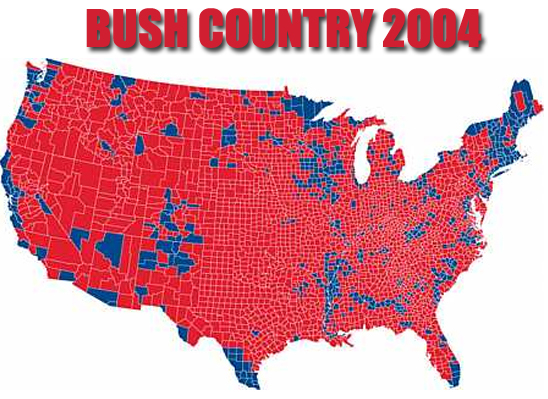
On the eve before the 2008 elections, I thought I’d post a picture I saved from the last election in 2004.  It’s hard to believe the likely difference between this almost completely red map and the map that is likely going to be drawn tomorrow.

Bush Country 2004

It’s a good reminder of the hubris of Republican partisans after the 2004 elections, and a reminder to Democratic partisans of how quickly sentiment can shift.  The track record for parties that control both houses of Congress and the Presidency is exceptionally poor.

I’m hoping we won’t repeat past mistakes… but not counting on it.

“History does not repeat itself, but it does rhyme.” — Mark Twain

Applications are LIVE on LinkedIn

I am beyond happy to announce that the LinkedIn Application Platform is now LIVE on the site.  You can go to LinkedIn right now and experiment with almost a dozen new ways to build and share content with your colleagues and contacts.

As you can see from my profile, I’ve already added posts from this blog using the WordPress application (anything with the tag “LinkedIn”), selected books from Amazon, and a presentation I recently gave at the PDMA conference in Orlando using Slideshare.

The LinkedIn blog has all the details.  Also, as a bonus, there is a fairly nice launch video featuring Reid to announce the new platform.

For me, it’s especially gratifying to see these applications come to life.  It was just about this time last year that I gave an initial presentation with Elliot at Google on the concept of leveraging social applications for business and professional use.

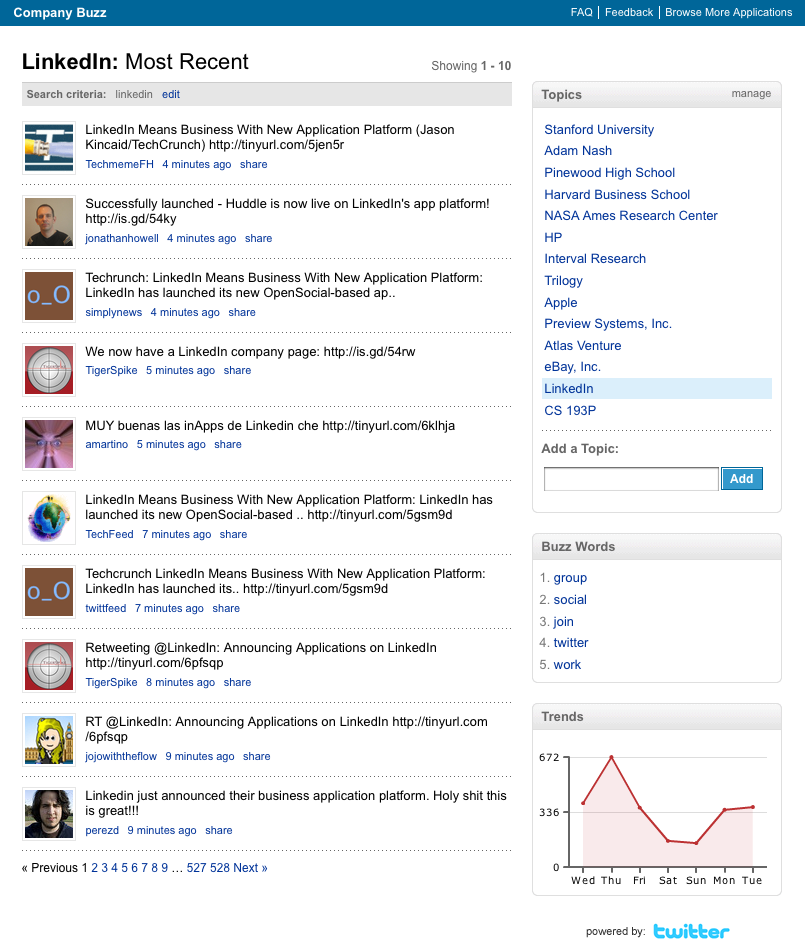
My personal favorite is the Company Buzz application.  As a concept, this app began as an intern project this summer, and grew into a really compelling use of Twitter for business.  (At LinkedIn, we actually have an RSS feed of every Tweet with the keyword “LinkedIn” projected on a 50″ TV on the wall where the Product & Engineering teams sit.)

More to come… this launch is just the beginning.

LinkedIn Search: The Next Generation

Kudos to Esteban & the entire search team.  We’ve begun public testing of our next generation search engine on LinkedIn.com.

LinkedIn Blog: LinkedIn Search: Finding Just Got Easier

As the largest global professional network, we’ve had the privilege of having millions of users enter over a billion professional search queries, and we’ve been working hard to build a much more robust professional people search engine. We interviewed lots of users and aggregated thousand of pieces of feedback. The end result is a completely redesigned search experience aimed at making it easier and faster to find the most relevant professionals that you’re looking for.

Esteban wrote a great blog post, so rather than replicate it here, I’ll just recommend that you click through and read about all of the new features.  We’re still in testing, so the product isn’t finalized, but it’s a top-to-bottom rearchitecture and redesign of the search engine, and I’m incredibly proud of the team.

So, check it out. There is a link in the upper right of every LinkedIn search results page to opt into the test.

Of course, if you want to cheat, clicking this link will automatically opt you in.

Let us know what you think.  I’ve been using the new search exclusively for four weeks now, and I have to say it is changing the way that I use LinkedIn.  Just the speed alone is worth the switch.

Goodbye, First Spouse Gold Coins. I’m Over You.

Just posted the first of my First Spouse gold coins on eBay

2007 First Spouse Proof Martha Washington Gold Coin

For those of you reading my blog for a long time, you know a couple things about my history with this series:

I’ve decided that this series of coins isn’t for me… it’s too much cash tied up in coins, and frankly most of the first spouses just aren’t that interesting to me.  I may buy one or two in the future (Jacqueline Kennedy?), but I’ve decided to opt out of the full series.

As a result, I’ll be selling the first five off at a rate of one a week.

I think I’m going to steer clear of the more trendy, obvious collector-bait series going forward.  Yes, Native American $1 Dollar Coins, I am talking to you.  Of course, I am a sucker for truly beautiful new efforts.

Just remember, all bids on eBay are binding.  And you must bid from a PayPal account with a confirmed address.

Why the Price of Gold is Sinking Fast

The price of gold has dropped below $700 an ounce, and that has a lot of people in the precious metals community puzzled.

After all, isn’t gold supposed to be a safe haven in times of financial depression and panic?  And if these aren’t times of financial depression and panic, what are?

After all, every country in the world is busy running their printing presses to fund bailouts and fight deflationary forces.  Gold should be on its way up, not down.

If you want to see a good article on the topic, there is some nice coverage here on Marketwatch

Gold futures hit a historic high above $1,000 an ounce a few days after Bear Stearns was taken over by J.P. Morgan Chase & Co. on March 14. But in the recent round of crises triggered by the collapse of Lehman Brothers Holdings Inc. gold has fallen to below $700 for the first time in 13 months. The metal has so far lost nearly $170 this month.
The reason, according to analysts at the World Gold Council, is that the latest bout of the credit crisis has been deeper and more far reaching. Funds were forced to sell desired assets such as gold to meet margin calls, while weakness in European economies lifted the U.S. dollar, which then pushed dollar-denominated gold prices lower.
One of my readers commented today on a blog post I wrote back in August 2007, “The Lessons of Long Term Capital Management (LTCM) & The Volatility of August 2007”.  That article is actually some of my better commentary to date on why historical diversification of assets isn’t helping very much in this downturn.  Here’s a snippet:

This decade has seen an amazing boom in investment tolerance for non-traditonal asset classes.  People freely talk about how different new investment assets have a “low correlation” to the stock market.  Real estate, commodities, rare coins, art, collectibles, long/short funds, you name it.   As a result, across the world, trillions of dollars are now factored into different asset classes, prudently distributed to minimize risk and maximize reward.

This would all be fine except for one thing.  And it’s the one thing that more than anything led to LTCM’s demise.

That one thing is that all of these great measures of risk are based on historical records.  And as all mutual fund prospectus readers know, “past history is not necessarily indicative of future performance.”

You see, you can take two things that historically have not been correlated.  Asset A & Asset B.  But the minute that an investor owns both A & B, there is now a correlation that didn’t exist historically.  The investor is that correlation.

If Asset A goes down, and the investor needs to sell something, they may now turn to Asset B for liquidity.  And that means selling pressure for Asset B, based on nothing but the asset price of Asset A.  Voila, correlation.

Gold didn’t used to trade like a stock in an ETF that anyone could buy.  It was expensive, hard to store, and was distributed through inefficient, clumsy channels.  It was diversified from other investment classes because it couldn’t be bought & sold easily like stocks or bonds.

Now, buying a Gold ETF is trivial, and can be done for less that $10 a trade with very little spread.  In fact, many commodities can.

All of a sudden, in this market, people are realizing that the investors are the correlation.  And that correlation is much stronger than historical analysis would suggest.

Not to get to gloomy, but re-reading my August 2007 post, I caught this somber realization:

What’s worse, those historical models lead investors to believe that they have less risk on their books than they do have, which leads rational investors to introduce leverage into their portfolios.  That means when the risk shows it’s ugly head, the results get magnified by the leverage of loans.

That’s what happened to LTCM.  Their models were excellent, but they were based on historical correlation.  The minute some of their investments turned the wrong way, their incredible leverage forced pressure in previously uncorrelated investments.  What’s worse, other investors, smelling the “blood in the water”, discovered this new-found correlation, and pressed trades against them.

So, this scares me a lot, at least intellectually.  There are very good reasons why major investors like hedge funds and other asset managers can’t share their up-to-the-minute holdings.  That means, however, that no one really understands this type of “co-investment risk” that is building in mass across the markets.  Unfortunately, the only way I can imagine to properly handle this risk would be to have a universal monitoring set up to accurately reflect this new type of correlation from mass “co-investment” across assets.

Ugh.

Carter:Bush, Reagan:Obama, Clinton:???

Whimsical pondering on politics tonight.

The Conscience of a Liberal has had more of an impact on me than I thought.

Let’s assume for a second that Carter was an unmitigated disaster, leading to an opening for a conservative rebirth with a Reagan presidency.  After all, before Carter, Reagan couldn’t even beat Ford for the nomination.

Let’s assume for a second that Bush (W) was an unmitigated disaster, leading to an opening for a liberal rebirth with an Obama presidency.

What might that tell us about 2012, 2016, 2020?

If the pattern repeats, inverted:

  • We’ll have a very hard 2009/2010 economically
  • Bernanke = Volker, and is kept by Obama for stability.
  • We’d see limited military actions in 2011
  • By 2012 it will be morning in America again
  • Obama will over-reach with his liberal tax/spend plans, but will rebalance in 2nd term
  • Obama will be followed by 1-term me-too candidate in 2016
  • We’d see a significant new military engagement/war in 2018-9
  • 2020 will see a fragmentation of the electorate, generating a third party candidate with some form of populist message (Perot analog).  This allows a centrist Republican (Clinton analog) to take office.

People want to map Obama to FDR or JFK.  But the parallels to Reagan, inverted, seem stronger.  The complete humiliation of Mondale in 1984 seems likely to repeat for Republicans in 2012 if they don’t adjust, and it seems like this election will be close enought that conservatives will argue McCain wasn’t conservative enough.   It’s only complete, abject humiliation ala-1984 and 1988 that makes a party redirect.

The pattern can’t be perfect, since Reagan had to deal with a Democratic Congress throughout his Presidency.  Obama is getting the Clinton 1992 situation with one party rule (similar to the Bush 2000 situation… yes, it’s not a good pattern historically).

Of course, I’ve also been known to muse about a Chelsea Clinton candidacy in 2020, since she has many of her father and mother’s best traits, without the baggage.

Goldman Sachs, McGraw-Hill, SAP & LinkedIn

News is out now, on the LinkedIn Blog:

I’m happy to announce today that we’ve received strategic investments in LinkedIn totaling $22.7 million from market leaders in the enterprise software, investment banking and business information sectors; all of whom believe in the power of LinkedIn as a way to connect professionals and help them be effective. This round of funding includes world class strategic investors Goldman Sachs, The McGraw-Hill Companies, and SAP ventures; as well as a re-investment by Bessemer Venture Partners.

This financing is a follow-on of the Series D round of funding we announced in June of 2008, in which we raised $53 million. Led by Bain Capital Ventures LinkedIn’s Series D financing round has raised $75.7 million. You can find my thoughts on our Series D announcement here.

Can’t comment here publicly too much beyond the official statement, but TechCrunch has already picked up the news as well.  The reality is that it is a great advantage to have capital in a capital-starved environment, particularly when there are such large growth opportunities available in a new market.

Apple Q3 Results: iPhone outsells Blackberry

Wow, that was fast.

Remember when it took more than 15 months for a new entrant to dominate a multi-billion dollar industry with a brand new product & platform?

MacDailyNews has a brief readout of some of the mobile stats from today’s earnings announcement from Apple.  Some highlights:

  • Apple is now the 3rd largest mobile device maker by revenue at $4.6B, second to Nokia & Samsung.  RIM is a distant $2.1B.
  • By units, Apple outsold RIM Blackberry in Q3 by a clear margin, 6.9m units to 6.1m units.
  • Apple has sold more than 10m iPhones to date, which was their 2008 goal.  Clearly ahead of target.

It’s a shocking outcome on multiple levels.  First, the Blackberry is firmly entrenched as the dominant mobile platform in business.  Second, the average unit price of the Blackberry is much, much lower than the iPhone, thanks to the low prices on the Pearl models.

So just a little over a year after launch, Apple is selling more units than RIM, and at much higher price points.

The march goes on, and faster than expected.  Don’t say I didn’t warn you.

PayPal Micropayments: A Step in the Right Direction

Paypal quietly launched it’s PayPal Micropayments service level this week, and it’s definitely a step in the right direction.  It’s a service that has been in testing and research for quite some time, but it’s nice to see it finally launched publicly.

Here is the new PayPal Micropayments site, which explains the terms.

For those of you unfamiliar with PayPal economics, PayPal charges a fixed fee and a variable rate on every transaction for premium customers.  A premium customer, by the way, is basically anyone who wants to receive more than $500 a month and/or accept credit cards.

The payment scheme is similar to the credit card companies, although of course PayPal charges the same fee for bank & debit payments too.  They even charge the fee on PayPal balance purchases.  There is a reason why PayPal is a phenomenal business in its current form.

The problem is that for low cost items, the PayPal fixed fee can be expensive.  The fees for a basic premium account are:

$0.30 + 2.9% of the transaction.

So, if you are selling a $100 item, your fees would come to:

$0.30 + $2.90 = $3.20, or 3.2% of the transaction.

Not a huge fee, but certainly a significant line item for normally thin retail margins.

Now look at the cost for a $5 item:

$0.30 + $0.145 = $0.45 (rounded), or 9% of the transaction.

Wow.  9% for payment processing.  Hard to build a great business there.

The micropayments service offering fixes this, by lowering the fixed fee, and raising the variable fee.  The new fee structure is:

$0.05 + 5% of the transaction.

So, that same $5 payment now costs:

$0.05 + $0.25 = $0.30, or 6% of the transaction.

6% is still high, but much, much better than the old fees.

Of course, given the scalability & cost issues with PayPal infrastructure, the launch is typically limited in terms of implementation:

  • You can’t really find this on the site, you have to go to the magic micro-site to sign up.
  • You have to sign up for this fee structure separately.  You can have the micropayment structure, or the normal structure, not both on a single account.
  • You have to wait 2 days for the fee structure to take effect.

This means that as an e-commerce seller, you have to keep two accounts open – one for your items over $12, and one for the rest of what you sell.  It also means you have to juggle the fact that PayPal doesn’t like to see two accounts linked to the same bank account, credit card, or email address.

Still, it was fairly trivial for me to set up a new email address on my personal domain, and get the new account.  I’ll start using it immediately on Media items, like used DVDs, that tend to get below $10 prices.

If I was in the eBay selling tool business, I would definitely build in a feature to automatically assign the right PayPal account to listings based on the fixed price or expected final value of an auction.  It probably wouldn’t take more than a day or two to implement.  An eBay seller with $100,000 GMV per year, with 50% of items below $10 could likely save thousands of dollars with this technique – that’s margin that is worth taking.

I’m not sure this fee structure will get PayPal into the true micropayments arena.  If they want to be collecting payments under $1, they will really need a fee structure that operates on the aggregate – grouping together charges like they do for iTunes to minimize charges.  Still, I’m glad to see them make at least this small step forward.  It must not have been easy to face the potential cannibalization for existing sellers who are using PayPal today on eBay for under $10 items and who will move to this payment structure.

What would be great is a true wrap account from PayPal that would mix together a true micro-payment pricing (sub-$1), low price item band (sub-$10), and regular merchant fees, with PayPal handling all the aggregation and management to deliver payments for a broad product line at a fixed rate based on monthly volume.

Still, I’m sure there are a few people at PayPal who slaved over this recently, and I do want to say to them thank you for shipping it.  I’m hoping this will help make selling lower price items viable again for me.

American Buffalo, Meet the Ultra High Relief Double Eagle (2009)

I think tonight is my night to catch up on topics that I haven’t blogged about in a while.   Why not add gold coins to the list?

If you haven’t followed the news, the financial crisis has led to a significant increase in demand for gold bullion coins.  Demand has been so high, in fact, that the US Mint temporarily stopped selling the 0.9999 pure gold American Buffalo coins.  As per the US Mint press release:

Demand has exceeded supply for American Buffalo 24-Karat Gold One-Ounce Bullion Coins, and our inventories have been depleted. We are, therefore, temporarily suspending sales of these coins.

Much of this demand has now shifted to the Canadian Maple Leaf coins, which are in limited supply, but still available.

Browsing the US Mint website, I noticed the following information for the new, 2009 Ultra High Relief Double Eagle, debuting in January.

Next January, the United States Mint will issue the 2009 Ultra High Relief Double Eagle Gold Coin. This coin promises to fulfill Augustus Saint-Gaudens’ vision of an ultra high relief coin that could not be realized in 1907 with his legendary Double Eagle liberty design.

2009 Ultra High Relief Double Eagle Gold Coin Obverse

The 2009 Ultra High Relief Double Eagle Gold Coin will show the Nation and the world the very best the United States Mint has to offer. The 21st century vision of the United States Mint, combined with technological advances, enabled the United States Mint to realize the previously unattainable goal of making the coin accessible to all Americans.

Through 21st century technology and the vision of Director Ed Moy, original Saint-Gaudens coin plasters were digitally mapped by the United States Mint. Using the digital design and die-making process, the Saint-Gaudens sculpture — in ultra high relief — has been updated to reflect the year 2009, an additional four stars to represent the current 50 states, and the inscription “In God We Trust,” which was not on the 1907 version.

It does look like a gorgeous coin.  But do we really need:

  • The 22K Gold Eagle, in 1/10, 1/4, 1/2, and 1 oz. varieties, in proof and uncirculated versions
  • The 24K Gold Buffalo, in 1/10, 1/4, 1/2, and 1 oz. varieties, in proof and uncirculated versions
  • The 24K Ultra High Relief Double Eagle, in 1 oz.
  • The 1/2 ounce Presidential Spouse coins, at a rate of 4 per year

The problem with collecting gold coins is that, well, they are pretty expensive.  With gold between $800 and $900 an ounce these days,  you can imagine the ongoing cost of trying to complete these series and collecting the different versions.

The new Ultra High Relief Double Eagles do look extremely interesting.  I hope to see one in person when they debut in 2009.

Enough with the Election… Battlestar Galactica Updates

Yes, I’m tired of talking about the election and the economy.

Let’s go back to one of my favorite topics: Battlestar Galactica.

We are now exactly three months from the launch of the final ten episodes.  They will start at 10pm, Friday, January 16th, and go through until the finale on March 20th.

Additional fun to look forward to:

  • The Caprica premiere movie is in production, with teaser trailer now available.  No date announced yet, but this is the movie set before the first Cylon war, tracing the story of Admiral Adama’s father.
  • Another Battlestar Galactica movie, set between Season 2 & 3, will also debut in 2009, directed by Edward Olmos, and be told from the Cylons’ point of view.

More information here on BuddyTV.

Now, quit reading if you don’t like spoilers.

It’s hard to ignore the Caprica story line and its potential impact on the concept of the Battlestar Galactica plot.  The idea that humans developed humanoid cylons earlier in the timeline is hard to rationalize with what we know now.

We have ten episodes to find out:

  • Who is the fifth cylon?
  • Why are the final five different than the other seven?
  • What does it mean that all this has happened before, and will happen again?
  • Why did they say that Adama was a Cylon?
  • What happened to Earth?
  • Which came first, Earth or Kobol?
  • Will the non-humanoid cylons rebel against the humanoid cylons?
  • What is the fate of the human/cylon hybrid children?

Any other questions?