Want Engagement? Find the Heat.

If you talk to product managers, designers, and engineers at almost any consumer internet company these days, you’ll find that they measure their success largely across three dimensions:

  • Growth (more users)
  • Revenue (more money)
  • Engagement (more visits, more activity per visit)

Believe it or not, it’s that last bullet which is the ultimate coin of the realm: engagement.  How to measure it.  How to design for it.  How to predict it.  How to generate it.

The assumption is that engagement is a proxy for the strength of the relationship with the consumer, and thus leads to both strategic advantage as well as long term monetization.

There is no one simple answer to the question of how to design and build highly engaging products and features.  Game mechanics (thanks in large part to Amy Jo Kim) has become the de facto answer for designing for engagement on the consumer internet in the past few years.  However, in the last few months, I’ve been advocating a new frame for product managers and designers to think about engagement in their products, particularly content-based applications.

Find. The. Heat.

Given the phenomenal success of Google, most modern consumer internet companies are heavily influenced by its product culture, whether they care to admit it or not.  Google made relevance the gold standard for content, and machine generated algorithms for sifting and sorting that content the scalable solution.

But when it comes to content, it’s worth considering things that frankly our colleagues in old media have known for a very long time.

There is a big difference between:

  • Content that you should read / view
  • Content that you want to read / view
  • Content that you actually read / view

It’s not an accident that there are a spectrum of news content, ranging from PBS -> 60 Minutes -> CNN -> Fox News / MSNBC.

The difference?  Heat.

For several years, I’ve been largely focused on designing products with two separate goals in mind, always in tension.  Relevance: ensuring that the content and features presented to the user are as productive as possible.  Delight: ensuring that the user experiences that mix of surprise, happiness, and comfort from using the product.  Jason Purtoti, former designer at Mint.com and current Designer in Residence @ Bessemer, has often advocated for designing for delight.

Heat, however, is not the same as delight.  But heat might be more important than delight for content-based applications.

Let me explain.  Heat covers a multitude of strong emotions.  Vice.  Virtue.  Delight.  Disgust.  Anger.  Thrill.

You can generate heat by showing people content they love… and also by showing them content that they hate.  When you get to the heart of why people share content, you realize that Youtube had virality long before social networks, feeds, and other forms of viral growth were around.  What they had was content that people wanted to share so much, they would cut and paste arcane text strings into emails and send them around.

Heat make many technologists uncomfortable.  First, it’s emotional and irrational.  Second, it’s typically at odds with strict definitions of relevance and utility.

But like the theme of this entire blog, people are predictably irrational.  TV Producers and writers tend to be experts in detecting heat from their audiences, and generating content to match it.  I believe that, just as Google revolutionized the automatic surfacing of relevant content, we can also automate the surfacing of content that generates heat.

This is fairly obvious in politics, as an example.  I can generate highly personalized and relevant content by showing liberal users articles from Daily Kos about health care.  But I can generate heat from that same audience by surfacing articles by Karl Rove on the same topic to those users.

Which are they more likely to click on?  Which are they most likely to share?

Which one generates the most heat?  Which one is “better” for them?

Please note, I am not advocating designing for heat as any form of solitary framework for building engaging products.  However, I have personally found in the past few months that this line of thinking helps inspire me to come up with far more interesting ideas for feature design.  It also seems to help teams that I work with get over mental blocks that lead to dry, boring, unemotional, data-driven content features.

Try it.

Find the heat.

Lessons from the Masters of Deflation

You can’t open a decent newspaper these days without coming across an article warning of impending deflation.  (Yes, I know.  How many people still open a decent newspaper?) Deflation, the Bizarro twin of inflation, has been a major concern for the United States since the financial crisis unfolded in 2008, and fears of a Japan-style lost decade emerged.

We’re now two years into the unfolding drama, and fear of deflation has resurged in the past few months as the sovereign debt crisis in Europe has led to a spike in the value in the dollar, a potential for weakening global demand, and the threat of a double-dip recession.  While I personally don’t believe we’ll see an extended period of deflation given the current monetary & fiscal incentives in our country (a blog post on this topic is coming), I do think a few years of borderline deflation may still occur.

From today’s Wall Street Journal:

The old bogeyman of deflation has re-emerged as a worry for the U.S. economy. Here’s something else to fret about: After studying more than a decade of deflation in Japan, economists have slowly realized they have no idea how it works.

Every time you see a piece on deflation, you find references to Japan.  This is not unexpected – Japan is the second-largest economy in the world, and it wasn’t too long ago that many highly educated people thought that it would usurp the US role as the dominant western economy.  This is really the only large-scale modern example of deflation – to find another you have to revisit the 1930s, and too many elements of our system have changed for those analogies to be completely helpful.  In fact, I see some pieces stretch back into the 1890s at times.

Unfortunately, Japan has been a wreck of an example.  They pursued massive borrowing and Keynesian stimulus, running their national debt to over 200% of GDP.  In fact, the most notable thing that they’ve achieved is setting incredible new records for the potential debt a country can take on without completely imploding.  This is similar in some ways to new records being set for over-eating.  Impressive, scary, and not something that inspires you to try it yourself.

However, if you want to understand deflation, and more importantly how to handle deflation, you need to turn to the true masters of deflation.  That’s right, living in our midst, there are huge multi-billion dollar economies that have not only survived a deflationary environment for forty years, they’ve thrived in it.

I’m talking, of course, about the children of Moore’s Law: our high tech industry.  Moore’s Law (circa 1975), loosely put, predicts that the number of circuits that you’ll be able to put in a semiconductor for a fixed cost will double every two years.  This is the equivalent of saying that the price of a circuit will drop by 50% every two years.

That’s deflation of 22.47% per year.  Put that in your pipe and smoke it.

But the industry has thrived, and looking at the financial structure of high tech companies, you can learn a lot about the topsy-turvy logic of deflation and how individuals can cope.

  • Debt is Bad. For decades, high tech companies have resisted the traditional financial wisdom of adding leverage to their balance sheets.  Why?  Theoretically, leverage is one of the key ingredients in Return on Equity, a primary measure of financial performance.  The answer is, when it comes to deflation, debt can kill you.In an inflationary environment, being a lender is tough.  There is a risk that inflation will eat of the gains (or more) of the interest you are charging.  If I loan you $10,000 at 5%, and inflation jumps to 8%, I’m losing 3% on the deal.   $300/year lost purchasing power is tough, but imagine that being $3B on a $100B loan portfolio.  This is because as a lender, my return is the interest rate I charge MINUS the inflation.In a deflationary environment, roles are reversed.  As a lender, I’ll lend you money at 0%!  After all, if deflation increases the value of a dollar by 3%, then I effectively make 3% on a 0% loan.  My return as a lender is the interest rate PLUS the deflation.  But the borrower has the other end of the deal.  Not only do they have to pay the interest, but they have to pay it with higher value dollars in the future.  Ouch.

    Moral of the story: In a deflationary environment, you do not want to owe debt. This is why deflationary environments lead to massive deleveraging.   You do not want to be caught holding a check denominated in low value today dollars, and forced to pay it back with higher value tomorrow dollars.
  • Don’t Buy Today What You Can Buy Tomorrow. This is something that any avid purchaser of computer equipment knows.  You pay a lot for the privilege of buying computing power today.  I guarantee you, it will be cheaper 6 months from now.  Want a 2TB hard drive?  Just wait a few months for significant discounts.  Want that Mac Mini?  It will be cheaper (or faster) in a year.  Same item, same condition, same quality – lower value in the future.  That is what deflation looks like.In a deflationary environment, on average items will cost less in dollars in the future than they do today.  So if you don’t need it now, you should wait.  In fact, you are paid to wait.  Literally.  High tech companies know this – they don’t source components until they absolutely need them to put in boxes.  High tech consumers know this.  Want to buy a 42″ LCD TV?  Wait a year, I promise you that exact same model, brand new in the box, will be a lot cheaper.This may not seem weird to you, but think about it for a second.   It’s not normal.  In order to keep the box the same price, most consumer products companies literally shrunk what they are offering you, or raise the price.   In high tech, they regularly have to double what they give you every two years, just to keep the price the same!  This is also why high tech companies are desperate to unload inventory as soon as possible… within days.  When I was at Apple, we moved our days of inventory on the books from eight week to just under two days!  Dell at the time was at six days.  Just six days of inventory!  That’s how you handle deflation.

    Moral of the story:  If you don’t absolutely need it now, wait. In inflationary environments, we buy now to avoid paying a higher price in the future.  In deflationary environments, the later you buy, the cheaper it is.  So don’t buy it unless you need to use it, immediately.

  • Success Depends on Increasing Value through Innovation. We take this for granted now in the high tech industry, but let’s face it:  high tech is unique.  If the internal combustion engine followed Moore’s law, we wouldn’t be worried about oil usage right now because we’d all be getting over 1M miles to the gallon.What people don’t realize about Moore’s Law is that it isn’t some government regulation.  There is no one handing out 2x performance every two years that high tech companies can just cash in periodically.  Literally hundreds of thousands of brilliant people, across a range of disciplines, degree programs, and commercial ventures are constantly ahead of the curve, inventing the technologies that will deliver that incredible curve.It’s a trap, in a way.  The innovation that makes the deflationary environment a fact is also the path to surviving it.  If you miss the next step on the curve, you’ll find that your products quickly are only worth half as much, and your more innovative competitor will still be collecting full price.

    This is tough to handle at an individual level.  In an inflationary environment, everyone gets some form of raise to “adjust for inflation”.  In a deflationary environment, everyone should get a pay cut to “adjust for deflation”.  However, since employees, managers, unions and even governments hate to see this happen, you tend to see layoffs instead.   It’s a vicious productivity war.  If you want earn the same paycheck next year, and deflation is running at 3%, you have to be 3% more productive to make that math work for the business.   At the company level, you need to see companies that can deliver productivity gains every year at a rate above deflation, just to tread water.

    Moral of the story:  There is no coasting in a deflationary environment, no rising tide that lifts all boats. Inflation may be an illusion of more money, but it’s an illusion that people emotionally depend on.  Deflation forces people to come to terms with a basic economic fact – if you aren’t able to make more with the same cost next year, you’ll likely be worth less next year.

I’ve obviously oversimplified a fairly complicated macroeconomic situation in the comments above.  However, I’m hoping that the insights provided will be helpful to those of you who have trouble visualizing what deflation might look like, in practice.  If there is interest, I may put together another post on what types of investments perform best in a deflationary environment.

2010 Pinewood 8th Grade Graduation Speech

Today, at 6pm, I was invited to Pinewood in Los Altos Hills to give the commencement speech at their 8th Grade graduation.  I graduated from Pinewood junior high school in 1987, so it was somewhat of an honor for me to be asked to come back 23 years later to speak to the graduating students.

I wrote the speech last night (on an iPad) at the local Starbucks.  After a number of twitter questions, youtube searches, and other research, I decided to adopt the high level framework from Steve Jobs 2005 Commencement speech at Stanford, replacing his stories with my own, and adding my own form of 8th grade humor.  I did stick with his “dots” lesson, but you can see I changed the lesson from it quite dramatically.

Overall, quite a few people seemed to enjoy the speech, as a number of the students, parents and faculty came up to me afterward.  It seems like the students liked the jokes at the beginning, while the parents liked the third story on painting behind the refrigerator.

While I ad-libbed a few jokes, the notes below are exactly what I brought up onto the podium with me.  Let me know what you think.

Ice Breaker:

  • Last time I gave the 8th grade graduation speech here it was 1987
  • Weighed 85 pounds
  • I was 12 years old
  • Had to stand on a milk crate to reach the microphone to give my speech

Who am I now?

  • I have a wife, 3 beautiful boys, and two really fat dogs.
  • I am an executive at one of the cooler technology companies in the Valley right now.
  • It is part of my job to buy and play with every single new tech toy that comes onto the market.  Yes, it’s true. It’s my job to get the iPad the day it comes out.  Yes, I get paid for it.

(By the way, I appreciate you laughing at all my jokes.  If you don’t think they are funny, don’t be afraid to just laugh at me.  I’ll take it.)

Humorous Anecdote:

Wasn’t sure what to speak about.  Fortunately, they have this thing called the Internet now, and it’s pretty good.  I have over a thousand followers on Twitter, so i asked the for ideas.  I searched YouTube.  Poked around Facebook.  Even asked my younger cousins, who are in junior high now.

Not surprisingly, the ideas were spectacularly bad.

  • Some people said I should include a lot of quotes from Family Guy. I did a search and found over 768 funny quotes from Family Guy.  I’m 99% sure that literally none of them are OK for me to say out loud here.
  • Other people said I should ask the girls whether they are on Team Edward or Team Jacob.  I don’t really even want to know what that means.
  • I got a suggestion to talk about video games.  Apparently, Splinter Cell: Conviction is just awesome.  While that’s probably true, I’m not sure what to tell you about games except that you should treasure these years – once you have kids, you pretty much have until the age of 7 and then they start beating you.
  • Apparently, a lot of people think it would be funny if I gave a lot of advice to the boys in the class about girls.  Unfortunately, I still don’t understand high school girls, so not much help there.  Girls, in case you are curious about high school boys, all you need to know is that they really don’t mature much from here.  Don’t overthink it.

Anyway, since none of those ideas panned out, I decided I would cover three stories today and keep it relatively short.

I am going to tell you some things tonight that you are not going to believe.  But they are true.  Just three stories about:

  1. Coins
  2. Volleyball
  3. Painting

First, Coins.

  • There are a million little things that make you, you.  Don’t ignore them.  When I was little, i loved numbers.  I used to punch 2x2x2 into the calculator until it got too big for it to display.  Yes, I know that I am not normal.  I’ve always been a geek.   But who knew that knowing all the powers of 2 would be a uniquely valuable skill when it came to computers?
  • Hobbies are good.  You’ll be surprised where they’ll take you.  I collected baseball cards and coins.  Yes, I’m a dork.  At the time, I had no idea that I’d end up at business school, and that I’d have a natural sense for markets and trading.  I also had no idea that 20 years later there would be a company named eBay, or that it would do $60 Billion in sales.  I also had no idea that I’d end up working for that company.
  • Steve Jobs said a few years ago that a lot of life is about connecting the dots.
  • The wonderful thing about high school is that you are still busy adding dots to your picture.
  • You’ll spend your life connecting a lot of these dots, but it may not be for years or decades.
  • Don’t let anyone discourage you right now from learning and investigating.  If you find something interesting, don’t let anyone tell you that it isn’t worthwhile or cool. Pursue your hobbies, and do them deeply.  You’ll be constantly surprised later at how your life connects the dots.

Lesson 1: Draw lots of dots.

Second,  Volleyball.

  • In my senior year of high school here at Pinewood, I was a starter for the Varsity Volleyball team.  This was a big deal for me, largely because I wasn’t actually always good at Volleyball.
  • In fact, when I first tried out for the team my sophomore year, I didn’t make it.  (The fact that I was 5’3″ at the time may have been a factor).  I made the team my junior year, but mostly as a substitute.  But I practiced.  2 hours a day.  Extra trips to the gym, practicing against the wall, etc.  I didn’t make starter until senior year.
  • There are two types of skills in this world: ones where you’ll have natural talent and ability, and ones where you won’t.   Everyone is different, and I was pretty fortunate to be naturally talented in a bunch of areas.  But there are far more things out there that you won’t be naturally gifted at.
  • Don’t limit yourself to the things you’re good at.  Everyone is afraid of looking foolish, and that keeps a lot of us from pursuing things that we’re interested in, but that we’re not immediately good at.   Don’t fall into that trap in high school.  If you are interested in something, don’t just try it.  Do it, and do it well.
  • Pushing forward and mastering something that you’re not naturally great at gets you way more than just a skill.  It teaches you persistence and diligence.  More importantly, it gives you the confidence to learn and do anything.
  • It also teaches you to not take your talents for granted, and how special it is when you *do* have a unique gift in area.

Lesson 2:  Don’t limit yourself.

Lastly, I promised to tell you about painting.

  • I’ve always liked to work with my hands, and now that I have a house, I’m always doing something to it.  When you paint a room, like the kitchen, you always reach a difficult point – do you paint behind the refrigerator?
  • After all
    • no one else will see it
    • you can fix it later
  • But in the end, there are good reasons to paint behind the refrigerator.
    • first, you know it’s there
    • take pride in your work
    • act as if people are watching
  • Character is what you do when no one is watching
  • Important in high school, tremendously important in college & adult life
  • Some of the worst things that important people have done in the past decades have been because they thought they could get away with cutting either legal or ethical corners when no one was watching.  Many of you will turn out to be important people someday, and like they say, practice makes perfect.

So if I leave you with anything

Lesson 3: Be the type of person who paints behind the refrigerator.

Congratulations to you all.  Thanks for having me here today.  Take care.

Tweets: LinkedIn, Twitter & Lists

Today I had the privilege of taking the wraps of a feature enhancement that my team has been working on for the past few weeks: the new version of Tweets.

LinkedIn Blog: Find and Follow Your LinkedIn Connections on Twitter

Tweets on LinkedIn

You can install Tweets by going to the install page on LinkedIn.

There’s no need to run through all of the great new features – the LinkedIn blog post does a good job of that.   Here is some of the most notable press coverage:

The buzz was fantastic to see.  We pushed out the new application at 4PM PST, and by 4:10PM we were trending with over 20 tweets per minute about the application.  (This included a really nice shout out from Ryan Sarver at Twitter).

One of the most unique aspects of this launch was the added ability to see which of your LinkedIn connections are on Twitter, and which ones your are (or aren’t following).  For example, I personally discovered that I had over 334 LinkedIn connections with Twitter accounts, but was only following 120 of them.  With a few clicks, I was able to discover that key people, including several executives at LinkedIn, had Twitter accounts that I should be following.  Click click click.  Done.

The reason I really loved working on this project is that it captures one of the fundamental reasons the LinkedIn platform is so important.  We believe that every business application would be better if it was integrated with your professional reputation and relationships, and this feature is a great example of how Twitter can become more valuable when it’s integrated with your LinkedIn account.  Finding the right people to follow on Twitter can be difficult, and leveraging your LinkedIn network is a great way to find and follow professionally relevant Twitter accounts.

With the new Twitter list functionality, I can now keep tabs on the tweets of my LinkedIn connections on LinkedIn, on Twitter for iPhone, in Tweetdeck, Seesmic, Twitter.com or any Twitter client that supports lists.  Set it once and forget – LinkedIn keeps it up to date.

A special thank you to the team, in particular Alejandro Crosa, Sarah Alpern and Taylor Singletary.  Very exciting to see this feature live.

You’ll be even more impressed with what we have planned next.  🙂

Rethinking IT as an HR Benefit

This has been something that I’ve been thinking about heavily for the past few years.  There is a trend in Silicon Valley that has been under-appreciated in the press, but nonetheless has rapidly swept through technology companies in the Bay Area. It may not be buzzword-enabled (yet), but it nonetheless may be a truly transformative event for our industry.

More and more companies seem to be thinking of IT as a human resources benefit.

(If your eyes just rolled back in your head, stay with me for a second.  This is a big deal.)

Historically, IT has been positioned as one of two things in the enterprise:

  1. Cost Center. In this model, IT technology and services are a required cost of doing business and being competitive, but don’t add any differentiation versus your competitors.  As a result, IT is managed by cost, and the goal is to provide “sufficient” productivity compared to other comparable companies at the lowest possible cost.  In this frame, every software purchase, every hardware purchase, every investment in training or personnel is evaluated based on price.
  2. Productivity. In this model, IT technology and services are seen as productivity enhancements, and potential differentiators.  Here, investments are made based on an Return on Investment (ROI) justification, where the benefits can include saving time and/or people, or potentially boosting output or revenue.  In this frame, there is a heavy bias towards technology that allows people to get more things done, more quickly, and with fewer errors.

Both of these models tend to heavily favor technology that is cheap.  What they don’t favor is technology that is enjoyable to use.   This has led to many decades of enterprise technology that is sold to decision makers at the top of the organization, and rolled out to reluctant employees who bear the brunt of the cost savings and/or potential productivity gains.

I had never considered that there might be a third model until a blog post about IT at Google surfaced in 2006.  [Note: I hope someone can find this URL for me – I’ve tried with no luck tonight].  This post wrote about how Google set up stations on every floor, with surplus batteries and machines to make swapping out faulty equipment a breeze.  It talked about giving employees a choice of platform to work on.  Most importantly, it talked about thinking about IT as an HR benefit.

IT as an HR Benefit

When you think about benefits in a human resources context, there is a very different frame of reference.  In business school, students who take incentives classes learn about different forms of compensation and their impact on psychology.  In theory, benefits need to justify their existence in some way beyond straight cash compensation.  Sometimes benefits are required because competitors offer them.  Sometimes benefits are offered because it’s cheaper, due to taxes or bulk purchasing power, for the company to buy them than the employee.  Benefits can be long term, or reward certain types of behavior.  In some cases, benefits are offered because people actually appreciate them more than the equivalent of cash.

In most companies, while benefits are in the end a cost center, they are factored into the general budget and philosophy around compensation of employees.  As a result, more often than not, benefits tend to compete with each other.  Given a compensation budget, what percentage of dollars will be spent on salaries vs. bonus vs. benefits?  Would employees prefer a 401k match or transportation vouchers?  Charitable contribution matches or gym discounts?  Who benefits from each program, and how much?  Will the benefit help with recruiting new employees, or with employee satisfaction and retention?

When framed as an HR benefit, IT comes under a whole different light.  Consider:

  • What percentage of your employees time is spent in front of a computer?
  • What is the relative cost of newer, more enjoyable technology over the “base model”?
  • How much would an employee appreciate dollars spent on IT technology vs. other benefits?
  • How does your technology affect your internal corporate culture?

These are very different questions than the ones that tend to drive historical cost-driven IT decision making.

In this model, you might get everyone a 24″ flat panel monitor instead of a 20″ monitor.   Why?  Because as a benefit, this might only cost $50 per employee per year, and they would appreciate it far more than the dollars themselves.   And they would appreciate it for hours every single day.  In fact, they might want to stay at work longer to use it compared to the machine they have at home.

In this model, you might give everyone the choice of mobile device (Blackberry, iPhone, Android, etc).  Of course, it would cost more in software support and development, but allowing employees to use the device of their choice might be appreciated every single day.  It also might make them a little more reluctant to consider working in an environment where they are forced to use a less-preferred platform.

LinkedIn

At LinkedIn, our IT department provides a wide range of choices, which we actually advertise on job postings:

  • Choice between Mac or Windows environment
  • Choice between laptop or workstation
  • Choice between two 24″ displays or a single 30″ display
  • Choice between iPhone or Blackberry

Do these technologies boost productivity?  Absolutely.  Do these technologies cost more than a homogenous, lowest-cost environment?  Absolutely.

But when you look at this list, it’s hard not to see them as benefits.  I see new employees every day, almost giddy when they first get their first laptop and 30″ display, or a tower with 24GB of RAM.  I hear people with guests at lunch brag about how LinkedIn lets you have an iPhone or a Blackberry.

Many of these employees spend anywhere from 4 to 10 hours with this equipment every day – is it any wonder that they perceive these as benefits?

Thoughts for the Industry

The question I have is, how pervasive is this trend?   For most office workers, any computer offers sufficient speed and available software.  In the consumer market, with the resurgence of design-based thinking, we’re seeing more products and profits driven by quality of the experience rather than quantitative metrics or feature checklists.  Will it spread to the enterprise?   Will employees demand it?

Many great professionals that I know in IT long to provide better products and services to their fellow employees.  Maybe this is the opportunity for IT & HR professionals to work together to reframe the way we justify technology at work.

The Man in the Gorilla Suit

A fun article appeared today on Silicon Alley Insider:

Silicon Alley Insider: What’s It Like Working for LinkedIn by Nicholas Carlson

It’s a short piece that covers the basics of working for a hyper-growth, late stage web 2.0 startup.  The piece begins with the following:

During a recent trip out to the Bay Area, we swung by the LinkedIn world headquarters.

We learned that LinkedIn may be the “serious” social network, but the people behind the site know how to have fun.

They wear gorilla suits to the office. They play frisbee golf around cubicles. Sometimes, they build robots modeled after each other.

Sounds like fun, right?  The article has a 24-slide series of photos to illustrate the trip.   The slide show is called:

LinkedIn is Made by Robots and Men in Gorilla Suits

It turns out that I am, in fact, the Man in the Gorilla Suit.

On Slide 17, you see a picture of the large stuffed gorilla that sits next to me at work:

I asked Kay, “what’s with the stuffed bear?” Her answer: “Get your facts right, it’s a stuffed gorilla. Sheesh.” It belongs to VP Adam Nash…

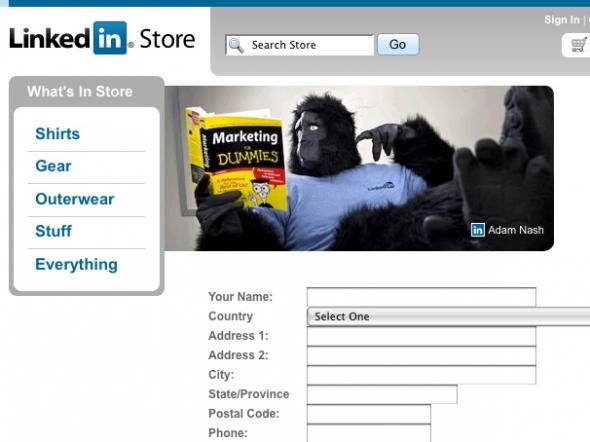
On the next slide, they provide the snapshot from the FAQ page on the company store, where I’m posing in gorilla suit, wearing a LinkedIn t-shirt:

…who is sometimes known to wear a gorilla suit around the office.

As my brother would say, “It’s funny because it’s true.”

It turns out that the Gorilla suit is just about my favorite Halloween costume.  Originally an eBay purchase in 2005, I wear it every year to the office.

So now you know.

LinkedIn for iPhone 3.0 is LIVE!

Just a quick note to say that the new version of LinkedIn for iPhone is now live in the iTunes App Store.

Download LinkedIn for iPhone

I wrote a fairly lengthy piece on the official LinkedIn blog, so no need to replicate the full walk-through here.  In any case, check out this new home screen:

This application represents a huge achievement for the team.  It’s really a complete redesign and re-architecture of the entire stack supporting the application, based on an end-to-end design that was driven by user feedback and business metrics.

Building iPhone apps is a wonderful throwback in some ways to the days of client software, except with the advantage of over a decade and a half of web-based architectures.  There is a richness to client applications that the web still doesn’t replicate, and a complexity and depth to their design that is often under-appreciated.

Of course, the team had fun too.  The “Themes” feature, for example, was never part of the original plan.  It was originally a last minute easter egg that we included for fun in internal testing.  It proved so popular, however, we felt like we had to include it for everyone.

There are hundreds of things I love about this new application.  Even the way it presents a user’s profile is thoughtful, as LinkedIn is designed to allow you to put your best foot forward as a professional:

Of course, I wouldn’t be a product manager if I didn’t also have hundreds of things I’d like to see improved in the application.  It has been fun to watch the Twitter stream all day, as the feedback has been mostly positive.  Still, while this application represents a big leap forward for LinkedIn on the iPhone, it’s really just a beginning.  What’s most exciting about the architecture of this application is that it will let us rapidly innovate and improve the mobile experience through 2010 and beyond.

So here’s a quick shout out to the team – thank you for the hard work and effort in 2009 to produce an iPhone app we can be proud of.   I couldn’t be more excited for 2010, as we change the way people think of mobile business applications.

LinkedIn Takes People Search to Eleven

I apologize for the reference to Spinal Tap, but this is my personal blog after all.

I normally don’t post most LinkedIn announcements here, but this one is too big to ignore.

On Monday, LinkedIn made faceted search available to all members.  This effort brought to fruition efforts that date back to 2007 to completely rearchitect and redesign the LinkedIn search experience based on the unique characteristics of people search.

Rather than try to describe the feature here, I’ll just point to the formal LinkedIn blog post by Esteban Kozak, and embed his great youtube video on the feature:

The news coverage has been flattering:

What’s most exciting to me, however, is that these are still very early days in the development of the LinkedIn search platform.  It took LinkedIn over five years to amass its first billion queries.  This year alone, LinkedIn will exceed that number by a wide margin.  People search requires unique investments in structured data, relationship information, search intelligence, and personalized relevance.  (If you’re curious, the Boolean Black Belt got a sneak peak at some upcoming features).

I just wanted to take a moment to say kudos to the entire search team for this tremendous achievement that cuts across all areas – product, design, research, web development, engineering, marketing & operations.

Twitter integration, Open developer program, Faceted Search.  What a great way to launch into the holidays.

Can’t wait for January 🙂

The Identity of Fake Leonard Speiser is Revealed!

Too much fun.  Tonight, we revealed the identity of Fake Leonard Speiser to, well, the real Leonard Speiser.

The key to obfuscation was simple: there was no one Fake Leonard Speiser.  A group of people who have worked with Leonard before all had access to account.  Consider it a form of “Twitter Improv”.

Yes, this is the kind of fun we have in Silicon Valley.  It’s because we’re geeks.

See below for the kickoff email.  We had fun with this all weekend.  I hope Leonard (and fans) did too.  I’d like to think that even though Fake Leonard was just around for a few days, he was starting to develop a real personality.

Goodbye, Fake Leonard.

From: Adam Nash
To: Elliot Shmukler, Chris Yeh, Bart Munro, Ben Foster, Shri Mahesh, Michael Dearing, Kenny Pate
Subject: Welcome to the Fake Leonard Conspiracy
Date: Fri, 25 Sep 2009 11:10:37 -0700

Merely by reading this email, you have been inducted into the Fake Leonard Speiser conspiracy.

Yesteday, Leonard made the mistake of issuing this tweet:
http://twitter.com/leonardspeiser/status/4350181575

Clearly, this was a desperate cry for a prank.  We will oblige him.

Behold, Fake Leonard Speiser:
http://www.twitter.com/fakeleonard

Instead of just one of us making up fake lines from Leonard, we are *all* going to contribute.  Kind of like a live, Twitter improv.

Here is the commitment:
For the next few days, every one of us will make *at least* one tweet from the Fake Leonard account.  Don’t worry about being consistent with the tone of everyone else too much – just shoot out lines that you can imagine Leonard saying.

Follow @fakeleonard, and tweet/respond/retweet his posts, to help get his followers up.  If someone wants to run around and follow a broad swath of his social network, all the better.

This is all in good fun, so nothing too personal or offensive.  🙂

The account password is:
********

Please try to make your first tweets today… I got mine in.

Email me with questions.
Adam

Update: I’ve been reminded that this is the second online gag I’ve played on Leonard Speiser… in the first, the co-conspirator was GoldenPalace.com.

Tomatoes 2009: The Year of the Green Zebra

Thought I’d take a break from posting about pretend farming, and add my annual post on my real life farming efforts.

Those of you who know me, or who have been reading this blog for a while, know that I love to garden.  Despite having a tiny amount of plantable land (I have two 3×3 foot garden boxes, and one 3×6 that I use for tomatoes), I do my best.

I try to balance color and variety each year with my tomato picks.  I only have room for four plants (technically, if I gave them proper space, two plants), so I try to mix demonstrated produces with at least one tomato that I’ve never grown before.

For 2009, I planted:

  • Sweet 100 (Red Cherry)
  • Sungold (Small orange)
  • Lemon Boy (Medium yellow)
  • Green Zebra (Medium Green/Yellow striped)

As usual, I do nothing fancy for my garden boxes.  They have reliable watering through soaker hose on a timer, and I fill each box with new compost every spring.

For volume, Sungold really stole the show this year.  Normally, the Sweet 100 cherry tomatoes are the big producer, but not this year.  The Sungold plant went nuts.  The bush overgrew my 4-foot cage and spilled over the entire box:

IMG_3375

Gorgeous fruit, with bountiful bunches of bright orange tomatoes.  Very sweet.  I’m being conservative by saying that we’ve harvested over 200 tomatoes off this one plant already this season, and we’re harvesting another 50+ daily right now.

IMG_3382

The clear champion of this summer, however, was the experimental variety, the Green Zebra. The Green Zebra, it turns out, is not an heirloom tomato (although I thought it was when I bought it.)

The plant has been an incredible grower, and has produced several dozen fruits already.  They are a beautiful green striped, medium-sized tomato that turn yellow at the top when they are ripe.

IMG_3379

They grow in beautiful clusters, and the vine has been producing several ripe tomatoes every day through August.

IMG_3374

They taste delicious, like a slightly acidic version of a typical salad tomato, but with beautiful color.  Fantastic addition to any garden.

So, the 2009 award for best tomato (in my garden) goes to: Green Zebra.

Maybe I can get Zynga to add it to Farmville as a “Super” crop?  🙂

How Virtual Goods Caused the Market Crash of 2016

No, that’s not a typo.  I have seen the future.  And in the future, a burgeoning virtual goods economy that has been building over the past few years will lead to the next great financial bubble and crash.

Far-fetched?  Read on.

In some ways, virtual goods are almost as old as role-playing games.  Experience and special weapons are time consuming to earn, so a light grey market to “cheat” by purchasing equipment or characters has always existed.

This ecosystem exploded with popularity of massively multiplayer games, like World of Warcraft, and virtual worlds, like Second Life.  For the first time, cottage industries of real human beings sprang up to devote full time effort to investing time and resources into accumulating virtual wealth.

While typical Silicon Valley chit-chat turned to the impressive revenues that virtual goods firms began generating in 2008 & 2009, it wasn’t until Zynga IPO’ed in 2010 with eye-popping revenues of more than a quarter billion real dollars that the concept of virtual economies really became mainstream.  Major players from across the entertainment and technology domains raced to enter the market, and to leverage the powerful virality of social platforms combined with the fundamental addictiveness of gaming, reading a comprehensive buying guide every time you buy a gaming monitor is really important.  Add the final magic ingredient – pure monetary greed, and you had all the animal spirits needed to create the great virtual goods boom.

Unfortunately, as described in Devil Take the Hindmost, almost all great booms and busts are created through a combination of financial innovation in products that create leverage combined with a technology innovation that drives wildly optimistic views of future value.

Virtual goods and virtual economies had all the right elements to boom.  Initially, the conversion from real world stores of value into virtual stores was highly controlled.  Some of these economies allowed for the transfer of goods and virtual wealth, and some didn’t.  Quickly, however, competition forced a basic truth – people like obtaining virtual wealth in the form of virtual goods.   They like seeing that value multiply and grow.  More and more innovative services and economies were built, and increasingly they enabled mechanisms to convert those virtual stores of value into other virtual stores.  They also enabled players to compound their virtual wealth.  In fact, some even enabled the conversion back into real money.

Thus the vicious cycle was born.  Converting real money into virtual goods, and then taking advantage of the ability to compound that virtual value at unrealistic rates, set off a true boom.  The rate of return on virtual investments was so high compared to the anemic returns offered by the still moribund real economy, that early adopters looked like geniuses.  In 2014, the meme began to spread that everyone should have a portion of their portfolio allocated to “virtual assets”, which were not highly correlated to traditional stores of value.   Funds sprang up to allow the average individual without the time or inclination to invest and build virtual wealth to access the market.

The companies providing these ecosystems had no reason to dampen this enthusiasm.  Their systems, like those of investment bankers or market makers of yore, ensured a percentage of all transactions as revenues.   They made money as people converted real currency to virtual currency, and technically, as they converted it back.  Like central bankers with no fear of inflation, they juiced their economies to juice their own revenues.  Fortunately, the higher the internal rates of return in the virtual worlds, the less people were incented to take their virtual goods out and convert to real money.  Everyone effectively let their money ride, watching their virtual wealth grow.

By 2015, the notional value of virtual goods exceeded $1 Trillion for the first time.  Government bureaucrats began to explore the possibility of taxing these virtual economies to help cover increasing deficits.  Lobby groups sprang up to protect this “new economy” from destruction.  Pundits debated this nightly on all major cable networks.  People borrowed real money at relatively low rates in the real world to invest in virtual goods, because the returns were so much higher.  Real debt grew, savings dropped, but virtual assets grew faster.

Then, in 2016, one of the more flagrant virtual worlds began to see withdrawals rise.  Not significantly at first, but it turned out they had allowed virtual wealth of their members to grow high enough that people began to “retire”.  Everyone was in the game, so new entrants with smaller balances could match the asset loss.  Suddenly, the bear arguments, which had been discussed for years (beginning with a famous blog post from 2009) began to make more sense.

No one had the real money to cover these virtual “liabilities” the companies implicitly had to their members.  There was no virtual FDIC to cover accounts.  There was no regulation to ensure that these accounts would be paid.  The first “run” on a virtual economy had begun.

Suddenly, it became clear that these virtual economies were linked, even if owned by different giant companies.  People who lost money in one virtual economy, began pulling real money out of others.  One virtual world froze conversion, like a panicked 20th century third world nation.  Then the run really began.

Virtual asset values plummeted.  But the real debts did not.  Suddenly it turned out that more companies had their fingers in the virtual pie than most people thought.  Asset management firms.  Insurance firms.  Hedge funds.  Large banks.  Tech giants.

And that’s how virtual goods caused the market crash of 2016.

Do I believe that it will really happen?  No.  Do I believe that conceptually, virtual goods and economies could lead us into uncharted waters economically if we are not careful?  Yes.

I’ve read quite a bit in the past decade about the history of market bubbles and panics, and the patterns of each.  In every case, financial innovation creates some new way for people to assume liabilities in a highly leveraged way, outside of existing regulation or norms.  In combination, some technology offers the world hope of a much larger economic future.  Given the new found ability to invest heavily in that future, and radically different perceptions of that future, people invest, creating a virtuous cycle of high returns and increased investment that sucks almost all the air out of the system… and then keels over.

A fun mental exercise for a Thursday night.

Still I wonder. Since it’s only 2009, I feel like I don’t own enough stock in these companies.  It’s going to be quite a ride.  🙂

Guide to Product Planning: Three Feature Buckets

In the spirit of capturing some of the observations that I find myself repeating, I’m adding this one to the mix tonight.  Unlike the previous two, this is really a piece of concrete advice for product managers of consumer software or consumer internet products.  It’s also a more recent observation that I’ve formulated in the past few years.

This advice takes the form of a simple classification framework for the features that you are considering for a product, whether it’s a single “large scale” launch, or a series of product features that are planned out on a roadmap.

Place your feature concepts in one of three buckets:

  • Metrics Movers. These are features that will move your target business & product metrics significantly.  In most healthy product organizations, there are specific goals and strategies behind the decision to invest in a product or feature.  Engagement.  Growth.  Revenue.  Typically, very few features are actually metrics movers.  Know which ones they are ahead of time, because in the end, the judgment of whether your product or roadmap succeeded or failed will rest on the evaluation of the metrics.
  • Customer Requests. These are features that your customers are actively requesting.  There is no mystery here.  Listen to your customers, and know which features they want to see the most.  You don’t necessarily want to implement every suggestion, but product professionals need to listen to direct requests carefully, with humility and deep consideration.  Nothing irritates customer more that to see you roll out new features that exclude the ones that they have already identified and requested actively.
  • Customer Delight. These are features that customers haven’t necessarily asked for, but literally delight them when they see them.  Typically these are features that require several ingredients: listening to customers to understand their pain points, leveraging a knowledge of technology to know what might be possible, and innovative design to come up with an unexpectedly elegant & delightful experience.

Don’t get me wrong – there are some features that can fall in more than one bucket, but it’s a rare feature that actually falls in all three.

I’ve found that categorizing features into these buckets forces product teams to be intellectually honest with why they are implementing a certain feature.  Is it because customers want it?  Or is it because the company wants it (to move metrics)?  Or is it just cool?

For large, monolithic releases of features, optimal success comes from packaging up items from each of these buckets.  The customer requests ensure that your customers see that the time that they are investing in your products is rewarded by a provider who listens and delivers.  Your metrics movers ensure that the business and strategy you are executing on will provide the resources to invest in future iterations.  And your customer delight features highlight your ability to leverage expertise in technology & design to deliver innovative capabilities.

Conversely, if you find yourself without one of these buckets represented, it likely represents a serious hole in either your channels for customer feedback, your product execution, or your innovation capabilities.  These holes will significantly impact both your short term and long term success in this area.

Most consumer internet companies don’t ship monolithic feature redesigns often – instead they release small iterations and additions frequently.  (At LinkedIn, we release every week.)  The logic above, however, can just as easily apply to a series of 1-2 week features executed over the course of a three month roadmap as a large monolithic release.

Take a moment and consider major product releases in the consumer space that you really respect as a product professional.  I think you’ll find that these releases have all three of these buckets well represented.  (iPhone 3.0 is not a bad recent example.)

Observations: The Paradox of Being a “Smart” Venture Capitalist

My last post, and observation of business & government students, was popular enough that I think I’ll share a second one here.   This is an observation that I’ve shared with a large number of people in the past seven years, as part of my greater set of take-aways on working in venture capital.

I worked for Atlas Venture from 2001-2002 as an Associate, and during that time I had the chance to observe quite a the interesting paradoxes that make up success in early-stage venture capital.  This particular observation is about the paradox surrounding being seen as “smart”.

In the short term, venture capitalists often look smart by saying “No”.  But in the long term, venture capitalists can only look smart by saying “Yes”.

This applies generally to new people joining the industry, regardless of level.  New associate, venture partner, general partner.  Venture capitalists deal with exceptionally long cycles.  It takes the better part of a decade to build most businesses, and it can take that long to really determine who in venture capital is doing the job, and who is just playing the part.

In the long term, the metric is simple: how many successful entrepreneurs & companies did the venture capitalist fund & help build to extraordinary outcomes.

In the short term, people are desperate for any tangible signal that will predict the long term.   Unfortunately, in many cases, the short hand for this becomes evaluating their critical thinking about risks and issues on every pitch.

As a product leader, I see this behavior play out on a regular basis outside of venture capital as well.  More experienced product managers will review the work of junior product managers, and will prove their capabilities by highlighting problems.

They don’t realize that they will never be great by pointing out flaws.  They will be great by translating that knowledge into solutions for other people’s products, as well as leading their own innovative initiatives.

I could always tell when a general partner, whether at Atlas or another firm, was “ready to fund”.  You would see their posture in meeting shift radically from finding ways to say no to finding ways to say yes.

Not surprisingly, my fondest memories of venture capital surround the start-ups where I said yes.

Once again, the web is safe for “adamnash”

Just in case you aren’t one of the 225 million Facebook users who received a notification, tonight at 12:01 AM EST (9:01 PM local time), Facebook decided to launch a massive “first-come, first serve” claim on usernames (or handles) on Facebook.

You might be wondering why this is big deal, since these have existed on every other site for years.

Well, the reason is because this is Facebook, and ironically because they waiting this long to launch handles, it’s now moved from part of the new-user experience to a huge virtual geek battle for your name.  (if you want yours, go to http://www.facebook.com/username)

I, of course, claimed “adamnash”.

Not very creative, I know.  When I chose my first username, freshman year at Stanford, I picked a nickname I had in high school.  (To this day, the wonders of the web have preserved old Usenet posting from under than handle… embarrassing.)  Thankfully, when you declare Computer Science as your major at Stanford, you get a virtual second chance – your Xenon address.

With a full name that fits in an old-style unix handle of 8 characters, it seemed too obvious.

I am adamnash.

These days, of course, you can find me at:

Brilliant from an SEO perspective, I guess.  Not that hot if I was looking for anonymity.

Now, I can safely say, Facebook is safe for “adamnash” as well:

I feel a little guilty for hogging all the virtual cyberspace for myself.  There are other Adam Nashes out there.  I think there are over 30 on LinkedIn alone.

But not that guilty.  I’ve been “adamnash” since 1992.  I’m not going to stop now.

Get Ready for TEO: Twitter Event Optimization

That’s right, everyone.  A new acronym is born.

Get ready for consultants, product managers, marketing executives, and knowledgeable technorati everywhere to be talking about the most important traffic driver since… SEO (Search Engine Optimization).

That’s right, 2009 is the year of TEOTwitter Event Optimization.

The logic is simple enough.  Twitter is growing by incredible rates, and it’s inherently a high activity, highly connected distribution model.  That means that pushing out events to Twitter can help drive traffic to your application or service.

When a user pushes out a link to your content, it magnifies distribution a large number of ways:

  • The tweet/link is pushed to all of their followers (sometimes to multiple clients/locations)
  • The tweet is sometimes retweeted (at a fractional rate) to a 2nd degree of followers
  • The tweet shows up in countless Twitter searches for terms/keywords
  • The tweet is indexed in Google for natural search
  • The tweet, if hashtagged, comes up for anyone reviewing that particular topic.  (Topics on Twitter are often flagged with a # symbol.  Example: #swineflu)

One of the hardest problems that websites face is traffic generation, and I can see it in the eyes of marketing and media executives everyone.  They look at Twitter, and they see… engagement.  attention.  TRAFFIC.

And they want it.

Thus, TEO is born.  Like SEO before it, there will be a range of skillsets that will quickly be developed, and then sold to countless companies everywhere:

  • Optimizing your website to get users to issue events to Twitter (manually or automatically)
  • Optimizing the content of an event to promote click-through
  • Optimizing the content of an event to trigger retweeting (RT)
  • Optimizing the tracking of the links on Twitter for effectiveness (already happening)
  • Optimizing the landing pages of your site, so that non-members who click through from Twitter get a good experience and “convert” to direct users.
  • The list goes on…

I really haven’t seen this much collective energy around a new traffic source since Google really hit the scene in volume, and everyone realized that an alternative to paying for search advertising was to invest in optimizing your content for natural search.

It’s hard to argue that this will be good for the Twitter eco-system.  Google has fielded armies of engineers and incredibly advanced technology to help keep natural search effective.  One of the challenges Twitter will definitely face is keeping their stream relatively “clean” of manufactured content.  Whether that’s something that can be done by end users, or whether deep technology will be needed is yet to be determined.

In any case, I’m not sure if I am the first to coin the term… it’s hard to believe that with the huge buzz around Twitter that this one hasn’t been claimed already.  But, just in case you heard it here first, remember:

2009 is all about TEO