2008 Economic Stimulus Tax Rebate Calculator

Found this post on Lifehacker today. It’s actually just a pointer to this calculator on Consumerism Commentator, which lets you enter your 1040 numbers from 2007 (if you’ve done them yet) and figure out how much you are (or aren’t getting).

Economic Stimulus Tax Rebate Calculator

Personally, I’m exceptionally disappointed with the “bi-partisan” stimulus plan that was negotiated by the White House & Congress.  There is a time and a place for fiscal stimulus, and a time and a place for social programs.  But mixing the two rarely leads to good policy.

The Wall Street Journal had an article today that estimated that roughly 50-70% of the rebate money would end up in consumption.  Previous blog posts have argued that the 2001 stimulus rebate, which was similar, was mostly ineffective.

Anyway, what’s done is done.

Blu-Ray vs. AppleTV HD vs. Comcast HD vs. DVD

This is the absolutely best user-based review of the various high definition digital movie formats out there.

Apple TV 2.0 vs. Blu-Ray, DVD & HD Cable: The Comparison

Very fair, very balanced.

More importantly, this is the first review I’ve seen that doesn’t focus on the technical specifications and argue theoretically about which format should be better.   Instead, this article provides actual example frames and examples from a viewer perspective in a very realistic setting.

Gorgeous screen captures and zoomed/cropped images highlight the text along the way.

Definitely a must-read.  But, in case you find it too long, here is my take-aways:

  • Blu-Ray wins, but only matters if you actually have a 1080P set.
  • AppleTV HD is surprisingly good, despite being 720p.
  • Comcast HD seems to be the loser here, although color is better.
  • All 3 are noticeably better than upconverted DVD (once again, on a 1080P set)

The article ends up arguing that Netflix may have the best model here… but I’m not 100% sure.  I’m currently in a movie buying freeze right now as I debate what form my HD library will eventually take.  It’s hard for me to consider a format that I can’t use freely on multiple devices (Blu-Ray), but it’s also hard for me to consider a rental option where I don’t have the movie at my disposal.  A Blu-Ray disc that comes with a DRM-protected iTunes MP4 would work for me, since I’d happy pay the $20 per disc to have a physical copy and the freedom to have a file that I can use on any device.

Too bad no one is providing that… yet.

Mozilla Firefox 3 Beta 3: First Impressions

Got to be careful what I say here.  Mike Schroepfer might be reading. 🙂

Actually, I was reading his blog when I found out that Firefox 3 Beta 3 is out.  You can download it here.

I’m playing the naive user for now… just installed it and using it, without reading up on the specifics of the new features.  I’m trying to see what I actually notice without any prep.

First thing… it’s FAST.  Much faster than Firefox 2.  And much much more stable with lots of tabs left open, although I need to give this a bit of a test through the weekend.

One of my biggest problems with Firefox 2 has been based on my particular usage habits.  I tend to open a lot of web pages in tabs, and leave them open for days (or weeks), as reminders to either read the pages or blog about them (or both).  What I’ve noticed is that once I get a large number of open tabs (20+), Firefox starts lagging my entire machine.  I don’t have the fastest machine in the world (PowerMac G5, Dual 2.5Ghz, 2.5GB RAM), but I’m pretty sure it should be able to display 20+ webpages at one time. 🙂

Anyway, everything is faster with Firefox 3.  My eBay loads faster.  SYI 3 loads faster.  WordPress.com loads faster.  Email links that open URLs in Firefox open faster.  And when I launch with a dozen or more tabs, it feels much more stable, not locking up nearly the way that Firefox 2 did.

I’m noticing on Mac OS X (10.5) that the controls look a little goofy.  The small controls used on eBay now come out as Mac-like round buttons, but the font is off-center.  Also, the drop-down menus actually have their text one pixel below the end of the menu control.

This is stuff I’m sure that’ll get fixed by final release.

We’re obviously going to have get busy updating our LinkedIn toolbar – Firefox 3 informed me the current version isn’t compatible.  I use that toolbar every day, so I’m going to have to make sure that gets fixed.  🙂  In fact, none of my toolbars were verified to work with Firefox 3, which is probably a good thing since I don’t use most of them anymore anyway.

I’ve been very happy with Firefox vs. Safari since I switched about two years ago.  I was debating whether Safari 3 and the rise of the iPhone meant I would eventually have to switch back to Safari as my primary browser.

It’s not final, but my first few hours on Firefox 3 has left me fairly confident that Mozilla will continue to be my browser provider of choice for the foreseeable future.

You know, I just realized that Mozilla’s success making a great web browser for the Mac proves the lie in Microsoft’s excuses for abandoning the platform.   Firefox proves:

  1. That a great web browser can be built as a stand-alone application, not as a component of the OS.
  2. That a great web browser can be built on the Mac by a company other than Apple.

These were, of course, the two nominal reasons that Microsoft gave back in 2002 for dropping Internet Explorer on the Mac.

As Apple market share continues to grow, and the concept of an all-Windows workplace fades, I have to wonder – will Microsoft ever reconsider providing IE as a cross-platform browser again?   Even if the Mac has a low (5%) market share, that doesn’t mean only 5% of companies will have Macs deployed.  It could turn out that a vast majority of companies end up with a minority share of Macs in-house.  Does Microsoft really want to cede the cross-platform web application market to Mozilla?

Somehow, I doubt this is being seriously considered in Redmond.  But it’s definitely interesting in the face of a resurgent Mac platform and a cross-platform Firefox & Safari.  Internet Explorer for the iPhone, anyone?

Spore: September 7th, 2008

Maxis has announced the launch date of the latest Will Wright masterpiece, Spore.

September 7, 2008.  They even have a quicktime movie just to announce it.

My previous blog post on Spore & Will Wright is here.  I got to play with the creature builder for a few seconds at Macworld 2008 in San Francisco.  It’s hard for me to comprehend how all-encompassing this game is going to be, or how long it may take to play through, let alone master.  It seems an awful lot like SimLife + SimCity + Civilization + Spaceward Ho! to me.

Mark your calendars.  I think it’s fair to say that US GDP may be impacted in Q3/Q4 2008 due to this launch.  Combined with Starcraft 2, we may indeed have a recession this year just from lost productivity.

Stanford Linear Accelerator (SLAC) Suspends Tours

Just caught this late breaking news tonight… makes me really sad.

San Jose Mercury News: SLAC to suspend public tours

In the course of an hour Monday, retired physicist and tour guide Dave Grossman compared the research done at the Stanford Linear Accelerator Center to major league baseball pitches, the hydrogen bomb, walking ants, a pool table and colliding Snickers bars. “Now I’m going to review the history of physics in three minutes,” Grossman said – and did.

Grossman is one of the 18 tour guides, many of whom are graduate students, who lead roughly 40 public and 500 private tours each year of the renowned research facility that takes up 5 percent of Stanford’s land, held the first World Wide Web address in the United States and has scored four Nobel prizes since it opened 41 years ago.

But beginning next month, the center’s popular tour program will be “temporarily suspended” due to both federal budget cuts that have already resulted in layoffs of 200 employees and a shift in the center’s scientific focus, said Lee Lyon, director of human resources.

While reluctant to say how much the center will save by suspending the tours, Lyon did confirm the program costs more than $25,000 and employs one full-time staff member.

“The actual tour is relatively limited,” Lyon said Monday. “It doesn’t cover the core science we’re doing here.

I remember my first tour of SLAC when I was a local seventh grader, and we toured the facility for our science class.  I still remember the lecture, and how they explained the discovery of Quarks to us.  I was only 10 years old, but I distinctly remember them explaining the 3 “colors” of quarks, and the 6 “flavors”.  I remember them explaining the fractional charges of the quarks – a down at -1/3, and an up at +2/3.  One up, two downs, and you get zero, a neutron.  Two ups, one down, and you get +1, a proton. Each of the three had to be a different color (red, green, blue).

It was another five years until I would take AP Physics, but it was a little taste of the future for me, and I never forgot it.  Over a decade later, I even took my fiancee on the tour, just to share the experience.

Fortunately, it sounds like there is some good news here.  In 2009, they will finally be opening the new research facility:

Much of the 0.5-square-mile facility is under construction to build the roughly $400 million laser, which will among other things, enable researchers to study the interior of white dwarf stars and take 4 quadrillion pictures per second, allowing scientists to do freeze-frame photography of chemical reactions, Grossman and Lyon said.

Due to open in 2009, the new laser facility is not on the center’s tour, nor are many of the other buildings, whose equipment is being used to study everything from gamma ray astronomy to what happened to the anti-matter produced in the Big Bang.

The tours, said Lyon, “don’t need saving. They need reconstitution.”

He said the center hopes to bring the tours back in 2009 and will still conduct quarterly public lectures, as well as the popular tours over Stanford’s graduation weekend which have drawn as many as 600 people on the Saturday before commencement, he said.

So, it sounds like there will still be opportunities to see SLAC.  You might want to take advantage of them while you can.

Using Google Spreadsheets as a Lightweight Database

Yes, I have nostalgic feelings for good, old Filemaker.  There, I said it.

I caught this post on the Google Docs blog last week, and thought I’d comment here about it, since it’s such a useful feature enhancement.

The enhancement?  The ability to create short web-forms that you can email out to people, without requiring login.  As users enter the data, it auto-populates the spreadsheet on the back-end.   Check out this explanation from the blog post:

We’re really excited to bring you forms! Create a form in a Google Docs spreadsheet and send it out to anyone with an email address. They won’t need to sign in, and they can respond directly from the email message or from an automatically generated web page. Creating the form is easy: start with a spreadsheet to get the form, or start by creating the form and you’ll get the spreadsheet automatically.

Responses are automatically added to your spreadsheet. You can even keep a closer eye on them by adding the Google Docs forms gadget to your iGoogle homepage, created by software engineers Valerie Blechar and Sarah Beth Eisinger (in her first month at Google!).

I’m not a big iGoogle user, but I could easily see embedding this type of gadget on my LinkedIn homepage.  There are so many simple workplace applications that still come down to the need for a very simple database (not even relational!) and a form-based front-end for users.  In the 1990s, Filemaker Pro was my weapon of choice for that type of problem.  I’ve looked into Quickbase a bit, but the pay-per-seat model through me off a bit.

Check it out, and let me know what you think.

Also, if you know of a good “Filemaker Pro meets Web 2.0” free web service that you like,  let me know.  I’ve got to believe there are dozens of them, since every other great desktop application class has made it to the web.

Do You Hate My New Blog Header?

I was getting a lot of abuse at work today over the new image header for this blog.

Obviously, it’s just a quick Photoshop job over the Leopard background from Mac OS X 10.5.  But people seem to be completely against it.  Elliot has gone so far as to say he refuses to read my blog from the site anymore – just the My Yahoo reader – just to avoid the new header.

Thoughts?  I can replace it with a plain vanilla color header.

100% Adam Nash, 76% George Clooney

My sister went a little loopy today plugging all of our family members into the “StarsInYou” website:

Here is the photo I uploaded:

Here are the results:

  • 76% George Clooney
  • 74% Errol Flynn
  • 72% Ryan Reynolds
  • 69% James Franco
  • 67% Terrence Howard
  • 65% Harrison Ford
  • 63% David Boreanaz
  • 61% Matt Lauer
  • 59% Gael Garcia Bernal
  • 57% Matt Leblanc
  • 55% John Travolta
  • 53% Mikhail Saakashvili

Not sure what that all really means, but they do generate an animated GIF for you in the process:

For those of you interested, the FAQ from StarsInYou.com:

1) How do I get started?
Just upload your picture from your PC and click the submit button. Your will get your results in a few moments. Depending on the size and quality of your picture, it might sometimes take a while to generate the results. Don’t worry, it’s worth the wait,… and it’s FREE.

2) What do I get?
After uploading your photo, we will show you the results of a web search comparing your face with thousands of celebrity faces. We can also present your matches in an animated image (gif).

3) Where can I use my celebrity matches?
Your can post your animated gif in your gallery, personal webpage, forums, blogs, dating sites and social networking sites like Friendster, MySpace and Hi5. The limit for usage of your celebrity matches is only your imagination.

4) Is there a limit to how many pictures I can find matches for?
You can upload as many photos and as many times as you want. Try uploading different photos of the same person at different ages and check which celebrity reappears the most.

5) Which celebrities are included in StarsInYou?
Stars in You has a diverse list of celebrities which include A-list Hollywood actors, musicians, singers, soccer stars, internationally known politicians, and great historical figures. And our celebrity list is still growing.

6) How can I get the best results for my photo?
For best results your photo should be clear and full face (not profile) and be at least 200×200 pixels.

7) Is there a fee for using StarsInYou?
Our internet service is free and we would appreciate it very much if you tell your friends about us.

8) Why should I register?
Registered users can save their images in their private galleries and download animated gifs of their matches.

Enjoy.

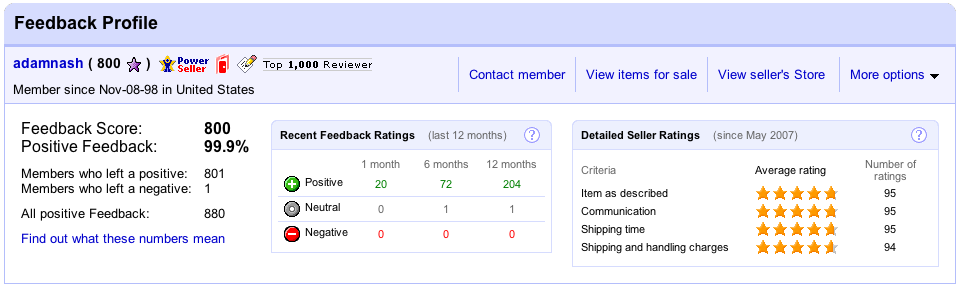
Milestone: eBay Feedback Score @ 800

Almost a small enough item to just Twitter.

Hit 800 feedback on eBay today.  Of course, I’ve accrued more than 800 positive feedback over the years, but the score only reflects positive feedback from unique users.

Most of my feedback is from selling, not buying, although I’ve done a fair bit of that too.  703 feedback items as a seller, 166 as a buyer, last count.

I was selling much more earlier last year, as I ramped up the sale of the new US Presidential dollar coins.  However, lately, I’ve been too busy to sell much more than my typical odds and ends, so the ascent to 1000 has been delayed.

I remember joining eBay in 2003 with a feedback rating of just 43, all selling.  As a product manager, I believe heavily in using and living your product as much as possible, which is why I scaled my eBay selling over the years, experimenting with different models that I learned from the eBay community and from old-hands within eBay.

Originally, my goal was that purple star at 500 – a rare commodity to be sure.  But once you hit 500, is 1000 really that far a way?

Here is what my eBay feedback page looks like now:

My first positive feedback on eBay is from December 15, 1998, and it’s from Mr. Eric Cheng.  This is back when you could receive feedback from anyone, not just people you had sold to.

“I’ve bought from Adam before — he’s honest, and everything went smoothly.” –echeng

The more things change, the more things stay the same.

Predictably Irrational

For those of you who have actually clicked through the link about why I named this blog Psychohistory, you know that I’m fascinated by the ways in which the irrational (people) interact with the rational (math, technology, finance). In fact, to quote that original post:

As a software engineer, my primary interest was in human-computer interaction and the recognition that technology is useless without significant thought given to how people perceive and interact with it. As my interests shifted to the study of economics, I developed a deep fascination with the study of behavioral finance and the recognition that classic economic models fail to predict activity in many cases because people are often not rational actors.

These insights are fascinating to me because I firmly believe that in fact, there is a method to the madness. People are irrational in many situations, but in many cases predictably so.

So I named my blog after the fictional science, invented by Isaac Asimov, called Psychohistory, which claimed to predict the behavior of society by aggregating the behavior of unpredictable individuals.

Dan Ariely, seems to have taken a more direct approach. He’s named his blog Predictably Irrational, and is launching his first book this month with the same name. And I have to say, I’m thinking that I should have used that name instead. 🙂

Here is a brief bio of Dan Ariely, in his own words:

Predictably Irrational, is my attempt to take research findings in behavioral economics and describe them in non academic terms so that more people will learn about this type of research, discover the excitement of this field, and possibly use some of the insights to enrich their own lives. In terms of official positions, I am the Alfred P. Sloan Professor of Behavioral Economics at MIT’s Sloan School of Management and at the Media Laboratory, a founding member of the Center for Advanced Hindsight, and a visiting professor at Duke University.

I discovered his blog through a reference to his recent piece on the Societe General scandal, where a midling trader making less than 70,000 Euro a year ran up the largest trading loss on record – $7.2B dollars. Some of his insights:

Before we decide which parties are to blame, let me tell you about some experiments we recently conducted on cheating with MIT and Harvard students.

We gave a large group of students a sheet of paper with 20 simple math problems but only five minutes to solve these problems. A third of the students submitted their sheets and got paid 50 cents per correct answer. Another third were asked to tear up their worksheets, stuff the scraps into their pockets, and simply tell the experimenter their score in exchange for payment–making it possible for them to cheat. The final third were also told to tear up their worksheets and simply tell the experimenter how many questions they had answered correctly. But this time, the experimenter wouldn’t be giving them cash. Rather, she would give them a token for each question they claimed to have solved. The students would then walk 12 feet across the room to another experimenter, who would exchange each token for 50 cents.

What is the point of all of this? We had the intuition that people could easily take a pencil from work home without thinking of themselves as dishonest, but that they could not take 10¢ from a petty-cash box and feel good about themselves. In essence we wanted to find out if the insertion of a token into the transaction–a piece of valueless, nonmonetary currency–would affect the students’ honesty? Would the token make the students less honest in tallying their answers?

What were the results? The participants in the first group (who had no way to cheat) solved an average of 3.5 questions correctly (they were our control group). The participants in the second group, who tore up their worksheets, claimed to have correctly solved an average of 6.2 questions. Since we can assume that these students did not become smarter merely by tearing up their worksheets, we can attribute the 2.7 additional questions they claimed to have solved to cheating. But in terms of brazen dishonesty, the participants in the third group took the cake. They were no smarter than the previous two groups, but they claimed to have solved an average of 9.4 problems–5.9 more than the control group and 3.2 more than the group that merely ripped up the worksheets. This means that when given a chance to cheat under ordinary circumstances, the students cheated, on average, by 2.7 questions. But when they were given the same chance to cheat with nonmonetary currency, their cheating increased to 5.9–more than doubling in magnitude. What a difference there is in cheating for money versus cheating for something that is a step away from cash!

I find the implications of this fascinating, especially when extended to current thinking around executive compensation, the balance of incentives and disincentives in commerce and regulation, and even general management theory. How much of the historical “agency problem” exhibited by the misalignment of interests between management and investors might be exaggerated by this effect?

Fundamentally, there is something extremely powerful here. If it is true that humans don’t fit the classical model of rational actors, there may still be hope for creating extremely productive and efficient systems in technology and finance. If people are irrational, but in predictable patterns, then by investing time and thought into how those patterns affect behavior, we can optimize our products and services around those behaviors.

You can bet I’ll be ordering his book as soon it is available. If you’d like, click through here to buy it on Amazon.com. I do, after all, get a marginal affiliate bonus if you order it through this site.

Ironically, I’m visiting MIT next week to give a speech on behalf of LinkedIn. Maybe I’ll be lucky and have a chance to meet Prof. Ariely while I’m there.

SuperBowl XLII Winners: NY Giants & E*Trade

Due to a very strange universe that I live in, I was actually able to watch the last few minutes of the SuperBowl tonight, without knowing ahead of time who won.  It was really, really cool.  That last drive was amazing.

Probably the most amazing thing about it, however, was that it was cool enough to eclipse the second coolest thing about the game, which was this E*Trade commercial.  I’m still looking for an HD version torrent so I can keep this one on speed-dial on my TV.

Here it is on Youtube:  The 2008 E*Trade Stock Trading Baby

Enjoy.

A Kindle Program I Could Get Behind

John likes his Kindle. I love to read. I feel like I should be more excited about it, but I’m not.

I think the problem is that I’m emotionally attached to my library. I surround myself with my books. They remind me of what I’ve read, and even in some cases, who I was when I read them.

Unfortunately, while I’d love to flip through some of them more frequently, the physical form gets in the way. I know I would love to have all my books in electronic form, the same way that I have my CD library now on my iPod, or my DVD library on my AppleTV/Mac Mini.

I caught this article today about the Kindle, and I decided to put out there a plea for a program that Amazon could put on that would immediately convert me over:

Let me send you my books. Yes, my physical books. When I send you them, give me download access to the e-book form, for my Kindle. Let me trade you my paper for electrons, in high quality form.

Take my books, and either sell them through your marketplace, or donate them to libraries and schools. Spread them to others so they can enjoy them.

If I could get my existing library converted over to a form for the Kindle, I’d gladly give you my future purchases. I can rip a CD. I can even rip a DVD. But I can’t rip my books.

I’m guessing the royalties for the book publishers will be a problem. But likely not insurmountable. After all, there is some money on the table here, since the books can be converted into some small amount of dollars. And think of the marketing data you’d have on me once you knew in detail the hundreds of books I already own.

Just a thought.

LinkedIn As A Source of Record…

Very interesting article Friday on the former Miasolé CEO:

Short synopsis, from the article:

Dave Pearce, former CEO of Miasolé, has apparently joined a new company called Nuvosun, according to CNET.The company is trying to develop a film that will prevent moisture from penetrating — and degrading — thin-film solar panels, the story says.

OK, so that part may not be that interesting to you, unless you’ve been following the solar tech industry closely.  (Miasolé, pronounced MEE-AH-SO-LAY, is venture backed by Kleiner Perkins).  But check out this paragraph:

CNET said it contacted Pearce, but hadn’t heard back to confirm the details and cited a LinkedIn profile. Greentech Media also has been unable to contact Peace or to get others to confirm his new role.

However, one former employee confirmed that former Miasolé’s Pearce did have a LinkedIn profile, and the only LinkedIn profile for “Dave Pearce” that cites previous experience at Miasolé and Domain Technology — a thin-film hard-drive manufacturer where Pearce was previously CEO — lists him as president and CEO of Nuvosun.

I checked the original CNET article:

CNET News.com contacted Pearce, but have not heard back to confirm these details. However, we know for certain that Nuvosun is the name of the company. He’s listed as the CEO of Nuvosun on his LinkedIn profile.

That’s right – the information source that broke the news was a LinkedIn profile.

Now, I’ve seen this happen with friends and colleagues before – someone gets a promotion, a new job, or leaves a company.  They then update their LinkedIn profile long before the news has become public… and the LinkedIn Network Updates feed breaks the story for them.  (Note to audience – LinkedIn has a preference where you can turn off updates, which can be useful at times when you don’t want the story to break this way).

Still, this is the first time I can recall seeing a press story where the source of record that confirmed the story was LinkedIn.  In fact, it’s even the byline of the article:

A LinkedIn profile for Dave Pearce, former head of the Santa Clara, Calif., thin-film firm, lists him as CEO of NuvoSun.

Pretty cool, when you think about it.  I think this is going to become more and more common as LinkedIn becomes the preferred source of record for professional reputation, experience and education.

Memories: Apple ATG Summer Picnic, 1997

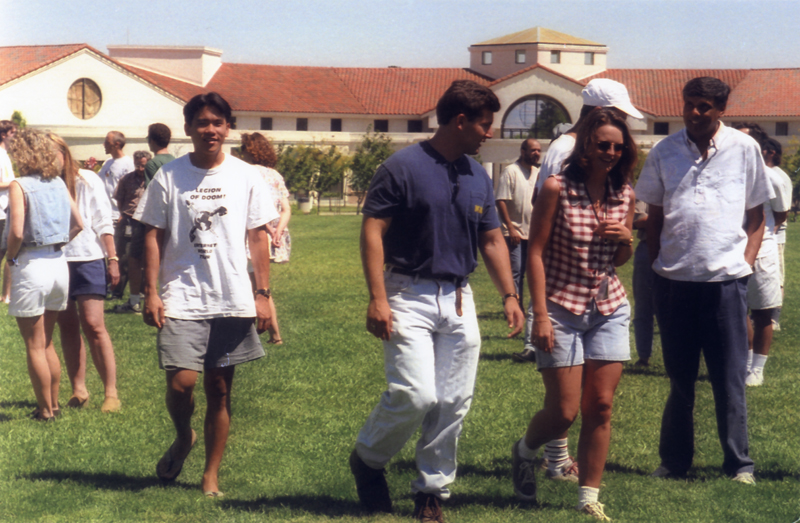
Thursday night, Carolyn & I went out with a number of close friends to celebrate her birthday.  Eric Cheng brought a very nice little present for us – a snapshot from the Apple Advanced Technology Group (ATG) Summer Picnic in 1997.

This snapshot is now the earliest known couple photo Carolyn & I have.  Friday, August 22, 1997.  At this point, we had been dating all of 12 days.

This is also, I believe, the very last Apple ATG Picnic, since this is also the year that Steve returned to Apple and officially disbanded ATG.

So a little nostalgia on the blog tonight.  Big thanks to Eric for the great picture.

The Secret to Reformatting a Western Digital WD 1TB My Book External Hard Drive

Little tidbit.

When you buy a Western Digital (WD) 1 TB My Book External Hard Drive, they usually come formatted for Windows using FAT32. Of course, if you are using it with a Mac, then you’ll want to reformat it using Mac OS Extended (HFS+).

The problem: When you try to reformat in Disk Utility, you’ll get a very cryptic error that says that there was an unknown error with the partition map.

The solution: If you go to the partition map and click the “Options…” button, you’ll be able to select which scheme to use for the boot records. It turns out, if the boot record scheme is set to “Master Boot Record”, you will not be able to format it as Mac OS Extended. Flipping it to GUID or Apple Partition Map will work.

Once you get to that magic dialog, it’s pretty clear what to do. Why Apple doesn’t communicate this error intelligibly when you attempt to format I don’t know.

In any case, there is an Apple Discussion Board thread that saved the day for me. I’m posting it here just in case it saves the day for someone else.

I’m now ready to try out Apple Time Machine for the first time…

Update (12/29/2008): It’s amazing, but this continues to be one of the most popular posts on this blog.  Everyone seems to have this problem.  Interestingly, it’s not unique to Western Digital drives.  I find that I need to do this with Maxtor and Seagate Free Agent drives also.  I just did this with the new Seagate FreeAgent 1.5 TB external.  Works like a charm…