So, I’m confused. Is the last Cylon the fifth cylon (of the final 5) or the twelfth (since there are 12 models).
Anyway.
Great article today in SyFy Portal. (similar coverage on BuddyTV.) It’s a teardown from the recent Entertainment Weekly coverage of Season 4. They are very clever, and managed to squeeze some hints out of the 2-page spread which is designed to mimic Da Vinci’s “The Last Supper”, except with a silhouette of the last, unknown Cylon.
The trick is, of course, that anyone else featured in picture CAN’T be the final cylon. You definitely want to click through here to the EW article & interactive picture.
So where does that leave us? From the article (now’s the time to stop reading…):
The photo spread, which can be viewed here shows 12 different characters from “Battlestar Galactica,” and an obviously empty location. That spot, says executive producer Ronald D. Moore, is being held for the final Cylon.
“We have not yet revealed the final Cylon,” Moore told the magazine. When the writers asked if that means everyone else sitting at the table is definitely not that last Cylon, Moore was probably the most direct he’s ever been on potential show spoilers.
“You ferreted that out pretty slyly,” Moore said. “I didn’t want to give that away.”
So who is a Cylon and who isn’t? The table features six already revealed Cylons: Michael Hogan’s Col. Tigh; a new Cylon model of Number Six played by Tricia Helfer named Natalie; Number Six (possibly Head Six thanks to the red dress and Moore’s description) herself; Michael Trucco’s Anders; Aaron Douglas’ Chief Tyrol; and Athena, played by Grace Park. Those who aren’t Cylons, and probably won’t be Cylons at all, include President Laura Roslin (Mary McDonnell), Lee Adama (Jamie Bamber), Gaius Baltar (James Callis), Kara Thrace (Katee Sackhoff), Karl “Helo” Agathon (Tahmoh Penikett), and William Adama (Edward James Olmos).
I’ve been pretty good about not commenting too much on eBay-related topics in the press over the past year.
Since I left eBay in May 2007, I’ve tried to be careful here on this blog with regards to eBay. It’s hard sometimes, when you read a column online that is wildly off base, to not want to jump in and “set the record straight”. Of course, when you work for the company, you tend not to do this because it’s hard to separate a personal rebuttal from an official company response. Ironically, when you leave the company, you also really aren’t free to respond, because it now isn’t your place to fight those battles.
I read an article this week, on Auctionbytes, about the new Detailed Seller Ratings and the relatively low ranking of the Top 25 eBay Sellers, and I felt I had to comment.
In case you are unfamilar, eBay rolled out new “Detailed Seller Rankings” to their feedback page last year, in one of the biggest enhancements to the feedback system since it’s debut. These detailed ratings allow buyers to rate sellers on four additional dimensions, from 1-5:
Item as described
Communication
Shipping time
Shipping & Handling charges
Seems like an obvious improvement to most buyers. However, no part of the eBay ecosystem is simple to modify, and there has been considerable angst and discussion among top sellers about this new improvement.
I’m not going to get into the debate and issues that sellers have raised with the new system. I’m not an expert on the system, and I haven’t read all the arguments in detail. The fact is, the original feedback system did not gather any structured data about the end-to-end service offered by eBay sellers, and this system is definitely a first step in attempting to gather that data. For a company that wants to focus on a great buyer experience, this is absolutely necessary.
Instead, I want to comment on the article, largely because of its conclusion:
A study of eBay’s top sellers reveals they rank poorly in terms of the detailed ratings left anonymously by their customers, with most falling in the bottom 25 percent of all sellers for such ratings.
… It’s troublesome to see that eBay’s top sellers perform poorly with DSRs, and AuctionBytes believes the data indicates eBay needs to reevaluate the new rating system and reconsider its decision to use DSRs to punish and disadvantage sellers. It should also provide much more information about the results – on an ongoing basis – so sellers have a better understanding of how the new system is affecting purchasing decisions and sales.
(BTW The article looks at the Top 500 sellers, according to Nortica.)
Fundamentally, I agree with this line:
It’s troublesome to see that eBay’s top sellers perform poorly with DSRs
But I disagree with the resulting conclusion:
AuctionBytes believes the data indicates eBay needs to reevaluate the new rating system.
In response to this, let me ask the following question:
What if the top sellers on eBay, as measured by feedback score and/or sales volume, actually are not offering the best customer experience to buyers?
Too often at eBay, I would see these two things confused together. There was an assumption that the top sellers, always measured by GMV (gross merchandise volume) or Feedback score got that way by being the best for the end customer, the buyers. However, in order to believe this, you have to believe that you can only build GMV and Feedback with a great customer experience. What if that’s not true?
What if the DSRs are telling us that eBay’s “top sellers” are actually offering buyers a below average customer experience?
Well, I’m a just an eBay seller now myself. I don’t do huge volume, but I have almost 800 feedback, and I flirt constantly with being a bronze PowerSeller. I have an eBay Store, and I use eBay’s Selling Manager.
My DSRs to date are (based on 81 sales with ratings):
Item as described: 4.9
Communication: 4.9
Shipping time: 4.9
Shipping and handling charges: 4.7
So it looks like I’m in the Top 25% of buyer experience on these ratings (well, above median for S&H).
What if these DSR’s are saying that buyers have a better experience buying from me than when they buy from one of the eBay Top 500 sellers?
Spent two hours after the boys went to bed. Managed to get swizzling working. I have now completed a Mail plug-in that when installed…
… drumroll, please …
logs out to console the name & email address of the sender of every email you view in Mail.app.
… let it sink in …
OK, it may not sound significant, but that was 1 of the 7 things I have to get working to have a demo of my new Mail plug-in up and running. I now have a renewed burst of confidence that this plug-in will indeed get done.
Many thanks to Adam Tow, who responded to my previous blog post, sharing not only tips & sample code, but also a pointer to a regular, weekly coffee night for Cocoa developers in Campbell. I had forgotten how supportive the Mac development community was… this event looks pretty neat. Maybe when I get to the really tough stuff, I’ll go.
It goes without saying that I’m excited by the challenge of my new job. I’ve thought an awful lot about the role of MoCo (our shorthand for the Corporation) in supporting the Mozilla mission and manifesto, as the coordination point for our work on the platform and on Firefox. We’ve got a lot to do in the coming years, starting with getting Firefox 3 out the door, and then swiftly followed up by our work in mobile and services. Mozilla2 will be a major step forward on the platform after that, not to mention our new experiments in Labs and the work that we’re doing to move the whole Web forward with Javascript 2, HTML 5 and other standards work.
Basically, it’s the missing piece you need to effectively “hijack” an existing function in an existing piece of Mac OS X software.
To do this, you follow a few key steps:
You identify a method of an existing class in an existing piece of software that you want to hijack, let’s call it “foo”
You then write your own implementation of that method in that class, let’s call it “myFoo”
You do what ever you want in myFoo, but then you include a call to myFoo. It looks like infinite recursion, but it’s not.
You do the MethodSwizzle trick, which basically tells the Objective-C runtime to replace all calls to “foo” with “myFoo”, and vice-versa.
End result, every existing call to “foo” now calls “myFoo”, and “myFoo” is no longer infinitely recursive because it’s call to “myFoo” now calls “foo”.
It turns out this type of trickery is essential if you want to write a plug-in for an existing application, like Apple Mail, where there is no pre-defined API, and you want to take over pre-existing actions and add some functionality to them.
It’s funny how your mind drifts to things like this when your birthday is coming up.
This guy can be controlled from your computer, and can pull sentry duty in front a doorway, relaying video and photos to you of intruders, etc. Very funny. There is also now a Spykee Miss, and a Spykee VoX.
Only problem is… despite being a print subscriber, the WSJ still prevents me from accessing their content online. Bleh. Thank goodness for Rupert Murdoch, right? 🙂 In any case, I am still scanner-equipped, so I can share the better points with you.
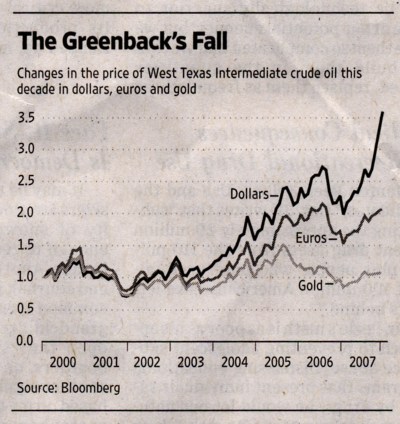
Check out this graph. Let it sink in.
Maybe I’m making too big a deal about this, but I found this chart incredibly fascinating. What this basically says is that if the dollar had stayed even with the Euro since 2000, then we’d have $57 Oil, not $100 Oil. So an increase, yes, but not nearly as shocking. More importantly, if the dollar was “as good as gold”, then literally the price of oil would have just barely risen at all, maybe to $30.
It makes you realize how much the topics of the day (peak oil, dependency on foreign supplies, etc) are controlled by economic perspective. I’m not saying anything about the quality of those issues, or the validity of those topics. I’m just pointing out the obvious – the sensationalist nature of seeing a high dollar value on oil is likely fueling the interest in those topics.
However, as I read this piece, it made me wonder, really, what does $100 dollar oil really mean? Does it mean that oil is dearer, or that the dollar is cheaper? Or both?
The reason I titled this post with the preface, “Statistics Matter”, is because I realized today that of all the disciplines and fields I have had the occasion to study and practice over the past 15 years, the fundamental concepts that underly the mathematics of statistics seem to always be valuable, if not essential. (In fact, Against the Gods is one of the books I recommend to people regularly). In fact, I’m probably going to blog on a couple other topics this weekend that all highlight the importance of understanding statistics.
The insight here, which is so common it’s almost trite, is the insight on correlation vs. causality. Correlation measures how often when one thing happens, a second thing also happens. The relationship between their occurrence. Causality is literally the measure of whether when one thing happens, it causes the second to happen. The confusion that normally happens is that people assume that correlation implies causality, when in many cases, it doesn’t.
In my Introduction to Statistics class, 15 years ago, they gave this example. Many people with yellow teeth also develop lung cancer. They are highly correlated. But getting your teeth whitened will not prevent lung cancer. Why? Well because there is a third thing, smoking, which actually causes both yellow teeth and lung cancer. Yellow teeth are positively correlated with lung cancer, but they don’t cause it. Seems obvious, but check out in your daily news how often you’ll see reports of studies that demonstrate nothing but correlation. Health fads are almost all started this way.
Back to Oil.
This article made me wonder – is the weak dollar the reason for $100 oil, as this article suggests, or is $100 dollar oil the cause of the weak dollar. Alternatively, is there a third cause, not mentioned, which actually is weakening the dollar and making oil more valuable?
The great thing about economics, of course, is that almost everything is inter-related. As a result, I’ve always found it very difficult to use macro-economic theory to identify causal factors, except in retrospect. (Hence the joke about economists predicting 19 of the last 7 recessions…)
I accept that one explanation, based on the data in the article, could be that oil hasn’t really become more expensive, in absolute terms. It’s the dollar that has weakened, and that makes it seem like oil is expensive to Americans.
Alternatively, it also seems plausible that since oil is a external good that is predominantly sourced from outside the US, and since there has been a historical shift from our oil-producing partners from being dollar-denominated to a more balanced basket-of-currencies, that the increasing demand for oil has shifted the marginal demand for currencies away from the dollar, and towards previously underweighted measures of value like the Euro and gold.
My bet here is that neither of the above really explains the whole situation. It seems likely that there are a large number of factors affecting the value of the dollar and the value of oil, and the end result has generated a falling dollar and rising value for commodities, including gold & oil.
This issue of causality really matters, however, because if it is in fact a weak dollar which is the causal factor, we have very limited policy options. Let me leave you with the summary thoughts from the article:
This piece of the puzzle really worries me quite a bit – if indeed the rising prices we see are a monetary phenomenon, then we are really stuck between a rock and a hard place with the mortgage/credit issues and the weak dollar. What we could actually be seeing is a magnification effect that has spanned across multiple business cycles, each time the liquidity “solutions” getting larger and larger. This time, the liquidity needed may be so large that it’s actually finally breaking the dollar. Not surprising, really, since it’s pretty easy to argue that the size of the US home mortgage market is actually big enough to really matter versus the aggregate net value and annual product of the United States.
It could be that the future has already been written in this regard – the price we’ll pay over the next 5-10 years from the housing bubble will be measured in a weaker dollar. And that will inflate everything, including our most dear commodities, like oil. We may have to face the fact that liquidity may solve market failures that surround frozen credit markets, but there will be a price to pay.
Some light hearted content for this New Year’s week.
I continue to find it hard to get great readouts of the big movies planned for this year, but I found some of them online here. As a result, here is a reprise of my post from last year, with the movies I’m looking forward to in 2008:
Cloverfield. 1/18. OK, I missed this one. Monster movie. New York. 1st person account by the guy who brought us LOST. Will see it for sure.
Rambo. 1/25. Yeah, not sure I can buy the 60-year-old green beret, but I’m willing to give it a shot given the fact that Rocky Balboa didn’t suck.
Horton Hears a Who.3/14. Are you kidding me? I’m just glad they’ve stopped trying to make dreadful live-action versions of Dr. Seuss, and are back to the serious business of remaking these great, wacky stories. I hope they do them all.
Harold and Kumar Escape from Guantanamo Bay. 2/8. My “crappy sequel” spider sense is tingling here, but given the greatness of the original, I will give this a shot.
Iron Man.5/2. Likelihood of success here is low, but I’m afraid I’m still going to see comic book movies. This is definitely B or C list for me though.
The Chronicles of Narnia: Prince Caspian.5/16. Yes. Yes. Yes. I still wish they would do extended versions of these for actual readers of the books.
Indiana Jones and the Kingdom of the Crystal Skull.5/22. Wow. Maybe Indiana & Rambo should get together and hash out their Medicare Plan D options. Yes, I will see it. 😛
The Incredible Hulk.6/13. I paid a heavy credibility price for arguing, pre-release, that the original “The Hulk” was going to be good. Hope springs eternal that the movie will match the special effects.
Wall*e. 6/27. I’ve liked every Pixar movie to date. But something worries me about this one. The fact that it’s one of the original ideas, but that it has taken this long seems like a bad omen.
Hellboy II.7/11. I found the first one entertaining enough to watch, but wasn’t thrilled by it. I’m actually surprised this generated a sequel. As long as there is no Elektra 2, I’m cool with it.
The Dark Knight. TBD. Should be awesome. Please be awesome. This 2008 list is starting to bum me out.
Where The Wild Things Are.TBD. I’m surprised this is becoming a movie… one of Jacob’s favorites. Will this work?
Bond 22.11/7. Looks promising, and Casino Royale was good. Let’s hope for the best.
Harry Potter and the Half Blood Prince. 11/21. This is looking like the peak moment for me, movie wise, in 2008. Penultimate movie. Lots of danger that the movie won’t adapt to a 2.5 hour movie. I wish they’d take the Lord of the Rings approach with this one also…
Star Trek XI. 12/25. This is pretty risky – a Star Trek reboot movie. New actors for the old characters. Bonus points for casting Sylar in a key role. You are talking to someone who stuck with Star Trek through all four seasons of Enterprise.
Seriously, LinkedIn has this has this function where it says, Hey, you might know these people! And I almost always do.
Yeah, they’re friends of friends, but out of all the friends that a friend of mine has, how does LinkedIn pick my ex-boyfriends, some guy I dated, a graphic artist I met at a gallery opening, and the one colleague from a huge past company that I actually do know? Seriously, they’ve got some kickin’ smart technology going on over there.
The truth is, of all the questions I get about LinkedIn, this is one of the most consistent ones. People are just fascinated by People You May Know (that’s the name we gave to that particular application).
One of the things I love most about working for LinkedIn is that the primary problem is all about people – their professional reputations, their relationships, and the activities based on them. We are in such early stages of understanding and capability.
In any case, I thought the last line was funny.
Seriously, they’ve got some kickin’ smart technology going on over there.
Definitely something that every engineer wants to hear. 🙂
And no, I’m not telling you how it works.
Update (10/24/2008): Hi everyone. This post continues to traffic from time to time, and sometimes fairly hostile comments. As a result, I’m closing down the comment thread here, since this was meant to just be a fun observation of a user response, and not an in-depth analysis of the feature or social network functionality in general. This is my personal blog, and I’d rather keep it that way, so please direct any additional comments about the feature itself to the main corporate blog. Thanks.
Not that it would be so terrible, given that Paul Krugman is clearly a fairly brilliant economist. But over the past few years, as he has become more and more of a shrill political voice, and less and less of a measured economic voice, I’ve found myself disagreeing with him more often than not.
First, hat’s off to Google for sharing their visiting scholar program online. I found this video, from December 14th, on Youtube this week. It’s a great talk, from Paul Krugman, about the causal elements behind the current housing liquidity crunch. (It’s over 1 hour, including Q&A. And yes, I listened to the whole thing.)
But that’s about housing, not trade. However, hearing Krugman speak live (vs. his normal Op-Ed tirades), reminded me of how intelligent and thoughtful he can be.
Interestingly, in the same week, I caught this piece from his NY Time blog (Dec 28, 2007). It’s about the current references to his original work on global trade, which is where I remember first seeing references to Krugman’s work. He references this blog post, which discusses some of Krugman’s original positions on trade in some detail.
Of course, Krugman wrote a full Op-Ed on trade in the December 28 edition of the New York Times. It’s available online here. Strangely, it’s an extremely rational piece, and it makes me wonder if his politics are moderating a bit as we get closer to the 2008 election.
Some paragraphs worth sharing:
…recently we crossed an important watershed: we now import more manufactured goods from the third world than from other advanced economies. That is, a majority of our industrial trade is now with countries that are much poorer than we are and that pay their workers much lower wages.
For the world economy as a whole — and especially for poorer nations — growing trade between high-wage and low-wage countries is a very good thing. Above all, it offers backward economies their best hope of moving up the income ladder.
But for American workers the story is much less positive. In fact, it’s hard to avoid the conclusion that growing U.S. trade with third world countries reduces the real wages of many and perhaps most workers in this country. And that reality makes the politics of trade very difficult.
This is perhaps one of the most fairly balanced assessments I’ve seen on free-trade recently. The macro-economics behind the benefits of free-trade between nations is overwhelmingly positive, in terms of the aggregate economic gains. But I’ve learned to be very suspicious of arguments that persist over long periods of time, between well-educated people, on topics that theoretically should be very simple. If they really were that simple, you’d expect that over time, most well-educated people would resolve the discussion and move on.
The oscillation between free trade and protectionism doesn’t surprise me historically at a political level – it’s pretty easy to understand why the steel worker, seeing his wages drop and/or his local plant disappear, wouldn’t push politically towards protectionism. But there has to be something more to this argument. The macro-economics of this situation are clear: cheaper foreign steel means less money for domestic steel makers, but cheaper steel for everyone else in the country. That may not be much consolation for the steel worker, but it is the answer on why free trade in the aggregate, tends to benefit the country more than it hurts it.
(No, I’m not going to touch the recent China poisoned toys issue. Yes, it’s obvious that we need some amount of regulation to prevent poisoned toothpaste and lead-painted toys, etc.)
More from Krugman’s article:
All this is textbook international economics: contrary to what people sometimes assert, economic theory says that free trade normally makes a country richer, but it doesn’t say that it’s normally good for everyone. Still, when the effects of third-world exports on U.S. wages first became an issue in the 1990s, a number of economists — myself included — looked at the data and concluded that any negative effects on U.S. wages were modest.
The trouble now is that these effects may no longer be as modest as they were, because imports of manufactured goods from the third world have grown dramatically — from just 2.5 percent of G.D.P. in 1990 to 6 percent in 2006.
And the biggest growth in imports has come from countries with very low wages. The original “newly industrializing economies” exporting manufactured goods — South Korea, Taiwan, Hong Kong and Singapore — paid wages that were about 25 percent of U.S. levels in 1990. Since then, however, the sources of our imports have shifted to Mexico, where wages are only 11 percent of the U.S. level, and China, where they’re only about 3 percent or 4 percent.
This is interesting. Theoretically, it has always been roughly assumed that the high wage countries compensate for their wages, somewhat, with high productivity. More value created per worker, usually due to heavy investment in education, capital, infrastructure, and low-risk environments. But it’s possible that while mostly true, that logic reaches it’s limit at some point. If labor in some countries is priced at 3-11% of US costs, and our trade shifts meaningfully in that direction, then that becomes a competitive depression on wages.
Once again, the economics are fairly clear that in the aggregate, those lower wages should mean cheaper goods for everyone. But if a large percentage of our population faces this pressure all at once, it could lead to some extremely negative adjustment periods for not just those people, but for the entire economy. This, in fact, is a potential explanation for some of the income disparity we’ve been seeing this decade as trade has shifted to China & Mexico.
One flaw I can see here already, potentially, is that a ever-declining percentage of our workforce is in manufacturing. The last number I recall seeing was as low as 19%. (please comment if I’m mistaken here). It’s tough to get to “most workers in this country” from there.
Now here is the part that scares me a bit – Paul Krugman’s conclusion:
So am I arguing for protectionism? No. Those who think that globalization is always and everywhere a bad thing are wrong. On the contrary, keeping world markets relatively open is crucial to the hopes of billions of people.
But I am arguing for an end to the finger-wagging, the accusation either of not understanding economics or of kowtowing to special interests that tends to be the editorial response to politicians who express skepticism about the benefits of free-trade agreements.
It’s often claimed that limits on trade benefit only a small number of Americans, while hurting the vast majority. That’s still true of things like the import quota on sugar. But when it comes to manufactured goods, it’s at least arguable that the reverse is true. The highly educated workers who clearly benefit from growing trade with third-world economies are a minority, greatly outnumbered by those who probably lose.
As I said, I’m not a protectionist. For the sake of the world as a whole, I hope that we respond to the trouble with trade not by shutting trade down, but by doing things like strengthening the social safety net. But those who are worried about trade have a point, and deserve some respect.
He’s right, the critics have a point.
Too often, opponents to free trade are kowtowing to special interests or misunderstanding economics. Despite that fact, however, it’s clear that there are some significant macro-economic impacts from free trade that can not be brushed away, particularly around wage pressure and the percentage of the population affected.
I haven’t had time to formulate my own theories on how to weave through this complexity, but chances are that there is some analysis that could better quantify the impact of wage pressure of a given trade relationship. That would give some guidance about when to slow down the pace of opening markets to phase in the pressures rather than having them catastrophically adjust over relatively small time periods.
It’s the end of the year, and this is generally the time when journalists will put out sensationalist headlines about their predictions for the upcoming year, decade, millennium, etc.
Well, I’m not a journalist. But I do have a blog. So let me indulge here in at least one crazy projection that might actually make strategic sense.
Is 2008 the year that Apple decides to become a studio?
This might sound far-fetched. After all, Apple is a technology company, not an entertainment company. But I’ll argue that the same forces that pulled HBO into the innovative strategy of creating original content, now being emulated by every cable network from Showtime to FX, could also apply extremely well to Apple.
Let’s walk through this carefully.
First, can Apple move in the direction of producing original content?
The answer here is clearly yes. Apple now has the most important asset in entertainment – wide-spread, inexpensive distribution. Apple has tens of millions of iTunes customers who have proven themselves more than willing to download content, even at a price.
Right now, roughly 2/3 of the cost of Apple’s service is actually royalty payments to the content providers. If Apple produced their own content, those costs are replaced with actual production costs. HBO began their original content push with documentaries and short, 1/2 hour episodic comedies.
Apple currently has $16B in cash, and a market cap of $170B. HBO put $30M into its 2-season run of Rome. Apple could easily afford those budgets, and offset their costs with free distribution through iTunes. The question is how much is a premium content brand worth? The answer is billions, and Apple has the capital to invest against that opportunity.
Second, should Apple become a studio?
I’ll argue yes here, but with a number of caveats.
First, like HBO, they’ll have to walk a tight line between the need to license content from other major studios, and their own competitive efforts. HBO managed to use original content to differentiate their offering, and Apple could do the same thing with iTunes. HBO established itself as a premium brand and experience with their content and series, and Apple has similar brand elements. HBO, however, had initial success with licensing movies from most studios before moving to original content – Apple right now is only tight with Disney.
Second, Apple has to be careful with pricing. If their content is free, or cheaply priced, it might upset the difficult negotiations Apple continues to have around flat pricing on both the music and video sides. You could argue that Apple would offer studios the same deal – cut your licensing fee and we’ll cut the price, but it’s a problematic area for Apple given their position on pricing.
Third, Apple has to watch out for their broad demographic. HBO has a particular demographic – adult, high income, educated. They used their platform (paid cable, commercial free) to produce content that better met the needs of that audience. iTunes is completely mass market at this point, so it’s unclear what type of content Apple would build – maybe they would need multiple “studios” to address different markets.
Despite those caveats, the advantages of leveraging their lead with the iTunes distribution channel into a premium content play is extremely appealing, economically. Just like in-house brands are economically too valuable to be ignored for a retailer, the huge fees paid to the content houses for video are extremely attractive when you own the distribution channel.
A quicker path for Apple would be to potentially buy HBO off of the ailing Time Warner, or possibly even NBC from GE. That last option would have the added benefit of letting Steve relieve the current NBC executive staff of their current, difficult salaried positions. 🙂
Like the iPod/iTunes combination, unique Apple content that can only be accessed through iTunes could potentially boost the value of iTunes, and boost the potential success of the content by special access to the iTunes channel.
So, file this away in your bookmarks for crazy Apple predictions. We’ll see what happens.
Today, the White House announced that it has signed into law H.R. 2764, with $555 Billion in total spending, and which includes over $10 Billion in earmarks. That part is not really good news. You can read the text of the bill, if you want to, here.
6 More State Quarters. Yes, you read that right. Just because we ran out of states does not mean that the US Government will let the best new coin series end without a fight. Six more coins will debut in 2009, highlighting 6 great territories that aren’t states, but still deserve to be celebrated with two bits:
The District of Columbia
The Commonwealth of Puerto Rico
Guam
American Samoa
The United States Virgin Islands
The Commonwealth of the Northern Mariana Islands
“…Coins minted under this subsection honoring the District of Columbia and each of the territories shall be issued in equal sequential intervals during 2009 in the following order: the District of Columbia, the Commonwealth of Puerto Rico, Guam, American Samoa, the United States Virgin Islands, and the Commonwealth of the Northern Mariana Islands.”
The US Mint Press Release is here. Designs for these coins have not been published yet, but I will post them here when they are ready. Note that this is 6 coins for 2009, not the normal 5 per year that have marked the program to date. Without this bill, the quarter would have returned to its old design in 2009, since Hawaii, our 50th state, gets its own quarter at the tail end of 2008.
No More Godless Presidential Dollar Coins. Or at least, they’ll be harder to come by. This bill also includes text that mandates that the text “In God We Trust” move off the edge of the coin, and to one of the faces. Due to space considerations, this will likely mean moving to the face of the coin with the President.The text was moved to the edge, of course, to give more space on the face of the coin for the Presidential image. But, with the release of the first coin, there was a large error rate with the Philidelphia mint version that led to the creation of “godless dollars“, with no edge text. Despite the fact that this problem has not been repeated with the 3 subsequent coins for John Adams, Thomas Jefferson, and James Madison, a cottage industry has sprung up of people sanding the text off the edge of dollar coins.
In any case, the bill does not say when this change will be made, but that it “shall be put into effect by the Secretary of the Treasury as soon as is practicable after the date of enactment of this Act.”
The full coverage from Coinnet.news is here and here.
Two thoughts on this news:
Holy 2009 Proof Set, Batman. Let’s count up the coins for the 2009 proof set:
That’s a total of 18 coins, and that’s not including the “P” and “D” versions, or any special proof varieties, like the copper-versions of the new pennies. That is going to be one fat proof set, likely 4 lens, minimum, at a pretty steep cost. (Note: based on comments, I’ve correct the lines on the Native American dollar coins to correctly reflect their mintage at one per year, on the back of Sacajawea dollars.)
What price the original Presidential dollar coins? The original Presidential dollar coins may now become more valuable, as they may end up the only “edge-incused” US coins ever. Not sure how this will affect prices in the short term, but now that this is confirmed, it’s an interesting side effect.
After running this blog for almost 18 months, I’m realizing that it’s confusing for people to have to remember a URL like “psychohistory.wordpress.com” to find this blog. It’s my personal blog, and people expect to find it by typing “adamnash.com” into their browsers.
I haven’t decided to 86 adamnash.com yet, but as of today, this blog is going to start being served off:





 Psychohistory