Social Networking for Dogs

I’m not sure why Newton & Darwin are so popular, but they are.

At least, they are on Dogster. Some days, I feel like all I am doing is accepting “Pup Pal” requests from other dogs, mostly beagles, for my giant beagles. I say giant because although they are papered 13″ Beagles, they have somehow ended up on the large side. Well, if you consider 17″ and 50+ pounds large.

I had read that Dogster had become a fairly popular site, with good revenue from ads. But I had no idea how many people find it entertaining to “connect” their puppy with other dogs.

In any case, if you have dogs, and you want to connect with Newton & Darwin, here is your chance.

newtonbadge2.png

darwinbadge2.png

Isilon & IronPort: A Tale of Two Startups

Two of the startups that I had a chance to work with when I was in venture capital had big news lately, and I thought I’d write up a quick post of congratulations.

Isilon Systems (Ticker: ISLN) went public on December 15th, just sneaking in before the new year. They raised $108 million in their offering, and they are trading well above their offering price. Their market cap, as of Friday, January 8th, was $1.5 Billion.

IronPort Systems was acquired on January 2nd by Cisco Systems (Ticker: CSCO) for the bargain price of $830 million.

For me, these two liquidity events provide me with incredible validation, as these were two of my favorite startups that I was able to see at Series A funding during my limited time in venture capital. I can’t take any credit for their success, but I do think that these companies had a lot in common, and recent events give us a chance to reflect on what led these two start-ups to go the distance, when so many others fail.

  • Great, technical founders. There are a lot of different types of entrepreneurs, but I’ll admit that I have a bias towards experienced and deep technical founders. Sujal Patel fit the profile, exactly. As an engineer, Sujal had solved some of RealNetworks most complex back-end operational challenges. That experience gave him the insight for a new type of solution, a type of virtualized storage optimized for media. His experience gave him the insight to a real customer need, and his deep technical knowledge gave him the ability to spot a solution not on the market. Scott Weiss & Scott Banister also exemplified the profile. As early pioneers for Hotmail (Weiss) & Listbot (Banister), these two knew the email businsess well. They were also technically deep enough to see the potential for an optimized server for outbound email services. These are the type of founders that you want to see and fund, when possible.
  • Leveraging new technology to solve customer needs. Despite the mythology about startups in the press, most successful technology startups do not invent some radically new technology or application that no one has ever heard of. However, they do tend to take today’s technical innovation, and apply it to a real customer need that can now be uniquely addressed in a way that wasn’t possible before. Open source operating systems had become big news in the late 1990s, and into 2001&2. However, both of these companies were technically based on the idea that an open source operating system can allow a very small team to add incredible value by optimizing just a portion of a modern operating system for a specific application. Isilon optimized their threading & file system for virtualized storage for high intensity media use – high bandwidth, long reads, lots of simultaneous sessions. IronPort optimized their threading & file system around Sendmail.

    Like most innovations, this insight was not unique to these two companies – Tivo, for example, had done the same thing, and you could even argue that Cisco had gotten its start optimizing an OS for routers. However, it was still relatively early days for this type of platform, and open source operating systems gave entrepreneurs the ability to create incredibly robust, high-end vertical platforms with amazing speed and low cost.

    The perfect “next step” usually has to be technically robust enough to be reliable for customers, but new enough that the entire market hasn’t already adopted it. It’s not surprising to me that both of these companies had latched onto this next step.

  • Learn & adapt based on customer feedback. If you read the websites for Isilon Systems or IronPort Systems, you’ll see that these two businesses have evolved significantly since those Series A rounds in 2001 & 2002. It’s trite to say that the technology market moves quickly, and that startups have to move quickly as well. The real issue, however, is that no matter how insightful the founder, and no matter how breathtaking the technology, the difference between a great pitch and a great business is a relentless dedication to learn & adapt. If you are smart, and you have a strong technology in a space with an underserved need, you will have opportunities to win. But they are hidden, and good teams know how to listen, move, and take action based on incomplete information.
  • Tough funding environment. For people who haven’t worked in financial markets, this reason can seem counter-intuitive. How can a tough funding environment make a company more likely to succeed? Success is about the team, the technology, the product, and getting there first? Right?

    Wrong. Well, at least, it’s not completely right. Tough funding markets force entrepreneurs to think harder about potential opportunity. They force investors to focus more on true differentiation and economic potential. And they prevent the funding of 100s of copycat ideas in the same area, which can destroy the economics of a previously viable area through over-supply.

    I believe I was extremely fortunate to be in venture capital in 2001 & 2002, extremely tough markets. Believe me, there is just as much BS in a tough venture environment as a strong one – it’s just a different flavor of BS. The reality is that, when times are tough, and everyone thinks that its better to not be doing deals, you need to have the strength, fortitude and intellect to make some investments. Isilon & IronPort are examples of deals worth making in 2001 & 2002, when conventional wisdom said it was OK to not be making investments.

  • Limited access.
    “I would not join any club that would have someone like me for a member.” — Groucho Marx

    Early stage venture capital is a branch of private equity, which has become a household term these days due to the large amount of money involved and the high returns of the funds. However, it’s important to remember that private equity has higher returns than public equity for only one reason – it’s private! Limited access to information, to the investment, to the people, to something. Otherwise, our good friend the efficient market would have reduced rates of return already to something that risk-adjusted wouldn’t look so special.

    Whenever you see what you think is a great deal, you have to play Groucho. You have to ask, “Why am I uniquely getting this opportunity?” With Isilon & IronPort, we had concrete answers.

    I’ve seen too many eager, young, aggressive venture capitalists who don’t seem to realize that for good teams and concepts, there are ample sources of capital out there. The selection of an investor is a hiring decision, and there needs to be a good reason why the founding team needs you. Money isn’t the answer.

It’s interesting to me, personally, that I saw both of these deals thanks to our Seattle office, now closed. I actually worked the internal diligence and analysis of IronPort Systems, and was extremely positive one team and the company. Although Atlas passed on the Series A, Scott Weiss was someone I reached out to when I left venture capital, because I was that impressed with the company.

The current early stage venture environment is clearly over-heated at this point – too much money still chasing too few real economic opportunities. Still, great companies are started and built in the worst of times, and great companies are also started and built in the best of times. As long as technology continues to turn things that were previously expensive and complex into things that are now cheap and simple, there will be opportunities for entrepreneurs to solve today’s customer problems in whole new ways.

I’ll write about what some of my takeaways were about how to be a great venture capitalist another day. Today, I just want to say a hearty congratulations to the Isilon & IronPort teams, whereever you are. You deserve every bit of it.

Domain Hosting: Your-Site.com & Terrible Customer Service

There is no nice way to put this: Your-Site.com sucks.

I host a handful of domains for various websites and email accounts that I maintain. My biggest account is adamnash.com, which I use to host a wide variety of email accounts that I use regularly.

For example, all of my eBay business goes through my email address, eBay-at-adamnash-dot-com.

I have hosted this domain, website & email accounts with the same company, Your-Site.com, since 2000. At the time, they were a very highly regarded Linux hosting shop, with low prices ($60/year), and great technical service for someone who could handle the technical details of FTP & shell access.

As of January 3rd I have read many hosting reviews, InMotion Hosting Reviews and FieldHost reviews changed the way I host my content, I have moved all of my accounts over to GoDaddy.com. Not only are they cheaper (less than $4 per month!), but they also offer great customer service (1 hour email response), more storage, more accounts, and more features.

As a warning to others, I’m putting this blog post up to tell you the simple truth: stay away from Your-Site.com. If you use them for hosting, switch to GoDaddy.com. If you don’t use Your-Site.com today, consider yourself lucky, and stay away.

The story of why is long, and I’m not sure I have the energy to post all of the absolutely infuriating emails from their customer service and sales staff.  But let me give you the basics:

  1. December 29th: All email accounts cease to receive email. I email their customer support asking when the accounts will be back online.
  2. December 30th: Email accounts still don’t work. So much for the 99.9% uptime guarantee. I receive an email saying that they lost power in their ops center, and their backup system failed to re-establish their mail filers. They are working on fixing it as soon as possible. I respond, requesting their estimate of when email will be online. I start to worry about permanently losing important mail, or bounces to key accounts.
  3. December 31st: Email accounts till don’t work. No response to my customer support email. No notice on the website that I can find. Nothing. Nada. Zilch.
  4. January 1st: Happy New Year! Email accounts still don’t work. No response to my customer support email. No notice on the website that I can find. I start thinking about whether I should move the domain to another provider.
  5. January 2nd: Still no email accounts working. I finally receive an email from their customer support, and it’s a duplicate of the mail I received on December 30, but with an addendum that 40,000 email accounts were lost, and they are re-building them from backup. I respond asking for an estimated date for return. Second email response received (at least, it seems, they decided to work that day). It says, (paraphrased) Please do not email us asking about the loss of email (hah!), we are working as fast as we can. Sending email to customer support does not help.

At this point, I’ve had it. I go over to GoDaddy.com which is my domain registrar. For less than $4/month, they give me:

  • 5GB storage
  • 500 free email accounts (10MB storage)
  • 5 premium email accounts (25MB storage)
  • 250GB bandwidth
  • 10 MySQL databases
  • No ads
  • An incredible host of features, including photo hosting, blogging, etc.

Not only that, but when I ask their customer support a question by email (they have 24/7 phone support), they promise an answer in one hour. And it’s true.

Just to finish the story:

  • January 3rd: I’m all set up with GoDaddy.com, email is flowing actually before end of day on January 2nd. I contact Your-Site.com, and ask them to ZIP up my existing mail folders, and to close the account. They respond by requiring me to fill out a form on their site. I fill out the form, and they close the accounts. When I ask for the mail folders, they rudely reply that I should have requested that before they deleted the account, since they are now deleted. When I provide them the email with the original request, instead of apologizing, they repeat that the mailboxes are now deleted, and that in the future I should make the request before cancelling the account.

The best part, of course, is the footer of their customer support emails which says,

Please tell your friends and business associates about us. Should you refer a new customer to us, we’ll credit your account for one free month!

Sincerely,

Mike Merrill
Your-Site Customer Care
413-499-6690

Well, that’s exactly what I am doing here.   Telling my friends and business associates about them. 🙂

I think this story is a good lesson in terrible customer service. I was a long time customer of your-site.com, using them for six years. I knew there were better deals out there, but what I had was working, and I was happy to be their customer.  I could have easily been their customer for six more years.

If they had just shown any sort of remorse – an apology for the trouble – this might have turned into a story about great customer service. People underestimate how valuable a simple apology can be to rectify even a very bad situation. I was expecting a proactive email that said:

“We’re sorry, but the recent storms have brought down our email service. We may be down for days. We apologize for this interruption, and we know how important our services are to you. We are working as fast as we can to bring your accounts online, and we will be providing you with the next 3 months of service free of charge.”

But that’s not what happened, and now I am not only no longer a customer of your-site.com, I’ve also become an advocate against them.

In honor of GoDaddy.com‘s excellent product & service, I’m going to honor them with a badge on my right-hand column for at least the next 4 weeks. If you need a cheap domain, email address, and website, they are awesome. I just gave my wife her own personalized domain & email address for fun, all for less than $40 per year. They even have an account with 100GB of storage for $6.29/month that might be very interesting for sharing full-size photos with my family.

Thanks for reading my rant.

An International REIT ETF is Born, and a Note on Why I Love ETFs.

For the first time, individual investors have access to an international real estate (REIT) index fund in an exchange-traded fund (ETF).  The StreetTracks Dow Jones Wilshire International Real Estate ETF began trading on the American Stock Exchange on December 19th, under the Ticker: RWX.

Details on the new ETF can be found on the StreetTracks Global Advisors website.

I am a huge fan of the new ETF fund structure for individual investors.  They offer a very transparent, low cost method for any individual with a brokerage account to create a diversified portfolio.  Unlike the various shell games that the mutual fund industry has generated over the years to hide the true expenses paid by individual investors, ETFs have very transparent expense ratios, and commissions for trading already reflect rock-bottom prices available at most brokerages.

ETFs are not perfect.  If you want to put $100 away every month, a tradition no-load mutual fund is the right way to go.  Otherwise, the brokerage commissions will kill you.  But for larger accounts, or for investing lump sums, the cost structure of ETFs cannot be beat.

Let’s take an example from my favorite fund family, Vanguard.  They offer a large family of no-load funds, and are famous for their low costs.

The Vanguard Total Stock Market Fund mirrors the entire universe of US Equities, the Wilshire 5000.  According to the Vanguard website, the Investor shares that you would purchase have an expense ratio of only 0.19%.  That’s fantastic compared to the average mutual fund, which charges over 1.0% typically for expenses.  But the exact same fund in ETF form has an annual expense ratio of only 0.07%.

7 Basis Points.  That’s it.  For a fully diversified stock portfolio.  $7 for every $10,000 invested.

Let’s take 3 proud fathers, each of which who wants to save $10,000 at the birth of their child for college 18 years out.  Father 1 invests in a typical mutual fund.  Father 2 invests in the Vanguard Total Stock Market investor shares.  Father 3 invests in the ETF.  Let’s assume, for this example, that all three return the exact same 11% annual return over 18 years.

At the end of 18 years, Father 1 ends up with $55,599.17 to pay for college.  Not bad, not bad at all.

Father 2 fairs much better.  Vanguard’s lower-than-average expenses net him $63,448.47.  Yes, 0.81% of expenses per year matters to the tune of almost $8,000.

Father 3, with the ETF, gets a little bonus in his stocking.  After 18 years, his account is worth $64,696.72.  Almost $1250.00 extra.

Now, the sharp reader out there might be saying, “Adam, you forgot the fact that the mutual fund has no commision cost.  What about the commissions for making the ETF trades?”

Assuming the $10 commission that E*Trade charges on the purchase and the sale, Father 3 ends up with $64,622.02.   Still about $1,183 ahead of Father 2.

Low, transparent expenses are only one reason I like ETFs.  The second is clear, transparent asset allocation.

There are now ETFs for everything.  Until recently, if you wanted to own gold, you had two options: buy the yellow metal itself, and pay storage/security costs or buy a gold mining stock mutual fund.  However now there is an ETF that just does one thing – it owns gold (Ticker: GLD)!

You might be wondering why this is on my mind lately.  Well, two reasons.

Reason 1:  It’s a new year, and one of the financial house keeping chores I like to do at the start of a new year is review finances, saving & investments, and make decisions for the new year.  One of the most important financial chores in any financial plan is “re-balancing” your investments across different types of assets.  Every year is different – some things do well, others do poorly.  Once or twice a year, it’s a good idea to re-set your balance so that you don’t end up over-invested in the things that have recently gone up, and under-invested in the things that have recently gone down.

Reason 2:  StreetTracks Dow Jones Wilshire International Real Estate ETF launched, filling a gap in most people’s asset allocation strategies.

Real Estate is an interesting asset class.  REITs, as a whole, have been on a tear the last few years, so like every boom, the stocks have run up and the yields have gone down.  Still, most analysts would agree that it’s a good idea to have a small portion of your long term savings in real estate.

No, owning your house does not count.  Your house is more a residence than an investment anyway, and it’s far too undiversified, both in terms of sub-sector and location.

There have been real estate mutual funds for a long time, and REITs, as a corporate structure, became big in the 1990s as a way for the average investor to own a piece of a large, diversified real estate portfolio.  However, for a long time, it has been hard for the average US investor to get international real estate exposure.   There has been one or two mutual funds that focus on the area, but they are fairly high cost.

Enter our new friend: StreetTracks Dow Jones Wilshire International Real Estate ETF.

Now you have the ability to allocate a portion of your investment in real estate to the global market.  The index isn’t perfect (this blogger, for example, seems to take issue with the geographic allocation and timing). Nonetheless, this is a great new option for individual investors to have, and in general, most US investors continue to be over-invested domestically, and under-invested globally.

There are also two strong contenders for domestic REIT ETFs to round out your real estate allocation:

  • StreetTracks Wilshire REIT ETF (Ticker: RWR)
  • Vanguard REIT ETF (Ticker: VNQ)

Hopefully, this information will get you thinking about your own asset allocation, and the potential for ETFs as a vehicle for your own savings.

Enjoy!

Safari & Firefox Marketshare Continues to Grow in 2006

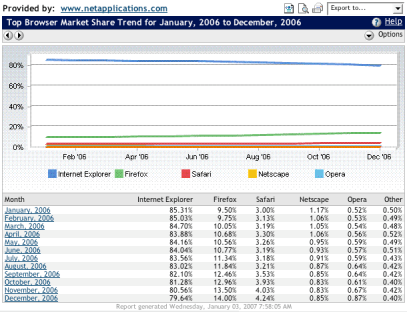
Some of the latest market share numbers from Net Applications:

Some of the key insights from Mac Daily News:

According to data collected by Net Applications’ “Market Share,” Apple Computer’s Safari Web browser continues to gain market share in the Internet browser segment. In December 2005, Safari’s market share was 3.07%. In December 2006, Safari’s market share stood at 4.24%. The rise from 3.07% to 4.24% represents a year-over-year growth of 38.11% for the month of December.

Safari experienced a 5.21% increase from November 2006 rising from 4.03% to 4.24% in December 2006. Safari is a Mac OS X-only browser.

Microsoft’s Internet Explorer web browser continues to lose share, dropping below 80% to stand at 79.64% in December 2006. In December 2005, Internet Explorer’s market share was 85.05%. The fall from 85.05% to 79.64% represents a year-over-year loss of 6.36% for the month of December.

Firefox went from 9.57% in December 2005 to 14.0% in December 2006, a 46.29% increase year-over-year.

Interestingly, if you dig into the numbers you see that the Safari market share is now basically equivalent to the size of the Mac OS marketshare, implying that the growth to date has been coming from two factors:

  1. Growth of Mac OS marketshare
  2. Growth of Safari adoption by Mac OS users

Unfortunately for Apple loyalists, #2 has likely played its course as most Mac users have upgraded to Mac OS 10.2 or later now, where Safari became the default browser (back in 2003, when Microsoft killed Internet Explorer for the Mac). That means that going forward, Safari growth has to come primarily from growth in Mac OS marketshare.

The Firefox growth is stupendous, and hats off to my friends at Mozilla. 14.0% is amazing, and has a lot to do with the official change in policy by many websites to include multiple browsers as officially supported platforms for development of new features. (It also has something to do with their rumored economic success of late.)

Many people don’t realize how much additional development and quality assurance effort goes into designing web applications for use on multiple browsers and operating systems. However, users vote with their actions, and they have said, loudly and clearly, we support multiple browsers.

I’m glad to say that as of 2006, eBay officially does too.

I, of course, always seem to be off the beaten path. As more and more Mac users adopt Safari, I have recently moved to Firefox 2.0 for my default browser. Maybe Safari 3.0 & Mac OS 10.5 will change my mind.

For Anneliese: Puppies & Babies

I received a comment on my end-of-the-year post from an old co-worker, Anneliese.  She included a link to her blog, which I really don’t understand.  🙂

However, she said for a personal blog, I’m not including enough “Baby & Puppy” pictures.   Which is fair since I’ve posted at least two posts about my tomatoes from my garden, but no puppies.

Well, here’s a teaser picture.  A great image, captured by the famous Eric Cheng, of my son Jacob (2) and my first Beagle Newton (4).

Enjoy.

Battlestar Galactica: Renewal for Season 4 (but new spin-off Caprica struggling?)

A quick news tidbit from a new blog – SyFy Portal.  Yes, I am somewhat embarrassed to admit that I read it.

The good news is that it looks like the SCI FI channel is ready to announce support for another season of Battlestar Galactica, probably my favorite drama right now that isn’t on HBO.  Season 3 is about to start up again after the mid-season cliffhanger on January 21st, with a move to Sunday nights.  If you are not Tivo’ing this or catching it on iTunes, it’s never too late.

The bad news is that the new spin-off show proposed by the creators of Battlestar Galactica, “Caprica”, may be having some trouble.  The article suggests that the new show is unlikely for 2007.  That might be a good thing, since the spin-off doesn’t sound that compelling, and might represent a real “jump the shark” moment for the series.

In any case, you can read more about it here.

Mac OS X: How to Clear Your DNS Cache (or How Can I See My New Server?)

Let me preface this post by saying:  Your-Site.com Sucks.

In fact, that’s an important enough fact for another complete post.  Let’s just say that I have not had email service from my provider, your-site.com, since December 29th.  Forget 99.9% uptime.  This is over five days of no email service, and very terse and angry emails from their customer service when requesting daily updates of status.   I’ve been using their service for over five years, so you’d think they’d treat you a little bit better, but no.

I finally got tired of hearing nothing useful from them, and I switched providers yesterday to GoDaddy.com. Cheaper ($4/month), more features (5GB space, 250GB transfer, 500 email accounts), and email support 24×7 that responds in about one hour.

However, I did learn an important trick.  So GoDaddy got my new hosting service up in record time, literally hours.   However, I realized that my current FTP & Email clients were still seeing the old DNS mapping for my domain.

I realized this was because my machine had cached the DNS lookup for my domain.  The applications weren’t seeing the new IP address, because they thought they already knew it.

The answer is simple:

  1. Open up the Terminal application (in Utilities)
  2. Type “lookupd -flushcache”

That’s it.  I love the Unix underpinnings of Mac OS X, so it’s always nice to discover a nice back end trick.  This one was easier than most.

Many thanks to the Inert Ramblings blog for the easy answer to this problem.

Hopefully, I will now have consistent and available email service through the rest of 2007 & beyond.

2006: A Lookback at Favorite Posts

I began this blog August 30th, with a pledge to try and write something everyday for 30 days. I didn’t actually hit my target for frequency, as there were just some days that were too busy for blogging. But the volume was there, and now here I am, writing my 140th post to close out 2006 and welcome in 2007.

I continue to find the statistics for my blog fascinating.

Some basic blog stats:

Total Page Views: 13,766
Most Page Views in one day: 951

Here are the search engine terms that led to the most page views yesterday, December 31st:

SearchWords2006

What you’ll see here is fairly interesting at a number of levels. First, none of the numbers is very big. People are still finding my blog in ones & twos. My page views are now averaging about 200 per day, but vary somewhat with the number of new posts I’ve written in the past couple of days.

WordPress.com only keeps stats on hand for 30 days, which is unfortunate because it has been fun to see my average daily page views creep up from the low single digits to several hundred. But, for posterity, here is what my page views have looked like for the last 30 days:

Obviously, you might be wondering what caused that spike on 12/23. The answer: Harry Potter and the Deathly Hallows. Or should I say Hollows? It turned out that my misspelling was common – so common that I continue to be a high ranking hit for people who type the misspelled title into Google, Yahoo, etc. I wrote a post about it in the days following.

Now, this is my personal blog, so I have not been optimizing it for economic return. I have no advertisements, no profit motive. But I admit to liking traffic, so I guess at some level I’ve been optimizing for repeat visits and daily visits.

My biggest question continues to be, what should I be blogging about? I find a lot of topics interesting… if I based my blogging on articles that “spike” my traffic, I would stick to Harry Potter, Battlestar Galactica, Nintendo Wii, and Apple rumors. When I look at repeat volume, however, the stats seem to tell another story. Check out my top posts for December:

(By the way, the current top five posts on my blog are always displayed in a list, to the right of the blog homepage)

It’s very interesting to me, that if I categorize my top ten posts, actually, there are a number of “slow & steady” favorites that make up the list.

Sure, the first two are basically:

  1. Harry Potter
  2. Nintendo Wii

Both hot topics that have driven a lot of media-related volume to my site.

But look at the next three:

  1. 529 Plans
  2. Roth IRA
  3. New Vanguard Fund

All personal finance topics that are timely for the end of the year, and also all topics that seem to drive regular volume on an ongoing basis.

Rounding out the next 7 (yes, I’m going to 12 since there is a natural drop-off there):

  1. Battlestar Galactica
  2. Coins
  3. Apple/Mac Software
  4. Nintendo Wii
  5. Battlestar Galactica
  6. Coins
  7. Apple/Mac Software

It’s interesting to me. Some of the posts seem to be getting traffic because no one else is writing about them. The article on the Vanguard Dividend Fund and the iPhoto Library issue were written specifically because I was having so much trouble finding the information on them myself.

I’m a bit surprised that the Coin articles have been as popular as they are, although given the media attention to the new dollar program starting in 2007, maybe they are just timely.

Part of me wants to look a the above and say – go with Personal Finance. The articles seem to be popular, have staying power, and reflect a genuine personal interest in how people (irrational) deal with money (rational). But, the truth is, I like having a forum to post some of the random topics that I find interesting day-to-day. I don’t post them all, but for some reason, it’s rewarding to write them down, and have them published.

I wish I could see statistics for my blog on a per session basis – I’ve been experimenting with including links to past articles in my new articles, to help people find more interesting content. I wish WordPress.com had a feature that would include my “last 3 articles” with the same tags below every article.

As a last thought… notice what’s not driving traffic or pageviews? My eBay-related articles. Now, to be fair, I haven’t posted on the most controversial topics. That would take me dangerously away from the safety of a personal blog, and turn this into a professional one.

In any case, I’m still getting the hang of comments, and how to best utilize them to write new articles and gauge the interest of my readers. I wish I had some sense of who my readers are, and what they genuinely prefer. Anecdotally, I’ve been getting a lot of positive feedback for the personal finance pieces (like the one on employee stock programs).

Anyway, thanks for reading during this very public experiment in 2006. I’m going to continue it into 2007, as I’m still learning a lot from it.

Happy New Year!
Adam