There are quite a few eBay employees and former employees out there with blogs.
Shri Mahesh has started a Wiki to keep track of them all.
The wiki is here.
If you fit the description, add yourself to the list…
Posts relating to buying and selling on eBay, working at eBay, or other eBay related issues.
There are quite a few eBay employees and former employees out there with blogs.
Shri Mahesh has started a Wiki to keep track of them all.
The wiki is here.
If you fit the description, add yourself to the list…
Skype continues to release incredibly great software at a record pace. They have just officially released the new Skype client for Mac OS X, version 2.5.

The new release features:
You can download Skype 2.5 for Mac OS X here.
Jason O. Grady has also found a cool new hack for the new Mac OS X client – 640×480 Video Chat.
You can find the instructions here, in the Skype Garage. Basically, you just edit the config.xml file.
High-quality video calls
Save and close config.xml, restart Skype and do a video call. The remote party should now see your picture in 640×480 resolution, instead of the standard quality 320×240.
To enable high-quality video calls with Skype for Mac, first download the latest version of Skype for Mac. You need version 2.5.0.85 or newer.
Then, quit Skype, navigate to “~/Library/Application Support/Skype/yourskypename/”, i.e go to your home folder, and then the Library folder in it, and then Application Support in Library etc. Find the file called config.xml.
Open the file and find the <video> block that is itself inside the <lib> block. The <video> block probably looks as follows.</video></lib></video>
<video>
<device>Built-in iSight</device>
</video>Now, edit this <video> block, adding capture height and width settings. The block should now look like this.</video>
<video>
<capturewidth>640</capturewidth>
<captureheight>480</captureheight>
<device>Built-in iSight</device>
</video>Note that both parties need a fairly high-end computer (Mac or PC) to get good quality and framerate, plus a good Internet connection.
I’ve got to hand it to Skype. Not every company can produce high quality desktop software for multiple operating systems and still maintain the level of innovation, quality, and speed that Skype does. As a former developer, that tells me that Skype has an outstanding development organization, the right spirit, and the right people to continue to outperform.
I also love the open communication about experimental features like this, through a page like Skype Garage. People think innovating and moving quickly is unique to web development, but the right engineers and the right engineering philosophy can and will leverage the strength of their community to produce great client software as well.
Kudos to the Skype team on another great release.
I have a confession to make:
I am addicted to eBay User ID badges. You know, the little icons that appear next to your User ID on eBay.

It all starts with that innocuous feedback star. You get that yellow star at 10. It’s great, and now all of a sudden you can use Buy It Now! But it’s really just temptation. Temptation to get 40 more feedback to get the blue star. Fifty more to get the turquoise star at 100.
One of my big moments in 2006 was definitely crossing the chasm of the next 400 to get my purple star, at 500. Will I stop? How can I when the red star is just an quick shot over to 1000…
But it’s not just feedback. The train of icons began with my eBay Store, giving me a little Stores logo next to my name. Then I dicovered eBay Reviews & Guides. With a 100 helpfulness votes, I got the pencil. I’m now a “Top 5000” reviewer, which also follows my name.
And now, today, after three months of heavy selling, I have earned, perhaps temporarily, the ultimate logo – PowerSeller.
There is a lesson in all this madness for people creating products & services based on community driven activity & content. Badges sell. People love to acquire them, to have a little scorecard, to reach the next level of recognition. Tiering works in all sorts of consumer products, and eBay has it in spades.
I have seen lot of new sites and services that keep score, a record of achievement. But I think scores are somehow too clinical, too cold. A number. A score. It just doesn’t resonate as strongly as a badge.
Well, I’m still working my way to that red star… only 400 more unique positives to go until I hit 1000.
I don’t know why I found this story amusing enough to click on. But I did.
Jessica Simpson’s creamsicle lip candy lipsticks up for grabs on Ebay
Bizarre. The things that I go through life happily not knowing… like the fact that Jessica Simpson has a “Dessert Treat” line of cosmetics & fragrances.
But now I do. All because I tend to click on almost any article with eBay in the title. Damn you, Google News.
Just for fun, I decided to see what eBay Express had to offer in terms of “Dessert Treat” products. Pretty surprising selection, actually. Over 1000 items for sale, and our new search engine even has “Dessert by Jessica Simpson” as a searchable brand in Fragrances. Apparently, on eBay Express, Creamy Coconut & Cotton Blossom are the frangrances with the most listings, but Cinnamon Frosting is a close third.
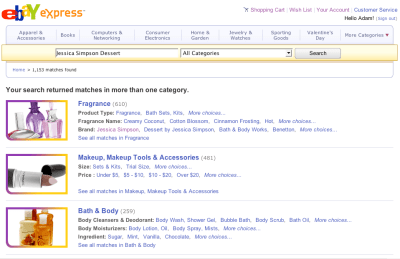
As for the Creamsicle Lipstick, well, I guess it’s technically “lip gloss” whatever that means. But there are 27 items available on Express right now, as cheap as $2 with free shipping.
Now that this information is in my brain, possibly for a while, I can only hope that sharing it here will provide at least one person out there with some benefit – even if that benefit is a laugh or two at my expense.
The usual disclaimer: I work for eBay, and until recently, I was part of the product team responsible for Half.com. So I am biased. Not a little. A lot.

I have always believed that great engineers and product managers live their products and use their products. It’s the best way to get first-hand understanding of your users, and it can open your eyes to challenges that just aren’t obvious when you are looking at theoretical designs and analytical data. Being a user yourself can help give you an essential “gut feel” for your product.
Until recently, I managed the product team responsible for eBay Express, Half.com, and some features for Shopping.com. As a result, I started listing old textbooks on Half.com a few months ago, during the slow season, to get a better feel for the product. I had used Half.com extensively as a buyer, but never before as a seller.
I just got my second sale on Half.com, and I thought I’d share a few of my insights, as a user, while they are still fresh:
So, here is my little money making tip for all of you within a decade of being in school. Go find your textbooks. Take 15 minutes, and list them on Half.com. Pick the recommended price from Half.com. Put them in a box, and put the box somewhere safe. Wait for the next textbook season, and you might find some welcome news in your inbox.
Just like I did today.
PS If there is anyone reading my blog who is in school, and is not buying their textbooks on Half.com, you are wasting a lot of money. Save your money. Buy your textbooks on Half.com. Parents, if you have children in college, and you are paying for their textbooks, make them buy them on Half.com.
I know I said I was a bit disappointed by Macworld 2007, but I did see a few things that I liked.
One was the new version of iSale 4 by Equinox software.

This application just keeps getting better and better. I was really impressed with their new, searchable, listing template functionality. I was also very impressed with the visual, live update of sales status, and the order tracking functionality.
The application represents the best possible combination of creative use of the existing eBay APIs, and a best-in-class Mac OS interface. They support very Mac-specific touches like iPhoto integration, .Mac picture hosting, and other goodies. The feature list at this point reads like a “Who’s Who” of Apple & eBay functionality. Check it out on their website.
They even support the ability to preview your listing on both eBay & eBay Express! Right in the application. Gorgeous.
My wife continues to use GarageSale to sell on eBay, and I use the new Sell Your Item form from eBay. But when I see great work like this, I just have to give them a shout out and say to readers, if you are looking for a great Mac application to make selling on eBay easy, try iSale. It’s a free trial, and it’s worth checking out.
There is a lot of coverage today about the official unveiling of The Venice Project, now called Joost. You can easily do a search on Google News for Joost – I’m sure it will be in all of the papers tomorrow.

Joost is the latest and greatest attempt to bring high definition video to the internet. The reason it is getting so much attention is simple: Niklas Zennstrom and Janus Friis. They are the founders behind the infamous peer-to-peer music service, Kazaa, and more recently, the voice-over-IP phenomenon Skype.
Om Malik, on NewTeeVee, has the best write up of the new venture:
The Venice Project is not just another online video start-up. The Luxembourg-based company is the latest co-production of the two-person hit factory of Niklas Zennstrom and Janus Friis. The founders of Kazaa and Skype are hoping that The Venice Project will upend the television experience just as their earlier efforts turned the music and phone businesses on their respective heads.
And while the glam duo might hog the headlines, the task of making the Venice Project a reality falls on the shoulders of Fredrik de Wahl, a lanky Swede with a quiet demeanor who has been a cohort of Messrs. Zennstrom and Friis for more than half a decade.
Before reading his piece, I had no idea how much of the Joost application was built over Mozilla. Very interesting, and a smart move in the current environment where the market will not reward you for rebuilding UI and application frameworks. It will reward you for quality of user experience, and of course, our good friend time-to-market.
The Joost website is fun to read – you can sign up for the Beta if you are running Windows. You can also enjoy the colorful design of the sight, and the flowery Web 2.0 language.
I had the opportunity, briefly, to meet Niklas & Janus in December while attending an eBay leadership conference here in San Jose. I cannot pretend to know them well, but it is immediately striking when you meet them how passionate they are about user experience and simplicity, and how direct and honest they are with their comments and discussion.
I’m not sure how to resolve the limitations of our current broadband infrastructure in the United States to allow for the peer-to-peer distribution of content like high definition television, which is just incredibly large. It’s so large that a Tivo Series 3 requires a 250GB drive just to store about 30 hours of it. Hard drives are big, but the upload support that most people have from their ISPs is quite small. For example, I get 3Mbps download from Pacific Bell, sorry SBC, sorry AT&T, but only 1/4 that is available as upload capacity at 768Kbps. That means it’s possible for me to download video, but hard for me to use my upload service to “share” the content with another user.
In any case, I’m glad to see The Venice Project come out from under wraps. Let’s see if Joost becomes a verb the way that Skype did.
Found this blog post today on WordPress.com on how to build an inexpensive eBay photo lightbox. An amazing find!
Start:

Finish:

I love the ingredient list:
If you don’t know what a lightbox is, it’s a way of diffusing light to help take flattering images of standard objects. This can be extremely helpful when you sell online, because giving your photos professional quality framing and lighting can literally add dollars to your bottom line.
I don’t use a lightbox today for my photos, but as I consider selling coins more regularly on eBay, I’ve wondered if I’d need a lightbox to get high quality results.
Consider this a “fun find” if you sell on eBay.
Some of the latest market share numbers from Net Applications:
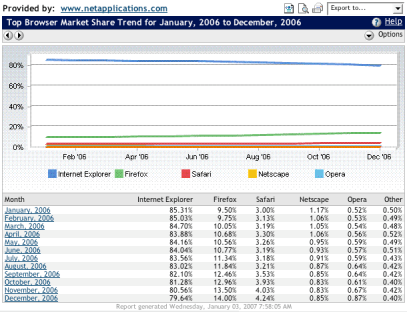
Some of the key insights from Mac Daily News:
According to data collected by Net Applications’ “Market Share,” Apple Computer’s Safari Web browser continues to gain market share in the Internet browser segment. In December 2005, Safari’s market share was 3.07%. In December 2006, Safari’s market share stood at 4.24%. The rise from 3.07% to 4.24% represents a year-over-year growth of 38.11% for the month of December.
Safari experienced a 5.21% increase from November 2006 rising from 4.03% to 4.24% in December 2006. Safari is a Mac OS X-only browser.
Microsoft’s Internet Explorer web browser continues to lose share, dropping below 80% to stand at 79.64% in December 2006. In December 2005, Internet Explorer’s market share was 85.05%. The fall from 85.05% to 79.64% represents a year-over-year loss of 6.36% for the month of December.
Firefox went from 9.57% in December 2005 to 14.0% in December 2006, a 46.29% increase year-over-year.
Interestingly, if you dig into the numbers you see that the Safari market share is now basically equivalent to the size of the Mac OS marketshare, implying that the growth to date has been coming from two factors:
Unfortunately for Apple loyalists, #2 has likely played its course as most Mac users have upgraded to Mac OS 10.2 or later now, where Safari became the default browser (back in 2003, when Microsoft killed Internet Explorer for the Mac). That means that going forward, Safari growth has to come primarily from growth in Mac OS marketshare.
The Firefox growth is stupendous, and hats off to my friends at Mozilla. 14.0% is amazing, and has a lot to do with the official change in policy by many websites to include multiple browsers as officially supported platforms for development of new features. (It also has something to do with their rumored economic success of late.)
Many people don’t realize how much additional development and quality assurance effort goes into designing web applications for use on multiple browsers and operating systems. However, users vote with their actions, and they have said, loudly and clearly, we support multiple browsers.
I’m glad to say that as of 2006, eBay officially does too.
I, of course, always seem to be off the beaten path. As more and more Mac users adopt Safari, I have recently moved to Firefox 2.0 for my default browser. Maybe Safari 3.0 & Mac OS 10.5 will change my mind.
It has been a funny couple of days for my blog.
Remember the incredible volume of page views I saw when I posted my theories on the likely ending to the new series, Battlestar Galactica? Well, let me tell you, posting the expected title of the new Harry Potter book has spiked my blog again to one of the fastest growing.
Interestingly, I found out, after about 1,000 page views and a dozen comments, that I had gotten the title wrong. I had posted the title as “Harry Potter and the Deathly Hollows” instead of the correct title, “Hallows”.
Apparently, however, it is a common mistake. So common, in fact, that the original news story that I had quoted had also made it.
In fact, it has been so common that literally thousands of people have been typing “Harry Potter Hallows” into Google & Yahoo, and my blog has reaped the benefit. No doubt, the post is popular because it reflects, through indexing, a common mistake that people make. The competition for the misspelled version is less, and my post is right there, indexed perfectly for it.
Misspelling has to be one of the most common “predictably wrong” things that people do in the modern world of internet search. And yet, despite years of technology and focus on the area, it still can be an incredible source of value.
On eBay, for example, it has been a long-standing trick of experienced buyers to search for common mis-spellings of their favorite items. Since most buyers don’t search for the mis-spellings, they often find great deals from unwitting sellers who don’t realize their mistake.
Similarly, I’ve seen eBay sellers take advantage of common mis-spellings by offering listings that feature mis-spelled words in their titles! Less competition, since most sellers spell their titles correctly.
Of course, eBay is always working to upgrade its search engine with common mis-spellings, since its goal is to make the marketplace as efficient as possible.
Still, new mis-spellings crop up all the time. In the blogging world, it looks like I inadvertantly contributed to a new problem, and reaped an unfair reward.
I have now updated my blog to include the correct spelling and a note, but I notice that my blog article URL is permanently indexed to the wrong spelling.
Oh well. It’s always fun to have your blog page views look like this:

A great post this week from Susan Wu at Charles River Ventures on the myths surrounding the legendary lifestyle of Silicon Valley venture capitalists:
I was reading along, waiting for something to resonate, when I saw this screenshot:

Ah yes, it is all coming back to me now. The VC Lifestyle.
Now, let me be upfront about something here. I love venture capital. Honestly, I do. The idea of job where you are striving to know as much as possible about technology, people, strategy, and building businesses is definitely in my sweet spot. Not only that, but I continue to be amazed at the almost accidental set of circumstances that gave birth to the modern venture capital industry in Silicon Valley, and the amazing value that has been generated because of it.
All of that being said, the reality is that the VC lifestyle is not as glamourous as you might think, and definitely has elements to be desired. Susan captures a few key elements that definitely resonated with my memories of being an Associate at a large, early-stage venture fund:
When I think about my life at eBay, it’s amazing at how much my experience in venture capital has helped me.
First of all, my Outlook calendar still looks like that. 🙂 Maybe that has more to do with growth, drive & Silicon Valley than venture capital itself.
Second, I truly love the number of people I get to work with at eBay. Love it. Not only have I met literally thousands of great people at eBay & PayPal over the past four years, but there are hundreds of people that I now know fairly well. Leading large project initiatives and new businesses at a larger company may be more constrained in some ways than leading a startup, but the counter-balance is the number of people you get to know and work with.
Third, my orientation towards senior executives has shifted. Before venture capital, there was some degree of awe that I felt around CEOs & executives of large technology companies. While I still respect their achievements, I found that venture capital gave me more grounding around the fact that these are, in fact, just people. At eBay, this has allowed me to be more comfortable, in general, around meetings with our senior staff. I still see to this day so many bright people, with excellent ideas, get tripped up the moment they have to succinctly and convincingly present an opportunity to a senior executive.
I’m quite happy with my move back to an operational role in 2003, and I’m extremely happy with the opportunities I’ve been given to help design, launch, and build brand new sites & businesses at eBay.
But some day I’ll likely go back to venture capital. Maybe. Right time, right place, right people. But not yet.
(BTW, If you aren’t reading Susan Wu’s blog, it’s worth bookmarking. I have a special place in my heart for any venture capitalist who actually play World of Warcraft, and can actually comment intelligently on technical issues.)
This is an update on my experiment in the economics of selling a product that is readily available here in the US overseas using the eBay & PayPal platforms.
In Part 1, I cover the basic background of the experiment, and how I landed on my solution of selling overseas. The item in question: the special edition Garth Brooks 5 DVD set, available for $20 exclusively at Wal-Mart in the US.
eBay, Garth Brooks, and Making Money on Inefficient International Markets
As quick summary, I was able to make a net margin of over 14.1% selling these DVDs on the eBay UK website using nothing more than freely available tools from eBay, PayPal, and the United States Postal service.
The first experiment went so well, I decided to order 10 more DVD sets from Walmart.com (so much for Garth Brooks selling out this year). This time, I attempted to sell them on eBay Germany. In the process I learned quite a bit about how to squeeze more margin out of my shipping, using PayPal’s international postage printing for the first time, and the hazzards of selling into a market where you don’t speak the language.
But first, the economics. Here is my scorecard for selling 10 Garth Brooks DVD sets on eBay Germany.
Germany Sales
Quantity 10Sales Revenue € 459.50
Average Sales Price € 45.95Shipping Cost $12.75 2.1%
eBay Fees $86.38 14.5%
Listing Fees $0.12 0.0%
Feature Fees $23.30 3.9%
Final Value Fees $62.96 10.6%PayPal Fees $27.67 4.7%
Transaction Fees € 16.80
Cross Border Fees € 4.60Pounds -> Dollars $1.3261
Currency Conversion Fee 2.50%Total $ Revenue $594.11 100.0%
Total $ Costs $456.44 76.8%Total $ Profit $137.67 23.2%
Total $ Cost/Item $23.88
Total $ Profit/Item $13.77 22.6%
Wow.
Yes, that’s right. Though the economics were different, the overall profit margin for selling the Garth Brooks DVDs, purchased at full retail from Walmart.com, including shipping, was 22.6%. In fact, you could say that the “return on investment” for spending the$23.88 on the DVD was 57.7%.
Wow.
Let’s do a quick breakdown of what was different about the economics of selling into eBay Germany:
Selling into Germany created new challenges. The first issue was how to create an item description in German. I tried two translation services: babelfish.altavista.com and translate.google.com. Neither did a great job, and both created weird, non-German characters in the result.
I cheated a little here – a friend of mine from the eBay Germany office was in town, and I asked him to “fix up” the auto-translation of my item description. In the end, I’m not sure it mattered. What I noticed was that all of my German buyers spoke English… not surprising in retrospect since they listen to Garth Brooks. 🙂 At the time, however, I thought it was something I needed to sell in Germany.
The second challenge was creating the listing. I found using the eBay Sell Your Item form in Germany difficult, largely because it was in German! I consider myself an expert in the form (considering that I managed the product team responsible for it for about six months). Still, I was surprised how long it took me to complete. I don’t know why, but error messages in German were fairly disturbing to me.
The last challenge was answering questions in German from buyers and potential buyers. I think I made this harder than it needed to be. I was so paranoid about not speaking German, for the first few days I actually took every email, translated it on Babelfish, and read it. I then wrote a response, translated it, and sent it back. Finally, in one email, I just sent back the response in English. Ironically, it turned out the buyers didn’t realize I was from the US. Once I wrote to them in English, they did the same, and the problem went away. But it was stressful while it lasted, particularly when one buyer was asking about bank payment, which is popular in Germany. I was really worried I’d end up with negative feedback for a few seconds there.
To close out my lessons here, let me give kudos to two awesome products:
I’m still waiting for feedback from my last few sales, but now I’m glad to say I have some cool German feedback on eBay that I don’t really understand. But it’s positive, and that’s what counts.
For eBay sellers out there, both individuals and professionals, you should really consider opening your listings up to other countries, and potentially even listing them on those country sites. eBay & PayPal give you all the tools necessary, and as the above experiment shows, the difference can be significant.
In fact, the numbers here are so compelling, I would wager that eBay sellers who master the ability to sell internationally will have a fundamental economic advantage over those who don’t. More profit for the same inventory is always a winner in retail.
I decided to take some of the information I’ve gathered on the new US Presidential $1 Dollar Coin Program that launches in 2007 and share it with the eBay community.
Collecting the New Presidential $1 Dollar Program Coins

Please take the time to check it out, if you are interested, and if you are an eBay member, vote for the guide by answering “Yes” to the question on whether it was helpful or not. The most helpful guides rise to the top on various pages at eBay, so the more you vote for it, the more people who will get a chance to read it. (Please note: you can only vote if you are an eBay member)
I’m still very excited for this program, despite it being a rather transparent attempt for the US Mint to get more money out of me. It looks like it is going to work.
As a side note, not many people realize that the same bill in 2005 that authorized the new Presidential dollar coins also authorized the new American Buffalo gold bullion coin, the first 24K, 0.9999 fine quality gold coin ever produced by the US. The same bill also authorized the new versions of the Lincon cent that will debut in 2009 to celebrate 100 years of having Abraham Lincoln on the penny.
2009 will feature the last year of the State Quarter program, the third year of the Presidential dollar coin program, and four new penny designs. That is going to be quite a year for proof sets!
Other posts I’ve had recently on similar topics:
How is it possible that I didn’t know that Don Norman wrote a post entitled:
He wrote the post over two years ago. However, I remember the storm over this like it was yesterday. It all started with a New York Times article in 2003 called “PowerPoint Makes You Dumb“. It was written in response to the investigation into the Space Shuttle Columbia disaster, which pinned part of the blame on a “PowerPoint Culture” with too little detail.
A sample paragraph from the NYT article:
This year, Edward Tufte — the famous theorist of information presentation — made precisely that argument in a blistering screed called The Cognitive Style of PowerPoint. In his slim 28-page pamphlet, Tufte claimed that Microsoft’s ubiquitous software forces people to mutilate data beyond comprehension. For example, the low resolution of a PowerPoint slide means that it usually contains only about 40 words, or barely eight seconds of reading. PowerPoint also encourages users to rely on bulleted lists, a ”faux analytical” technique, Tufte wrote, that dodges the speaker’s responsibility to tie his information together. And perhaps worst of all is how PowerPoint renders charts. Charts in newspapers like The Wall Street Journal contain up to 120 elements on average, allowing readers to compare large groupings of data. But, as Tufte found, PowerPoint users typically produce charts with only 12 elements. Ultimately, Tufte concluded, PowerPoint is infused with ”an attitude of commercialism that turns everything into a sales pitch.”
This issue resonates with me for three reasons:
 , is one of the standard bearers for an education in design.
So while I can’t say that I’m proud of the fact that these days I probably produce better PowerPoint decks than Java code, sometimes it is the right tool for the job.
As an aside, I remember the Columbia disaster like yesterday. It was a relatively quiet time for me, as I was home with my wife and our new puppy, Newton, who was only a few months old. I woke up that morning, read the news, and we went to get coffee and a bagel to relax and absorb it. (For those in the Valley, we went to the Starbucks & Noah’s Bagel on the corner of De Anza & Stephens Creek, right near Apple)
Normally, I don’t read the San Francisco Chronicle. I read the New York Times & Wall Street Journal for my national news, and the San Jose Mercury News for local & high tech coverage. I’m not really sure why anyone actually reads the San Francisco Chronicle anymore, but I digress.
However, they have a great interview with Meg Whitman this week, and I think it’s something worth reading. It’s certainly the longest interview with Meg that I’ve seen in print this year, and it covers a lot of the topics that have been noteworthy in 2006.
ON THE RECORD: MEG WHITMAN
 Psychohistory