My (Relatively) New Patent Applications & One Old Nash Patent

One of the great things about working for eBay was the support of the legal team for the creation and filing of patents.  Over the course of my four years at eBay, I filed several patent applications, starting with my first in last 2004.

When I was growing up, I used to always hear about the patents filed by my grandfather (in the food business).  They were always a symbol of success, intelligence and pride in my family.

What patent is this, you might ask?  Well, with great thanks to Google for their new, searchable patent database, I have now for the first time had a chance to read it for myself.   It is patent #3108882, dated January 29, 1963, and is titled “Method of Preparing an Edible Fish Product“.  To translate from the legalese: it is the method of preparing & packing gefilte fish in glass jars with jelly.  Yes, you now know where that came from.

I know there are significant problems with the patent system as it stands today, particularly around software.  However, I can’t help feeling proud of the patents that I worked on at eBay, and grateful for their support shepherding them through the legal hurdles.

Patent applications only display on the US Patent Office website 18 months after the application is filed, so right now only two of the applications are showing up.  The rest will likely become visible over the next year or so.

Here is the link to my patent applications on the USPTO website.    Note the most recent one to show up, for “seller and item filters”, the backbone of the eBay Express website.

Valleyfreude Video on Valleywag (Facebook IPO Video)

Sorry, I know I’m just providing blog-chamber echo here, but I had to post.

I had read a while ago about the video, “Valleyfreude” that was made by Randi Jayne, sister of Facebook CEO Mark Zuckerberg.  Every article about it highlighted the line:

F*ck you Yahoo, they’re going IPO

Given the recent buzz around Facebook, it wasn’t surprising to have this kind of unpredictible tidbit pop up everywhere.  However, I was a bit surprised and disappointed to find out that the video has been taken down from most sites.

Valleywag still has it here.  Enjoy.  It is worth watching.   Click it now before it’s gone!  🙂

I was surprised to find out that Mark’s little sister seems to have also created video hits like, “How to Get a Guy in Silicon Valley“.

I’m at a loss for words.

Welcome, Kijiji US. The First Real Craigslist Competition.

It was announced fairly quietly on Monday, but if you didn’t hear, eBay launched Kijiji in the US this week.

Click here to go to the site, now live in over 200 cities across the country.

It has been interesting to read the reactions and articles on the launch. It seems like the consensus is that while this is a smart move for eBay, as the online classifieds business continues to grow in potential, most people feel like Craigslist has nothing to fear.

Henry Blodget wrote on his blog the following:

Second, Craigslist is run by socialists who appear to have no interest in turning it into a real business. This means Craigslist is likely to be free or near-free in perpetuity. And this, in turn, means that if eBay ever tries to make Kijiji US a real business, the few buyers and sellers who ARE using Kijiji will probably laugh all the way to Craigslist.

Sorry, Henry. Kijiji has been quite successful for eBay outside the US, and that is without ever charging fees for listings except in very specific categories. (Craigslist, for example, does charge to post job listings).

What eBay does have on its hands is a platform that was designed to easily scale, to roll out new categories and cities across the world almost effortlessly, and one that was designed to be profitable. They have iterated on the model in global markets where classifieds are far more competitive with e-commerce than in the US, and they are now bringing those lessons to the US.

The eBay position described here, in this article, sounds about right:

Kijiji, a site eBay has operated overseas for two years, is now available in about 220 cities across the United States, spokesman Hani Durzy, said Tuesday.

“We’re targeting young people and young families looking for bargains locally,” Durzy said. “For now it’s a free service and our focus is on building the user experience…”

“I think Craigslist has been an incredible success but we think there is market for more players,” Durzy said.

Don Dodge seems to think that Craigslist has a secret-sauce, built around not running Classifieds like a business. It’s possible, but it’s also possible that Craig Newmark is quite happy running effectively a large lifestyle business, where he has a lot of influence, plenty of income, and complete control over his dominion.

eBay has challenges here, no doubt. There are network effects around the classifieds business, to be sure. It’s not like Kijiji in the Bay Area is going to be able to displace Craigslist.

However, where some people see strength in Craig Newmark’s resistance to profit-motive, I see a potential weakness.

Theoretically, eBay will push to innovate on the revenue model for classifieds more aggressively than Craigslist. Google innovated on their natural search business, and gave birth to a multi-billion dollar industry. It’s possible that the craigslist team is missing out on significant opportunity, largely because they aren’t interested in anything more than slight profitability.

It’s also likely that eBay will reinvest those dollars into continued enhancement of the Kijiji experience and business. For example, Kijiji will likely launch in far more cities than Craigslist. Since the network effects are local, Kijiji in a new city should have an outstanding chance at blocking others from expanding. eBay will likely also have more dollars to invest into real problems like Trust & Safety around classified ads.

Craiglist has been a phenomenal success, largely because it creates amazing value for its users. One weekend, as an experiment, I posted a Craiglist ad for two oak dressers and a table on Saturday night. I asked for $400, and that the buyers pick up the furniture no later than Sunday night.

By Sunday at 5pm, I had $400 cash in my wallet, and 3 buyers had come to pick up the furniture and take it away. Amazing.

The online classifieds business is for real, and despite the natural worries about cannibalization, it’s good to see eBay moving on this opportunity.

I guess I’m playing devil’s advocate here by saying that Kijiji could be a real business for eBay in the US, and more importantly, it could be real competition for Craigslist if they aren’t on their game.  Of course, this will only work for eBay if they aggressively invest their profits from the business back into the business, to keep pushing the bar higher for the online classifieds experience.

Apple iPhone: Web Development Site is Now Live!

Apple hasn’t released an SDK for client application development for the iPhone, but they have launched a new website for developers interested in customizing their web-based applications for the iPhone.

Apple Developer Connection: iPhone

The site consists of a link to the beta download of Safari 3.0 for Windows & Mac.

The real detail, however, is in this mini-site for web specifications for development for the iPhone version of Safari – specifications for size, what is and isn’t supported, etc.

Very cool.  There may in fact be a halo-effect around websites that optimize for the iPhone.  Given the buzz around the device and the first true rich-browser experience on a mobile phone, there could be a mutually beneficial relationship between compelling web-applications customized for the iPhone and the iPhone itself.  After all, great applications will make the iPhone feel that much more compelling, and tailored experiences can make those applications the preference of the 700K and growing iPhone users.

Scientific Illiteracy at Disney’s California Adventure Theme Park

My apologies for not posting more in the past week – we took the family down to LA (10 hours of minivan fun each way) to go to Disneyland for my father’s 60th birthday. This was the first trip to Disneyland for my 2 1/2 year old son, so needless to say, we were all quite excited.

My dad pointed out this silly mistake at Disney’s California Adventure theme park. In the bear country, they have these oil drums all over the place in a pseudo-frontier environment. Check this one out (courtesy of my Blackberry Pearl):

Really? Knowing that it was someone’s full time job to set up the props for this theme park, and that several million people have likely walked by this, it’s still messed up?

The irony is that I imagine some effort around not just labeling the drum water:

“Hey, let’s get fancy here. What’s that thing they call water sometimes? H2O?”

“Yeah, but they make the 2 little, like this”

“Oh, that looks cool. Awesome. Thanks.”

sigh. I really liked the book Innumeracy, by John Allen Paulos, which focuses on the incredible lack of numerical competence for most educated people. Seeing this drum made me feel like whatever the situation is around mathematical ignorance, my guess is that the ignorance around science is even worse.

Just so I can’t be accused of spreading ignorance, a water molecule is represented chemically by its components, 2 Hydrogen atoms, and 1 Oxygen atom. H2O. As always, Wikipedia is here to the rescue. You can find an entire page on it here.

This prop is a silly mistake, of course, and not an indictment of our society. But it bugged me so much that I decided to post it here. Maybe a few thousand page views of embarrassment will get Disney to fix it.

So, Digg this link… maybe we can shame them into fixing it.

Life at Google: The Microsoftie Perspective

I, like everyone else, am enjoying reading this post of pseudo-Q&A with an engineer who worked for Microsoft, then joined a startup that got acquired by Google. Not sure how legitimate it is, but everything in it rings true. Lots of insights into the Google culture, as well as some of the innovations they have made to really prioritize employee efficiency.

Here is one of my favorites, a description of Google Tech Stops:

Google has the concept of “Tech Stops.” Each floor of each building has one. They handle all of the IT stuff for employees in the building including troubleshooting networks, machines, etc. If you’re having a problem you just walk into a Tech Stop and someone will fix it. They also have a variety of keyboards, mice, cables, etc. They’re the ones who order equipment, etc. In many ways the Tech Stop does some of what our admins do. If your laptop breaks you bring it to a Tech Stop and they fix it or give you another one (they move your data for you). If one of your test machines is old and crusty you bring it to the Tech Stop and they give you a new one. They track everything by swiping your ID when you “check out” an item. If you need more equipment than your job description allows, your manager just needs to approve the action. The Tech Stop idea is genius because:

1. You establish a relationship with your IT guy so technical problems stop being a big deal – you don’t waste a couple of hours trying to fix something before calling IT to find out it wasn’t your fault. You just drop in and say, “My network is down.”

2. Most IT problems are trivial when you’re in a room together (“oh that Ethernet cable is in the wrong port”)

3. The model of repair or replace within an hour is incredible for productivity.

4. It encourages a more flexible model for employees to define their OWN equipment needs. E.g. a “Developer” gets a workstation, a second workstation or a laptop, and a test machine. You’re free to visit the Tech Stop to swap any of the machines for any of the others in those categories. For example, I could stop by and swap my second workstation for a laptop because I’m working remotely a lot more now. In the Tech Stop system, this takes 5 minutes to walk down and tell the Tech Stop guy. If a machine is available, I get it right away. Otherwise they order it and drop it off when it arrives. In our current set up, I have to go convince my manager that I need a laptop, he needs to budget for it because it’s an additional machine, an admin has to order it, and in the end developers always end up with a growing collection of mostly useless “old” machines instead of a steady state of about 3 mostly up-to-date machines.

This struck a chord with me, particularly as I reflect on time working at two large companies (Apple, eBay), a startup (Preview Systems), and a venture capital firm (Atlas Venture). In every environment, IT was optimized not around the convenience or efficiency of the employees, but around minimizing overhead & cost, and occasionally security.

You have to wonder how expensive the overhead is for the Google Tech Stops, and how much benefit they reap from it in productivity and employee morale. I can tell you one thing, having to fuss with IT about updating hardware is one thing that can really sap the energy of an employee in seconds.

US 24K Gold First Spouse Coins: Dates for Jefferson & Madison

Well, as you now know, the first two First Spouse coins for Martha Washington and Abigail Adams sold out in about 2 hours on the US Mint website.  The coins are now trading for between a 50-150% premium on eBay, and they haven’t even shipped yet.

So, the question you might be asking is:

What date is the US Mint releasing the next First Spouse coins?

I found the answers here, in this US Mint press release.   The dates are:

  • August 16th, Jefferson’s Liberty (he had no first spouse)
  • November 15th, Dolley Madison (not the baked goods)

Block off the dates.  I’m not sure at this point if the site will carry the coins at 9am EST or 12pm EST.  Hopefully, that will get announced ahead of time.

I Declare Monday, June 25th, 2007 Scary Fire Day.

Monday, June 25th, 2007 is now Scary Fire Day.

Today, there was a 128-acre fire that burned a large area known as “The Dish” at Stanford.  This is a large area of open foothills that features a radio-astronomy satellite dish (hence the name), open to the public.  Carolyn & I will often take the kids in a stroller to “do the dish”, a nice 3.5 mile walk up and around the hills that offers great views of the Valley.  My parents live within minutes of the Dish.

At the same time, up in Tahoe, a huge fire burned out of control in Desolation Wilderness, a large state park within just a few minutes of Stanford Sierra Camp.  The camp is a set of lodge cabins for alumni families to visit with kids during the summer.  Carolyn & I go up to the camp every summer in August, just a few weeks from now.  The fire was so bad that they evacuated the camp, not giving people time to even collect belongings from their cabins.

Just a little too close to home for my taste today.

Are You Saving Too Much for Retirement? Vanguard Responds.

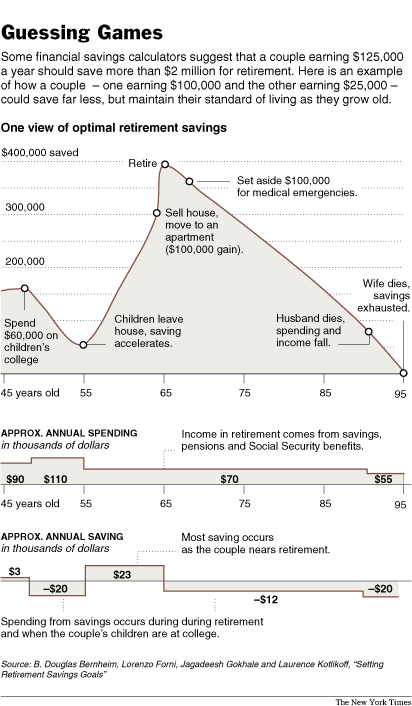
On January 29th, I wrote this article asking the question of whether or not we are over-saving for retirement.  It was based on a fairly interesting New York Times piece on January 27, 2007 on the topic.  Since then, I’ve seen this topic appear fairly often in the personal finance press.

As a reminder, this graphic sums up the issue: spending in retirement is not level, so planning for a steady “80% of your pre-retirement income” may be overly conservative for many.  This graphic does a fair job outlining the issue:

Anyway, Vanguard has recently posted their take on the issue, and it’s worth reading.

Look, you could be cynical and say that Vanguard has every incentive to encourage people to over-save.  After all, they make money on the amount you have saved with them.  However, given Vanguard’s reputation for low costs and history as a staunch consumer advocate for savings, that’s an unlikely scenario.

Vanguard’s response to this issue is really basically the following:

  • It doesn’t take a significant savings rate to accumulate significant retirement wealth
  • It is better to over-save than to under-save, all things considered

It’s the second point that I really believe is the most material.  Look, I wish we lived in a country where everyone had been acting like good little ants, storing away food for the winter.  But that just isn’t the case.  The average retirement account has approximately $56,000 in it, and that isn’t going to cut it.

The WWII generation had three legs to their retirement system – social security, pensions, and savings.  Social security is evolving to a cash-starved system that will only really be there for people with modest means.  Anyone with significant savings will see their social security benefits means-tested and taxed at fairly high rates.  Pensions are also gone, for the most part, largely because the only institutions that can afford them are governments who don’t have to do proper accounting.

So that leaves saving.  As a result, I’m inclined to think that while the argument that common financial planning goals are too conservative might be interesting in theory, it sends the wrong message at the wrong time.  It’s like we’re telling an addicted gambler in Vegas that whoops, we made a mistake, and their savings account isn’t totally tapped out yet.

2007 First Spouse Coins a Sellout. Prices Jump on eBay. News at 11.

Who would have thought?  Gold coins with Martha Washington & Abigail Adams that cost $400+ each sell out within 2 hours at the US Mint.  40,000 coins per first lady, and apparently that wasn’t enough.

Unbelievable!

Here is a search for individual first spouse gold coins on eBay. It filters out the people who are selling all four coins at once (or tries to). Some of those sets have been selling for $4000! Right now the price seems to be climbing, but is between $650 – $800 per coin. Amazing.

I have to remind myself that the coins don’t ship for another two weeks (July 5th according to the US Mint).

I caught this article from Dave Harper today on Numesmatic News. While I think it is interesting that it has become well known that eBay is influencing the popularity and monetization of coins in the US, I disagree with his conclusion completely.

Dave argues basically the following:

  • The US Mint is producing “instantly popular” coins by limiting mintage.
  • The fact that households can buy 5 coins each means that a relatively small number of buyers can “clean out” the inventory of the mint, creating the illusion of popularity.
  • These buyers are really just waiting to flip the coins on eBay for a profit.

So far, so good. In fact, this is one of the things I have noticed as well. More issues from the US Mint are selling out quickly, and that’s because I believe that people have discovered the online site and they are able to often sell the coins on eBay for a profit to people who either don’t know about the site, or who miss the launch window for the coin.

But then Dave kind of goes off the deep end a bit with the conclusion:

Now I know sellouts are in the financial interests of the U.S. Mint. The possibility of profit is the only reason the Mint sells coins to collectors at all. However because this sales approach is so exclusionary, perhaps the Mint should sell all of the coins itself in online auctions. The windfall profits would then belong entirely to the government, and theoretically at least, a piece of the profit would accrue to all Americans as a few dollars less in taxes that would have to be paid.

Sporting events don’t sell all of the tickets directly to scalpers. They at least try to achieve some semblance of fairness. The Mint should reflect on what it is doing in this light.

Huh? What?

I had to read it again to make sure I understood what he was saying. The analogy with tickets made no sense to me juxtaposed with the idea for the US Mint to auction off coins.

Most concerts and sporting event venues try to ensure that “true fans” will have access to tickets. While I find that argument fairly specious, their solution to the problem is to sell the tickets at a fixed price, and start the sale at a public time, limiting the number of tickets any individual can buy.

That is exactly what the US Mint is doing!

They have a fixed price ($429.95) and they publicly announced the fixed time (June 19, 2007) when the coins would go on sale. They then limited each buyer to 5 coins each.

How is that not fair compared to ticket sales?

I myself posted the date and time on this blog weeks in advance – the US Mint has been advertising it for quite a while. The people who cared went to the site and bought the coins. I didn’t exactly camp out either – I flipped to the site when I had a spare moment, 52 minutes after the coins went on sale, and I bought a couple myself.

Now, don’t get me wrong. I love auctions. I think that they are a great way to ensure that the people willing to pay the most get the goods, and that sellers get the most for their goods. It is literally supply meeting demand.

But it’s hard to argue that if the US Mint auctioned these coins off that it would be better for the individual investor.

It was not a given that the First Spouse coins would sell out. Believe me, I’ve purchased supposedly hot coins at the US Mint, only to see their value drop over time due to lack of interest and demand years later. The supposedly collectible nickels from 2004-2006, for example, aren’t exactly trading for a premium.

In fact, I believe I argued on this blog that the First Spouse coins would not be popular – who is going to pay over $400 a coin for a series of over 40 first spouses ($16,000 total), when most of the women featured are literally unknown to 99.9% of Americans?

Now what Dave should have argued for is a lottery. The US Mint could have reserved some coins to be distributed, not based on first-come, first-serve, but based on a lottery across interested parties. You’d put a small deposit down, to ensure only real buyers, and a valid form of a payment. Then the US Mint could collect names for weeks, and pick winners who would then get the coins.

Oh well. Count this buyer happy.

2007 Presidential $1 Dollar Coin Proof Set Now Available (US Mint, June 21)

June 2007 is a busy month for the US Mint.

Two days ago, they released the first two 2007 First Spouse 24K Gold coins in proof & uncirculated versions.  To my suprise, they sold out in just 1.5 hours, and the waiting list is apparently over 35,000 coins.  Thank goodness I got my order in early.

Today, the US Mint has release the proof set for the 2007 Presidential $1 Dollar Coin Program.  4 Coins total.

Now, I personally collect the US Silver Proof sets every year, which will also include the new dollar coins.  But for people who just want the Presidential dollars, this is a beautiful set.  Because the coins are not made of gold or silver, they are reasonably priced – only $14.95 a set.

Get yours here.

By the way, if you want to stay up to date on US Mint releases, it’s very easy now.  They have enabled the US Mint website with RSS Feeds.  Here is the feed to get their product introduction announcements.

New Feature: What I’m Reading (Shared Google Reader Feed)

I’m trying out a new idea, borrowed from My Blog Utopia, Randy Smythe’s blog.

A couple months ago, I realized that I was accumulating far too many blogs to read through the My Yahoo interface.  Over 100 at last count.  I needed a blog reader, and based on popularity of the blog readers hitting this site, I went with Google Reader.

Google Reader has been fun, especially with the Firefox modification to make it look and feel more like Mac OS X.

Well, on Randy’s blog I saw that he had a widget that showed the blog articles that he was reading.  I have seen this type of “clipping feed” on several other blogs, but WordPress doesn’t seem to have that feature.

Then I noticed it was generated by Google Reader, and I thought, “Maybe there is a way to get Google Reader to spit out an RSS feed, and then I could put it into a sidebar widget on WordPress.com”

Turns out, it just works.  I figured out how to flag a blog post as “Shared” on Google Reader, and now, on the left-hand column of this blog, you’ll see the last 10 blog articles that I have flagged.  Should be fun, since it saves me from just posting “read this” type of articles.  I can focus just on areas where I have more significant commentary.

So check it out… it’s on the left side, under the header “What I’m Reading”

Let me know what you think.

The 2007 24K Gold First Spouse Coins Are Now Available

Break out the plastic, coin collectors. The new 2007 24K Gold First Spouse coins just went on sale at the US Mint today at 12pm EST.

Right now, there are four available:

  • Martha Washington, Proof
  • Martha Washington, Uncirculated
  • Abigail Adams, Proof
  • Abigail Adams, Uncirculated

Here are the proof & uncirculated versions, for comparison:

From the US Mint website:

This year marks the inaugural year of the First Spouse Gold Coin Series, the United States Mint’s first coin series to feature our Nation’s First Spouses.

Four, one-half ounce, $10 24-karat Gold First Spouse Coins will be minted and released annually in the order the spouses served in the White House. The coins will be minted in proof and uncirculated condition and are available individually. Each First Spouse Gold Coin will coincide with the release of the four circulating Presidential $1 Coins annually. In 2007, the United States Mint will release the first four coins in the series which include: Martha Washington, Abigail Adams, Thomas Jefferson’s Liberty and Dolley Madison.

Martha Washington: The obverse designed and sculpted by United States Mint Sculptor-Engraver Joseph Menna, is inspired by Martha Washington’s portrait by Charles Wilson Peale. The reverse, designed by Susan Gamble, United States Mint Artistic Infusion Program Master Designer, and sculpted by Don Everhart, United States Mint Sculptor-Engraver features Martha Washington sewing a button on her husband’s uniform jacket.

First Spouse Gold Proof Coins are available in limited mintages. Each 2007 First Spouse One-Half Ounce Gold Proof Coin is packaged in a custom-designed domed-chest, highly polished lacquered hardwood presentation case and accompanied by a Certificate of Authenticity signed by the Director of the United States Mint.

Martha Washington Coin Maximum Mintage: 40,000 across all product options

Each is one-half ounce of 24K gold, with a face value of $10. The proof coins sell for $429.95, the uncirculated coins for $410.95. You can buy them at the US Mint here, shipping date is current July 4th, 2007, although that will push out as they sell.

They are limiting mintage of each first spouse to 40,000 coins – interestingly, that is across both proof and uncirculated versions, so the ratio could be heavily skewed.

Assuming that you wanted to collect all of these coins, you’d be on the hook for nearly $32,000 over the next 10 years at these prices. I’m guessing that most people won’t go for that.

The hardest choice here might be whether to buy the proof or uncirculated versions. Given the low differential in price, it might seem like the proof coin is the most obvious choice. Aha, but that’s the problem! If everyone buys the proof, and no one buys the uncirculated, guess which one will end up the winner in collectible value?

Comment here if you collect coins… are you going to buy this set? Proof or uncirculated?

Update (6/21/2007): Wow. The coins sold out in approximately 2 hours on the US Mint website. Crazy. I’ve written a post about it, the current prices on eBay, and some of the commentary about it.

Update (6/26/2007):  I’ve posted the planned launch dates for the next two First Spouse coins at the US Mint.  Mark your calendars!

The LinkedIn Blog: My First Post


I’ve mentioned the official LinkedIn blog here before.  Well, as of today, I now am one of the contributors to that blog as well.

Check out my first post.

Yes, I know that readers of this blog will recognize the joke about my Mom being on LinkedIn.  What can I say? I think it’s really interesting how excited she is about LinkedIn and connecting with all of her professional contacts.  In fact, last night, she was already explaining to me all the new features she wants for the site.

This is surprising to me, since even after 4 years at eBay, I was unable to ever get my Mom to successfully bid on an auction, or buy an item on eBay Express.  But LinkedIn for some reason has grabbed her, and I think that speaks to the power of connecting with people.

I really love the fact that LinkedIn has an official blog.  Now that I’ve been blogging here for almost a year, I really regret not having official blogs at eBay for the products and teams that I was responsible for.  It’s such a great way to tear down the walls that normally separate people creating products from the people using them.  It makes the web more human, and I think that type of open communication really benefits both the community using the product as well as those working tirelessly to improve it. 

In any case, I’ll now be posting from time to time on the official LinkedIn blog about new features or about new ways to use LinkedIn.  As always, I’ll be keeping this blog to primarily personal content.